CPT code 63081: Vertebral corpectomy, cervical spine
CPT code 63081: official descriptor and procedure overview CPT code 63081 descri...

Last Updated: Oct 6, 2026
C7910 is the CCSD code for anterior vitrectomy, the removal of prolapsed vitreous gel from the front of the eye with a vitreous cutter. UK private medical insurers list it in section 4.10 (Vitreous) of the CCSD schedule.
C7910 is billed as the primary code when vitrectomy is the planned operation. When vitreous prolapses during cataract surgery, it follows the cataract code as an additional procedure, paired with an ICD-10 diagnosis.
Let Pabau's smart automation suggest the right codes, reduce claim denials, and keep your practice compliant—effortlessly.
Automate repetitive tasks and focus on what matters most—your patients.
Reduce coding errors and ensure compliance with the latest regulations.
Clean claims, fewer denials, and faster reimbursements.
Powerful insights and reporting to help your practice thrive.
HIPAA compliant SOC 2 certified GDPR-compliant Trusted by 4,000+ clinics worldwide

CCSD Code C7910 is anterior vitrectomy, listed in section 4.10 (Vitreous) of the CCSD schedule that UK private medical insurers use.
When vitreous prolapses during cataract surgery, C7910 follows the primary cataract code, such as C7122 to C7125 for phaco or C7180 for extracapsular extraction.
A payable C7910 claim pairs an ICD-10 diagnosis with an operative note that names the vitreous cutter and says whether the vitrectomy was planned.
Pabau, the practice management platform we build, sends claims to Healthcode and holds each one until the membership number and authorisation code are in place.
CCSD Code C7910 is the procedure code for anterior vitrectomy in the CCSD schedule, the coding framework UK private medical insurers use. Bupa, AXA Health, Aviva, Vitality Health and WPA all bill against it. The official descriptor is “Anterior vitrectomy”.
C7910 is one of the eye CCSD codes in chapter 4, Eye and orbital contents, where it opens section 4.10 (Vitreous). The posterior pars plana vitrectomy codes, such as C7922 and C7920, sit in the same section.
The CCSD schedule sets the code and its descriptor, and each insurer attaches its own fee. The sterling amount a practice receives for C7910 therefore varies by insurer and by year. Always check the current fee against the insurer’s published tariff before invoicing.
C7910 appears on claims from ophthalmologists and vitreoretinal surgeons in independent sector hospitals and consulting rooms. It is not an NHS code and has no role in NHS payment systems.
Anterior vitrectomy is the removal of vitreous gel from the anterior segment of the eye using a vitreous cutter. It is performed when vitreous has prolapsed forward from its normal position behind the lens. The aim is to stop vitreous becoming trapped in the cataract wound or pulling on the retina, as both can damage vision long term.
The surgical steps typically follow this sequence:
The operative note must reflect each of these steps. A note that records only “vitreous loss managed”, without saying a vitreous cutter was used, is a frequent cause of C7910 claim denials.
The key coding question for C7910 is whether the vitrectomy was planned before surgery or arose as an intraoperative complication. The CCSD code is the same in both cases. The claim structure, primary code and ICD-10 pairing differ, as the diagram below shows.
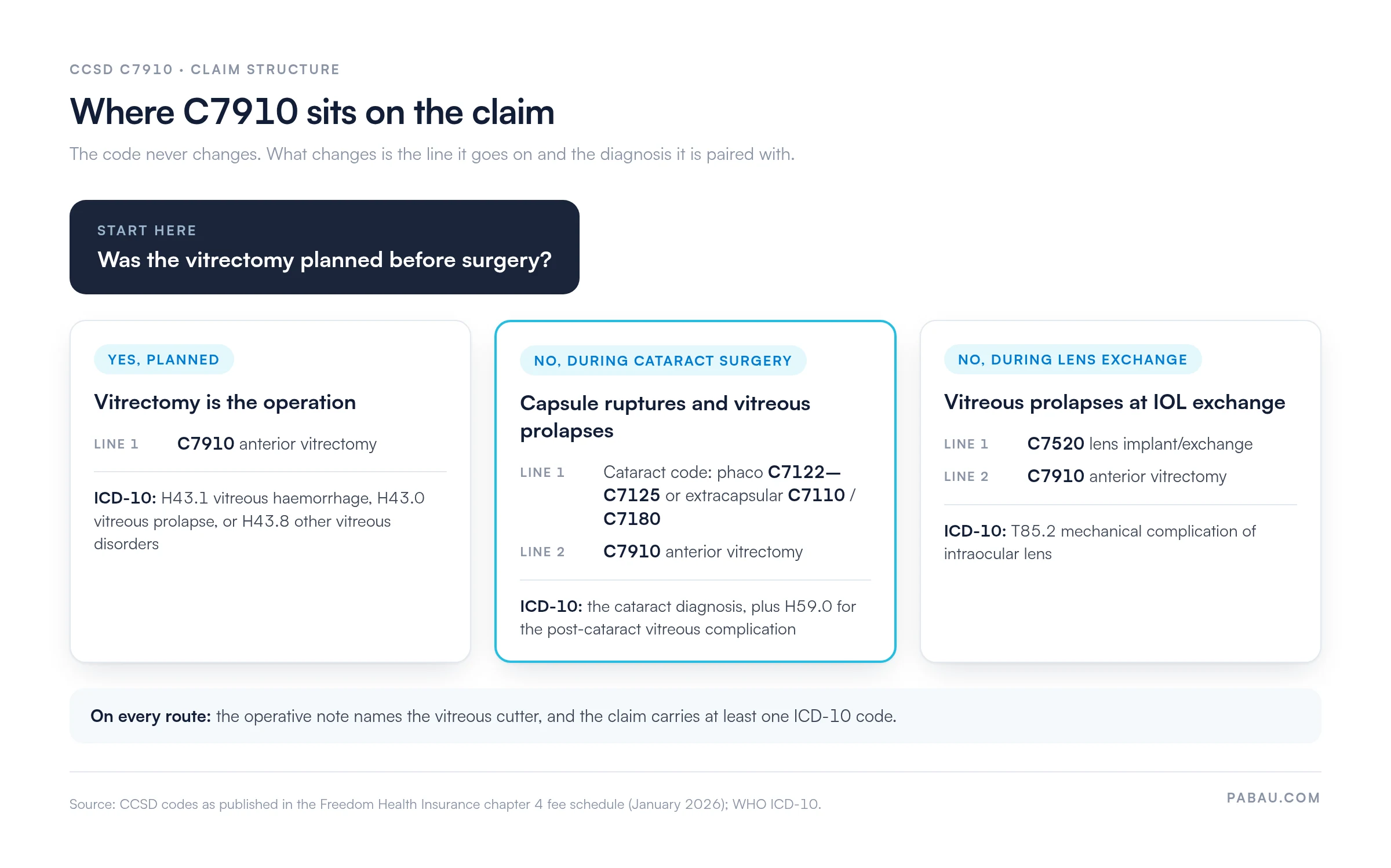
When C7910 is secondary, insurers generally expect both codes on the same claim, with the cataract code listed first. Billing C7910 as primary when the records show a cataract admission can prompt an insurer query or audit. Code order should match what the surgeon planned and what happened in theatre.
When posterior capsule rupture with vitreous prolapse occurs during phacoemulsification, the claim typically carries two procedure codes. The phaco code comes first, and C7910 follows as an additional procedure. Whether the insurer pays a separate fee for C7910 depends on its own rules for additional procedures.
For same-session bilateral phaco, the primary line is C7125 rather than two C7122 lines. C7910 is then added for the eye that needed the vitrectomy.
Before submitting a dual-code claim, confirm the following with the relevant insurer:
The operative note is the billing team’s primary evidence. It must state that vitreous prolapse occurred, that a vitreous cutter was used, and what steps cleared the anterior segment. A note that says only “complicated cataract surgery”, without naming the complication or the instrument, is unlikely to support C7910 as a separate code.
A short coding checklist for complicated cataract cases helps billing staff here. It prompts them to request a supplementary operation note whenever a vitreous cutter was used. The same pairing applies to an extracapsular case billed under C7110, where C7910 is added as the second line.
Several CCSD codes sit next to C7910 in the lens and vitreous sections of chapter 4. Picking the wrong one, or combining them incorrectly, is a common source of rejected ophthalmic claims.
The key difference between C7910 and the pars plana codes is anatomical. Anterior vitrectomy clears vitreous that has moved forward into the anterior chamber. Pars plana vitrectomy under C7922 treats vitreous and retinal disease behind the lens.
Coding a pars plana procedure for what was operatively an anterior vitrectomy is an error insurers can query on audit. Let the operative note drive the code selection.
UK private medical insurers require at least one ICD-10 diagnosis code alongside every CCSD procedure code on a submitted claim. For C7910, the right diagnosis code depends on whether the vitrectomy was planned or arose as a surgical complication.
Verify ICD-10 pairings against the current NHS Classifications Browser edition before submitting, as codes and descriptors are updated. UK claims use WHO-based ICD-10, so US ICD-10-CM codes such as H59.01 do not apply. The guide to Bupa CCSD codes explains how Bupa expects diagnosis codes to sit alongside CCSD codes on invoices.
An operative note can be clinically accurate and still lack the billing details an insurer looks for. The following elements should appear in the claim submission or its attached documentation.
Digital operative note forms that prompt surgeons for these details at the point of dictation remove the need for retrospective chasing. The documentation then supports the code before the claim goes out.

Build a standard complication addendum for operative notes in your ophthalmology practice. When a vitreous cutter is used, the surgeon completes it before leaving theatre. It records the instrument, vitreous volume, wound status after vitrectomy, and a planned or unplanned flag. Billing staff then hold the evidence a C7910 claim needs before they submit, which cuts down on insurer queries.
Pre-authorisation requirements for anterior vitrectomy differ by insurer and by whether the procedure is planned or arises as an intraoperative complication. For planned cases, most insurers generally require authorisation before the procedure. For emergency intraoperative vitrectomy, retrospective authorisation is typically available but must be requested promptly.
Pre-authorisation rules change without notice. Treat the table as a starting point and confirm current requirements with each insurer before submitting. Missing pre-authorisation on a planned procedure often leads to a denial that is hard to overturn.
Anterior vitrectomy claims tend to be denied for a predictable set of reasons, and each has a fix.
Pabau’s claims management software checks the details insurers need before a claim goes to Healthcode. If the membership number or authorisation code is missing, the claim cannot be sent until it is added.
In many ophthalmology practices, the operative note sits in one system and the invoice in another. Billing staff then rebuild each C7910 claim by hand, chasing the surgeon for the vitreous cutter detail and the authorisation reference.
Pabau keeps the patient’s insurer, policy and authorisation details on the patient record, next to the clinical notes. Claims go to Healthcode from the same place, and each one shows its status, from submitted to paid or returned with an error.
Validation checks run every time a claim is sent, so a missing membership number or authorisation code stops it before the insurer sees it. Digital forms let surgeons complete the complication addendum in theatre, so the evidence is on file when the claim goes out.

Pabau keeps insurer and authorisation details on the patient record, checks them before each claim goes to Healthcode, and tracks every claim to payment.

C7910 is simple to code once the claim mirrors what happened in theatre. Put the cataract or lens code first when vitrectomy was a complication, and lead with C7910 only when it was the planned operation.
Payment then rests on the paperwork. Ask surgeons to name the vitreous cutter in every complicated cataract note. Pair each claim with the right ICD-10 code, and secure authorisation before planned cases. Skip those steps and the fee waits on a resubmission instead.
Book a demo to see how Pabau checks authorisation details and sends ophthalmology claims to Healthcode from the patient record.

Need a reference for Bupa CCSD billing? Bupa CCSD procedure codes guide covers how Bupa applies the CCSD schedule to private consultant invoicing in the UK.
Billing an extracapsular case without an implant? CCSD code C7110 explains extracapsular extraction without implant and when to add C7910.
Coding a posterior vitrectomy instead? CCSD code C7922 covers pars plana vitrectomy and vitreous biopsy billing for UK insurers.
Treating both eyes in one session? CCSD code C7125 covers bilateral phacoemulsification with lens implant and its bundling rules.
Want fewer returned PMI claims? Pabau claims management checks membership numbers and authorisation codes before each claim goes to Healthcode.
CCSD Code C7910 covers anterior vitrectomy, the surgical removal of vitreous gel from the anterior segment of the eye using a vitreous cutter. UK private insurers accept it for a planned vitrectomy and for vitrectomy during cataract surgery. The usual trigger in cataract surgery is posterior capsule rupture with vitreous prolapse.
C7910 is billed as a primary code when anterior vitrectomy is the planned operation. It is billed as a secondary code when it arises as a complication during cataract surgery. In that case the cataract code comes first, such as C7122 to C7125 for phaco or C7110 or C7180 for extracapsular extraction. Whether the insurer pays a separate fee for the secondary code depends on its rules for additional procedures.
Most UK insurers generally require pre-authorisation for a planned anterior vitrectomy, but confirm the rule with each one. Aviva and WPA terms in particular should be checked case by case. For emergency intraoperative complications, insurers usually accept retrospective authorisation if contacted promptly. Rules change without notice, so verify current requirements before the procedure date.
The most common denial triggers are a missing pre-authorisation reference and an operative note that does not mention the vitreous cutter. Others are C7910 billed as primary on a cataract authorisation, and an invoice with no ICD-10 diagnosis code. Most can be corrected on resubmission if the clinical records support the code. Preventing them is still faster than reclaiming rejected invoices.