CPT code 93503: Swan-Ganz catheter billing and modifiers
CPT code 93503: Official descriptor and procedure overview In the AMA CPT code s...

Last Updated: Oct 23, 2026
CCSD code C6980 is the UK private insurance code for removing a foreign body from the anterior chamber of the eye. That chamber is the fluid-filled space between the cornea and the iris. Most fragments arrive at speed, from hammering, grinding or drilling metal. Published schedules rate the surgery Intermediate, with surgeon fees of £350 to £410.
Depth decides the code. A fragment lifted out of the chamber is C6980, while a corneal splinter or an iris fragment takes a different code. Five anterior chamber procedures can't share the claim, so the wash-out and chamber reformation stay in the note, off the invoice.
Let Pabau's smart automation suggest the right codes, reduce claim denials, and keep your practice compliant—effortlessly.
Automate repetitive tasks and focus on what matters most—your patients.
Reduce coding errors and ensure compliance with the latest regulations.
Clean claims, fewer denials, and faster reimbursements.
Powerful insights and reporting to help your practice thrive.
HIPAA compliant SOC 2 certified GDPR-compliant Trusted by 4,000+ clinics worldwide

CCSD code C6980 covers surgical removal of a foreign body from the anterior chamber of the eye.
Freedom Health Insurance rates C6980 Intermediate at £350, and National Friendly lists it at £410.
Chamber reformation, injection, irrigation, valve insertion and X-ray guided retrieval can’t share a claim with C6980.
The operative note must name the eye and place the fragment in the anterior chamber.
The anesthetist invoices separately, using the same code against the insurer’s anesthetist fee.
CCSD code C6980 is the schedule entry for removal of foreign body from anterior chamber. Ophthalmic surgeons use it when a fragment has crossed the cornea and settled in front of the iris.
Most cases follow a penetrating eye injury. Metal striking metal is a common cause, such as a hammer on a chisel. The surgeon usually reaches the fragment through a small incision at the edge of the cornea. Forceps or a magnet then lift it out.
C6980 sits in chapter 4 of the schedule, Eye and orbital contents, under the Iris and anterior chamber heading. You can browse its neighbors in our CCSD codes by chapter index. The Clinical Coding and Schedule Development Group sets the codes, while each insurer sets its own fee.
Depth is the detail that decides the code, so start with the neighbors.
Foreign bodies in and around the eye are spread across several codes. Each one reflects how deep the fragment went, and the complexity rises with it.
Code to the place the fragment was removed from. A splinter that pierced the cornea is still C6980 if the surgeon lifted it out of the chamber. One caught in the iris tissue itself is C6450 instead.
Fragments that reach the lens or the back of the eye fall outside C6980. Check the chapter 4 listings for those cases before you code. When no fragment comes out and the surgeon only draws aqueous from the chamber, bill paracentesis under C6920.
The fee depends on whose schedule the patient’s policy follows. Two published schedules show how far the figure moves for the same operation.
Both Freedom Health Insurance and National Friendly publish their schedules as PDFs, so you can check the current figure yourself.
Here’s how that plays out. Say the surgeon charges £450 for the operation. A Freedom patient’s benefit covers £350, which leaves a £100 shortfall. On National Friendly’s £410, the same charge leaves £40.
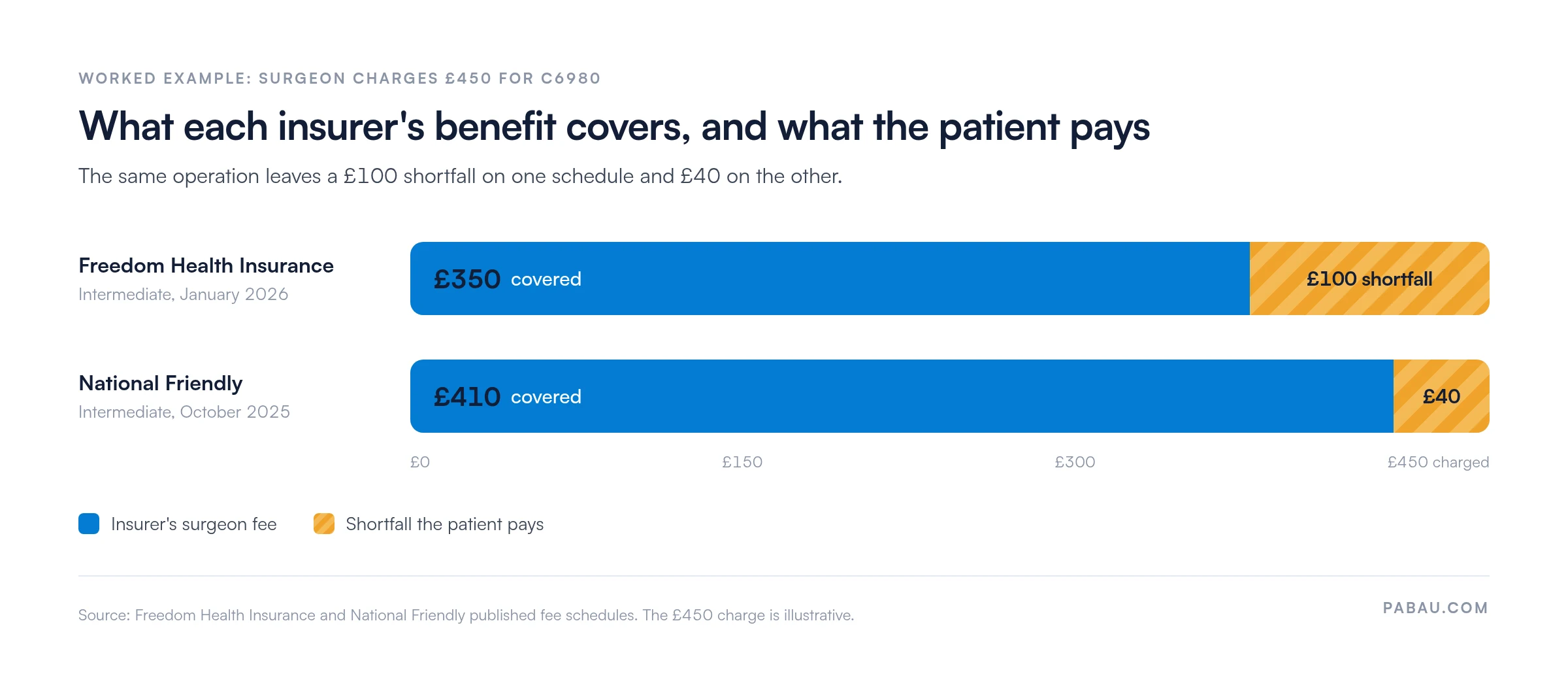
Unless the surgeon has agreed to work within that insurer’s fees, the patient pays the difference. Tell them in writing before surgery, not when the invoice lands.
For Bupa patients, check the live figure on the Bupa code search before you quote. Our Bupa CCSD codes guide explains how its fee categories map to payments.
The CCSD schedule flags five codes as unacceptable combinations with C6980. Several look like natural add-ons, which is exactly why they end up on the invoice.
Keep the wash-out and the chamber reformation in the operative note, but off the invoice. The note still shows the work, and the claim stays clean. When an anterior chamber injection is the whole operation, C6930 is the code to bill.
Anterior vitrectomy is not among the five blocked pairings. If vitreous prolapses into the chamber alongside the fragment, clearing it is billed separately under C7910.
Other codes in the same Iris and anterior chamber section carry their own pairing rules. CCSD lists C6610, ciliary body ablation, as an unacceptable combination with C6710 for cyclodialysis.
The CCSD Group’s full listing sits behind a login. If a combined case looks unusual, confirm the current rules with the patient’s insurer first.
Insurers read the note against the descriptor. Before the surgeon signs, check that it covers six details.
Anesthesia is billed separately. The anesthetist invoices against the same procedure code, using the insurer’s anesthetist fee. Freedom, for example, lists £213 for the anesthetist on C6980.
A foreign body case often reaches theater within hours of the injury. The claim follows five steps, and the first one is easy to skip under pressure.
Delays tend to start at step one or step five. A missing authorization number or a vague note will hold the claim until someone fixes it.
Urgent cases leave paperwork behind. A two-minute check catches the loose ends before the insurer does.
Once the insurer accepts the claim, save its reference in the patient record. You’ll need it for any chase or appeal.
Watch for these slips. Each one can turn a clean C6980 case into a queried claim.
Private eye-surgery practices often run claims in two places. The booking lives in one system, while the claim gets keyed into Healthcode by hand.
Pabau, the practice management platform we build, connects to Healthcode directly. With its claims management software, the claim builds from the patient record. The CCSD code, membership number and authorization reference carry across, and Pabau checks the required fields before sending.
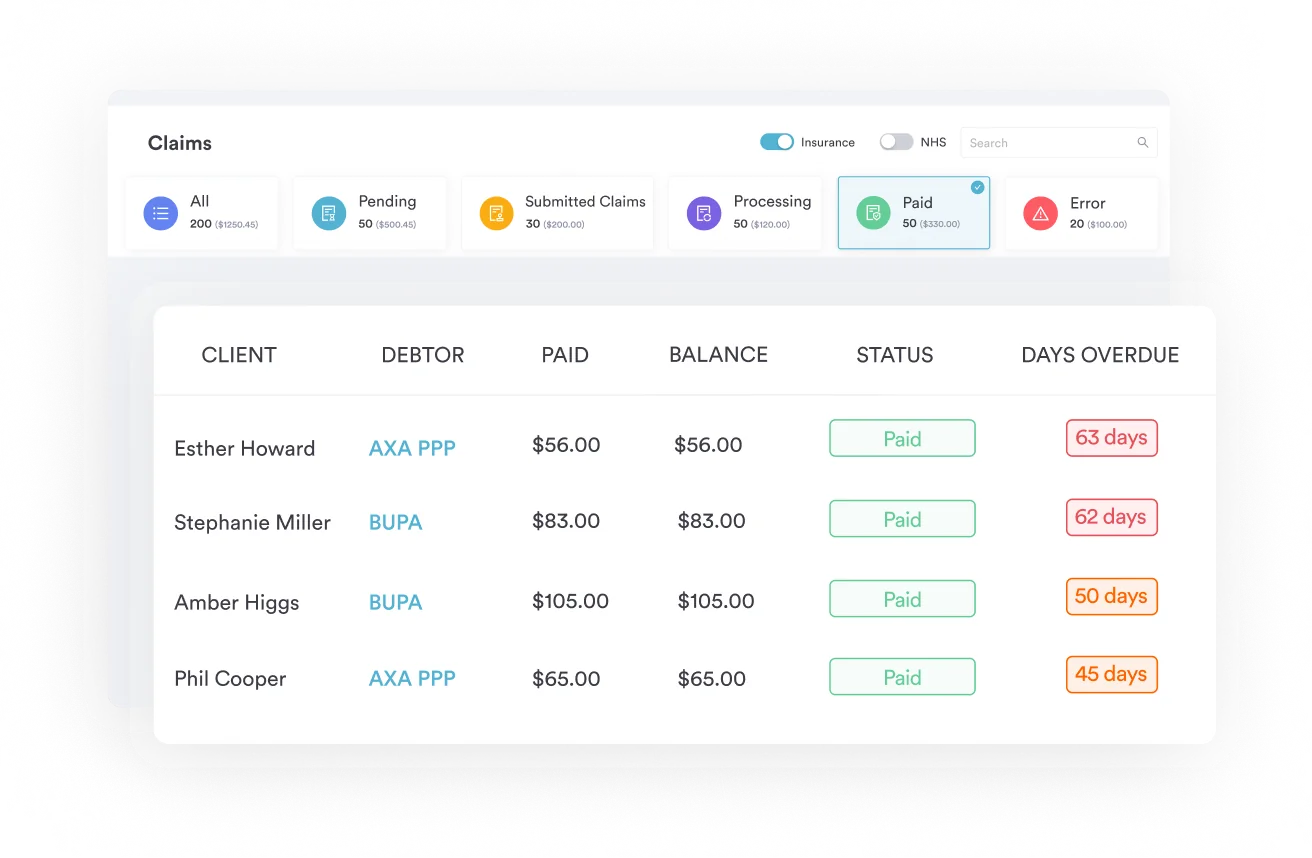
Your team then follows every claim and payment in one view. Queries get answered while the case is fresh, instead of weeks later.

Pabau sends CCSD claims like C6980 to Healthcode from the patient record and checks required fields first. Then you can track each claim’s status in one place.

C6980 pays an intermediate fee for delicate surgery, and the claim turns on one detail. The note has to place the fragment in the anterior chamber of a named eye.
Write that note first after theater, while the case is clear. Keep the wash-out and reformation in the record but off the invoice, and the code choice settles itself.
Book a demo to see how Pabau carries a C6980 claim from the patient record to Healthcode and tracks it to payment.

Was the fragment lodged in the iris? CCSD code C6450 covers foreign body removal from the iris, a Major procedure.
Injecting into the chamber as a standalone procedure? CCSD code C6930 explains how anterior chamber injections are billed.
Billing another chapter 4 eye procedure? CCSD code C0620 covers drainage of the orbit and the note it needs.
Want every Bupa code in one place? Bupa CCSD procedure codes sets out the full schedule and its fee categories.
Browsing codes by chapter? CCSD codes by chapter lists each chapter of the schedule with links to every code guide.
For a fresh injury, S05.5, penetrating wound of eyeball with foreign body, is the usual pairing. For an old retained fragment, use H44.6 if it is magnetic or H44.7 if it is not.
No. The radiology provider bills the scan under its own code, separate from the surgeon’s and anesthetist’s invoices.
No. The descriptor names the anterior chamber only. If the fragment sat in the lens, look up the lens codes in chapter 4 instead.
Either can be used, depending on the injury and the patient. Record the anesthetic type in the note, since a separate anesthetist fee applies when one attends.
No. NHS hospitals record procedures in OPCS-4. CCSD codes like C6980 are for privately funded care billed to UK insurers.