

HCPCS code E0198: Water pressure pad billing guide
HCPCS code E0198 is a water pad for a standard mattress HCPCS code E0198 is the ...

Last Updated: Oct 13, 2026
S2068 is the HCPCS Level II code for breast reconstruction with deep inferior epigastric perforator (diep) flap or superficial inferior epigastric artery (siea) flap, including harvesting of the flap, microvascular transfer, closure of donor site and shaping the flap into a breast, unilateral.
That leaves Medicaid programs and commercial payers, where S2068 is the standard way to report these two flaps. The code is also still active. CMS slated it for retirement, then changed its mind in 2023.
Let Pabau's smart automation suggest the right codes, reduce claim denials, and keep your practice compliant—effortlessly.
Automate repetitive tasks and focus on what matters most—your patients.
Reduce coding errors and ensure compliance with the latest regulations.
Clean claims, fewer denials, and faster reimbursements.
Powerful insights and reporting to help your practice thrive.
HIPAA compliant SOC 2 certified GDPR-compliant Trusted by 4,000+ clinics worldwide

HCPCS Code S2068 reports unilateral breast reconstruction with a DIEP flap or an SIEA flap.
The code is active. CMS planned to retire it at the end of 2024, then reversed that decision in August 2023.
Medicare does not pay S2068. Bill it to Medicaid and commercial payers, and use CPT 19364 for Medicare patients.
Most payers require prior authorization first. A missing or expired PA number is a leading denial reason for this code.
Practice management software like Pabau keeps the PA date, the operative note, and the payer’s code preference on one patient record.
The official descriptor for S2068 is breast reconstruction with deep inferior epigastric perforator (DIEP) flap or superficial inferior epigastric artery (SIEA) flap, unilateral. It includes the flap harvest, the microvascular transfer, donor site closure, and shaping the flap into a breast.
The code sits in the HCPCS Level II S-code series, which CMS maintains for Medicaid and private payers rather than Medicare. The rest of the series behaves the same way. HCPCS code S0800 for LASIK also sits outside Medicare, and only commercial or vision plans that accept S-codes pay it.
The status row is the one worth pausing on, because it nearly read differently. CMS proposed discontinuing S2066, S2067, and S2068, and slated all three to sunset on December 31, 2024. Surgeons and patient groups argued that folding these flaps into a single CPT code would cut reimbursement and push practices away from microsurgical reconstruction.
CMS held a public meeting and reconsidered. On August 21, 2023 it announced it would maintain all three S-codes, according to the American Society of Plastic Surgeons. So S2068 is live, and the reversal is why coders still find conflicting advice about it online.
Because this code set has been reconsidered once, treat its status as something you confirm rather than assume. HCPCS codes are updated quarterly, so run an HCPCS code lookup against the current release before submitting a large batch of reconstruction claims. Any future change would reach your commercial payers first, not Medicare.
S2068 covers two perforator-based autologous reconstructions performed after mastectomy. Both move skin and fat from the lower abdomen to the chest and reconnect the blood supply under a microscope. Neither one harvests rectus abdominis muscle, which is the technical detail the code is priced around.
Four acronyms get confused in operative reports and on claim forms. Only two of them belong to S2068.
The operative report has to name which of these was performed. A coder who assigns S2068 from a report saying only “free flap reconstruction” is guessing. That guess is a common audit trigger for any cosmetic surgery practice.
Both procedures are performed predominantly after mastectomy for breast cancer. Referrals usually arrive from a breast surgeon or an OB-GYN practice, so the diagnosis and pathology often start outside your records.
That clinical context matters commercially. The Women’s Health and Cancer Rights Act obliges most group health plans covering mastectomy to cover the reconstruction as well.
Use S2068 for Medicaid and commercial payers, and CPT code 19364 for Medicare. That one rule settles the majority of cases. The exception is a commercial payer whose own policy names CPT instead, which is why the payer decides the code rather than the procedure.
Search for a CPT code for DIEP flap reconstruction and you land on 19364. Its descriptor groups fTRAM, DIEP, SIEA, and GAP flaps together, so it says nothing about which technique the surgeon actually used. S2068 names the technique, and that specificity is what commercial payers price against.
There is no CPT code S2068. Searches for that phrase come from the two systems sitting side by side on one case. S2068 is HCPCS Level II, and 19364 is its CPT counterpart. Which one you send changes both the rate you are paid and whether the claim is accepted.
Verify with the individual payer before you submit. Sending S2068 to a payer that requires CPT will be denied, and the reverse is equally true. This is where claims management software with configurable payer profiles earns its place. The rule gets applied when the claim is created, not remembered.
If codes like these are new territory, start with what practice management software actually does for billing workflows.
Medicaid programs and commercial payers accept S2068. Medicare does not, and no appeal will change that, because S-codes are excluded from the Medicare code set by design. Submitting one to Medicare produces a rejection you can only fix by resubmitting with a CPT code.
Flagging the payer type at scheduling is the cheapest fix available. Good practice management features put that flag in front of the billing team before the patient arrives. The S-code and CPT workflows never get crossed.
Check the insurance card at registration, not at billing. Note whether that payer accepts HCPCS S-codes or requires a CPT alternative, and store the answer against the payer in your billing system. One lookup at registration prevents a denial 60 days later.
There is no national fee schedule for S2068. Because S-codes are outside Medicare, no CMS Physician Fee Schedule rate exists for this code. Payment comes from your contracted rate, the state Medicaid schedule, or the individual plan’s terms, and it varies widely by payer and geography.
To confirm a code before you price a case, the AAPC HCPCS lookup draws on current CMS data. Payer-specific rates are not published anywhere public. Request the fee schedule from your provider relations contact, or pull it from the payer portal.
Because rates differ so much between contracts, tracking realized payment per payer is more useful than tracking the billed amount. Financial reporting inside an EHR for private practice shows which contracts are actually paying for reconstruction work.
S2068 is unilateral by definition, so laterality always has to be stated. Use RT or LT for a single breast. For bilateral reconstruction in one operative session, use modifier 50 or two separate line items, depending on what the payer’s provider manual says.
Bilateral rules are the known source of variation here. Some payers want modifier 50 on one line. Others reject that and require two lines. Getting it wrong produces either a denial or a half payment, and a half payment is the harder one to notice.
Read each payer’s bilateral policy once, then build it into the billing system as a payer-level rule. The same applies to any add-on service billed alongside the primary reconstruction code.
Most commercial payers require prior authorization, or PA, before they will pay for free flap breast reconstruction. Their published reimbursement policies set the medical necessity criteria your request has to meet. A claim submitted without a valid PA number is a leading denial cause for this code.
Keep the PA number, the approval letter, and the expiry date on the patient record rather than in a separate tracker. That correspondence contains protected health information.
Thin documentation is the second most common reason S2068 claims are denied or audited. Each item below does a specific job. Some establish medical necessity, some confirm laterality, and some tie the claim to the authorization on file.
The practical problem is that these documents are created by different people at different times. The billing team stops chasing four people before it can submit.
Structured note templates prevent the vaguest of those failures. That stops an operative report going out that says “free flap” and nothing more.

S2068 has two sibling S-codes and one CPT counterpart, and the four are usually documented on four different pages. The table below puts them side by side, with the current status of each and where each payer type stands.
Reconstruction codes rarely travel alone. The mastectomy from the same episode of care carries its own code, and two of those trip coders up regularly.
The nipple-sparing mastectomy CPT code and the skin-sparing mastectomy CPT code are the same code. Both are 19303, mastectomy, simple, complete. It applies regardless of how much skin is preserved or whether the nipple is kept.
The American College of Surgeons published that clarification in 2015. Earlier guidance had sent coders to the subcutaneous mastectomy code 19304, which has since been deleted.
For Medicare rates on the CPT side, the CMS Physician Fee Schedule gives the current payment for 19364. Practices billing across several flap types are better served by plastic surgery practice management platforms that hold a code reference library by procedure category.
The Women’s Health and Cancer Rights Act of 1998 obliges any group health plan that covers mastectomy to cover the reconstruction as well. That includes reconstruction of the affected breast, surgery on the other breast to produce symmetry, prostheses, and treatment of physical complications.
For S2068, it means most commercial group plans are legally required to cover DIEP and SIEA reconstruction. WHCRA amends the Employee Retirement Income Security Act, so it reaches self-funded employer plans as well as insured group coverage.
Individual market plans with no group connection sit outside WHCRA, so coverage there depends on the plan document and state law. Medicaid runs on a separate obligation. State programs must cover medically necessary reconstruction after mastectomy under federal Medicaid statute, whether or not WHCRA applies.
Knowing which mandate covers a given patient changes what you do with a denial. A denial from a plan subject to WHCRA is worth appealing with the statute cited, rather than written off.
The patient’s own bill turns on it too. A nationwide analysis in Annals of Plastic Surgery put the median out-of-pocket cost of autologous reconstruction at $597. A denial that sticks moves far more than that onto the patient.
S2068 denials cluster around five predictable failure points, and all five are preventable before the claim leaves the building.
Running these five checks before submission takes about two minutes per claim. Billing software with pre-claim edit logic runs them for you. It flags a missing modifier or an empty PA field automatically, so the system holds the checklist rather than a person.
Turn the five denial reasons into a five-line pre-submission check. Confirm the payer is not Medicare. Attach a PA number that is still valid on the surgery date. Apply the RT, LT or modifier 50 rule that this payer uses. Confirm the operative report names DIEP or SIEA. Check nothing bundled into S2068 has been billed separately.
One S2068 claim touches four places in most practices. The authorization lives in a payer portal or a spreadsheet. The operative report sits in the EMR. The bilateral rule sits in a biller’s memory. The claim itself goes out from a fourth system entirely.
That split is where all five denial reasons above come from. A PA quietly expires while a surgery is rescheduled. An operative report says “free flap” and nobody catches it until the audit letter. A payer that wanted two line items receives modifier 50.
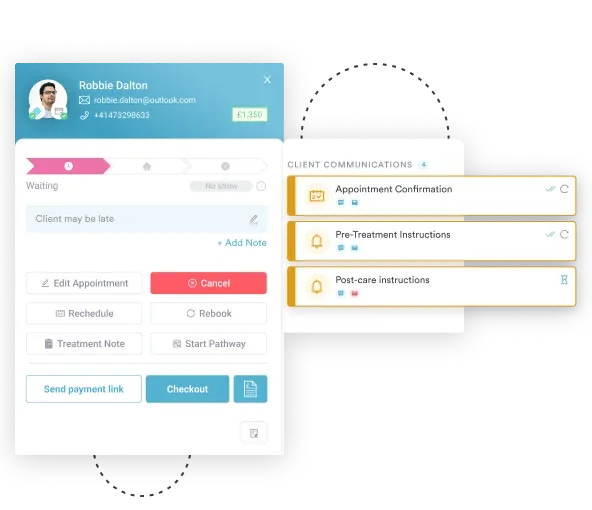
Practice management software like Pabau keeps that lifecycle on one patient record. The authorization dates, the operative note, the consent forms, and the payer’s code preference all sit against the same patient. The biller reads one screen instead of four.
Automated workflows can flag a PA approaching expiry before the surgery date moves. That turns a re-authorization into a five-minute task instead of an appeal.
For a reconstructive practice, the outcome is fewer surprises 60 days after surgery. Your team finds the missing authorization at scheduling, and your surgeons stop being asked to rewrite operative reports months after the fact.

Pabau ties operative documentation to billing workflows and supports payer-specific modifier rules. Prior authorization is tracked on the patient record, so fewer reconstruction claims come back denied.

S2068 is precise on purpose. It exists because CPT 19364 folds four different flaps into one descriptor, and commercial payers wanted to price the perforator techniques separately. That precision is also where the denials come from.
The 2023 reversal is the trade-off worth remembering. The code survived, but it survived a review, and it is still paid by everyone except Medicare. Treat it as infrastructure that gets re-checked each year, and keep a CPT fallback configured for the payers that ask for one.
Everything else is workflow. Verify the payer type at scheduling and attach a live PA number. Apply the modifier that payer actually wants, and make the operative report name the flap.
Pabau holds those checks against the patient record instead of a paper list. Book a demo to see how a reconstructive practice runs the whole S2068 lifecycle in one system.

Billing an implant-based reconstruction instead? HCPCS C1789 covers the implantable breast prosthesis supply code and its coverage rules.
Removing an existing implant before a flap? CPT 19328 sets out the documentation and modifier rules for intact implant removal.
Coding radiation therapy in the same episode of care? CPT 19298 covers brachytherapy catheter placement and how payers review it.
Billing for an intra-articular fracture repair? Intra-articular fracture repair billing covers billing for primary open reduction of intra-articular fractures with internal fixation in orthopedic surgery.
Billing for a secondary fracture repair? Secondary long bone fracture billing covers billing for secondary open reduction of a fractured long bone after non-union or mal-union.
HCPCS Code S2068 reports unilateral breast reconstruction with a deep inferior epigastric perforator (DIEP) flap or a superficial inferior epigastric artery (SIEA) flap. It is an HCPCS Level II S-code used by Medicaid programs and commercial insurers, not Medicare.
Yes. CMS proposed retiring S2066, S2067 and S2068, and slated all three to sunset on December 31, 2024. It reversed that decision on August 21, 2023 and kept the codes. S2068 carries no termination date in the current code set.
No. S2068 is an HCPCS Level II S-code, and Medicare does not accept any S-series code. For Medicare patients having DIEP or SIEA reconstruction, submit CPT 19364 instead and verify the rate with your Medicare Administrative Contractor.
S2068 is a unilateral code, so use modifier RT for the right side or LT for the left. For bilateral reconstruction in one session, use modifier 50 or two line items, S2068-RT and S2068-LT. Rules differ, so confirm with each payer’s provider manual.
Yes, in most cases. Most commercial payers require prior authorization before approving free flap breast reconstruction, and most Medicaid programs require it too. Check whether the payer wants the request filed against S2068 or against CPT 19364. A missing or expired PA number is a leading denial cause.
S2068 names the DIEP and SIEA techniques specifically and is billed to Medicaid and commercial payers. CPT 19364 covers any free flap, including fTRAM, DIEP, SIEA and GAP. Medicare requires 19364, and some commercial payers prefer it, so verify payer policy before submitting.
WHCRA requires group health plans that cover mastectomy to cover the reconstruction as well, including flap procedures reported with S2068. Most commercial group plans are therefore obliged to cover DIEP and SIEA reconstruction. A denial from a plan subject to WHCRA is worth appealing with the statute cited.



