HCPCS Code G0163: Skilled nursing observation and assessment
What is HCPCS Code G0163? HCPCS Code G0163 is a deleted Level II code for skille...

Last Updated: Oct 15, 2026
A3300 is the CCSD code for implantation of a neurostimulator to a cranial nerve. UK private insurers use it for the initial implant on any cranial nerve, most often the vagus nerve for drug-resistant epilepsy. Published schedules place it in the Major complexity band.
The code pays the surgeon for exposing the nerve, placing the electrode and tunnelling the lead. It does not cover the pulse generator, the anaesthetist's fee, or the programming visits that follow. Insurers want written pre-authorisation for the procedure and the device separately, and a missing reference number is the fastest way to lose the claim.
Let Pabau's smart automation suggest the right codes, reduce claim denials, and keep your practice compliant—effortlessly.
Automate repetitive tasks and focus on what matters most—your patients.
Reduce coding errors and ensure compliance with the latest regulations.
Clean claims, fewer denials, and faster reimbursements.
Powerful insights and reporting to help your practice thrive.
HIPAA compliant SOC 2 certified GDPR-compliant Trusted by 4,000+ clinics worldwide

CCSD Code A3300 covers the initial surgical implantation of a neurostimulator to any cranial nerve.
The vagus nerve (CN X) accounts for most A3300 claims, followed by the hypoglossal nerve (CN XII).
A3300 pays for the surgical work only, so the pulse generator and electrode go on a separate device benefit.
Most UK private insurers want written pre-authorisation for the procedure and the hardware on two separate tracks.
The operative report has to name the specific cranial nerve, or the insurer will request records before paying.
CCSD Code A3300 covers the surgical implantation of a neurostimulator to a cranial nerve. Within the CCSD schedule it sits in the neurosurgery chapter and applies only to the initial implant.
Revision, replacement and removal of an existing device each take a different code. Most UK private insurers mirror the Bupa CCSD codes list. That list keeps A3300 distinct from the peripheral nerve and spinal cord stimulator codes elsewhere in the schedule.
The code is nerve-agnostic within the cranial nerve group. The same A3300 applies to the vagus nerve (CN X), the hypoglossal nerve (CN XII) and the glossopharyngeal nerve (CN IX). Any other cranial nerve takes it too. What decides coding accuracy is that the operative report identifies the nerve targeted and the technique used.
The surgeon exposes the target cranial nerve through a cervical or skull-base approach, depending on which nerve is being implanted. A nerve cuff electrode is placed around or adjacent to the nerve and tested intraoperatively to confirm impedance and stimulation thresholds.
A subcutaneous tunnel then connects it to an implantable pulse generator (IPG) sited in a subclavicular or abdominal pocket. Device programming happens post-operatively and is not included in A3300.
A3300 applies to neurostimulator implantation on any cranial nerve. In practice, three nerves account for the vast majority of procedures billed under this code.
Vagus nerve stimulation (VNS) is by far the most commonly implanted cranial nerve neurostimulator in UK private practice. Before billing A3300, confirm the specific device carries CE marking or UKCA certification.
The Medicines and Healthcare products Regulatory Agency (MHRA) oversees that route for the UK market, and insurers ask for the certification alongside the hardware claim.
Most bundling errors on this code start with its scope. A3300 covers the surgeon’s work in exposing the nerve and placing the electrode. It also covers tunnelling the lead and creating the subcutaneous pocket for the pulse generator. It does not cover the device hardware itself.
Coders working the same operation on a US schedule bill the generator under CPT code 61885, a separate cranial neurostimulator code. Neither schedule folds the hardware into the surgeon’s fee.
Verify bundling rules with the specific insurer before submitting. Funders such as Healix and Vitality publish their own unbundling guidance alongside their CCSD-based fee structures, and it can differ from the standard CCSD schedule.
Check the patient’s insurer approved benefits list before surgery. Most UK private health funds want the specific IPG model and electrode on their approved device list first. Only then will they reimburse the hardware alongside A3300. Submitting the prosthesis claim with a device that is not on the list is one of the fastest routes to a full rejection.
A3300 sits within a cluster of neurostimulator codes. Reaching for it when a revision or removal code applies is a common cause of insurer queries. The table below maps the nearest neighbouring codes to their descriptors.
CCSD codes are reviewed annually, so verify current numbers against the CCSD code reference and the Bupa code search tool before you submit.
Note: the adjacent code numbers above (A3302, A3304, A3306, A3308) illustrate the typical code-family structure. Verify the exact descriptors and numbers in the current CCSD schedule before billing, since the codebook goes through an annual review.
Not every cranial nerve procedure belongs to the neurostimulator family. Where the surgeon excises a lesion from a cranial nerve through an intracranial approach rather than implanting a device, A2900 applies.
The same boundary holds for two further intracranial procedures. A surgeon who destroys the nerve from inside the skull, by thermocoagulation or rhizolysis, bills A2600. Decompression of the nerve through a craniotomy, which frees it from a compressing blood vessel, is coded A3200.
Four coding errors generate the majority of insurer queries on A3300 claims. Knowing each one helps billing coordinators catch problems before submission rather than after rejection.
The operative report is the primary document supporting an A3300 claim. Incomplete operative notes are a leading reason insurers request further information before settling neurostimulator claims. Build the note from a structured template with mandatory fields. The detail below then lands in the record on the day of surgery, not months later.
Prior authorisation is required by most UK private health insurers before a cranial nerve neurostimulator can be implanted. It applies to the procedure (A3300) and to the device hardware, and the two run on separate tracks.
Submit the hardware pre-authorisation independently of the procedure authorisation, because insurers process them through different approval pathways. A procedure approval does not cover the implant cost.
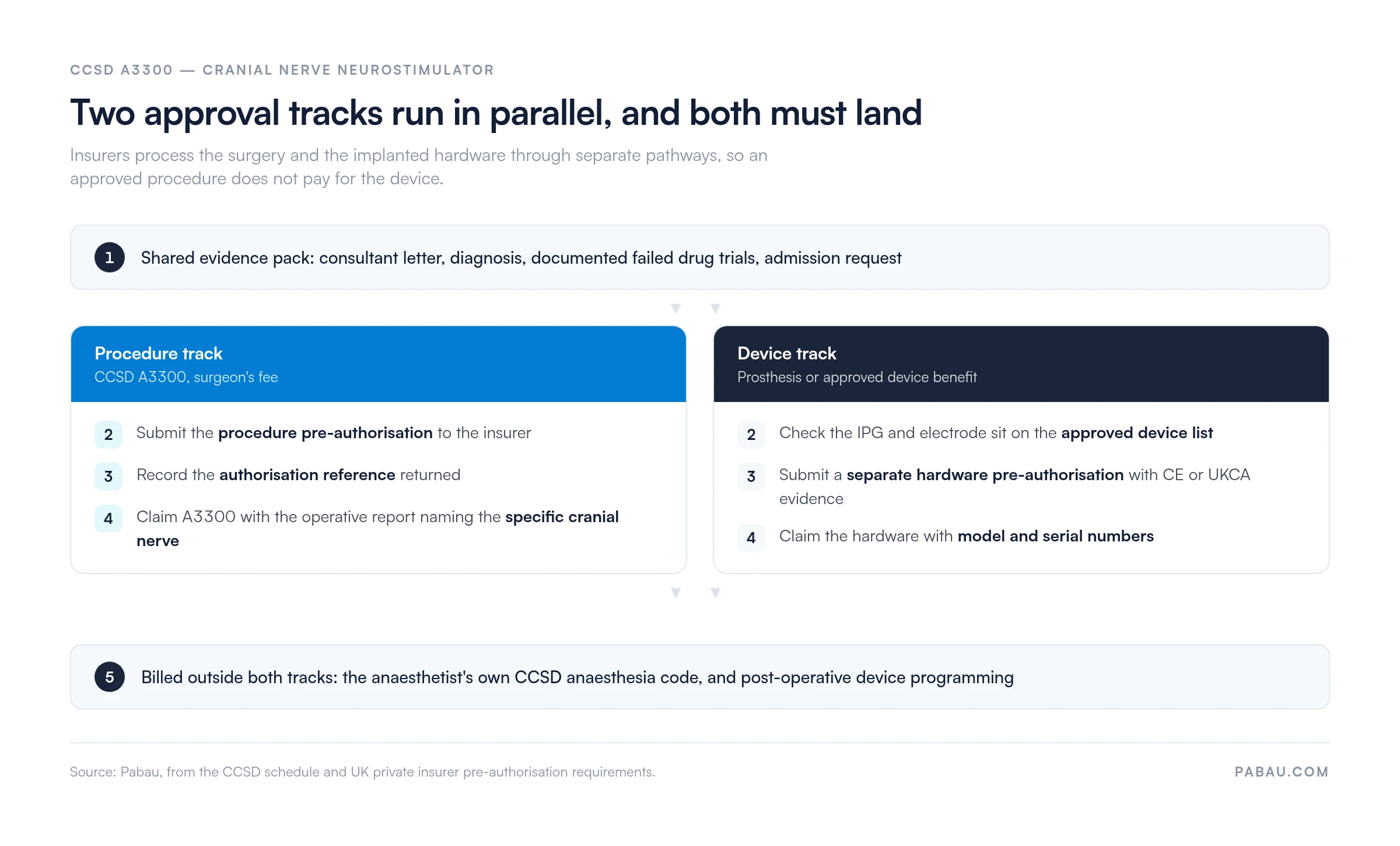
The supporting evidence pack for prior authorisation usually runs to four items.
Requirements vary by funder and change often, so confirm them directly with the insurer before booking surgery.
CCSD Code A3300 is a UK private health insurance billing code. It has no NHS tariff equivalent and is not used within NHS reimbursement. Each insurer sets its own fee for A3300 from a schedule derived from CCSD, so the figure differs by insurer and by year.
The Cigna UK fee schedule publishes CCSD-based fee levels and updates them annually. So do the Bupa, Aviva, AXA, WPA, Healix, Vitality and Allianz Care schedules. Always check the current fee on the insurer’s own portal rather than a prior year’s figure.
Gap fees apply when the surgeon charges above the insurer’s scheduled benefit. The insurer pays its scheduled amount and the patient is liable for the difference, unless a no-gap agreement is in place.
Neurostimulator implantation is a high-cost procedure and the gap can be significant, so make sure patients understand their potential out-of-pocket liability before consent is taken.
Claim denials on A3300 fall into five predictable categories, and each has a specific fix. Billing coordinators who handle neurostimulator work regularly lean on software for billing teams to log denial reasons and spot the pattern behind repeat rejections.
Map each rejection you receive back to one of the five rows above. The insurer’s own reason code usually names the category. Group several months of rejections that way and the failing step in your process becomes obvious.
Cranial nerve neurostimulator implantation is performed under general anaesthesia in virtually all cases. The anaesthetist bills a separate CCSD anaesthesia code alongside A3300, and the two codes are not bundled.
That code comes from the CCSD anaesthesia schedule, typically the band matching procedure complexity. The anaesthetist submits their own claim independently of the surgical team.
The diagnostic codes submitted with the A3300 claim have to support medical necessity. For VNS implantation, that means the relevant ICD-10 epilepsy codes (G40 range) or treatment-resistant depression codes (F32 or F33 range). For hypoglossal nerve stimulation, the OSA diagnosis code G47.33 applies. The anaesthetist will typically use the same diagnostic codes on their own claim.
Coordinate billing timelines with the anaesthetist before the patient is discharged. The anaesthetist’s A3300-associated claim must reach the insurer within the same episode of care window as the surgical claim. A delay between the two submission dates can trigger a query even when both claims are valid.
Most neurosurgical billing teams assemble an A3300 claim from three places. The operative note sits in one system and the authorisation references sit in an inbox. The device serial numbers are on a sticker in the patient’s file. When an insurer queries the claim four months later, someone rebuilds that pack by hand.
Practice management software like Pabau holds all of it on the same patient record. Operative note templates carry mandatory fields for the nerve, the approach, the impedance readings and the device details.
Both authorisation references are stored against the same admission, so a coordinator can see whether the procedure track and the device track have cleared.
That changes what happens when a query lands. Your team opens the patient record and answers from it, instead of chasing three systems for documents written months ago. Claims that would have waited weeks in a queue get resolved the same working day.

Pabau keeps operative notes, authorisation references, device documentation and claim submissions on one patient record. Your team answers an insurer query without rebuilding the file.

CCSD Code A3300 sits on a high-cost procedure, and insurers scrutinise it accordingly. Denials rarely turn on clinical disagreement. They trace back to a missing authorisation reference, an operative report that never named the nerve, or a code chosen for the wrong procedure.
Three checks catch most of them. Confirm both authorisations before the patient reaches theatre. Template the operative note so the nerve and device details cannot be left blank. Then check the procedure actually performed against the code before anything is submitted.
Book a demo to see how Pabau keeps A3300 operative notes, authorisation references and device records on one patient file.

Billing a cranial nerve repair rather than an implant? CCSD code A3000 sets out what intracranial cranial nerve repair covers and what it does not.
Coding a deep brain stimulation case? CCSD code A0980 explains what the implantation fee pays for and where the hardware benefit takes over.
Need to decode the rejection reason on a claim? Denial codes in medical billing covers the standardised reason codes insurers return.
Checking what an insurer will actually pay? Bupa procedure code fee schedule walks through how CCSD-based fee levels are structured.
CCSD Code A3300 is the UK private health insurance procedure code for surgical implantation of a neurostimulator to a cranial nerve. It covers the electrode placement, subcutaneous tunnelling, pocket creation for the pulse generator, and intraoperative testing. It does not include the hardware (pulse generator or electrode), post-operative programming, or anaesthesia, which are billed separately.
Yes, prior authorisation is required by most UK private health insurers for cranial nerve neurostimulator implantation. Authorisation is needed separately for the procedure (A3300) and for the device hardware. Submitting without a valid authorisation reference is the most common cause of A3300 claim rejection. Confirm requirements with the specific fund before booking the patient for surgery.
A3300 includes only the surgeon’s procedural work: electrode placement, tunnelling, pocket creation, and intraoperative testing. The pulse generator (IPG) and electrode hardware are not included. Both must be pre-authorised and billed separately, usually under the insurer’s prosthesis or approved device benefit.
A3300 applies to neurostimulator implantation on any cranial nerve. In practice, the vagus nerve (CN X) accounts for most A3300 claims, covering drug-resistant epilepsy and treatment-resistant depression. The hypoglossal nerve (CN XII) comes next, for obstructive sleep apnoea. The operative report must name the specific nerve stimulated.
A3300 is for the initial implant only. Revision (repositioning or revising an existing electrode), removal, and pulse generator replacement are billed under separate neighbouring codes in the CCSD neurostimulator code family. Using A3300 for a revision procedure will typically trigger an insurer query, as they can cross-reference prior A3300 submissions for the same patient.
Yes. The anaesthetist bills a separate CCSD anaesthesia code concurrently with the surgical A3300 claim. The two codes are not bundled and are submitted independently. Coordinate billing submission dates to ensure both claims fall within the same episode of care window the insurer uses for this admission.