HCPCS code Q4154: Biovance billing, Medicare rate and denial guide
HCPCS code Q4154: definition and code details HCPCS code Q4154 is a Level II cod...

Last Updated: Oct 6, 2026
A2952 is the CCSD code for excision of acoustic neuroma (vestibular schwannoma) – tumours less than 2.5cm (performed by single surgeon). Tumours more than 2.5cm or compressing the brain stem are coded A2953, and a combined oto-neurosurgical team is coded A2954 at any tumour size.
Let Pabau's smart automation suggest the right codes, reduce claim denials, and keep your practice compliant—effortlessly.
Automate repetitive tasks and focus on what matters most—your patients.
Reduce coding errors and ensure compliance with the latest regulations.
Clean claims, fewer denials, and faster reimbursements.
Powerful insights and reporting to help your practice thrive.
HIPAA compliant SOC 2 certified GDPR-compliant Trusted by 4,000+ clinics worldwide

CCSD Code A2952 covers excision of acoustic neuroma (vestibular schwannoma) by a single surgeon where the tumour is less than 2.5 cm.
Tumour size and the surgical team decide the code. A2953 covers tumours more than 2.5 cm or compressing the brain stem, and A2954 covers a combined oto-neurosurgical team at any size.
A2952 is an unacceptable combination with both A2953 and A2954, so only one of the three codes is billed per tumour.
UK private insurers, including Bupa, AXA Health and Aviva, typically require pre-authorisation for this procedure, backed by a documented MRI measurement.
Pabau, the practice management platform we build, supports CCSD code entry, document attachment and insurer submission for A2952 claims.
CCSD Code A2952 is a neurosurgery procedure code within the Clinical Coding and Schedule Development (CCSD) schedule. It covers excision of an acoustic neuroma (vestibular schwannoma) less than 2.5 cm, performed by a single surgeon. The code sits under the Nerves heading in chapter 2 of the schedule, which covers the brain, cranium and other intracranial organs.
UK private medical insurers, including Bupa, AXA Health, Aviva, Vitality and WPA, use the CCSD schedule to process surgical claims.
Three qualifiers define A2952, and all three must be present for the code to apply:
Acoustic neuroma is a benign tumour of the vestibular branch of the eighth cranial nerve. It grows within the internal auditory canal (IAC) and may extend into the cerebellopontine angle (CPA) cistern. Despite the name, acoustic neuroma is correctly called a vestibular schwannoma in contemporary clinical and pathological terminology. Both terms appear in private insurer correspondence and operative notes. Either is acceptable, provided the histopathology report confirms the diagnosis.
Acoustic neuroma excision is a posterior fossa craniotomy performed under general anaesthesia. The goal is to remove the tumour while preserving the facial nerve and, where possible, residual hearing. The tumour arises from Schwann cells on the vestibular nerve within the IAC and expands into the CPA cistern. Pre-operative gadolinium-enhanced MRI shows tumour size, extension, and proximity to the facial nerve. That MRI report is the document that establishes whether A2952 or A2953 applies.
Three surgical approaches are used for acoustic neuroma excision. A2952 covers the excision regardless of which approach the surgeon selects; the approach does not change the code.
Intraoperative facial nerve monitoring using continuous electromyography (EMG) is standard practice during acoustic neuroma excision. Whether intraoperative neurophysiological monitoring (IONM) is separately billable alongside A2952 depends on each insurer’s schedule. Confirm with the individual insurer before assuming separate reimbursement.
The CCSD schedule splits acoustic neuroma excision into three codes. Tumour size and brain stem involvement separate A2952 from A2953. A combined oto-neurosurgical team moves the case to A2954, whatever the tumour size.
The CCSD schedule has listed A2952 and A2954 as an unacceptable combination since 6 August 2014, so a joint operation is never billed under A2952. The schedule also lists A2952 and A2953 as an unacceptable combination, so only one of the three codes is billed per tumour. Before surgery, confirm with the insurer how each member of a combined team invoices under A2954.
Tumour size comes from the documented MRI measurement, not from the intraoperative impression. The tumour may look larger or smaller once exposed surgically. The pre-operative MRI measurement governs code selection, and the operative note must record it.
Taken in order, three questions settle the code, and the first one that applies decides it.
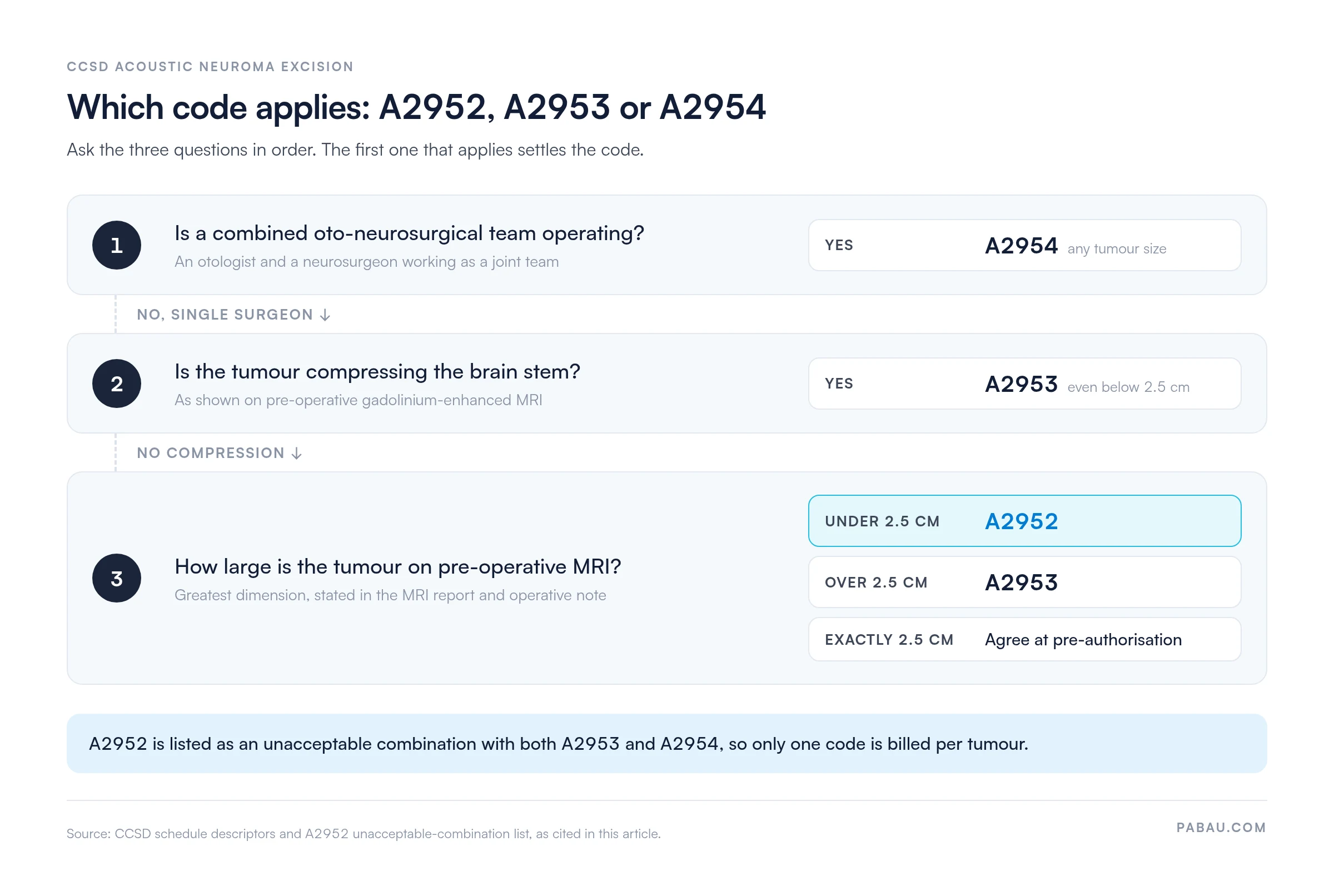
A2952 covers tumours less than 2.5cm and A2953 covers tumours more than 2.5cm. A tumour measured at exactly 2.5 cm fits neither wording cleanly. Agree the code with the insurer at pre-authorisation, and state the radiologist’s measurement in both the imaging report and the operative note.
Several codes in the wider CCSD code library may accompany or be confused with A2952. Knowing which are separately billable and which are bundled prevents both underbilling and overbilling. A lesion of a different cranial nerve is coded A2900 instead, the general intracranial cranial nerve excision code.
The Bupa CCSD procedure code guide includes neurosurgery chapter codes and Bupa’s specific fee schedules. Cross-reference this alongside your insurer’s schedule when building a claim bundle.
UK private insurers will not pay an A2952 claim without a complete clinical record. Missing a single document is enough to trigger a query or outright rejection. Use the following checklist when preparing each submission.
Structured clinical documentation at each stage of the patient pathway makes claim submission faster and appeals easier to prepare. With each document above captured at the point of care, the billing team does not need to chase the surgical team retrospectively.
Most UK private insurers require pre-authorisation before they will fund acoustic neuroma excision. Proceeding without it risks the entire claim being declined regardless of clinical necessity. While requirements vary by insurer and policy year, the following reflects standard practice for major payers.
Bupa’s code search portal allows practices to look up procedure codes and check current authorisation requirements online. AXA Health’s specialist forms portal provides AXA’s procedure fee chapters and authorisation submission routes. Aviva’s fee schedule covers CCSD-coded procedures and their specific pre-authorisation requirements. Always verify with the specific insurer for the policy year in question, as requirements change annually.
If surgery proceeds without pre-authorisation where the insurer requires it, the insurer may decline the claim entirely. In that scenario, the patient becomes personally liable, which creates a significant financial and relationship risk for the practice.
Acoustic neuroma excision claims draw insurer queries because the code qualifiers are specific and the documentation requirements are extensive. These are the denial triggers to guard against.
A denied A2952 claim can usually be appealed. The appeal window varies by insurer, so check the deadline in the denial letter and start the appeal straight away.
Keep a copy of every document submitted with the original claim, including the pre-authorisation confirmation. If the insurer claims they did not receive a document, you can produce proof of submission. Building this into the claims workflow from the outset prevents appeals from stalling on administrative disputes.
Pabau, the practice management platform we build, includes private practice claims software. It lets UK practices enter CCSD codes, attach clinical documents and submit claims to insurers without switching between systems. For an A2952 claim, the workflow follows the same sequence as the documentation checklist above.
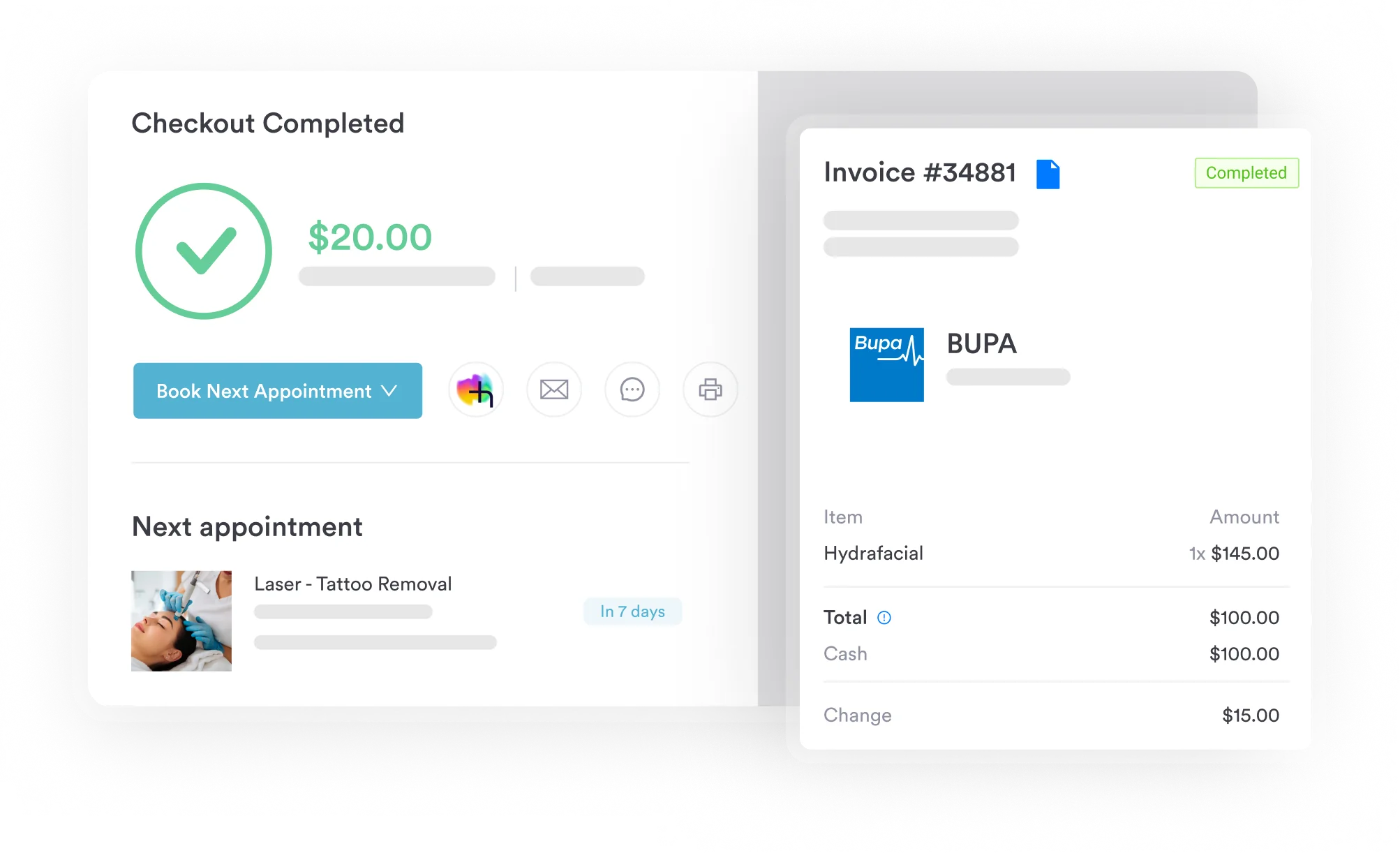
With a structured claims workflow, the code, the MRI report and the appeal trail sit in one patient record. The billing team can then answer an insurer query without going back to the surgical team.

Pabau helps UK private practices enter CCSD codes, attach supporting documents, and submit claims to insurers without leaving the platform. Book a demo to see how the claims workflow handles complex neurosurgery cases.

The code for acoustic neuroma excision is settled before the operation, not after it. Agree A2952 with the insurer at pre-authorisation, on the strength of the radiologist’s measurement and a named single surgeon. If the plan changes to a joint team, or the scan shows brain stem contact, re-authorise under the right code before surgery.
That front-loads the paperwork, but it leaves the assessor little to query once the claim arrives. Pabau keeps the MRI report, operative note and authorisation reference on one patient record, so the claim goes out complete. Book a demo to see how Pabau handles CCSD claims for complex neurosurgery.

Need a structured overview of CCSD billing for Bupa claims? Bupa CCSD procedure codes and billing guide covers the Bupa schedule structure, code lookup and invoicing requirements for UK private practice.
Operating on a larger tumour or one pressing on the brain stem? CCSD Code A2953 explains the single-surgeon code for tumours over 2.5 cm or compressing the brain stem.
Excising a lesion of another cranial nerve? CCSD Code A2900 covers the general code for intracranial cranial nerve lesion excision.
Billing a cranial nerve decompression instead? CCSD Code A3200 walks through coding and documentation for decompression of a cranial nerve by craniotomy.
CCSD Code A2952 covers open surgical excision of an acoustic neuroma (vestibular schwannoma) less than 2.5 cm, performed by a single surgeon. Tumours more than 2.5 cm or compressing the brain stem are coded A2953. A combined oto-neurosurgical team is coded A2954 at any size, and radiosurgery is not covered.
Yes. A tumour less than 2.5 cm on pre-operative gadolinium-enhanced MRI points to A2952, and one more than 2.5 cm points to A2953. Brain stem compression makes A2953 apply even below 2.5 cm. The MRI report, not the intraoperative impression, decides the code, and the operative note should state the measurement.
A2954. It covers acoustic neuroma excision managed by a combined oto-neurosurgical team, irrespective of tumour size. The CCSD schedule has listed A2952 and A2954 as an unacceptable combination since 6 August 2014, so a joint operation is not billed under A2952.
Intraoperative facial nerve monitoring using EMG is standard clinical practice for acoustic neuroma excision. Whether it is a requirement for claim acceptance, and whether it is separately billable, depends on the individual insurer’s schedule. Confirm both points with each payer before submission.
No. A2952 covers open surgical excision only. Stereotactic radiosurgery procedures, including Gamma Knife and CyberKnife, are coded under different CCSD codes. Using A2952 for a radiosurgery case is a coding error and will result in claim rejection.