

CCSD code G5100: Bypass of duodenum billing guide
CCSD code G5100 bills a bypass that leaves the duodenum in place CCSD code G5100...

Last Updated: Oct 16, 2026
25130 is the CCSD code for a dorsal root ganglion block performed with radiofrequency. The lesion is made by radiofrequency energy rather than by an injected agent, so the operative note has to name the technique.
UK private medical insurers bill against the CCSD schedule, and most treat this procedure as elective. Prior authorisation is usually needed before the treatment date. An injected block of the same ganglion is coded 25120.
Let Pabau's smart automation suggest the right codes, reduce claim denials, and keep your practice compliant—effortlessly.
Automate repetitive tasks and focus on what matters most—your patients.
Reduce coding errors and ensure compliance with the latest regulations.
Clean claims, fewer denials, and faster reimbursements.
Powerful insights and reporting to help your practice thrive.
HIPAA compliant SOC 2 certified GDPR-compliant Trusted by 4,000+ clinics worldwide

CCSD code 25130 covers a dorsal root ganglion block made with radiofrequency energy, not with an injected agent.
The operative note has to name the radiofrequency modality, the spinal level and side, and the guidance used.
An injected block of the same ganglion is coded 25120, and intrathecal neurolysis is 25140.
UK private medical insurers usually want prior authorisation first, with bilateral levels approved on the same reference.
Practice management software like Pabau keeps the note, the authorisation and the claim on one patient record.
CCSD code 25130 is code for a radiofrequency block of the dorsal root ganglion. Its official descriptor reads: Dorsal root ganglion block (radiofrequency). The code sits in the interventional pain and nerve block part of the CCSD schedule, the coding framework UK private medical insurers bill against.
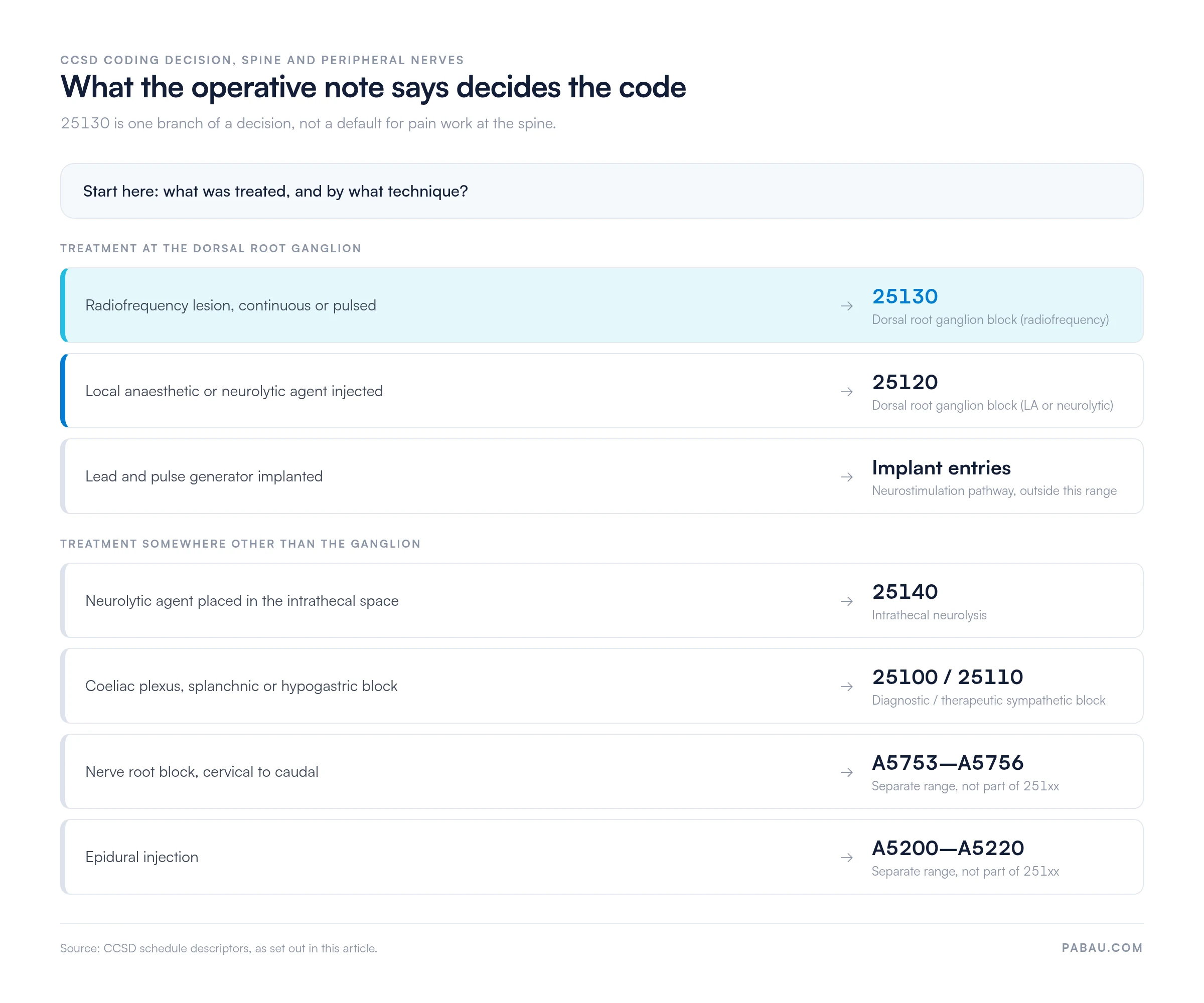
The technique is what the number describes. Radiofrequency energy is applied to the ganglion through a cannula, either as a continuous thermal lesion or as pulsed RF. An injection of local anaesthetic or a neurolytic agent at the same target is a different procedure, coded 25120.
Implanted DRG neurostimulation falls outside the descriptor too. That pathway involves a lead and a pulse generator, and it is coded under the relevant implant entries rather than here. Confirm the technique in the note before you reach for 25130.
Not every radiofrequency ganglion lesion is a 25130 claim. A lesion made at the trigeminal ganglion carries its own number, CCSD 25160, because 25130 describes the dorsal root ganglion alone. A permanent lesion made on a named peripheral nerve, rather than a ganglion, is coded A7300.
The CCSD technical guide sets out how descriptors are worded and revised. Read the current version once a year, because descriptors do change between schedule releases.
The dorsal root ganglion, or DRG, is a cluster of sensory nerve cell bodies inside the intervertebral foramen. It sits just before the spinal nerve root leaves the vertebral column. Treating it there changes how pain signals reach the spinal cord.
A consultant in pain medicine or a consultant anaesthetist performs the procedure. Knowing the steps helps the coder confirm that the note supports 25130 rather than an adjacent code:
From that report, the coder pulls four facts: the radiofrequency mode, the level and side treated, the guidance modality, and the testing result. A report that says only “DRG block performed” supports none of them.
25130 fits when radiofrequency treatment of the DRG is the planned intervention for pain traced to one or more named spinal levels. Insurers expect a discrete pain generator and a record of conservative care that did not hold.
Clinical indications you will see behind a 25130 claim include:
Three presentations sit outside the code. Non-specific low back pain without a radicular component is the first. Centralised pain with no named spinal level is the second. A documented plan for implanted neurostimulation is the third, because that is a different pathway.
Unbundling is a leading cause of denials and post-payment audits on this code. The table below sets out what normally sits inside 25130 and what may travel with it. Payer policy decides the last column, so check the current fee schedule before you bill.
Image guidance is the contested line almost every time. Where the insurer bundles it, adding a guidance code turns a payable claim into an unbundling query, however the procedure was performed. Practice management software like Pabau can hold those payer rules for you. Pabau’s tools for cleaner claims flag a conflicting companion code before the invoice goes out.

Picking the right number means knowing what its neighbours describe. Auditors find miscoding here more often than anywhere else in the pain schedule, so it is worth reading the whole group once. The rest of the family is listed in the CCSD code library.
Two mistakes account for most of the trouble. The first is coding 25130 when the consultant injected an agent, which belongs to 25120. The second is assuming a nerve root block or an epidural lives somewhere in this range.
Neither does. Nerve root blocks run A5753 cervical, A5754 thoracic, A5755 lumbar and A5756 caudal, while epidural injections run A5200, A5210, A5211 and A5220. Neurolytic root blocks made by radiofrequency denervation have their own entries again, in the A5763 to A5766 range.
The A5753 to A5756 family stops at caudal. A sacral root block under X-ray control is coded 25012, with the imaging inside the descriptor rather than billed beside it.
Anatomy and technique together decide the code, so query an ambiguous report before submission. The chart below runs that decision in the order a coder reads the note.
For descriptor comparisons across one payer’s version of the schedule, the Bupa CCSD code reference is the quicker check.
A complete operative note is the strongest protection a 25130 claim has. UK private medical insurers run coding audits and ask for the original clinical record. A vague procedure report will not survive that review, however correct the code on the invoice looks.
The note needs all of the following:
Those records then have to stay retrievable. UK GDPR and CQC obligations both expect secure retention and quick access to the file. A payer audit is exactly that kind of request.
Build one procedure note template for 25130 that pre-fills the fixed fields: radiofrequency mode, spinal level and side, guidance modality and indication. The consultant then completes only what changes between patients. Standard templates cut omissions, and they shorten the review before submission.
UK private medical insurers treat interventional pain procedures as elective, and most want authorisation before the date of treatment. Submitting without it is the leading cause of outright denials on this code. Retrospective requests are rarely accepted.
Authorisation rules differ by insurer and change with each policy year. The table below reflects general practice drawn from provider documentation. Treat it as a prompt to check, not as a substitute for the current provider manual.
Most UK payers want the same three points covered in the request. Conservative management has been tried and has failed. A diagnostic block localised the pain to the level now being treated. The clinical indication is documented in full.
Two details are worth handling at the request stage. Name both sides if the block will be bilateral, because one reference number rarely stretches to cover the second side. Ask for a fresh authorisation when the procedure is repeated, and record why the repeat is clinically justified.
Needle placement at the dorsal root ganglion needs real-time imaging. The British Pain Society and the Royal College of Anaesthetists both treat image-guided technique as the standard of care for DRG interventions. Fluoroscopy is the usual choice, with CT used where the anatomy is difficult.
Whether that imaging earns a companion code or sits inside 25130 is a payer decision, not a CCSD one. Record the modality used and confirm needle tip position in the note either way. Insurers treat undocumented guidance as unbundling, even where the guidance genuinely happened.
CCSD gives each procedure a complexity classification, such as minor, intermediate or major. Published insurer schedules put 25130 at major, where the injected block at 25120 sits at intermediate. The fee itself does not travel with the code, because each UK insurer publishes its own rate in its own schedule.
So there is no single national figure for 25130. Bupa, AXA Health, Aviva, VitalityHealth, WPA, Healix and Cigna UK each set their own rate, and each revises it on its own cycle.
To work out what a specific patient’s claim should pay:
Never quote a figure for 25130 without a date-stamped source from that insurer’s schedule. Fees are revised on the insurer’s own timetable, and an out-of-date number reaches the patient as a surprise invoice. That is how complaints and slow payment start.
Denials here are repetitive, which is good news. A short pre-submission check catches most of them before the invoice leaves the building.
When a claim comes back unpaid, work through these steps in order:
Review every refused 25130 claim within five working days. Administrative refusals are the most recoverable of the six, and they go stale quickly once the insurer’s window starts running.
Audit ten 25130 claims against their operative notes every six months. A systematic error shows up in that sample long before a payer finds it. One example is a note template that never asks for the radiofrequency mode.
Run this list against the note and the invoice together, one claim at a time. It takes about a minute, and it removes the causes listed above.
Six yes answers is a claim worth sending. A single no is a claim worth holding for an hour.
Pain practices billing the CCSD schedule carry a heavier claim workflow than most outpatient specialties. Authorisations have to be tracked per procedure, and payer bundling rules have to be applied. The note also has to be complete before the invoice is raised.
Pabau, practice management software built for private healthcare, holds those steps in one place. The consultant and the biller work from the same record, so nothing is retyped between the note and the claim.
Four capabilities matter most for this code:
Practices moving off manual coding usually see resubmissions fall inside the first billing cycle, because the note and the claim stop drifting apart. The billing team stops chasing the consultant for a level or a mode, so you can close the month on time.

Pabau’s CCSD code library, structured procedure notes and Healthcode submission help UK pain practices send clean claims for interventional procedures, 25130 included.

25130 has a narrow scope, and that is what makes it easy to bill wrongly. One word in the operative note, the technique, separates it from 25120 on one side and from an implant pathway on the other. Payers read that word before they read the invoice.
So the work sits earlier than most billing teams expect. It happens at the point of care, in the fields the consultant fills in, not in the invoice run at the end of the month. Book a demo to see how Pabau captures those fields while the patient is still in the room.

Billing the injected version of the same block? CCSD code 25120 covers the local anaesthetic and neurolytic dorsal root ganglion block, and how payers treat each variant.
Wondering how the schedule turns into a payable fee? Bupa procedure codes fee schedule explains how procedure codes and fee schedules line up in UK private billing.
Comparing the systems your billing team works in? Best medical billing software in the UK reviews the platforms UK private practices use to submit and track claims.
CCSD code 25130 covers a dorsal root ganglion block made with radiofrequency energy. The cannula is placed at the ganglion under image guidance, and a continuous or pulsed lesion is made there. An injected block at the same target is coded 25120, and implanted DRG neurostimulation is coded elsewhere again.
The technique differs, while the anatomical target stays the same. Both codes describe treatment of the dorsal root ganglion. 25130 is a radiofrequency lesion, and 25120 is an injection of local anaesthetic or a neurolytic agent. The operative note settles which one happened, so name the modality or the agent explicitly.
In almost all cases, yes. UK private medical insurers treat radiofrequency pain procedures as elective and want approval before the treatment date. Retrospective requests are rarely granted. Send the request with the clinical rationale, and name both sides if the block will be bilateral.
It depends on the insurer. Some UK payers fold image guidance into the fee for 25130, while others allow a companion code. Check the current fee schedule before you add the line. Record the modality and the needle tip confirmation in the note either way, because undocumented guidance reads as unbundling.
There is no single UK figure. CCSD assigns the procedure a classification, and each insurer sets its own fee against the code in its own schedule. Look the code up in that insurer’s current schedule or fee finder, and check the consultant’s fee-assured status before quoting anything to the patient.
Payer policy decides it, and the policies differ. Each treated level needs its own entry in the note, naming the side and the parameters used there. Several insurers cap the levels they reimburse in one session, and a second unit may be reduced under a multiple-procedure rule.



