








Key takeaways
The ADOS-2 is a semi-structured, standardized observation that qualified clinicians use when evaluating autism spectrum disorder.
Module choice follows the person’s expressive language level first, with chronological age as the second factor.
Every module takes 40 to 60 minutes to administer, and scoring, interpretation, and report writing add one to two hours.
Western Psychological Services holds the copyright, restricts who may buy the kit, and sells each module’s protocol booklet as a consumable.
Modules 1 to 4 also produce a comparison score, a 1 to 10 rating calibrated for age and language level.
The ADOS-2 (Autism Diagnostic Observation Schedule, Second Edition) is a semi-structured, standardized observation used in autism spectrum disorder evaluations. Western Psychological Services (WPS) publishes it. Each session pairs naturalistic observation with planned activities, so the clinician can watch social communication, play, and repetitive behavior in one sitting.
One boundary matters before you read on. This page explains how the instrument works, but it is not the ADOS-2 and does not reproduce any part of it. WPS sells the kit, the protocol booklets, and the coding rules. You use them only after formal training.
The sections below cover module selection, scoring, administrator qualifications, the ADI-R comparison, and how ADOS-2 findings reach a diagnostic report.
What is the ADOS-2 assessment?
The ADOS-2 is a direct observation of social communication and behavior, coded against standardized criteria, and used as one input into an autism diagnosis. It covers 12 months through adulthood. The clinician codes what they see across four observation areas:
- Communication: Verbal and non-verbal language, gesture, and the functional use of speech
- Reciprocal social interaction: Eye contact, facial expression, social overtures, and turn-taking
- Play and imagination: Symbolic play, the quality of pretend activity, and creative flexibility
- Restricted and repetitive behavior: Stereotyped movements, sensory interests, and inflexible routines
The diagnostic algorithm then folds those codes into two domain totals, social affect and restricted and repetitive behavior. That is why a report can show observation notes across four areas but only two algorithm domains.
The ADOS-2 is not a diagnosis on its own. Results have to be read alongside developmental history, the Autism Diagnostic Interview-Revised (ADI-R), observation in other settings, and clinical judgment.
How the five modules are selected
Module choice follows the person’s expressive language level first, with chronological age as the second factor. Each person receives one module only. WPS sets the criteria out like this.
Module 1 has no upper age limit, and Module 2 is open to any age, so the table carries no narrow age bands. A 9-year-old who is not yet verbally fluent takes Module 2, not Module 3.
Every module takes 40 to 60 minutes, so the older bands are not longer sessions. WPS also advises keeping the full kit in the room. If the person’s language level turns out different from what the referral suggested, you can switch modules without rescheduling.
Each module runs a set sequence of activities with the kit’s stimulus materials. Module 3, for example, opens with a construction task and make-believe play. It then moves through storytelling, cartoons, and structured conversation topics such as friendships and loneliness.
How scoring and classification work
Scoring runs in three steps. You code the behaviors immediately after administration, transfer those codes to the algorithm form, then compare the algorithm total against the module’s cutoffs.
What that comparison produces depends on the module:
- Modules 1 to 4: One of three classifications, either autism, autism spectrum, or non-spectrum. The difference between the first two is severity, not category.
- Toddler Module: A range of concern rather than a classification, because a formal ASD classification is not appropriate at that age.
- Comparison score, Modules 1 to 4: A 1 to 10 rating of overall symptom level. It sets the person against children of the same age and language level who have an ASD diagnosis.
The comparison score is what makes progress tracking possible. Because it is calibrated for age and language, you can compare two sessions even when the person moved to a different module in between. Research papers usually call the same measure the calibrated severity score.
No single figure rules autism in or out. A total sitting just above a cutoff needs more scrutiny, not less, and the rest of the evaluation has to agree with it.
Who can administer the ADOS-2?
Only a clinician who meets the publisher’s Qualification Level C and has completed ADOS-2 training may administer and score it. WPS checks credentials before it ships a kit. Eligibility rests on your degree and license, not your job title.
- Licensed psychologists with graduate training in assessment
- Developmental pediatricians and pediatric neurologists with autism training
- Licensed clinical social workers or counselors holding autism assessment credentials
- Other licensed clinicians whose scope of practice and training cover diagnostic assessment
In a psychology practice, that usually leaves one or two named clinicians holding the assessment work. Plan cover for them before a waiting list builds up.
Training is a separate purchase, and the cost side is easy to underestimate. These are the figures published on the WPS product page.
Protocol booklets are consumables, so that $105 pack is a recurring cost rather than a one-time one. WPS holds the copyright on all ADOS-2 materials, and reprinting or adapting them needs written permission. Code and score only on booklets you have bought. Figures come from the WPS product page linked above and change from time to time.
How results reach the diagnostic report
The report puts ADOS-2 findings inside a wider clinical formulation rather than presenting them as the verdict. A complete report usually carries:
- The referral question and the developmental history behind it
- Which module was administered, and why that module was chosen
- Behavioral observations from the session, activity by activity
- Algorithm totals, the classification, and the comparison score where one applies
- Findings from other instruments, including the ADI-R and cognitive, language, and adaptive testing
- The diagnostic conclusion against DSM-5 criteria, with a severity level
- Recommendations, referrals for services, and a review date
Families hear the conclusion in a feedback session rather than reading it cold. A shared family meeting agenda keeps that conversation on track when school and therapy teams attend.
Our psychiatric evaluation template gives you a broader documentation frame if you are writing the whole formulation rather than the observation section alone.
ADOS-2 vs. ADI-R: key differences
The ADI-R (Autism Diagnostic Interview-Revised) and the ADOS-2 are often used together as the standard autism diagnostic pair. Both are standardized, but they answer different questions.
Used together, the two instruments triangulate. The ADOS-2 shows whether the person presents with ASD features now, and the ADI-R asks whether those features were there through development. Collecting developmental history at intake makes that second half of the picture much easier to assemble.
Limitations of the ADOS-2
Wide adoption does not mean the ADOS-2 is free of problems. Five limitations come up repeatedly in the literature and in practice:
- Cost and training barrier: A kit plus the video training program runs past $4,000 before you count clinician time. That keeps the instrument out of many under-resourced services.
- Cultural and linguistic bias: The norms rest on predominantly white, English-speaking samples. Social expectations and non-verbal styles differ across cultures, so coding can misread people from minority backgrounds.
- Situational factors: A child who is anxious may not engage with the activities. Anxiety or selective mutism can shrink the behavioral sample a single session produces.
- Masking: Autistic people, particularly girls, women, and adults, often suppress repetitive behavior and social difficulty during a formal assessment. That produces false negatives.
- Intellectual disability confound: Intellectual disability can move ADOS-2 scores independently of autism, so the two have to be reasoned apart deliberately.
None of this argues against using the ADOS-2. It argues for treating the scores as evidence rather than as an answer.
How Pabau supports autism assessment workflows
The ADOS-2 happens in a room with a kit and a trained clinician, and no software changes that. What software can change is everything around the session. Practice management software like Pabau handles the intake, the scheduling, the note, and the handoff, so the clinical hour stays clinical.
Autism assessment rarely sits in one building. Language testing often happens at a speech therapy practice while the observation runs elsewhere. Both sets of notes still have to reach the same report.
Assessment services often stitch this together by hand. Caregiver history forms arrive on paper, the observation notes live in a notebook, and the report gets typed up days later from memory. Pabau’s client record keeps all of it in one place:
- Pre-assessment intake: Caregivers complete consent and developmental history forms digitally before the appointment, so your preparation starts from their answers.
- Scheduling: Book the full 40 to 60 minute session plus scoring time, with automated reminders that cut no-shows.
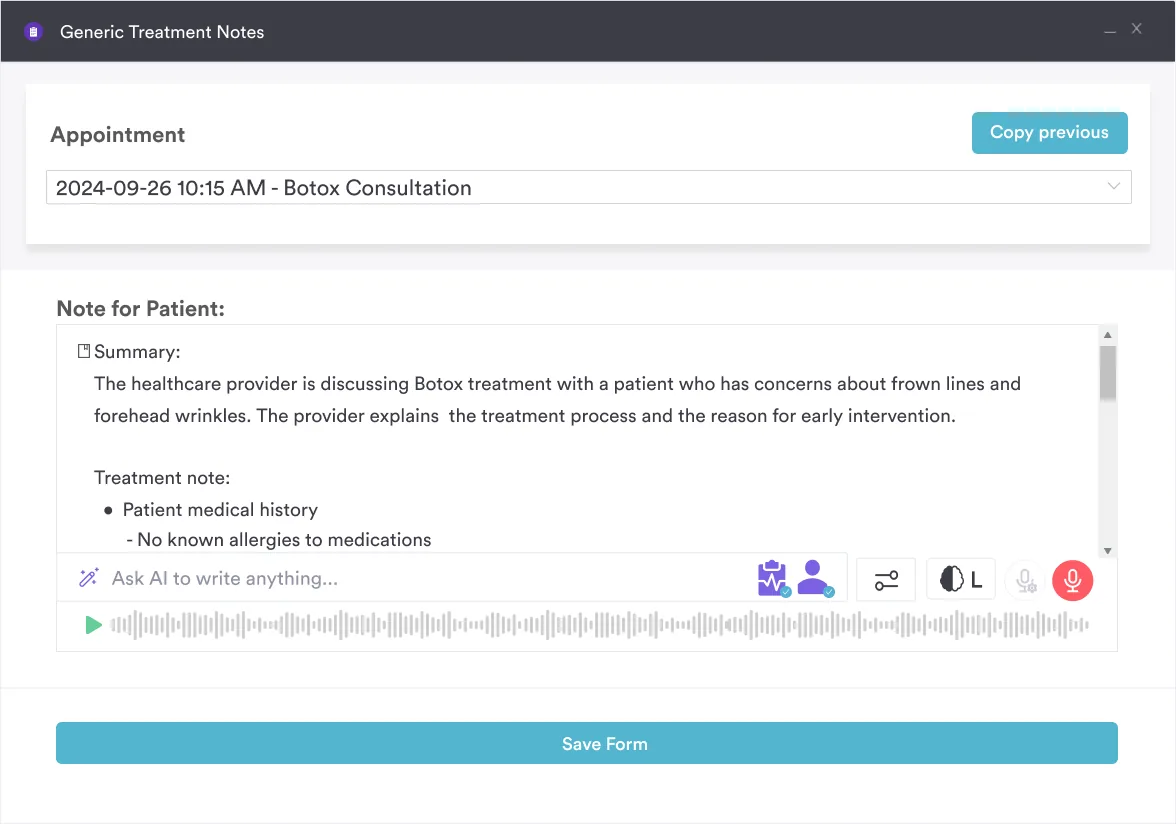
- Post-assessment documentation: Pabau Scribe, our AI scribe, drafts a structured note from your dictation, capturing observations and diagnostic impressions while they are fresh.
- Multi-assessment coordination: Automated workflows flag when cognitive, language, or adaptive testing is still outstanding, so no diagnosis is issued on partial data.
- Results communication: Report templates, follow-up booking, and secure portal access move the outcome to families, schools, and therapists without a paper chase.
Pabau does not administer or score the ADOS-2, and it should not. It removes the admin that surrounds the session, which is where assessment services usually lose hours.

Keep autism assessment admin off the clinical hour
Pabau handles digital intake, scheduling, and clinical notes for assessment services, so caregiver history and session documentation sit in one client record. Your clinicians spend the session observing, not writing it up.

Conclusion
If you are searching for an ADOS-2 form to download, the honest answer is that the instrument is not available that way. The kit, the protocol booklets, and the coding rules come from WPS, and they come with a qualification check attached.
What you can control is the documentation around the session. Get the developmental history in before the appointment. Pick the module from language level rather than birthday, and write the observation detail down while it is fresh.
That is what makes a report defensible when a school or an insurer reads it. Clear patient education is what makes it useful to the family.
The trade-off worth remembering is time. Every hour spent chasing forms or retyping notes is an hour not spent on the diagnostic reasoning that only you can do. Book a demo to see how Pabau handles intake, scheduling, and clinical notes for autism assessment services.

Continue your research
Screening adults before a full evaluation? Autism spectrum quotient (AQ) covers the cut-offs and clinical use of the most common adult self-report screener.
Working with toddlers instead? Modified Checklist for Autism in Toddlers (M-CHAT) walks through the screener most primary care teams use before an ADOS-2 referral.
Need a frame for the written formulation? Psychiatric evaluation template gives you a section-by-section structure for the full assessment write-up.
Also scoring ADHD instruments? How to score the Vanderbilt ADHD Rating Scale shows the same code-first, interpret-second discipline on a different tool.
Communicating results back to families? Engaging families in speech therapy covers family-centered practices that carry over to assessment feedback sessions.
Frequently asked questions
What is the ADOS-2 assessment used for?
The ADOS-2 is a standardized observation that trained clinicians use when evaluating autism spectrum disorder, from 12 months through adulthood. It pairs planned activities with naturalistic observation to sample communication, reciprocal social interaction, play, and restricted or repetitive behavior.
Is there a free ADOS-2 assessment available online?
No. The ADOS-2 is proprietary and copyrighted by Western Psychological Services (WPS). Only clinicians who meet the publisher’s qualification requirements can buy the kit and protocol booklets. Free downloads advertised as ADOS-2 forms are note sheets or unrelated screeners, and none of them carry the coding rules.
Can the ADOS-2 assessment alone diagnose autism?
No. The ADOS-2 is one component of a comprehensive evaluation. A diagnosis needs developmental history from the ADI-R or a caregiver interview. It also needs cognitive and language testing, adaptive functioning data, observation in other settings, and clinical judgment. Clinicians have to rule out intellectual disability, language disorder, anxiety, and ADHD as alternative explanations.
What does an ADOS-2 assessment report include?
A complete report documents the referral question, the module administered, and the reason for that choice. It then sets out the behavioral observations, the algorithm totals and classification, the comparison score where one applies, and findings from other instruments. It closes with the diagnostic conclusion against DSM-5 criteria, a severity level, and recommendations for services.
Can the ADOS-2 assessment diagnose autism in adults?
Module 4 is designed for verbally fluent older adolescents and adults, so the ADOS-2 does apply. Adult assessment is harder, though. Adults have often built compensation strategies, which suppresses the repetitive behavior and social difficulty a single session would otherwise show. Clinicians usually lean more heavily on developmental history for adult cases.