ICD-10 Code S42.444P: Medial epicondyle fracture, right humerus
ICD-10 Code S42.444P: full descriptor and code validity ICD-10 Code S42.444P car...

Last Updated: Oct 13, 2026
Billable Code Specific Code
W58.12XS is the billable ICD-10-CM code for struck by crocodile, sequela. It names a crocodile strike as the cause of a late effect, such as a scar, contracture or nerve damage. The original injury has already healed.
Placement is the rule that matters most. W58.12XS is a Chapter 20 external cause code (V00-Y99), so it never goes first. The residual condition leads the claim, and W58.12XS follows it. Use the 7th character S only after the injury has resolved. While it is still healing, the visit takes D instead.
Let Pabau's smart automation suggest the right codes, reduce claim denials, and keep your practice compliant—effortlessly.
Automate repetitive tasks and focus on what matters most—your patients.
Reduce coding errors and ensure compliance with the latest regulations.
Clean claims, fewer denials, and faster reimbursements.
Powerful insights and reporting to help your practice thrive.
HIPAA compliant SOC 2 certified GDPR-compliant Trusted by 4,000+ clinics worldwide

W58.12XS is a billable external cause code for the late effects of a crocodile strike. It is valid in the current ICD-10-CM release, so confirm it in the CMS/CDC annual update each year.
The 7th character S means the acute injury has healed. The residual condition, such as a scar, contracture or PTSD, is coded first.
W58.12XS can never be the principal or first-listed diagnosis, and listing it first is a common reason these claims fail edits.
Place, activity and status codes (Y92, Y93 and Y99) belong to the initial encounter and are not normally reported on sequela visits.
Pabau’s practice management software pre-fills claims from the patient record and checks required claim fields before submission.
ICD-10 code W58.12XS names a crocodile strike as the cause of a late effect the patient is treated for today. The original injury has healed, and the visit is about what it left behind. The code is valid in the current ICD-10-CM release; confirm in the CMS/CDC annual update.
Here are the facts to check before you code.
W58.12XS describes a residual condition caused by a crocodile strike, once the original injury has resolved and no wound care continues. Read it one character at a time:
Think of a patient back months after an attack with a thick scar over the forearm. Or picture chronic nerve pain in a limb struck during a wildlife incident. W58.12XS doesn’t describe that scar or that pain. It records the event that caused them.
The placeholder X trips up a lot of coders. Per ICD-10-CM Official Guidelines Section I.A.4, an X fills any empty position when a code shorter than six characters needs a 7th character. Without it, S lands in the wrong slot and the code fails claim edits.
The 7th character separates three stages of the same event. Treat them as interchangeable, and every visit in the W58.12X family gets misreported.
Per ICD-10-CM Official Guidelines Sections I.A.5 and I.C.19.a, 7th character S marks an encounter for a sequela (late effect) of an injury. So the test is whether the original injury has resolved.
If the wound is still open, infected or healing, W58.12XD is the right code. Once the visit treats a leftover condition from a healed injury, S applies.
The diagram below puts that decision and the claim order side by side.
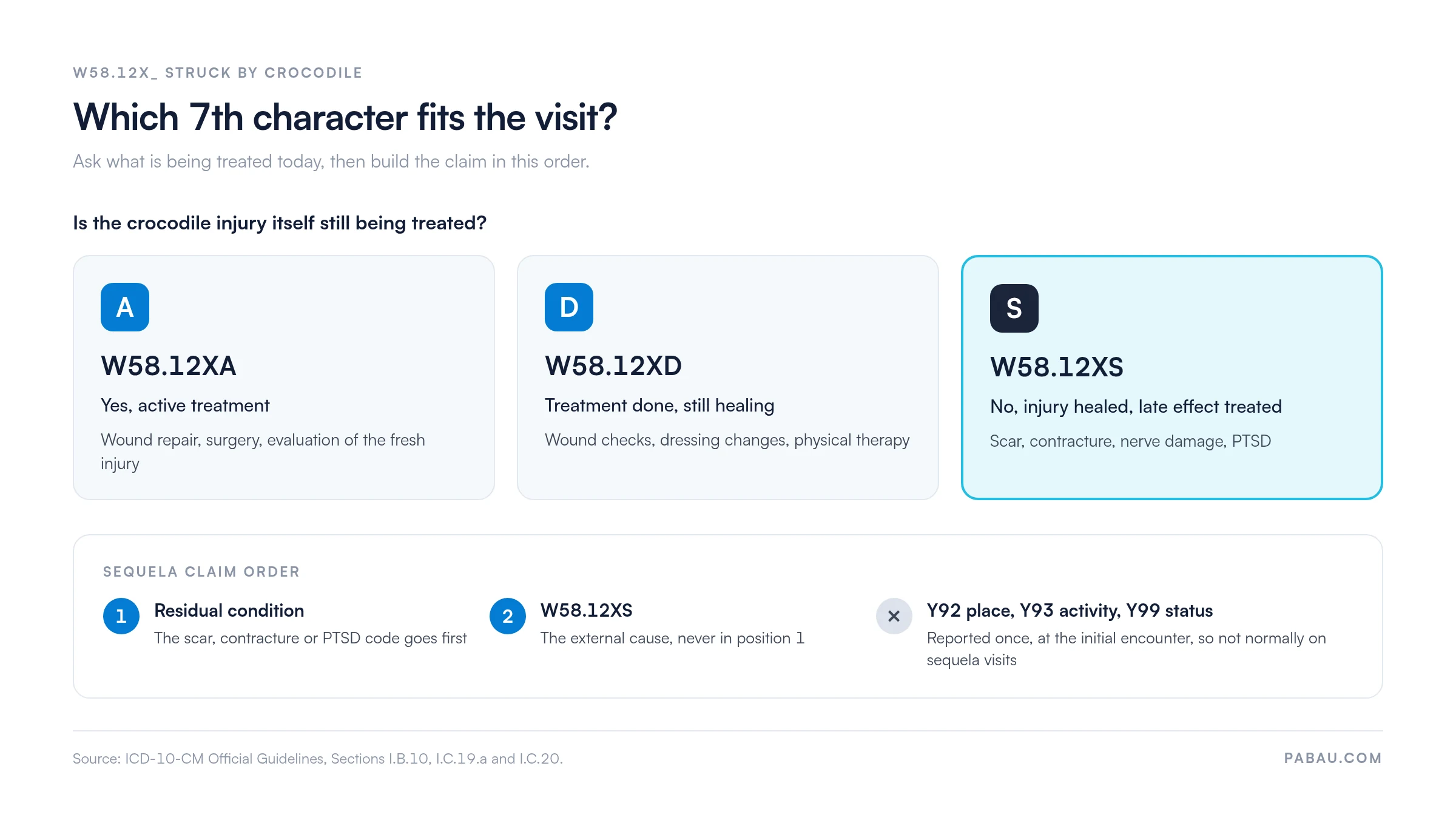
Check the provider’s note for ‘history of’ or ‘late effect of’ before you pick the 7th character. If the note describes a scar from a prior crocodile attack, the injury has healed and S fits. If it records wound care on the strike wound, use D. Never assign S while the original injury is still being treated.
W58.12XS sits in category W58, Contact with crocodile or alligator. Knowing the layout prevents the classic mix-up in this category. That’s picking a W58.0- alligator code when the animal was a crocodile, or the reverse.
The species matters for accurate data and for audits. In the United States, alligators are far more common, and wild crocodiles live mainly in southern Florida. So the note should name the animal. When it doesn’t, query the provider rather than guessing between W58.0- and W58.1-.
W58.12XS needs a residual condition in the record. The code only names the cause, so a separate code for the residual condition goes with it and is listed first. These are the late effects you’ll see most, with the wording the provider’s note should carry.
ICD-10-CM Official Guidelines Section I.B.10 asks for two things on a sequela claim. The note must state the residual condition, and it must link that condition to the past injury. A note listing PTSD without mentioning the crocodile incident doesn’t support W58.12XS.
A sequela prompt in the encounter template makes this routine. When the template asks for the residual condition and its cause, both elements reach the coder every time. That habit is a core part of medical billing compliance, and it’s cheaper than reworking a denied claim.
Sequela coding follows a set order under ICD-10-CM guidelines. Getting it wrong is a common reason these claims fail edits, even when each code is valid on its own.
A patient returns eight months after a crocodile struck their left forearm on a fishing trip. The wound closed long ago, but a hypertrophic scar now limits wrist movement. The provider writes “hypertrophic scar of left forearm, late effect of crocodile strike.”
The claim lists L91.0 (hypertrophic scar) first and W58.12XS second. No Y92 or Y93 code goes on, even though the fishing trip is in the history.
Order matters for a clean claim because many payer edits reject an external cause code in the first diagnosis position. A claim with W58.12XS in position 1 can be rejected or denied, even though the code itself is valid.
W58.12XS is an external cause code, not a condition code. It carries no payment of its own and isn’t subject to Local Coverage Determinations (LCDs). Payers focus on the residual condition code listed before it. Still, the external cause code affects how the claim moves in a few ways.
External cause codes are a small part of revenue cycle management, but they’re easy to track. Note which plans ask for supporting records on sequela claims. Then attach those records before submission next time.
Most W58.12XS denials come from a short list of repeat errors. Each one is easy to spot once you know what to look for.
Sorting rejections by Claim Adjustment Reason Code (CARC) shows which error you’re dealing with. That’s the starting point for denial management workflows. Repeated CARC 16 (claim lacks information) or CARC 11 (diagnosis inconsistent with procedure) on W58.12X claims usually points to a coding problem, not eligibility. Check for sequencing errors or a missing residual condition code first.
Keep a medical billing denial codes reference next to this table. It helps billers read remittances faster and correct claims before they age.
Once a quarter, filter your clearinghouse rejection report for codes starting with W58. ‘Invalid code’ rejections often mean a missing placeholder X. Denials citing CARC 11 often mean W58.12XS was listed first.
Many billing teams still build sequela claims by hand. They copy diagnoses from the note into a clearinghouse portal, then learn about a missing field when the rejection arrives.
Pabau, the practice management platform we build, starts the claim from the patient record instead. Its claims software for practices pre-fills each claim from the visit. Built-in ICD-10 and CPT lookup libraries help coders find and select W58.12XS and the residual condition code. Required claim fields are checked before submission, so incomplete claims are caught in-house.
For US practices, claims go out through the Claim.MD clearinghouse integration. Eligibility checks run before the visit, and electronic remittance advice (ERA) comes back into the same system. Code order is still your coder’s call, so the sequencing rules above still apply.

Pabau pre-fills claims from the patient record, checks required claim fields and submits through Claim.MD. Eligibility checks and ERA sit in the same system.

Coding a crocodile strike’s late effect comes down to one question. Is the injury itself still being treated? If it has healed, the residual condition leads, W58.12XS follows, and the Y92, Y93 and Y99 codes stay off.
S tells the payer the acute episode is closed. If the note can’t back that up, query the provider before billing. A quick question costs far less than a corrected claim.
Want claims that start from the visit record, with required fields checked before they go out? Book a demo to see how Pabau handles claims for external cause and sequela visits.

Coding the active-healing visit instead? ICD-10 code W58.12XD covers the subsequent encounter, when the crocodile strike injury is still healing.
Need to understand how claim denials are categorized and resolved? Denial management in healthcare walks through the denial lifecycle and how to build appeal workflows.
Want a reference for common billing denial reason codes? Medical billing denial codes covers CARC and RARC codes with practical resolution guidance.
Looking for guidance on electronic remittance and ERA files? Electronic remittance advice explains how ERA 835 files map to claim outcomes.
W58.12XS is the billable ICD-10-CM external cause code for struck by crocodile, sequela. It’s used when a patient is treated for a late effect, such as a scar or PTSD, after the original injury has healed.
Yes. W58.12XS is valid in the current ICD-10-CM release. The main code set update takes effect each October 1, so confirm it in the CMS/CDC annual update.
No. Guidelines set no time limit on sequela coding. A scar treated three months or ten years after the crocodile strike still takes W58.12XS, as long as the note links it to the injury.
Yes, if you report external cause codes. Guidelines assign the external cause code, with the right 7th character, at each encounter where the injury or its late effect is treated.
A healed crocodile bite takes W58.11XS. For alligators, use W58.01XS for a bite and W58.02XS for a strike. Choose by the mechanism the provider documents.
No. External cause codes can never be the principal or first-listed diagnosis. Code the residual condition first and list W58.12XS after it.