CCSD Code H3334: Low anterior resection billing guide
CCSD Code H3334: Definition and clinical scope CCSD Code H3334 covers an open an...

Last Updated: Oct 16, 2026
ICD-10 code W58.13XD is the billable ICD-10-CM code for “crushed by crocodile, subsequent encounter.” You report it when a patient returns for follow-up care after active treatment of a crocodile crush injury is complete. It’s an external cause code, so it always sits alongside the injury code and never stands alone.
Coders usually meet W58.13XD at wound care visits, orthopedic follow-ups and physical therapy visits after the initial emergency or surgical encounter. The two most common errors are leaving out the injury diagnosis code and using 7th character A once active treatment has ended.

W58.13XD is valid and billable for FY2027 (effective October 1, 2026) and sits in category W58, contact with crocodile or alligator.
The 7th character D marks a subsequent encounter, when active treatment is complete and the visit is for aftercare, follow-up or a cast change.
W58.13XD can’t be the principal or first-listed diagnosis, so it always accompanies an injury code such as a fracture or crush injury.
The placeholder X in position 6 is mandatory, so W58.13XD is a valid code and W58.13D is not.
ICD-10 code W58.13XD is a billable external cause code for a subsequent encounter after a crush injury from contact with a crocodile. It sits in the ICD-10-CM chapter for external causes of morbidity (V00-Y99), which classifies how injuries happen rather than the anatomical injury itself.
Per the CMS ICD-10-CM code tables, W58.13XD is valid and billable for FY2027 (effective October 1, 2026). No deletions or descriptor changes have been announced for this code through FY2027.
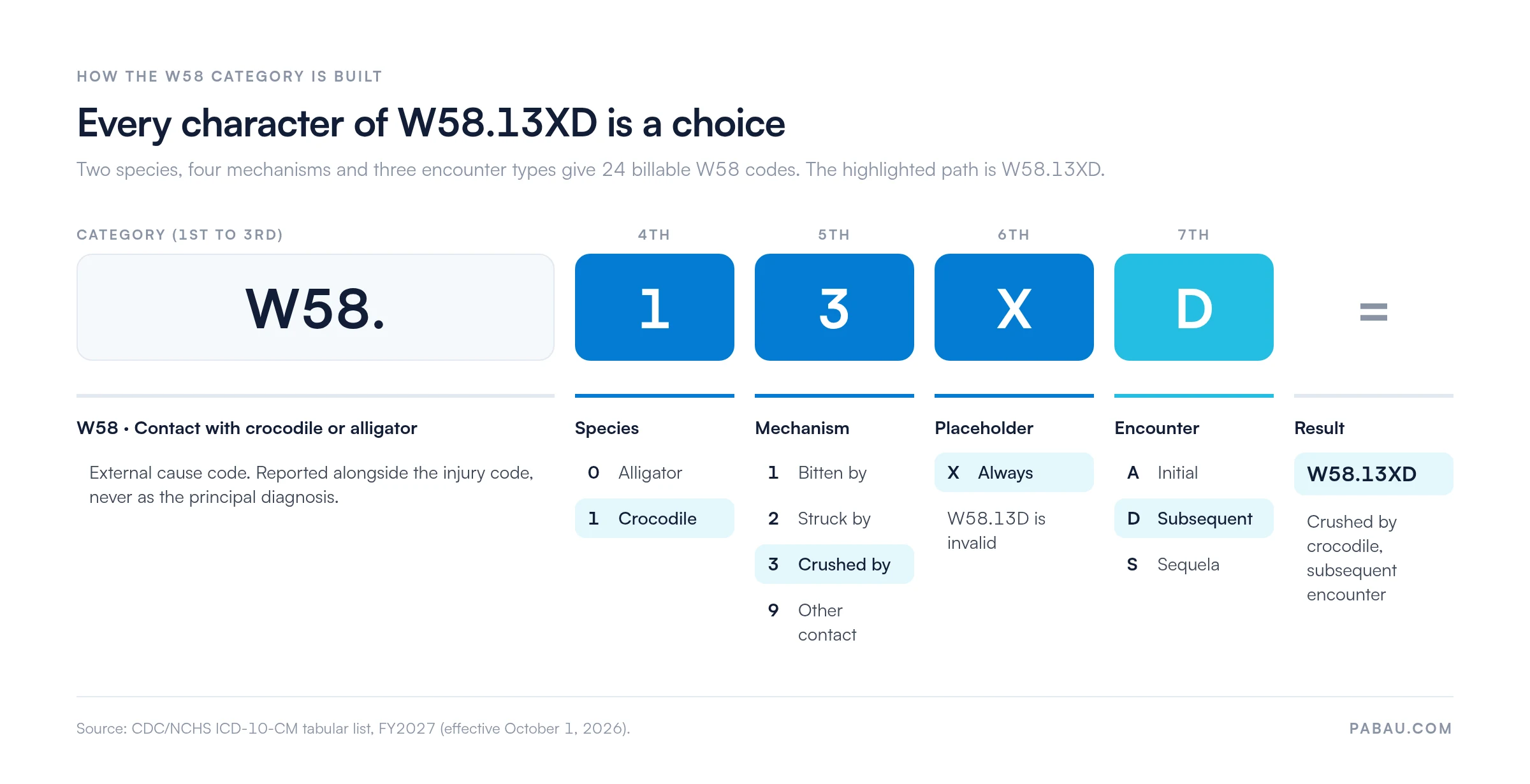
Every character in W58.13XD carries a specific meaning under the ICD-10-CM coding structure. Knowing what each one does makes an invalid or wrong variant much easier to spot. Two common slips are W58.13D (placeholder X omitted) and W58.03XD (alligator rather than crocodile). Check the full structure against the CDC/NCHS ICD-10-CM web tool each year when the October 1 update takes effect.
Why the placeholder X matters: Codes in the W58 category need all seven characters. Position 6 has no clinical meaning for this code, so the X holds its place. Submitting W58.13D drops the placeholder and produces an invalid code that most clearinghouses and payers will reject outright.
Subsequent encounter (7th character D) applies once active treatment is complete and the patient is receiving routine care while the injury heals. The ICD-10-CM Official Guidelines for Coding and Reporting define three encounter types for injury codes. Picking the wrong one is a common reason external cause claims get flagged during audit.
Key distinction: D does not mean “second visit.” It means the patient has moved out of active treatment and into the aftercare phase. A patient still receiving surgical wound management at visit two may still warrant W58.13XA. W58.13XS is reserved for complications that emerge after the original injury has fully healed, not while it is still resolving.
The W58 category covers all ICD-10-CM external cause codes for contact with crocodiles and alligators. The species is coded at the fourth character, and the mechanism (bitten, struck, crushed or other contact) at the fifth. Use the AAPC Codify ICD-10-CM lookup to navigate the W58 hierarchy when confirming a sibling code.
The diagram below shows how each character choice builds W58.13XD out of the category.
Alligator vs crocodile: The 4th character makes the distinction. The .0x codes are for alligators, and the .1x codes are for crocodiles. Documentation must name the animal. When the species is unclear from the clinical note, query the provider before coding, because the wrong subcategory adds audit risk.
Crushed by crocodile (W58.13XD) covers subsequent encounters where the mechanism was the animal’s body weight or jaw pressure. That’s distinct from a bite wound (W58.11XD) or being struck by a crocodile (W58.12XD). Crocodile crush injuries often involve the extremities. They lead to orthopedic and rehabilitation visits where W58.13XD is reported alongside fracture or crush injury codes.
External cause codes in the W58 category are supplementary. They need a primary injury diagnosis, and the medical record must contain specific details to support W58.13XD. Meeting clean claim requirements before submission reduces documentation requests from commercial payers who may flag exotic-injury codes for review.
As an external cause code, W58.13XD describes how the injury happened, not the anatomical damage that resulted. ICD-10-CM guidelines in Section I.C.20 require external cause codes to accompany the injury codes that describe the clinical findings, never replace them. Submitting W58.13XD as a standalone principal diagnosis is likely to be rejected or denied.
The 7th character on companion injury codes should match the W58.13XD encounter type. A subsequent encounter for a healing fracture pairs with a D or G 7th character on the S code. If the injury codes carry 7th character S for late effects, W58.13XS becomes the correct external cause instead.
CMS accepts W58.13XD as a valid ICD-10-CM code for FY2027. W-category external cause codes aren’t subject to National Coverage Determinations (NCDs) on their own. Payer acceptance depends on the principal diagnosis submitted alongside them and whether it meets medical necessity criteria. The external cause code itself doesn’t drive payment.
When a commercial payer requests documentation for W58.13XD, send the original encounter note that established the injury mechanism first. That note confirms the species, the mechanism and the move from initial to subsequent encounter. Keep it flagged in the patient record for the whole aftercare episode.
Exotic-injury external cause codes draw extra scrutiny in billing audits. They’re rare, so documentation problems are harder to catch before submission. Strong denial management workflows flag these patterns before they reach the payer. The five errors below account for most W58.13XD rejections and denials.
By the time a follow-up visit is billed, the provider has already documented the injury code and W58.13XD. The slow part comes next. Claims often get rekeyed into a separate clearinghouse portal, and a rejection may only surface when the remittance arrives.
Pabau, the practice management platform we build, turns the invoices you already raise into electronic CMS-1500 claims. Through its Claim.MD integration, those claims reach thousands of US insurance payers. Real-time eligibility checks confirm the patient’s coverage before the aftercare visit, so fewer claims bounce for avoidable coverage errors.
Pabau’s end-to-end claims management tracks claims, submitted codes and payer responses in one place. Each claim shows as paid, pending or denied, and electronic remittance advice is matched back to the claim it settles. Your team can rework a denied claim while the visit is still fresh.
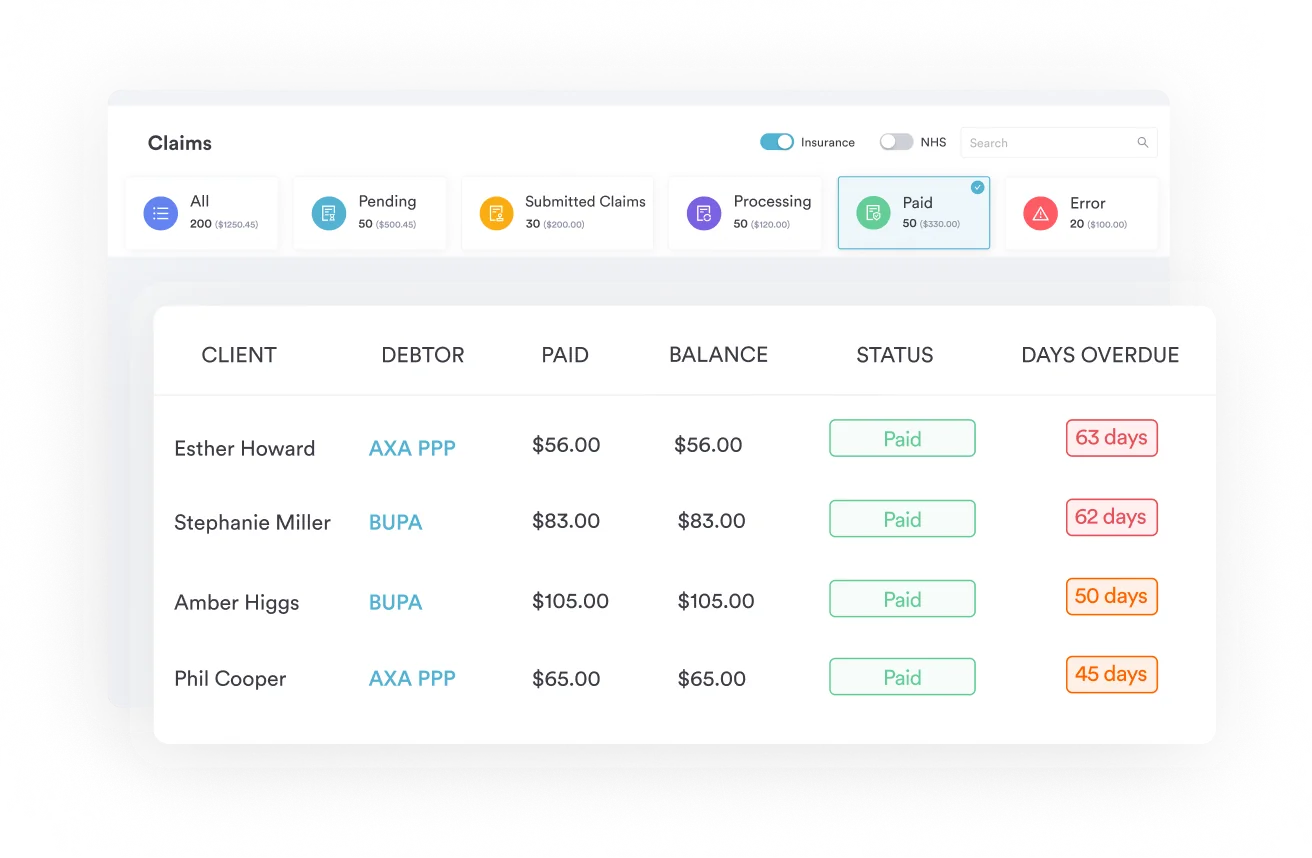

Pabau’s claims management tools help practices track claims, submitted codes and payer responses in one place. Denied follow-up claims get spotted and reworked quickly.

Getting W58.13XD right comes down to one question at each follow-up visit: is active treatment over? If it is, D is the correct 7th character, the placeholder X stays, and the injury code goes first on the claim.
The trade-off worth remembering is documentation. A crocodile crush injury is rare enough that payers may ask for the original encounter note, so keep it flagged for the whole aftercare episode.
If your practice bills follow-up injury visits often, one view of every claim makes rejections easier to catch and rework. Book a demo to see how Pabau tracks claims, submitted codes and payer responses in one system.

Coding a strike rather than a crush? ICD-10 code W58.12XD covers being struck by a crocodile at a subsequent encounter.
Need to understand how clearinghouse submissions work? Medical claims clearinghouse guide covers how claims are checked and routed to payers before payment.
Want a walkthrough of clean claim rules? Clean claim requirements explained outlines the documentation standards that prevent rejections at first submission.
ICD-10 code W58.13XD is the billable diagnosis code for “crushed by crocodile, subsequent encounter.” It’s an external cause code for follow-up care after a crocodile crush injury, once active treatment has ended.
A subsequent encounter (7th character D) applies when the patient is receiving routine aftercare for an injury that is still healing. A sequela (7th character S) applies when a late effect develops after the original injury has healed. Using S while the injury is still resolving is a coding error that can trigger audits.
No. W58.13XD is a supplementary external cause code and can’t be the principal or first-listed diagnosis. Per ICD-10-CM Official Guidelines Section I.C.20, external cause codes always accompany an injury code. A claim with this code alone is likely to be rejected or denied.
Yes, the X in position 6 is mandatory. Codes in the W58 category need seven characters, and no clinically meaningful 6th character exists, so X fills that position. Omitting it produces W58.13D, which is invalid and will be rejected by the clearinghouse or payer.
The W58 category covers every external cause code for contact with a crocodile or alligator. Codes split by species (.0x alligator, .1x crocodile) and mechanism (1 bitten, 2 struck, 3 crushed, 9 other contact). The 7th character then sets the encounter type: A, D or S.