ICD-10 code S61.201A: Open wound of left index finger without nail damage
ICD-10 code S61.201A covers a left index finger wound of unstated type ICD-10 co...

Last Updated: Oct 16, 2026
Billable Code Specific Code
W56.11XD is the billable ICD-10-CM code for bitten by sea lion, subsequent encounter. It applies once active treatment for the bite has ended and the patient returns for routine care, such as a wound check or suture removal.
W56.11XD is an external-cause code, so it always follows the injury code, which carries the 7th character D as well. Place, activity and status codes from the first visit are not repeated on the follow-up claim.
Let Pabau's smart automation suggest the right codes, reduce claim denials, and keep your practice compliant—effortlessly.
Automate repetitive tasks and focus on what matters most—your patients.
Reduce coding errors and ensure compliance with the latest regulations.
Clean claims, fewer denials, and faster reimbursements.
Powerful insights and reporting to help your practice thrive.
HIPAA compliant SOC 2 certified GDPR-compliant Trusted by 4,000+ clinics worldwide

W56.11XD is a billable ICD-10-CM code for a sea lion bite at a subsequent encounter, valid for FY2026 claims.
The 7th character D means active treatment has ended and the patient now receives routine care, such as wound checks or suture removal.
W56.11XD is an external-cause code, so it is never the principal diagnosis and always follows the injury code.
On a follow-up claim the injury code carries D as well, and the Y92, Y93 and Y99 codes from the first visit are not repeated.
Practice management software like Pabau links diagnosis codes to the claim, so no code is retyped between lookup and submission.
ICD-10 code W56.11XD is the 7-character, fully specified ICD-10-CM code meaning “Bitten by sea lion, subsequent encounter.” It sits in Chapter XX (External causes of morbidity, V00-Y99) and block W50-W64 (Exposure to animate mechanical forces). Its category is W56, contact with nonvenomous marine animal. The code is confirmed billable and valid for services reported under FY2026 per the CMS ICD-10-CM update files.
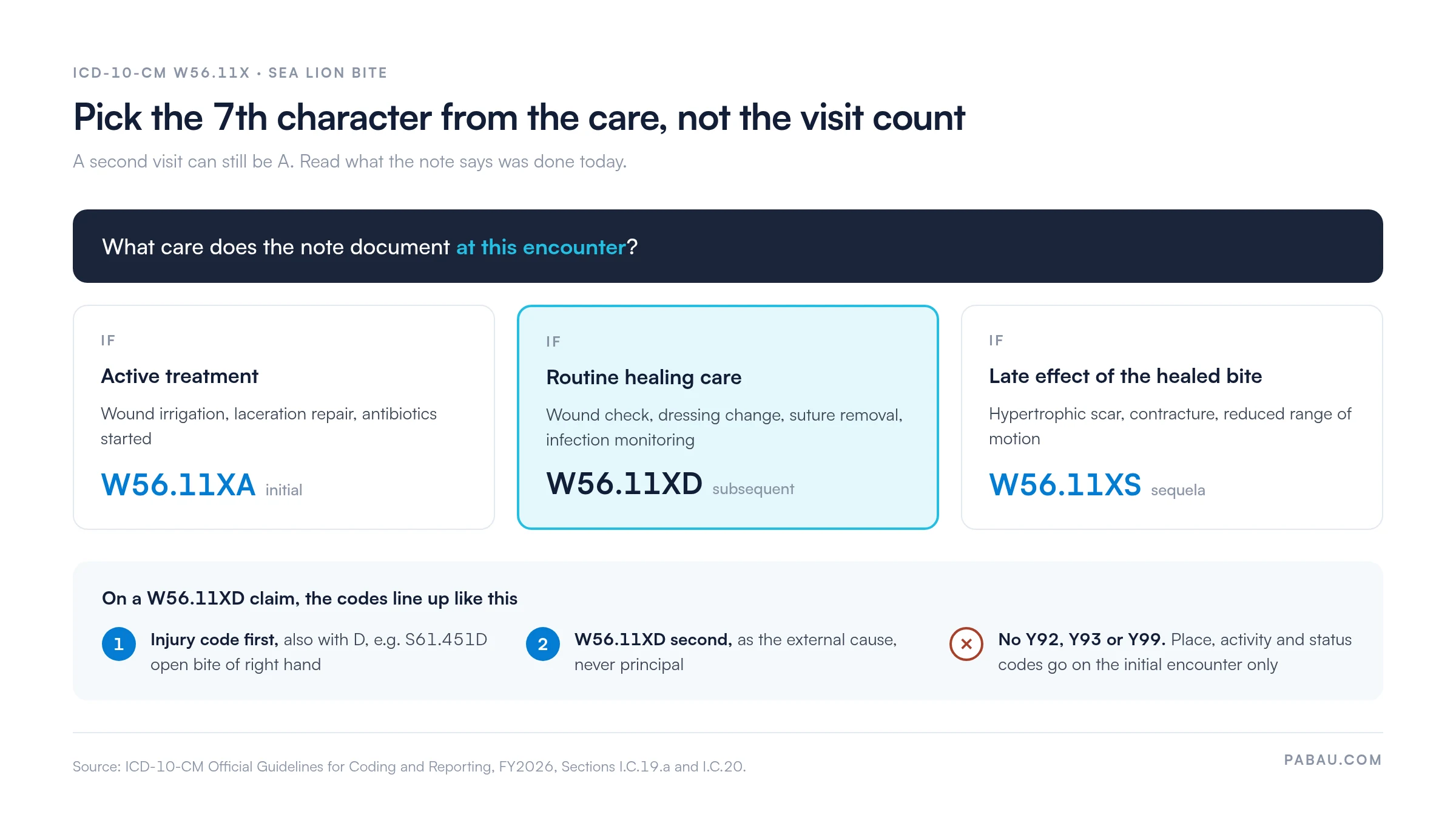
The 7th character D means the patient is receiving routine or rehabilitative care after active treatment has ended. A second visit does not qualify on its own. A patient who arrives for a second appointment still receiving active treatment for an acute wound uses W56.11XA, not W56.11XD. The change from A to D follows the type of care, whatever the visit count.
ICD-10-CM Official Guidelines Section I.C.19.a sets three 7th-character options for injury codes, and the external-cause code takes the same character as the injury it explains. A coder who reads “second visit” as “subsequent encounter” applies D too early, and the claim no longer matches the note.
The choice between the three W56.11X variants turns on the care documented at this encounter. Active treatment for the bite injury itself requires W56.11XA. Routine follow-up after the injury has been initially managed requires W56.11XD. A complication or late effect directly caused by the original bite, occurring after the wound has healed, requires W56.11XS.
Documentation cues help distinguish the correct qualifier. A note describing “wound irrigation, antibiotic initiation, and laceration repair” signals active treatment (XA). A note describing “suture removal, wound healing well, no signs of infection” signals subsequent encounter (XD). A note describing “hypertrophic scar at prior bite site” or “limited range of motion from healed bite wound” signals sequela (XS).
Read for these clinical phrases instead of counting visits. The diagram below maps each type of care to its code and shows how a W56.11XD claim lines up.
W56.11XD descends from a clear hierarchical chain within the CDC/NCHS ICD-10-CM classification. Understanding its place in the hierarchy helps coders navigate adjacent codes and apply the right parent-category logic. Sea lion bites cause mechanical injury, not envenomation. That is why sea lions sit in W56 with the nonvenomous marine animals, outside the T63 toxic effect categories.
The placeholder X in the 6th position is mandatory. W56.11 has only five characters, so X fills the sixth position and the encounter qualifier D takes the seventh. Omitting the X or the D produces an invalid code that the clearinghouse rejects.
Coders frequently look up adjacent codes when the species is uncertain or when a patient presents with a different type of marine-animal contact. The table below covers the W56 codes most commonly queried alongside W56.11XD, using the subsequent-encounter (D) qualifier for comparability.
W56.11XD is an external-cause code and can never serve as the principal diagnosis on a claim. Per ICD-10-CM Official Guidelines Section I.C.20, external-cause codes are supplementary codes that explain how an injury happened. The wound or injury code must be listed first.
Submitting W56.11XD as the only code, or placing it before the injury code, produces an invalid claim structure that payers reject.
Correct sequencing for a follow-up visit after a sea lion bite looks like this:
Check the injury code first. A bite indexes to the open bite codes, such as S61.45- for the hand, not to a laceration code. Confirm laterality and the exact site before attaching W56.11XD as the secondary code. A claim whose wound site and mechanism don’t match is hard to defend on review.
W56.11XD never travels alone. The injury code is its one required companion, and on a subsequent encounter that code carries the 7th character D as well. The place, activity and status codes reported on the initial claim do not come back.
Payers that collect place and activity data take it from the initial claim, so a D claim without Y92 or Y93 is complete as filed. A clean claim submission process that validates code combinations catches the opposite error, a Y code copied forward from the first visit.
The four errors below are the ones a coder can catch before a W56.11XD claim goes out. Each one misapplies either the external-cause sequencing rules or the 7th-character logic.
When one slips through, the remittance carries a reason code that names the problem. Our guide to medical billing denial codes shows how to trace that code back to its cause.
A clearinghouse that runs pre-submission edits catches the incomplete-code and principal-diagnosis errors before the payer sees them. The wrong 7th character is harder to catch, because W56.11XA and W56.11XD are both valid codes. Only the note can settle which one fits.
The clinical note must clearly support the subsequent-encounter qualifier for W56.11XD to hold up under audit. A note that reads as though active treatment is ongoing invites a payer or auditor to question the D qualifier. Linking the coded encounter to its note with audit-ready claims management software leaves a trail that supports the choice.
The following elements should appear in the visit note for a subsequent-encounter sea lion bite claim:
When a note reads like a first-visit assessment, a reviewer has grounds to question the D qualifier, however routine the visit was. The fix sits in the note, not in the claim.
Flag the care type at the top of every follow-up note. One line does it, such as ‘Routine follow-up care, with active treatment completed at the prior encounter.’ That line tells the coder to use the D qualifier. Building it into the follow-up note template puts it on every visit without anyone having to remember it.
Many practices still code a bite follow-up in one tool, check the descriptor in another, and retype both into the claim. Each hop is a chance for a dropped X, a copied-forward Y92 or an A that should have been a D.
Practice management software like Pabau keeps ICD-10-CM code search inside the patient record. The coder picks W56.11XD next to the note that justifies it, and the codes flow into the claim without retyping.
Pabau also connects to the Claim.MD clearinghouse, which checks claims for format and code errors before they reach the payer. You rework fewer rejections, and the note already backs the D qualifier if an auditor asks.

Pabau embeds ICD-10-CM code search in the clinical workflow, so coders and clinicians pick diagnosis codes without a separate reference tool. Selected codes flow into the claim automatically.

W56.11XD is one of the easier external-cause codes to get right, as long as the note does its job. Code from the care documented at the visit, and let the injury code lead with its own D.
The point worth remembering is that the follow-up claim should be shorter than the first one. The place, activity and status codes stay on the initial claim, and copying them forward adds an error to a claim that was otherwise clean.
Book a demo to see how Pabau ties follow-up notes, ICD-10-CM codes and claims together, so bite follow-ups go out right the first time.

Need a clear walkthrough of what happens after a claim submits? Electronic remittance advice explains how to read ERA files and identify denial reasons before they age into write-offs.
Dealing with repeated claim rejections across multiple codes? Denial management in healthcare covers the systematic workflows that prevent rework on external-cause coding errors.
Want to understand the clearinghouse’s role in pre-adjudication edits? Medical claims clearinghouse details how claim scrubbing catches invalid code combinations before payer submission.
W56.11XD is a billable ICD-10-CM code meaning “Bitten by sea lion, subsequent encounter.” It is used once active treatment for the bite has ended and the patient returns for routine care, such as suture removal. It is an external-cause code and is listed after the wound or injury code.
W56.11XA applies while the patient is receiving active treatment for the sea lion bite. W56.11XD applies once active treatment has ended and the patient is receiving routine or rehabilitative care. The type of care decides it, not the visit number, so a second visit can still be XA.
Use the 7th character D when the note documents routine follow-up care after the injury has been managed. That covers wound monitoring, dressing changes, suture removal, or infection checks with no new active intervention. Being the second or third visit is not enough on its own.
Yes. W56.11XD is a fully specified, billable ICD-10-CM code valid for FY2026 claims, per the CMS/NCHS Tabular List. It needs an injury code in the first position and cannot be submitted as the principal diagnosis.
The usual causes are submitting W56.11XD as the only or principal diagnosis, or using XD while active treatment was still underway. Omitting the placeholder X also invalidates the code. Pre-submission validation catches most of these, while the XA-versus-XD choice depends on the note.
No. Under ICD-10-CM Official Guidelines Section I.C.20, a place of occurrence code (Y92) is reported only once, at the initial encounter for treatment. Leave it off the W56.11XD follow-up claim, along with the activity (Y93) and external cause status (Y99) codes.