ICD-10 Code V28.01XD: E-bike driver noncollision accident, nontraffic, subsequent encounter
ICD-10 Code V28.01XD: Definition and billable status ICD-10 Code V28.01XD is the...

Last Updated: Oct 20, 2026
Billable Code Specific Code
V78.7XXD is the billable ICD-10-CM code for person on outside of bus injured in noncollision transport accident in traffic accident, subsequent encounter. It covers a person riding on the exterior of a bus, such as a step, bumper, or roof. The injury happens on a public road without any collision.
The D marks a subsequent encounter, when active treatment has ended and the visit is routine follow-up. It is easily confused with V78.5XXD, the bus driver code, or V78.2XXD, the same injury off the public road. Report it after the injury diagnosis, never on its own.
Let Pabau's smart automation suggest the right codes, reduce claim denials, and keep your practice compliant—effortlessly.
Automate repetitive tasks and focus on what matters most—your patients.
Reduce coding errors and ensure compliance with the latest regulations.
Clean claims, fewer denials, and faster reimbursements.
Powerful insights and reporting to help your practice thrive.
HIPAA compliant SOC 2 certified GDPR-compliant Trusted by 4,000+ clinics worldwide

ICD-10 Code V78.7XXD applies to a person riding on the outside of a bus, such as on a step or bumper. The injury comes from a noncollision traffic accident.
The patient’s role decides the subcategory: bus drivers take V78.5 or V78.0, passengers V78.6 or V78.1, and nontraffic outside riders V78.2.
Two placeholder X characters fill positions 5 and 6, so the D encounter character lands in the required 7th position.
V78.7XXD is an external cause code and is always sequenced after the injury diagnosis, per ICD-10-CM Official Guidelines Section I.C.20.
Pabau’s claims management software scrubs every claim for missing or invalid details before submission.
ICD-10 Code V78.7XXD is a billable ICD-10-CM diagnosis code. Its full official descriptor is Person on outside of bus injured in noncollision transport accident in traffic accident, subsequent encounter.
It is valid in the current ICD-10-CM fiscal year. The code set is maintained jointly by the Centers for Medicare and Medicaid Services and the National Center for Health Statistics (NCHS).
As an external cause code in the V-code block, V78.7XXD is never reported as a standalone diagnosis. It documents the mechanism and circumstance of injury, not the injury itself. The primary injury, such as a fracture, laceration, or contusion, receives its own ICD-10-CM code and is always listed first on the claim.
Coders new to transport injury coding should check the current tabular list in the CDC/NCHS ICD-10-CM web tool before billing. The V-code block can change with each ICD-10-CM fiscal year release, which takes effect every October 1.
Every character in V78.7XXD carries a distinct meaning. Knowing the structure prevents two frequent errors. Coders drop a placeholder X, or they pick the wrong person-type subcategory.
The two placeholder X characters are not optional. ICD-10-CM requires codes that use a 7th character extension to be exactly 7 characters long. When the subcategory code has fewer than 6 characters, X placeholders fill the empty positions.
Submitting V78.7D or V78.7XD instead of V78.7XXD produces an invalid code that most clearinghouses reject before the claim reaches the payer.
V78.7XXD applies when a person riding on the outside of a bus is hurt in a noncollision accident on a public road. ICD-10-CM treats a “person on outside” as someone carried by the vehicle without occupying the driver’s seat, a passenger seat, or the cargo space.
Typical positions include the entry step, the running board, the rear bumper, the roof, or the outside of an open door. “Noncollision” means the bus struck no other vehicle or object. “Traffic” means the accident happened on, or started on, a public highway or street.
Included scenarios:
Excluded scenarios (use a different code):
V78.7XXD documents the external cause of an injury already captured by a separate ICD-10-CM code in the patient’s record. Without a paired condition code, it cannot carry a claim on its own. The basics of medical billing show how each diagnosis code on a claim supports the services billed.
The 7th character D in V78.7XXD indicates a subsequent encounter. At this visit the patient receives routine care after active treatment of the injury has ended. No fixed number of visits or timeframe separates an initial from a subsequent encounter. The stage of treatment decides it.
“Initial encounter” does not mean the first calendar visit. A patient may transfer to a new provider while still under active treatment for the same injury. The receiving provider still uses 7th character A. The switch to D happens when active treatment ends, however many visits have occurred.
When auditing claims with V78.7XXD, check the medical record for clear documentation that active treatment has concluded before the D designation was applied. Payers auditing transport injury claims often flag cases where active treatment notes and a D encounter code appear on the same date of service.
V78.7XXD sits within a cluster of closely related codes that differ by person type, accident setting, and encounter type. Selecting the wrong adjacent code is a common audit trigger for transport injury claims.
The grid below sorts the subsequent-encounter codes by the two questions that decide them. What was the patient’s role, and did the accident happen on a public road?
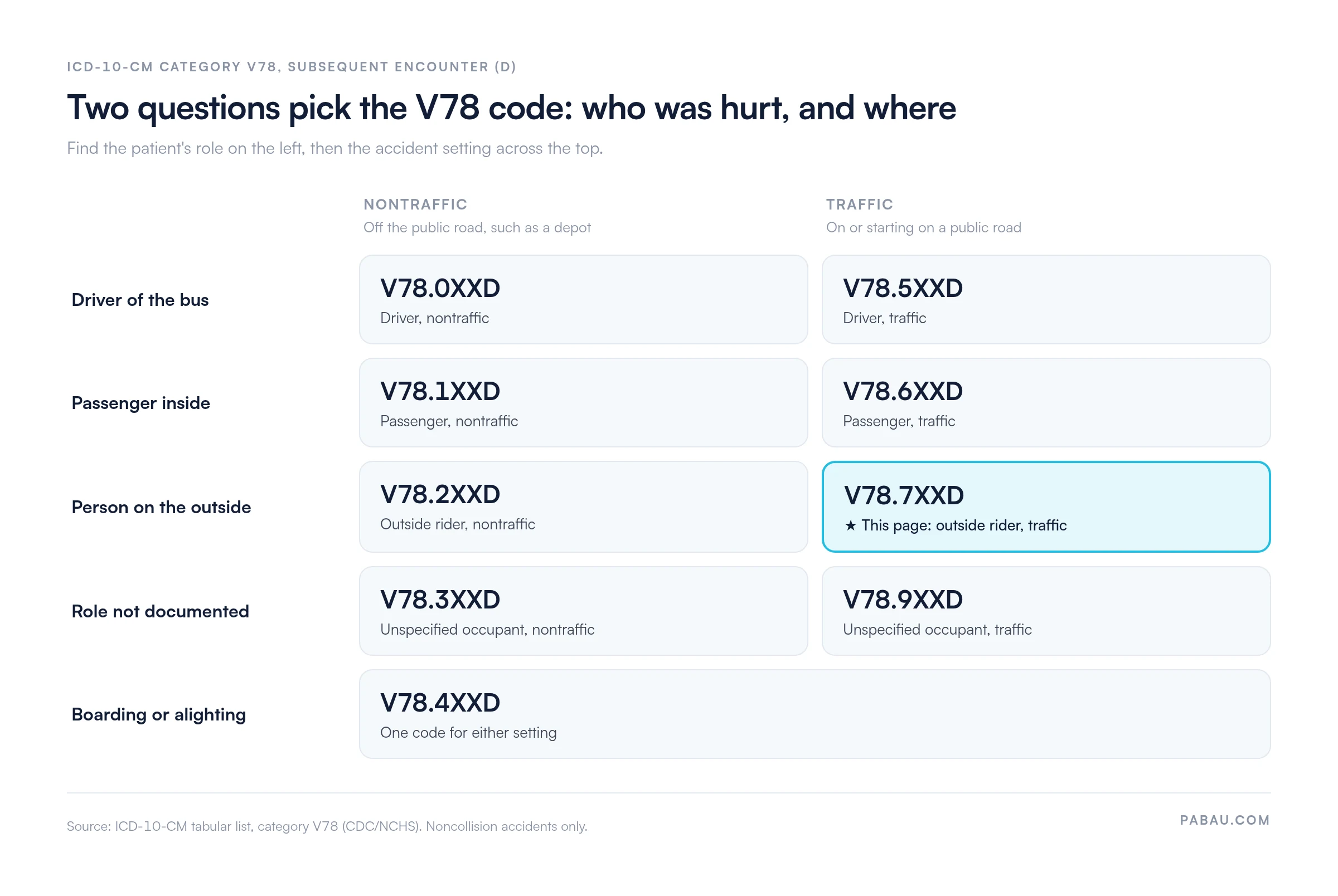
Refer to the AAPC ICD-10-CM code lookup to confirm the full descriptor for any adjacent code before coding. The 4th character is the most common source of errors in this cluster. Check the patient’s role and the accident setting against the medical record before selecting a subcategory.
Per ICD-10-CM Official Guidelines Section I.C.20.a, external cause codes are supplementary and must always be sequenced after the primary injury diagnosis. V78.7XXD cannot appear as the first-listed or principal diagnosis on any claim. The full external cause set for this injury looks like this:
A clean claim for a transport injury typically pairs V78.7XXD with a specific musculoskeletal, neurological, or soft-tissue injury code. Submitting V78.7XXD without a primary injury diagnosis is a frequent reason these claims are rejected.
Pabau’s Claim.MD clearinghouse integration submits claims electronically and tracks remittances, so a missing companion code surfaces as a denial faster.
The medical record must support every element of V78.7XXD to withstand payer audit. Vague or internally inconsistent documentation is a frequent audit trigger, alongside incorrect sequencing.
Required documentation elements:
Practices managing transport injury claims should review their medical billing compliance workflows so that documentation captures role, setting, mechanism, and encounter type at every visit. Missing details found during an audit are hard to add after the fact.
Transport injury external cause codes attract a predictable set of denials, and most are preventable with pre-submission checks. Each rejection comes back with a reason code, and the guide to medical billing denial codes explains what each one means.
Systematic denial management workflows that track external cause code rejections by denial code show practices where errors come from. A repeated pattern points to a documentation template, while a one-off points to a single coding slip.
Not every payer requires external cause codes like V78.7XXD. Where they appear, they can still change how a claim is processed and how benefits are coordinated.
Medicare and Medicaid: The ICD-10-CM guidelines set no national requirement to report external cause codes. Reporting becomes mandatory where a state reporting mandate or a specific payer policy requires it. Without one, practices are still encouraged to report them, because they describe how the injury happened.
Commercial payers: Many commercial insurers require external cause codes to trigger coordination-of-benefits review. A transport accident code on a claim signals that a third-party liability payer (auto insurance or employer workers’ compensation) may be responsible. The payer may pend or deny the claim pending verification of liability coverage. Providing complete accident documentation with the initial submission reduces these delays.
Workers’ compensation payers: Workers’ compensation carriers are generally not HIPAA-covered entities and may operate under state-specific code sets or additional documentation requirements. Do not generalize Medicare billing rules to workers’ comp claims. Confirm requirements with the specific carrier for each state where the practice operates.
Auto insurance and PIP payers: Personal injury protection (PIP) payers frequently require the full accident detail that V78.7XXD provides. A vague code may prompt a request for records. One example is V78.9XXD for an unspecified occupant when the record shows the patient rode outside the bus.
Transport injury claims usually fail on small details: an external cause code listed first, a missing placeholder X, or a role the notes never state. Coders often catch these only after a rejection comes back.
Pabau’s claims management software scrubs each claim for missing or invalid details before it leaves the practice. Structured note templates prompt clinicians to record the patient’s role, the accident setting, and the treatment phase. After submission, electronic remittance advice brings denial codes back into the same record.
The result is fewer resubmissions on follow-up visits, so the practice gets paid without a second round of corrections.

Pabau’s claims management software scrubs every claim for missing or invalid details, then submits it electronically through the clearinghouse. Fewer transport injury claims come back for avoidable fixes.

ICD-10 Code V78.7XXD is correct only when four facts line up. The patient rode outside the bus, nothing was struck, the accident was on a public road, and active treatment has ended. If the record cannot support any one of them, an adjacent V78 code fits better.
The safest habit is to settle role and setting before the first claim goes out, then reuse them on every follow-up. Strong revenue cycle management turns that habit into a standard step. To see how Pabau handles transport injury claim workflows, book a demo.

Need a clearer picture of how ICD-10 fits into the full billing cycle? What is medical billing covers the end-to-end process from encounter to payment posting.
Curious how clearinghouse submission works after coding? Claim.MD clearinghouse explains how electronic claim validation and submission reduce rejection rates before claims reach the payer.
ICD-10 Code V78.7XXD means a person riding on the outside of a bus was injured in a noncollision traffic accident. It is used at a subsequent encounter. The patient is receiving routine care after active treatment has ended. V78 covers bus occupants in noncollision accidents, .7 marks a person on the outside in traffic, XX are placeholders, and D marks the encounter.
V78.7XXA is used while the person injured on the outside of the bus is still receiving active treatment. V78.7XXD is used once active treatment has ended and the visit is routine follow-up. The switch depends on the treatment phase, not the number of visits.
Yes. V78.7XXD only explains how the injury happened, so it is sequenced after the injury diagnosis, per ICD-10-CM Official Guidelines Section I.C.20.a. The injury itself, such as a fracture from the fall off the bus, must appear first on the claim.
Use D when the visit is routine follow-up for the injury from riding on the outside of the bus. Use S when the visit treats a late effect of that injury, such as a scar or joint stiffness. With S, the late effect is coded first and V78.7XXS follows.
Two placeholder X characters are required, in positions 5 and 6. V78.7 has only four characters, but codes that take a 7th character must be exactly seven characters long. The two X values fill the space so the D lands in position 7. Dropping either X creates an invalid code that clearinghouses reject.