ICD-10 Code S53.013D: Anterior subluxation of unspecified radial head
ICD-10 Code S53.013D: Quick reference summary Use the table below as your first ...

Last Updated: Nov 6, 2026
Billable Code Specific Code
V43.73XA is the billable ICD-10-CM code for person on outside of car injured in collision with pick-up truck in traffic accident, initial encounter. It applies to someone riding on a car's bumper, roof or running board when the car and a pick-up truck collide on a public road.
The code sits in Chapter 20 (External causes of morbidity) and is always reported after the injury code it explains. It is most often confused with V43.23XA, the same collision in a nontraffic accident, and with V43.63XA for a passenger inside the car.
Let Pabau's smart automation suggest the right codes, reduce claim denials, and keep your practice compliant—effortlessly.
Automate repetitive tasks and focus on what matters most—your patients.
Reduce coding errors and ensure compliance with the latest regulations.
Clean claims, fewer denials, and faster reimbursements.
Powerful insights and reporting to help your practice thrive.
HIPAA compliant SOC 2 certified GDPR-compliant Trusted by 4,000+ clinics worldwide

V43.73XA codes an injury to a person riding on the outside of a car when it collides with a pick-up truck on a public road.
The 4th character 7 sets the role and traffic status. The 5th character 3 names a pick-up truck as the other vehicle.
Use V43.23XA when the same collision happens entirely off the public highway, such as in a private parking lot or on a farm.
External cause codes like V43.73XA are never first-listed. They follow the S00-T88 code that describes the injury itself.
Pabau, the practice management platform we build, scrubs each claim for missing or invalid details before it reaches the clearinghouse.
ICD-10 code V43.73XA is the billable code for a person on the outside of a car hit by a pick-up truck in a traffic accident.
It covers the initial encounter. The code set is maintained by the Centers for Medicare & Medicaid Services (CMS) and the National Center for Health Statistics (NCHS). Every neighboring transport code has its own entry in our ICD-10-CM library for coders.
It applies when the patient was riding on the car’s bodywork, bumper, roof, running board or step, and the crash happened on a public road. The 7th character A marks the encounter where the injury is under active treatment. V43.73XA is an external cause code, so it always follows the injury code on the claim.
ICD-10-CM defines a person on the outside of a vehicle as someone transported by it without occupying the driver’s, passengers’ or cargo space. The tabular list names traveling on the bodywork, bumper, fender, roof, running board or step, and hanging on the outside.
That definition rules out most crash patients. A driver is the occupant operating the car, and a passenger is any other occupant inside it. Both have their own V43 codes. V43.73XA fits a narrow set of cases, such as someone riding on a step or clinging to a door frame.
Two vehicle definitions matter as well. A car is a four-wheeled motor vehicle designed primarily for carrying up to 7 persons, and it does not include a van or minivan. If the patient was riding outside a pick-up truck, SUV or minivan, the injury belongs in V50-V59, not V43.
Each character in V43.73XA carries a specific meaning. Misreading a single position produces a code for a different accident, and often a denied claim.
The 4th character carries two facts at once: the injured person’s role and the traffic status. In V43, 7 means a person on the outside of the car in a traffic accident. The same role in a nontraffic accident takes 2.
The 5th character names the other vehicle. It is 1 for an SUV, 2 for another type of car, 3 for a pick-up truck and 4 for a van. Swap the 3 for a 1 and the code becomes V43.71XA, the same rider hit by an SUV.
The placeholder X at position 6 is not optional. Under ICD-10-CM Official Guidelines Section I.A.4, it fills any empty position when a code needs a 7th character. The CDC ICD-10-CM browser tool shows V43.73 has only five characters, so omitting the X produces an invalid code that clearinghouses reject.
The scope of V43.73XA is narrow, so checking it against the record prevents reporting it where a sibling code applies.
The 7th character tells the payer where the patient is in the course of treatment. External cause codes take the same 7th character as the injury code they accompany, so the two must agree on every claim.
A common mistake is using character A because it is the patient’s first visit with this provider. The character describes the treatment phase, not the provider relationship. A patient seen by a specialist three weeks after the accident for follow-up wound care takes character D.
The V43 codes form a grid on three axes. The 4th character sets the injured person’s role and the traffic status, and the 5th character names the other vehicle. Misreading any one axis produces a code that describes a different accident. The diagram below asks the three questions in the order a coder should answer them.
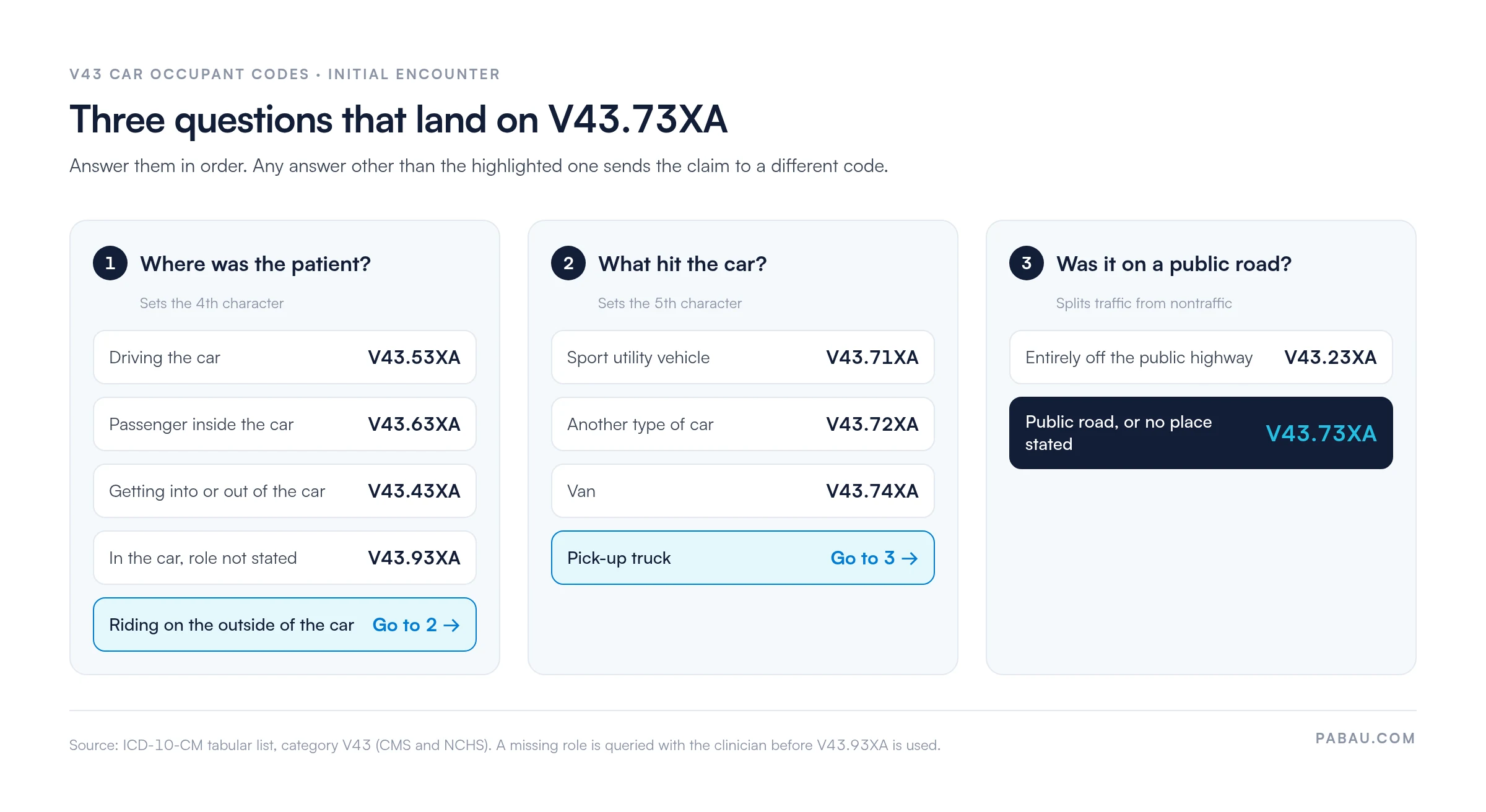
Each end point in the diagram is a separate code with its own official title. The table lists them for the initial encounter.
The role axis causes most errors on this code. Notes rarely describe someone riding outside a car. A coder who reads “outside” loosely can report a pedestrian or passenger injury as V43.73XA. The traffic axis works the other way: a missing location defaults to traffic, so V43.23XA needs a stated off-road place.
Before you pick between V43.73XA, V43.23XA and V43.63XA, check the note for three facts. Where was the patient on the car, what hit it, and was it on a public road? If the place is missing, ICD-10-CM assumes a public highway. If the role is missing, query the clinician.
V43.73XA is an external cause code. Under ICD-10-CM Official Guidelines Section I.C.20, an external cause code is never the principal or first-listed diagnosis. The injury is coded first.
Sequence the claim in this order:
Supporting V43.73XA through an audit requires the clinical record to answer four questions about the event. A missing answer gives payers and auditors grounds to deny or recoup the claim.
When documentation is incomplete, query the clinician before the claim goes out rather than guessing at the role. Submitting a clean claim means every code is supported before it leaves the practice.
External cause codes produce a predictable set of denial patterns. Each one has a fix at the documentation or coding stage, before the claim is submitted.
Recurring external cause denials usually trace back to the same missing fact in the note. Structured denial management workflows route each denial type to the right fix, so the documentation template gets corrected once.
External cause reporting requirements vary by payer type. A correctly coded claim may still be handled differently depending on who is paying.
CMS has no national mandate requiring external cause codes on Medicare Part A or Part B claims. They are encouraged but not required for most Medicare submissions. Medicare Administrative Contractors (MACs) can set stricter local requirements, so confirm current policy for your jurisdiction.
State Medicaid programs vary. Some states require external cause codes on accident-related claims as a condition of payment, and others treat them as optional. Practices billing Medicaid for motor vehicle injuries should check current state policy before assuming the code is optional.
Commercial health insurers increasingly expect external cause codes on accident claims, to coordinate benefits and identify subrogation opportunities. Auto liability insurers and workers’ compensation carriers usually want the full chain: injury code, external cause code, place of occurrence and status code.
Sending V43.73XA to an auto liability payer without the injury code and Y92.4- road code commonly delays payment. Understanding how medical billing fundamentals interact with payer rules helps practices set documentation standards before coding starts.
Errors on a V43.73XA claim usually start before coding. The note says “MVA”, the coder guesses the patient’s role, and the claim goes out with the wrong 4th character.
Pabau’s claims tools for coders scrub every claim for missing or invalid details before it leaves the practice. US practices then submit through Claim.MD, which also runs eligibility checks before the visit.
When a claim is rejected, Pabau marks it “Needs action” and links your team to the field that needs correcting. The coder fixes the code pairing once, and the claims dashboard shows when it moves to paid.

Pabau’s claims management software scrubs each claim for missing or invalid details before it reaches Claim.MD. Rejected claims land in a Needs action queue that points to the field to fix.

V43.73XA belongs on a claim only when the record answers three questions. Was the patient riding on the outside of the car? Was the other vehicle a pick-up truck? Did the crash happen on a public road?
Build those three prompts into your accident intake template, and the choice between V43.73XA, V43.23XA and V43.63XA stops being a judgment call. Leave them out, and every vague “MVA” note becomes a coder query or a denial.
Book a demo to see how Pabau scrubs external cause claims before they reach the payer.

Need to understand how clearinghouse validation works? Understanding the Claim.MD clearinghouse explains how real-time claim edits catch sequencing errors before payer submission.
Seeing recurring denials across your practice? Denial management in healthcare covers structured workflows for routing and resolving denial patterns by code category.
Want to understand how external cause codes fit into billing? What is medical billing covers the end-to-end process from encounter documentation through payment posting.
Coding the same rider hit by an SUV? ICD-10 code V43.71XA covers a person on the outside of a car in a traffic collision with a sport utility vehicle.
ICD-10 code V43.73XA means a person on the outside of a car was hit by a pick-up truck in a traffic accident. It covers the initial encounter. It is a billable Chapter 20 external cause code, reported after the injury diagnosis.
Both codes describe a person on the outside of a car hit by a pick-up truck. V43.73XA is for a traffic accident on a public highway. V43.23XA is for a nontraffic accident that happens entirely off the public highway, such as on private property.
A person on the outside of a car is being carried by it without occupying the driver, passenger or cargo space. Examples include riding on the bumper, roof, running board or step, or hanging on the outside.
Use A (V43.73XA) while the injury is under active treatment, such as an emergency visit, surgery or the first evaluation. Use D (V43.73XD) for follow-up visits during healing, such as cast removal, wound checks or physical therapy.
No. V43.73XA is an external cause code, so it is never the principal or first-listed diagnosis. List the S00-T88 injury code first, then add V43.73XA and any Y92.4- road code in secondary positions.
ICD-10-CM assumes a vehicle accident happened on a public highway unless another place is specified, so the traffic code applies. The patient’s role still has to be documented. If it is missing, query the clinician before choosing V43.73XA.
The X fills position 6 so the 7th character A lands in position 7, as Section I.A.4 of the official guidelines requires. Without it, the code is invalid, and most billing systems reject it at the front end.