ICD-10 Code S82.242H: Displaced spiral tibial shaft fracture, delayed healing
ICD-10 Code S82.242H: Definition and code details ICD-10 Code S82.242H designate...

Last Updated: Oct 15, 2026
Billable Code Specific Code
V43.71XA is the billable ICD-10-CM code for person on outside of car injured in collision with sport utility vehicle in traffic accident, initial encounter.
Two details separate it from its neighbors in the V40-V49 block. The injured party was outside the vehicle rather than an occupant, and the collision happened on a public road. A collision off a public road takes V43.21XA instead.
Let Pabau's smart automation suggest the right codes, reduce claim denials, and keep your practice compliant—effortlessly.
Automate repetitive tasks and focus on what matters most—your patients.
Reduce coding errors and ensure compliance with the latest regulations.
Clean claims, fewer denials, and faster reimbursements.
Powerful insights and reporting to help your practice thrive.
HIPAA compliant SOC 2 certified GDPR-compliant Trusted by 4,000+ clinics worldwide

V43.71XA is the billable ICD-10-CM code for the initial encounter, with V43.71XD for follow-up visits and V43.71XS for sequela.
The ‘person on outside of car’ designation is the differentiator that decides this code. It applies only when the injured party was not an occupant inside the vehicle.
Traffic accident means the collision happened on a public road. A collision anywhere off a public road takes V43.21XA instead.
V43.71XA is always a secondary code. A primary injury diagnosis such as a fracture or contusion must be listed first on the claim.
ICD-10 code V43.71XA is a valid, billable ICD-10-CM code for fiscal year 2026, effective October 1, 2025. The full official descriptor is: Person on outside of car injured in collision with sport utility vehicle in traffic accident, initial encounter.
The CDC/NCHS ICD-10-CM web tool confirms the code’s billable status and full descriptor for each fiscal year edition. When searching for this code, verify you are viewing the FY2026 edition released October 1, 2025. Older archived editions can surface in search results without warning. For broader guidance, the CMS ICD-10 codes page publishes annual update files and the full tabular list.
V43.71XA sits within the ICD-10-CM external cause chapter, which runs from V00 to Y99. Its position in the hierarchy tells you exactly which vehicle type, which person position, and which accident context apply.
The V40-V49 block is labeled “car occupant”, and that label is the first documentation trap. A person on the outside of a car is coded under V43.7x, not under the driver and passenger subcategories (V43.5x and V43.6x). Emergency department notes often describe the patient as “involved in an accident with an SUV” and stop there. Without a note on whether the patient was inside or outside the vehicle, coders must query the record, and billing waits. The wider ICD-10-CM code index applies the same occupant-versus-bystander split across the V-code range.
A patient hurt while boarding or alighting a car belongs in V43.4- instead, and a collision with another car gives V43.42XS as a sequela. A driver struck by a van on a public road takes V43.54XD at a follow-up visit.
The same person-position split runs through the bus block, V70-V79. A person on the outside of a bus struck by a two- or three-wheeled motor vehicle in traffic takes V72.7XXA at the initial encounter.
The 7th character in V43.71XA determines the encounter type. Selecting the wrong one is a common reason external cause codes return to the coder for correction. Each character maps to a distinct phase of care.
The most common error in this code family is using 7th character A for every visit beyond the emergency department. Once the patient moves to a follow-up appointment or physical therapy, the code shifts to V43.71XD. The A character is reserved for active treatment of the fresh injury. Use A for first treatment, D for ongoing care, and S for late effects.
The sequela character S is often misapplied. Use V43.71XS only when the primary injury has healed but has left a residual condition. Chronic shoulder pain and nerve damage both qualify, provided the record ties them to the original traffic collision. At that point the sequela injury code becomes the principal diagnosis, rather than the original fracture or contusion. V43.71XS then supplies the external cause context. Document the causal relationship explicitly in the record, because payers do deny sequela claims when the connection to the original event is unstated.
A traffic accident, in ICD-10-CM terms, is one that occurs on a public highway or road. The ICD-10-CM Official Guidelines for Coding and Reporting draw the line at the public roadway itself. Any location off that roadway is nontraffic, including parking lots, driveways, private roads, farm tracks, and construction sites. Those scenarios take V43.21XA instead.
The distinction changes what a payer will accept. Some payers handling workers’ compensation or auto liability claims code-edit for traffic versus nontraffic status, because it affects coverage determination and subrogation. Coders who default to a traffic code when the documentation is ambiguous expose the practice to audit risk.
Emergency department notes are the second documentation trap here. Providers often write “motor vehicle accident” without specifying whether it occurred on a public road. A patient struck by an SUV on an open public street is a traffic event and takes V43.71XA. The same collision in a supermarket parking lot is nontraffic and takes V43.21XA. Both involve an SUV and a person outside the vehicle, yet the ICD-10 code differs. Flag vague “MVA” documentation for a provider query before the claim goes out.
Under the ICD-10-CM Official Guidelines for Coding and Reporting (Section I.C.20), external cause codes including V43.71XA are supplementary codes. They describe the circumstances of an injury but are never assigned as the principal or first-listed diagnosis. The injury itself, whether a fracture, laceration, or contusion, must lead the claim.
Key sequencing rules coders must follow:
Payer requirements vary. Medicare does not universally require external cause codes for outpatient claims, but many commercial payers and all workers’ compensation carriers expect them. Review individual payer contracts before assuming the codes are optional. Practices running high injury volumes lean on cleaner claims management software to validate code pairings before submission. The structural checks that manual review tends to skip then run at claim build.
Documentation that supports V43.71XA must establish three facts. The patient was on the outside of the car, not inside it. The other vehicle was a sport utility vehicle. The collision occurred on a public road, not off one. All three must be inferable from the medical record, the police report, or an explicit provider attestation. Missing any one of them creates an audit flag. A short documentation checklist at the point of charting prevents the most common deficiencies before the claim is built.
Three denial reasons dominate V43.71XA claims. The first is the external cause coded as principal diagnosis. The second is a 7th character mismatch between the injury code and the external cause code. The third is a traffic or nontraffic classification that contradicts the clinical record. Sound denial management starts by sorting rejections into those three buckets before anyone reworks a claim.
Run a code-pairing audit quarterly on all V43.7x claims. Pull any claim where V43.71XA, V43.71XD, or V43.71XS was submitted as the principal diagnosis. That is an automatic sequencing error. Also check that the 7th character matches across the injury code and the external cause code on every line.
Because V43.71XA is always a secondary code, every claim using it must include a primary injury diagnosis. The injury codes most commonly paired with it reflect the mechanism. A person struck by an SUV while standing outside a vehicle typically presents with upper extremity, shoulder, or lower limb injuries. Head and thoracic trauma also appear, depending on the collision dynamics.
The AAPC Codify ICD-10-CM lookup lets coders search injury codes by keyword and check the pairing logic for external cause codes. A standard code-pairing template for external-cause encounters cuts the per-claim query time. Consistent pairing protocols beat case-by-case improvisation at the coder level.
V43.71XA belongs to the V43.7x subcategory, which covers person-on-outside-of-car injuries in traffic accidents. The second-to-last digit names the vehicle struck: 1 is an SUV, 2 another type of car, 3 a pick-up truck, and 4 a van. The nontraffic counterpart sits one subcategory away, in V43.2x, where the same vehicle digit applies. Three questions settle the code before the 7th character is added.
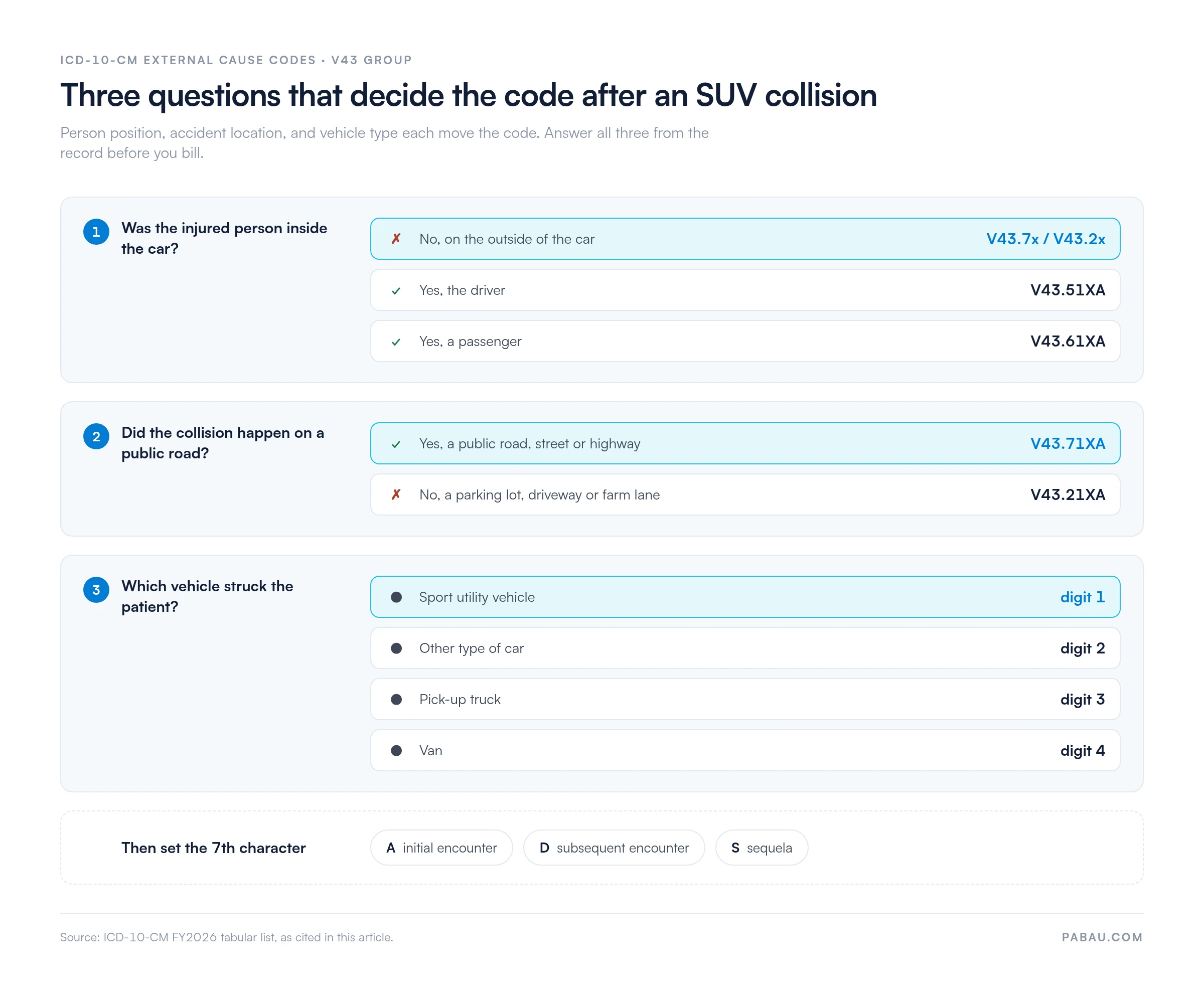
The most common sibling-code selection error is confusing V43.71XA (traffic) with V43.21XA (nontraffic). Both describe a person on the outside of a car struck by an SUV, and only the accident location separates them. V43.72XA covers a collision with another type of car on a public road, so it belongs to a different vehicle digit. Confirm the location and the vehicle type from the source record before coding. The WHO ICD-10 browser traces the international classification that ICD-10-CM derives from, which helps most with claims that cross borders.
Build a quick-reference crosswalk in your EHR or superbill template for SUV struck-pedestrian codes. List V43.71XA (traffic), V43.21XA (nontraffic), and the three encounter variants side by side. Coders who can scan the pair at the point of coding select the right code in seconds.
Most practices catch an external cause sequencing error after the payer does. A coder assigns V43.71XA, the claim goes out with the code in the wrong position, and the rejection lands two weeks later. Reworking that claim costs more staff time than the original encounter did.
Practice management software like Pabau applies those rules at claim build instead. Sequencing is checked before submission, so an external cause code cannot lead the claim. The 7th character on the injury code and on V43.71XA is compared, and a mismatch is flagged while the encounter is still open.
Documentation stays in the same system. The note recording the patient’s position, the vehicle type, and the accident location remains attached to the claim. An auditor’s question is then answered without a records hunt across two systems.

Pabau’s claims management tools help practices build accurate external cause code pairings and track encounter types across follow-up visits. Clean claims go out with consistent 7th character sequencing. See how it works for your practice.

The core challenge with ICD-10 code V43.71XA is documentation precision, not code complexity. Three facts must be in the record. The patient was outside the vehicle, the other vehicle was an SUV, and the collision happened on a public road. Any one of those missing triggers a query or a denial.
Two sequencing decisions catch practices most often. One is the traffic versus nontraffic split with V43.21XA. The other is the 7th character progression from A to D as care continues. Build both checks into the charting template, and coders stop re-reading the same records to answer them.
Book a demo to see how Pabau validates external cause code pairings before your injury claims reach the payer.

List Item #1
List Item #2
ICD-10 code V43.71XA is the billable ICD-10-CM diagnosis code for a person on the outside of a car injured in an SUV collision. The full descriptor places it in a traffic accident, at the initial encounter. It is a valid, specific code for FY2026, effective October 1, 2025. It is used as a supplementary external cause code, never as the principal diagnosis.
Yes. V43.71XA is a billable, specific ICD-10-CM code valid for HIPAA-covered transactions in fiscal year 2026. It is not a nonspecific or header code. However, it must always be listed as a secondary code alongside a primary injury diagnosis code. It cannot be submitted as the principal or first-listed diagnosis on a claim.
V43.71XA (7th character A) is used at the initial encounter when the patient is receiving active treatment for a fresh injury. V43.71XD (7th character D) applies to subsequent encounters, meaning follow-up visits while the patient is still under active care for the same injury. V43.71XS (7th character S) is used when treating a sequela. That means a late effect or complication arising after the acute phase of the original injury has resolved.
A traffic accident in ICD-10-CM is one that occurs on a public highway or road, which is what V43.71XA requires. Parking lots, private driveways, construction site roads, and farm tracks are nontraffic locations and fall outside this code. A collision in one of those places takes V43.21XA instead, the nontraffic counterpart for the same SUV scenario. The accident location must be documented in the clinical record or police report to support the traffic code selection.
V43.71XA is typically paired with primary injury diagnosis codes that reflect the mechanism. The most common are lower limb fractures (S72.001A), concussion codes (S06.0X0A), shoulder or upper extremity contusions (S40.012A), and rib fractures (S22.31XA). The primary injury code must match the 7th character encounter type used on V43.71XA, so both reflect the same phase of care.
V43.71XA and V43.21XA describe identical collision scenarios, a person on the outside of a car injured in an SUV collision. They differ only on accident location. V43.71XA is for traffic accidents on a public road, while V43.21XA is for nontraffic accidents off a public road. V43.72XA covers a collision with another type of car in traffic, so it is not the counterpart. Confirm where the accident happened and which vehicle was involved before coding.