ICD-10 Code S82.242H: Displaced spiral tibial shaft fracture, delayed healing
ICD-10 Code S82.242H: Definition and code details ICD-10 Code S82.242H designate...

Last Updated: Oct 15, 2026
Billable Code Specific Code
V19.19XA is the billable ICD-10-CM code for pedal cycle passenger injured in collision with other motor vehicles in nontraffic accident, initial encounter.
Coders frequently confuse it with its sibling codes in the V19 block because the passenger vs. driver distinction sits in one digit that is easy to overlook under time pressure. Getting it wrong means a claim for an acute bicycle collision injury goes out under the wrong role, triggering a denial or a RAC audit flag.
Let Pabau's smart automation suggest the right codes, reduce claim denials, and keep your practice compliant—effortlessly.
Automate repetitive tasks and focus on what matters most—your patients.
Reduce coding errors and ensure compliance with the latest regulations.
Clean claims, fewer denials, and faster reimbursements.
Powerful insights and reporting to help your practice thrive.
HIPAA compliant SOC 2 certified GDPR-compliant Trusted by 4,000+ clinics worldwide
ICD-10 Code V19.19XA is the billable diagnosis code for a pedal cycle passenger injured in collision with other motor vehicles in nontraffic accident, initial encounter. It covers a bicycle passenger hurt by a car, truck, or bus somewhere other than a public road.
That word “nontraffic” carries most of the weight. V19.19XA fits a driveway, a parking lot, private land, or an off-road path. The same collision on a public road belongs to V19.59XA instead.
The code is valid through the FY2026 year and is always reported as a secondary diagnosis. Its parent, V19.19, cannot be submitted without the 7th character.

V19.19XA is billable and valid for FY2026, which runs October 1, 2025 through September 30, 2026.
The code covers nontraffic collisions only, so a crash on a public road takes V19.59XA instead.
The parent code V19.19 is not billable, because the 7th character is required on this code family.
The 7th character A marks an initial encounter, D a subsequent visit, and S a sequela.
V19.19XA is an external cause code, so it is always sequenced after the injury diagnosis.
ICD-10 Code V19.19XA carries the full official descriptor: Pedal cycle passenger injured in collision with other motor vehicles in nontraffic accident, initial encounter.
The CDC/NCHS ICD-10-CM web tool confirms the code is billable and valid for HIPAA-covered transactions from October 1, 2025 through September 30, 2026.
The parent code V19.19, without the 7th character, is not billable. Payers reject claims submitted under V19.19 because ICD-10-CM requires the most specific code available. The 7th character is not optional on this code family.
V19.19XA must always appear alongside a principal diagnosis code describing the injury the patient sustained. A fracture, laceration, or concussion code carries the clinical picture. V19.19XA explains the mechanism and the context behind it.
Every code in the V19.00 to V19.29 range describes a nontraffic accident. The traffic versions sit higher in the category, at V19.40 through V19.69. Role and setting together decide which of the six initial-encounter codes below is correct.
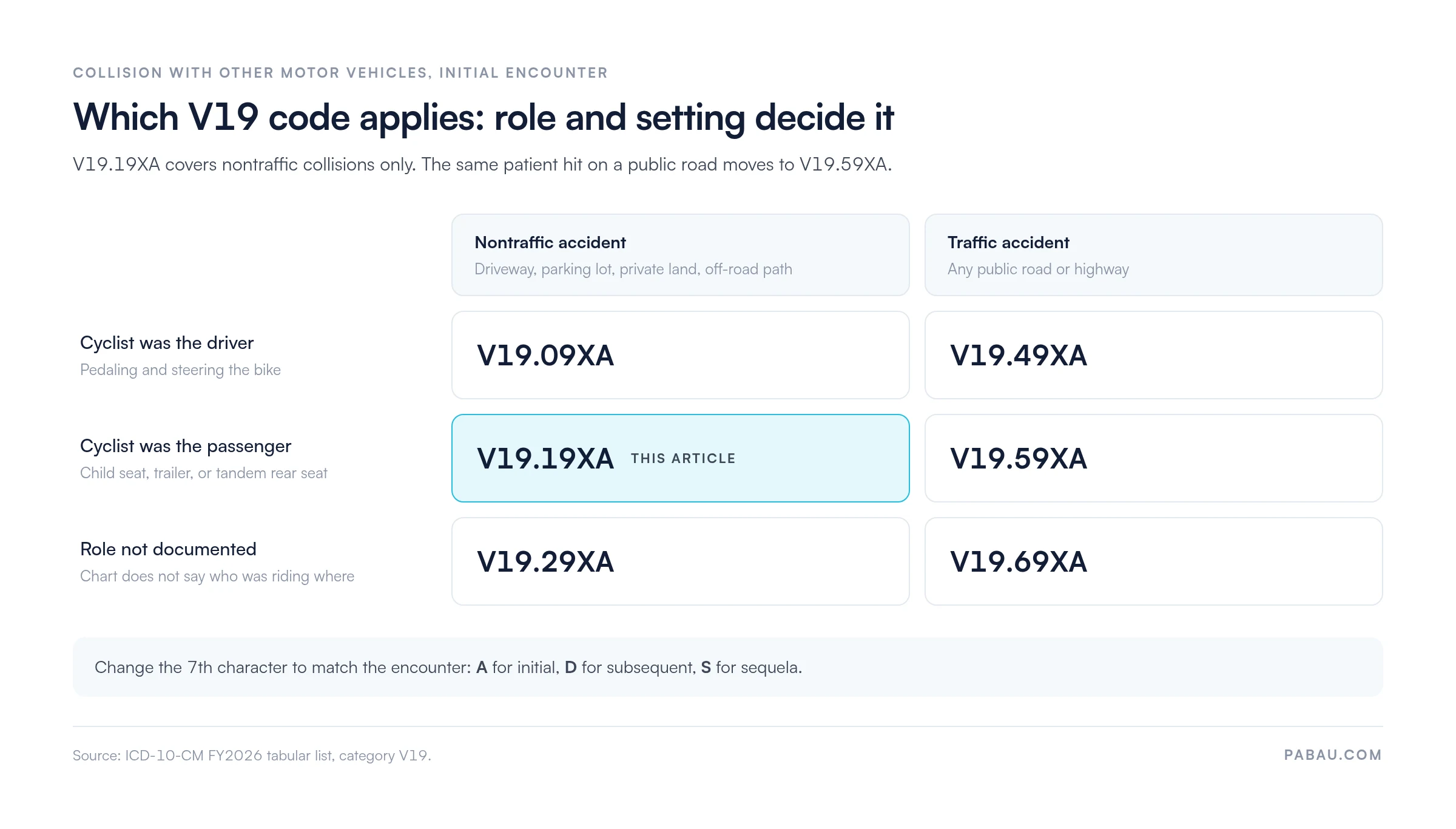
ICD-10-CM treats a traffic accident as one occurring on a public highway. A nontraffic accident happens entirely somewhere else: a driveway, a parking lot, a private road, a farm track, or a park path closed to cars.
The default matters more than most coders expect. Chapter 20 assumes a vehicle accident happened on the public highway unless the record names another place. So an undocumented location points to V19.59XA, not to V19.19XA.
Reach for V19.19XA only when the note says where the collision happened, and that place is off the public highway. “Struck by a reversing car in a supermarket parking lot” supports it. “Struck by a car while riding” does not.
V19.19XA sits within the ICD-10-CM chapter for external causes of morbidity (V00-Y99). Knowing where it falls in the hierarchy prevents mis-selection from the adjacent codes in the V19 block, which is a common source of claim errors.
The “X” placeholder in position 6 is required because the code structure mandates a 7th character but has no 6th-character subdivision here. Omitting the X, or substituting another letter, makes the code structurally invalid. The claim then fails an edit before it reaches the payer.
The 7th character defines the encounter type and decides which version of the code applies to each visit. Using A for a follow-up, or D for an initial trauma assessment, flips the encounter type and can trigger an audit.
Use V19.19XA at every visit where active treatment is being started or delivered for the acute bicycle collision injury. That includes the emergency department presentation, initial imaging, and the first specialist consultation. It is not restricted to a single visit, because the definition hinges on treatment phase rather than visit count.
Switch to V19.19XD once the treatment plan is established and the patient is returning for routine management. Physical therapy after an initial orthopedic assessment, wound checks, and follow-up imaging all qualify as subsequent encounters.
V19.19XS applies only when the patient presents with a condition caused by the original injury after that injury has healed. Chronic pain, scarring, or nerve damage coded as a sequela needs its own principal diagnosis code alongside V19.19XS.
The V19 category splits by cyclist role before it splits by collision type. Passenger codes and driver codes look nearly identical but describe different scenarios for insurers and for public health reporting. Misidentifying the role shifts the code family entirely.
A pedal cycle passenger rides as a secondary occupant: on a tandem, in a bicycle trailer, or in a child seat fitted to the bike. The driver is the person pedaling and steering. Where the chart does not state the role, use the unspecified rider codes rather than guessing.
Vehicle type narrows the choice further. A pedal cycle is human-powered, so a motorized tricycle takes the passenger out of V19 entirely. If that tricycle hit a motorcycle off the highway, the follow-up visit codes to V32.1XXD.
Coders working on bicycle collision injuries routinely cross-reference the sibling codes around V19.19XA. The AAPC ICD-10-CM code lookup and ICD List both carry the full V19 range. The table below covers the codes referenced most often alongside V19.19XA. Our ICD-10-CM code index holds the wider set of diagnosis code references.
“Other motor vehicles” means any motorized vehicle not already captured by a more specific sibling category. Cars, trucks, SUVs, motorcycles, and buses all fall under it. Where the vehicle type is documented precisely, check the wider V10-V19 range for a more granular code first.
Those vehicle types matter only as the colliding party here. The motorcycle driver’s own injuries sit in V20-V29, and sequela care after a nontraffic collision with unspecified motor vehicles takes V29.008S.
The occupants of the colliding vehicle carry their own codes. A pick-up truck or van passenger hurt in a nontraffic collision with a pedal cycle takes V51.1XXS, a sequela code.
What the cyclist hit matters as much as where the crash happened. A collision with a nonmotor vehicle leaves V19 altogether. A driver hurt that way on a public road codes to V16.4XXD at the follow-up visit.
The CMS ICD-10 codes guidance and ICD-10-CM Official Guidelines Section I.C.20 govern how external cause codes like V19.19XA are used. Five rules cover almost every question that comes up on a V19 claim.
Denials on these codes cluster tightly, which makes them easy to audit. Our guide to denial management in healthcare covers how to group rejections by root cause and work them in batches.
External cause codes in the V00-Y99 chapter are POA exempt under CMS guidance, so inpatient coders do not assign a POA indicator to V19.19XA. Outpatient coders are not subject to POA reporting at all. Trauma centers that auto-populate POA fields should confirm their software excludes external cause codes from that rule.
Five documentation elements have to be in the record before a coder can assign V19.19XA. Missing any one of them forces a downgrade to a less specific code, which affects reimbursement and raises audit risk.
Emergency physicians and trauma nurses usually capture the injury mechanism in the chief complaint or the history of present illness. It rarely lands in a formal external cause field. Read every part of the note, including nursing triage documentation, before you settle for an unspecified code.
Audit denials on V19.19XA claims by filtering your clearinghouse rejection report for codes in the V10-V19 range. Most of them cluster around three root causes. The first is the non-billable parent V19.19. The second is the initial encounter character A on a follow-up visit. The third is a nontraffic code on a crash the chart never placed off the highway. Fixing those three patterns resolves most V19-series rejections.
In most practices, a V19 claim is assembled in one system and submitted in another. The coder reads the note in the chart and keys the diagnosis into a billing tool. Checking what happened to the claim means logging into a clearinghouse portal. Rejections surface days later, with no link back to the note that caused them.
Practice management software like Pabau keeps those steps in one place. Our medical claims management connects to Claim.MD. US practices submit electronically to thousands of payers, run real-time eligibility checks, and post ERA remittances without leaving the system.
Pabau also runs a background check on every claim before you send it. It confirms that required details like membership numbers and authorization codes are filled in. Each claim then moves through clear stages, from Pending to Submitted, Processing, Paid, or Error. When a V19 claim errors, you can see it the same day and fix the documentation while the encounter is fresh.
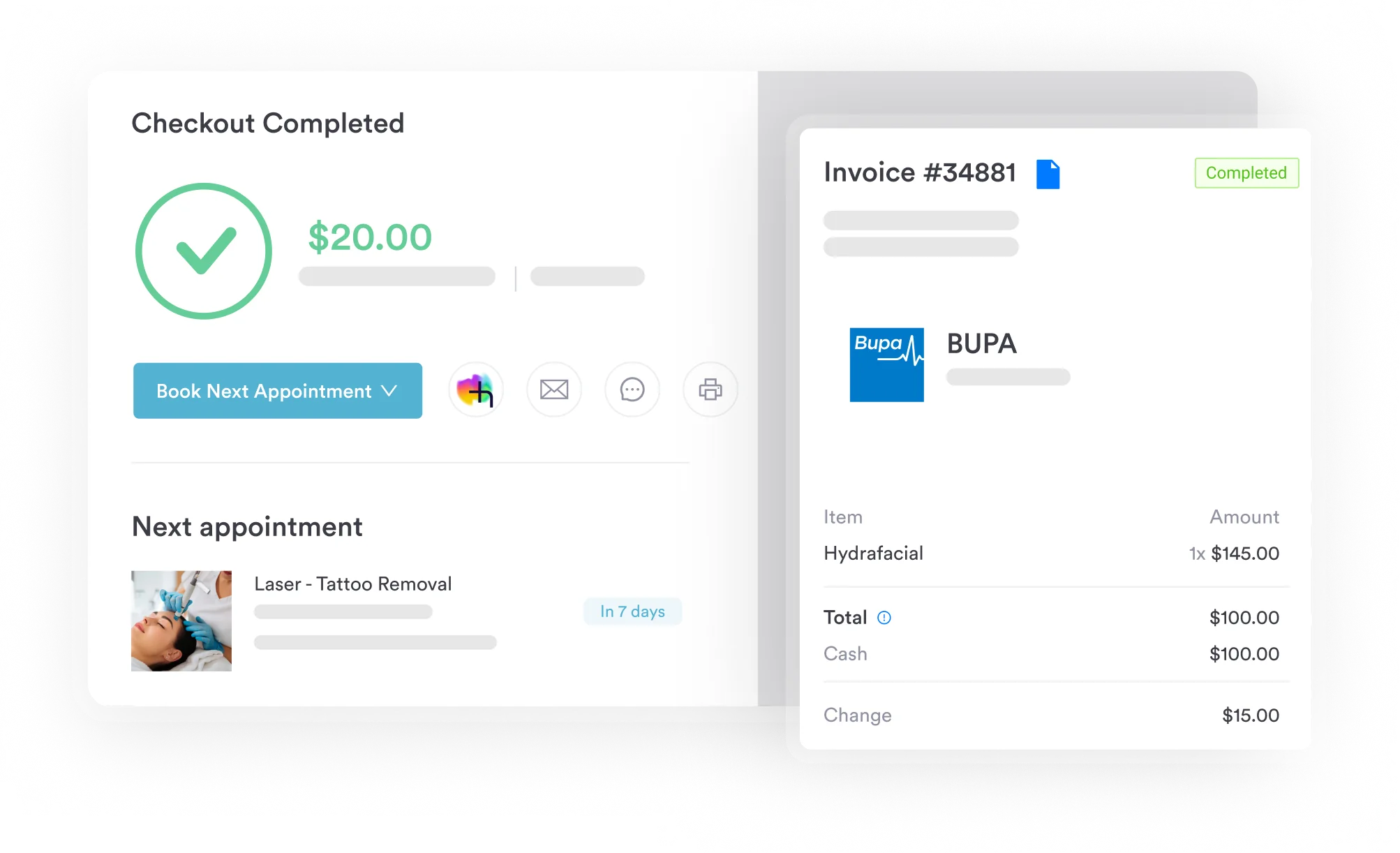

Pabau connects to Claim.MD for US practices. Submit claims electronically, run real-time eligibility checks, track every claim by stage, and post ERA remittances from one dashboard.

V19.19XA is a code you should reach for less often than its popularity suggests. Because ICD-10-CM assumes a public highway unless the note says otherwise, most bicycle collision charts point to V19.59XA. V19.19XA is correct only when someone wrote down where the crash happened.
That makes this a documentation problem rather than a coding one. One line in the triage note naming the parking lot, the driveway, or the private path decides the code. It also decides the claim, and whether the encounter gets paid on the first pass.
Ask your clinical team for that line, and give your billers a system that shows them a rejection the same week it happens. Book a demo to see how Pabau handles external cause claims from charge entry through to ERA reconciliation.

Need guidance on trauma billing compliance? Medical billing compliance covers the documentation and submission standards that govern external cause codes.
Looking to reduce claim denials across your practice? Denial management in healthcare outlines systematic approaches to identifying and resolving recurring denial patterns.
Want to understand how clearinghouses process ICD-10 claims? Our medical claims clearinghouse guide explains how claims are validated and routed to payers.
ICD-10 Code V19.19XA is a billable ICD-10-CM diagnosis code. It covers a pedal cycle passenger injured in collision with other motor vehicles in nontraffic accident, initial encounter, and is valid for FY2026 claim submissions.
Yes. V19.19XA is a billable ICD-10-CM code valid for HIPAA-covered transactions from October 1, 2025 through September 30, 2026. Its parent, V19.19, is not billable without the 7th character and should never be submitted to payers.
No. V19.19XA covers collisions in nontraffic accidents only, meaning a driveway, parking lot, private road, or off-road path. A collision on a public highway is coded V19.59XA. ICD-10-CM assumes a public highway unless the record names another place.
The 7th character defines the encounter type. A is the initial encounter, during active treatment. D is a subsequent encounter, for routine follow-up once treatment is established. S is a sequela, for late effects after the acute injury resolves. Pick the character that matches the stage of care, not the visit number.
The driver is the person controlling and pedaling the bicycle. The passenger is a secondary occupant, such as a child in a seat or a rider on a tandem. Driver codes fall in V19.00-V19.09 for nontraffic accidents; passenger codes fall in V19.10-V19.19. Where the chart does not state the role, use the unspecified rider codes V19.20-V19.29.
Assign the external cause code as a secondary code, paired with a principal diagnosis describing the injury sustained. Before choosing V19.19XA, confirm the chart documents the patient as a passenger and the vehicle as a pedal cycle. The note must also name a motor vehicle as the collision party, and place the crash off the public highway.
Per ICD-10-CM Official Guidelines Section I.C.20, external cause codes are always secondary codes and never principal diagnoses. V19.19XA is POA exempt for inpatient claims. Pair it with activity (Y93.-) and status (Y99.-) codes where documentation supports them, and report the right 7th character at every encounter in the episode.