

ICD-10 code S61.201A: Open wound of left index finger without nail damage
ICD-10 code S61.201A covers a left index finger wound of unstated type ICD-10 co...

Last Updated: Oct 16, 2026
Billable Code Specific Code
V00.02XD is the billable ICD-10-CM code for pedestrian on foot injured in collision with skateboarder, subsequent encounter.
It sits in the external cause chapter (V00–Y99) and is valid for reimbursement as of the 2026 edition, which became effective October 1, 2025. The code is commonly confused with its siblings V00.02XA (initial encounter) and V00.02XS (sequela). The 7th character is the only differentiator, and selecting the wrong one triggers claim denials.
Let Pabau's smart automation suggest the right codes, reduce claim denials, and keep your practice compliant—effortlessly.
Automate repetitive tasks and focus on what matters most—your patients.
Reduce coding errors and ensure compliance with the latest regulations.
Clean claims, fewer denials, and faster reimbursements.
Powerful insights and reporting to help your practice thrive.
HIPAA compliant SOC 2 certified GDPR-compliant Trusted by 4,000+ clinics worldwide

V00.02XD is billable for the 2026 ICD-10-CM edition (effective October 1, 2025), valid for claim submission
The 7th character D signals subsequent encounter: Routine care after the active treatment phase is complete
External cause codes like V00.02XD must be assigned alongside the injury diagnosis code, not in isolation
Pabau’s claims management software supports ICD-10 code entry and electronic claim submission for subsequent-encounter codes
ICD-10 code V00.02XD is the 2026 ICD-10-CM diagnosis code for a pedestrian on foot injured in collision with a skateboarder, subsequent encounter. No motor vehicle is involved. The injured party is walking, and the other party is riding a skateboard.
Reverse the roles and the category changes. A skateboarder struck by a pedal cycle takes V01.92XD at follow-up, when the chart does not say whether traffic was involved. V00.02XD stays with the pedestrian on foot.
The code is classified as billable and specific, so it goes on a claim without a more detailed sub-code beneath it. It belongs to the ICD-10-CM external cause chapter, which spans V00 through Y99 and captures the circumstances of an injury rather than the injury itself.
Because V00.02XD is an external cause code, it describes the mechanism and setting of an injury. It does not stand alone on a claim. Coders must also assign the injury diagnosis code, covering the tissue damage, fracture, or contusion.
A place-of-occurrence code is added where documentation supports it. Omitting the primary injury code and submitting only V00.02XD is a common source of denials.
The 7th character D indicates a subsequent encounter. The patient is receiving routine care during the healing or recovery phase, after active treatment of the injury has been completed. This is the most commonly misapplied character in the V00 family.
The CMS ICD-10-CM Official Guidelines for Coding and Reporting define subsequent encounter as any visit after the patient has received active treatment. “Active treatment” means the encounter at which the injury was first managed. That covers the emergency department visit, the urgent care visit, or the outpatient appointment where the physician first treated the injury.
Every follow-up visit after that point uses 7th character D. That includes wound checks, cast changes, physical therapy coordination, and medication adjustments made during recovery.
Decision rule: Ask whether the patient is still in the active treatment phase. If the answer is yes, character A is correct. If the answer is no but the injury is still healing, character D is correct. If the injury has healed and left a lasting complication, character S applies.
The choice between D and S trips up many coders. A patient who returns for a residual condition after full healing needs S, and a patient who is still healing needs D.
The parent-code chain shows how ICD-10-CM narrows from a whole chapter down to one billable code. It matters most when documentation is incomplete and a less-specific code is the only defensible choice.
The X in the 6th position is a placeholder character. ICD-10-CM requires the 7th character to identify encounter type for all V00 codes. The X fills the 6th position so that character can be assigned. Never omit the X or submit V00.02D as a shorthand, because claims systems reject codes that skip a required placeholder. The breakdown below maps each segment of the code to what it reports.
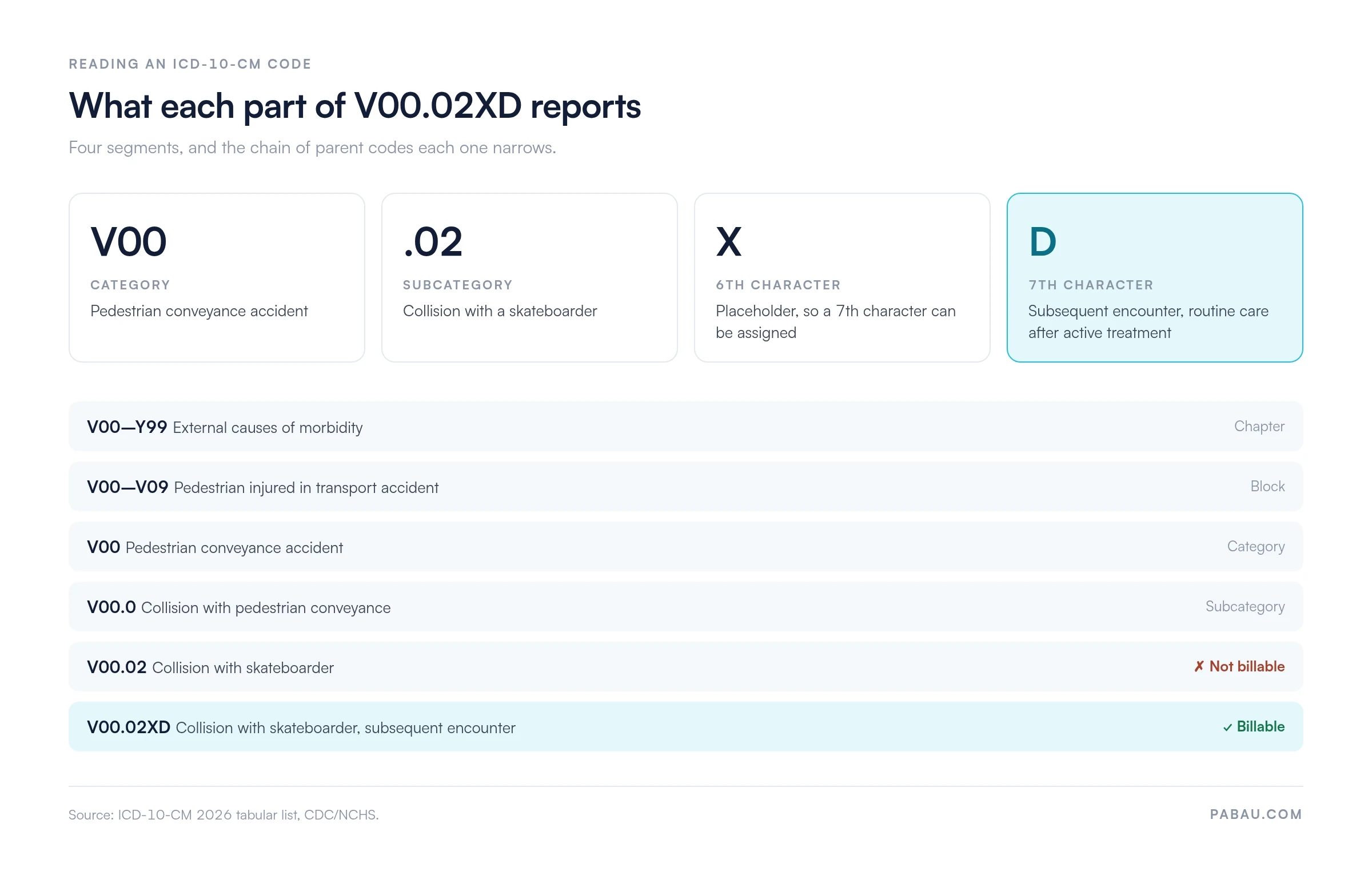
Verify the full hierarchy using the CDC/NCHS ICD-10-CM official web tool, which reflects the current edition’s tabular list and index entries.
When reviewing a chart, coders often have to choose between adjacent codes in the V00.0 subcategory. The table below covers the codes most commonly referenced alongside V00.02XD.
Every code in that table stays inside V00, the category for collisions with pedestrian conveyances. An animal-drawn vehicle, a ridden animal or a nonpowered streetcar is a nonmotor vehicle, which puts that collision in V06. Use V06.90XA at the initial encounter when the record leaves traffic status unspecified.
The AAPC Codify ICD-10-CM lookup lists the full sibling set for V00.02 side by side. That helps when a chart note names the conveyance but not the encounter type.
External cause coding rules for V00.02XD are governed by Section I.C.20 of the ICD-10-CM Official Guidelines for Coding and Reporting. Five rules decide how a subsequent-encounter visit is reported:
Common denial trigger: Using V00.02XD on a claim where the injury diagnosis code is absent. Claims reviewers sometimes see the external cause code submitted alone, with no corresponding fracture, contusion, or soft-tissue injury code. Always pair V00.02XD with the primary diagnosis.
A payer that rejects the pairing sends back a reason code rather than an explanation. The list of denial codes in billing translates each one, so the billing team can see whether sequencing or documentation caused the rejection.
Submitting a clean claim for a subsequent-encounter visit also requires the medical record to document that active treatment has concluded. If the note does not clearly distinguish follow-up from ongoing active management, a payer may reclassify the encounter as initial. The D character is then flagged as incorrect.
ICD-10-CM publishes no formal inclusion terms for V00.02XD at the 7th-character level. The plain-language descriptions below are accepted as equivalent when they appear in clinical documentation:
These descriptions are not official inclusion terms. They represent documentation language that maps to V00.02XD once a coder applies the index lookup and the 7th-character rules. The authoritative lookup remains the CDC/NCHS ICD-10-CM web tool.
Document the transition from active treatment to subsequent encounter in the patient record explicitly. Write it as ‘follow-up for injury sustained in a collision with a skateboarder on [date], initial treatment completed at [facility]’. That single line gives auditors and payers what they need to confirm the D character, and it heads off avoidable denials.
Pabau is practice management software built for practices handling injury follow-up visits and outpatient rehabilitation. Its integrated ICD-10 code library lets practitioners search by keyword or code number, then select V00.02XD or one of its siblings inside the patient record. Nobody retypes the code between systems, because it travels from the clinical note into the claim.
For subsequent-encounter tracking, Pabau’s claims management software links encounter type to claim generation. Coders working with codes like V00.02XD tag the visit as a follow-up, and the correct 7th-character logic carries forward into the billing workflow.
Claims are then submitted electronically through Claim.MD, Pabau’s US clearinghouse partner. It supports CMS-1500 and 837P submissions across thousands of US payers.

When a claim comes back denied, Pabau shows the remittance advice next to the original claim, so coders spend less time hunting for the error. That closed loop between documentation and payment reconciliation cuts the rework cycle on external cause code denials.

Pabau connects clinical documentation to claim submission in one workflow. Search ICD-10 codes, assign the correct encounter type, and submit electronically through Claim.MD without switching systems.

For injury codes like V00.02XD, build a standard subsequent-encounter documentation template. It should capture the date active treatment ended, the name of the treating provider, and the current healing status. Those three data points answer every common payer audit question about the D character.
V00.02XD covers a pedestrian on foot injured in collision with a skateboarder, seen at a follow-up visit. The description is specific, the billable status is confirmed for the 2026 edition, and the 7th-character rules are clear. D is for routine care after active treatment, not for the first visit or for residual conditions after healing.
Getting that distinction right on every claim prevents the most common denial pattern for this code family. Pair the code with the injury diagnosis, and write the note so a payer can see that active treatment has ended. Book a demo to see how Pabau keeps encounter type, documentation, and claim submission in step for injury follow-up visits.

Need guidance on how ICD-10 claims flow through a clearinghouse? Medical claims clearinghouse overview explains how electronic submissions reach payers and what happens at each step.
Want to understand how denial codes map to coding errors? Denial codes in medical billing covers the most common CARC codes and how to resolve them.
Looking for a superbill format that supports external cause codes? Superbill guide covers how to structure superbills to capture all required diagnosis and external cause codes for clean claim submission.
ICD-10 code V00.02XD is a billable ICD-10-CM diagnosis code for a pedestrian on foot injured in collision with a skateboarder, subsequent encounter. It is valid for reimbursement in the 2026 ICD-10-CM edition, effective October 1, 2025, and belongs to the external cause chapter (V00-Y99).
Yes, V00.02XD is a billable and valid ICD-10-CM code for the 2026 edition. It can be submitted on a claim for reimbursement purposes. As an external cause code, it must be sequenced after the primary injury diagnosis code, not listed first on the claim.
V00.02XA is used for the initial encounter, when active treatment of the collision injury is provided. V00.02XD is used for subsequent encounters, when the patient is receiving routine care during the healing or recovery phase after active treatment is complete. The only difference is the 7th character: A for initial, D for subsequent.
The 7th character D in ICD-10-CM means subsequent encounter. The patient is receiving routine care during the healing phase, after active treatment of the injury or condition has been completed. It applies to all follow-up visits after initial treatment, including cast changes, wound checks, and rehab referrals.
V00.02 takes three 7th character options. A is the initial encounter, used when active treatment is provided. D is the subsequent encounter, used for routine care during recovery. S is the sequela, used for late effects after the original injury has healed. All three form billable codes: V00.02XA, V00.02XD, and V00.02XS.
The parent code for V00.02XD is V00.02, which describes a pedestrian on foot injured in collision with a skateboarder. V00.02 is not billable on its own; one of its 7th-character extensions (XA, XD, or XS) must be selected to create a valid, billable code.



