ICD-10 code S61.201A: Open wound of left index finger without nail damage
ICD-10 code S61.201A covers a left index finger wound of unstated type ICD-10 co...

Last Updated: Oct 16, 2026
Billable Code Specific Code
T86.99 is the billable ICD-10-CM code for other complications of unspecified transplanted organ and tissue.
Let Pabau's smart automation suggest the right codes, reduce claim denials, and keep your practice compliant—effortlessly.
Automate repetitive tasks and focus on what matters most—your patients.
Reduce coding errors and ensure compliance with the latest regulations.
Clean claims, fewer denials, and faster reimbursements.
Powerful insights and reporting to help your practice thrive.
HIPAA compliant SOC 2 certified GDPR-compliant Trusted by 4,000+ clinics worldwide

T86.99 is a billable ICD-10-CM code for other complications of unspecified transplanted organ and tissue. It is valid for FY2026, from October 1, 2025 through September 30, 2026.
Use T86.99 only when the transplanted organ or tissue type is not documented. If the organ is named, a more precise T86 sibling code applies.
T86.99 differs from T86.898, which covers a named tissue that has no dedicated T86 subcategory. T86.899 is not the parallel code. That one means an unspecified complication of other transplanted tissue.
Practice management software like Pabau connects ICD-10 code selection to claim submission, so transplant coding errors surface before the claim goes out.
T86.99 is not POA-exempt, which means inpatient claims require a Present on Admission indicator. Confirm the current CMS POA exempt code list before submission, as most complication codes carry this requirement.
T86.99 applies when a transplant patient presents with a complication and the documentation does not identify which organ or tissue was transplanted. The code sits within Category T86, which covers all complications of transplanted organs and tissues under Chapter 19 of ICD-10-CM.
Three conditions must all be true for T86.99 to be the correct code:
The “other complications” qualifier in the description means the complication does not fall into the rejection or failure subcategories already enumerated in T86. Rejection codes (e.g., T86.11 for kidney transplant rejection) and failure codes (e.g., T86.12 for kidney transplant failure) are more specific. T86.99 covers the remaining complications, for an unspecified organ.
Understanding the parent-child structure helps coders confirm they are at the right level of specificity. The CDC/NCHS ICD-10-CM web tool allows coders to navigate the full hierarchical path from chapter to individual code. For T86.99, the path is:
T86.9 is the non-billable parent subcategory. Coders must always reach the fifth character for a billable, submittable code. The T86.9 family splits five ways:
Our ICD-10-CM code library covers the neighboring diagnosis codes a transplant encounter often needs alongside T86.
The T86 category has organ-specific subcategories for the most commonly transplanted organs. When the organ is identified in the documentation, coders should always select the organ-specific code rather than defaulting to T86.99. The AAPC Codify ICD-10-CM lookup provides the complete T86 code range for cross-reference.
If a transplanted organ is named anywhere in the encounter documentation, the organ-specific subcategory applies. T86.99 is reserved for records where the organ type was never written down and a provider query cannot recover it.
Heart-lung transplants show how that rule plays out. When the graft is documented and the complication sits outside rejection, failure, and infection, the encounter belongs in T86.39. The same split applies to bone marrow, where a named complication outside those three takes T86.09.
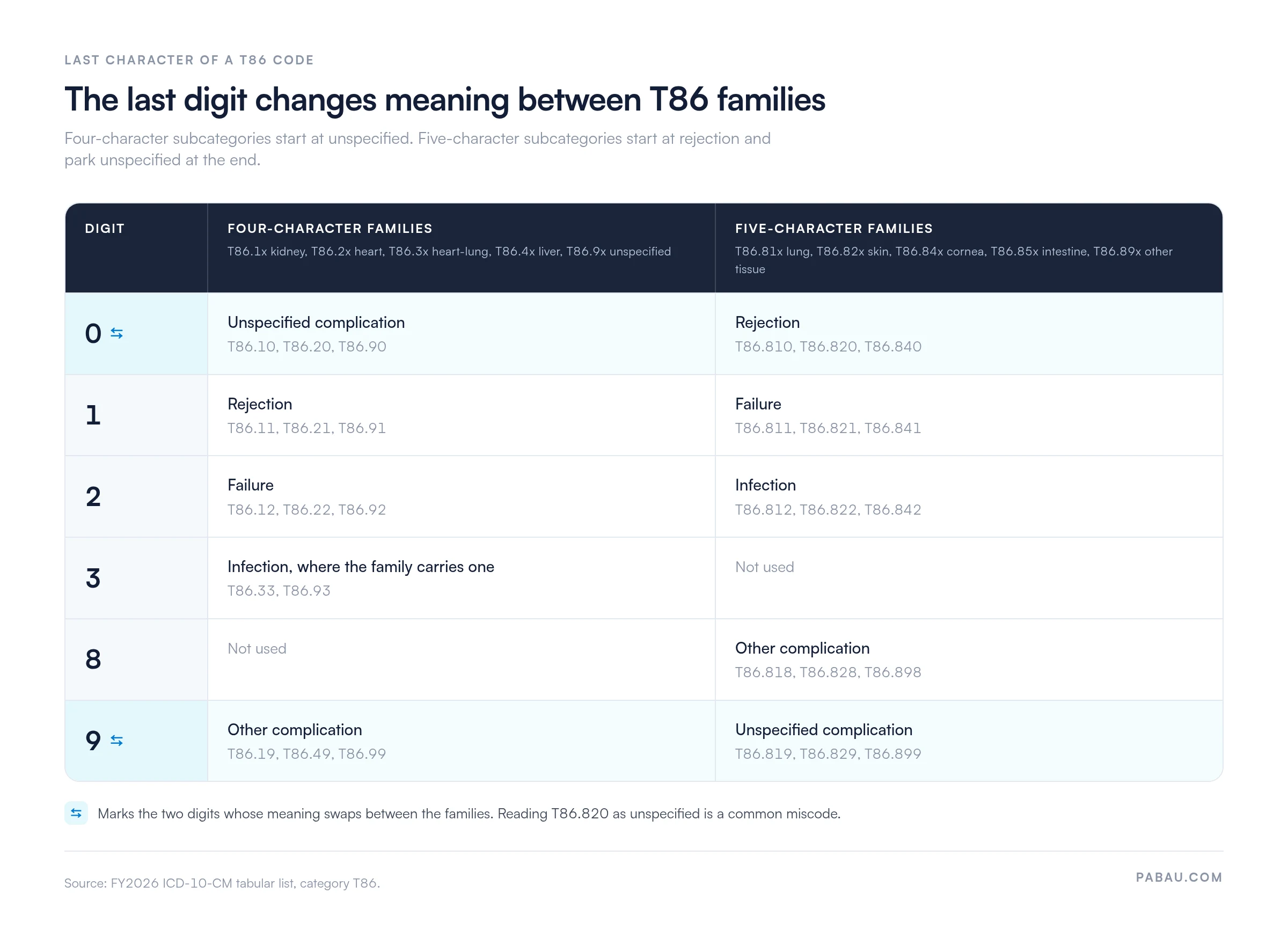
Two traps sit inside this table. T86.3x is not the lung code, because it covers heart-lung transplant complications. A lung-only complication belongs in T86.81x instead. The fifth character also flips meaning between the shorter and longer families.
In the four-character subcategories such as T86.1x, the 0 means unspecified and the 9 means other. In the five-character families such as T86.81x and T86.82x, the 0 means rejection, the 8 means other, and the 9 means unspecified. Reading T86.820 as an unspecified skin graft complication is a common miscode. That code means skin graft rejection.
The decoder below sets both patterns side by side, with the two digits that swap meaning marked.
This is the most common point of confusion in the T86 category. Both codes cover other complications. They differ on one dimension, which is whether the transplanted organ or tissue is named.
The practical test is what the note names. If the provider writes “pancreas transplant complication,” T86.898 applies, because the tissue is named and has no subcategory of its own. If the note says “transplant complication” with no organ or tissue named, T86.99 applies.
Within T86.89x, the named complication picks the sixth character. A pancreas graft documented as failed is coded to T86.891, not T86.898.
One more distinction saves a rejected claim. T86.899 is not the parallel of T86.99, because it means an unspecified complication of other transplanted tissue. The code that lines up with T86.899 is T86.90. Query the provider before assigning T86.99, since medical billing compliance expects the highest specificity the documentation supports.
This distinction trips up clinicians and coders alike. Z94 codes and T86 codes apply to very different clinical scenarios. Using one when the other is correct changes what the claim tells the payer.
Z94 codes represent transplant status. The patient has a functioning graft, and no complication is active at the current encounter. For example, Z94.0 (kidney transplant status) means the patient has a transplanted kidney that is working without documented complications. These codes sit in Chapter 21 (Factors influencing health status) and are used as secondary or additional codes.
T86 codes represent active transplant complications: rejection, failure, infection, or other complications that are the reason for the encounter or a significant condition affecting care. T86.99 falls here. According to the WHO ICD-10 browser, this structural separation between status and complication codes reflects a consistent international classification principle.
The ICD-10-CM Official Guidelines for Coding and Reporting allow Z94 and T86 codes on the same claim. That happens when a patient with a transplant history develops a new complication. The T86 code captures the active problem, and Z94 records the background status.
Payers expect provider documentation to support every diagnosis code submitted on a claim. For T86.99, four elements must be present in the note to withstand audit review. Each one has to be legible in what the provider wrote, not inferred from the encounter.
Documentation that is complete at the point of care keeps the billing cycle moving. Retroactive provider queries delay claim submission and increase the risk of timely filing denials.
T86.99 is valid for submission on both professional (CMS-1500) and institutional (UB-04) claim forms. Practices submitting ICD-10 codes electronically should verify their clearinghouse supports the current FY2026 code set.
Practice management software like Pabau submits electronic claims through Claim.MD, our US clearinghouse partner, which reaches thousands of US payers. Claim.MD validates ICD-10-CM codes against the current CMS tabular list before submission.
T86.99 also has to be sequenced correctly relative to the other diagnosis codes on the claim. When the complication is the reason for the encounter, T86.99 is the principal diagnosis. When it is a coexisting condition affecting care, it sequences as an additional code.
The ResDAC guide to ICD codes in Medicare files provides useful context on how diagnosis codes are read in claims data downstream.
On inpatient claims, the POA indicator is required since T86.99 is not on the CMS POA exemption list. A clearinghouse that validates POA indicators before transmission cuts the risk of inpatient rejections on this point. Remittance advice is worth reading once the claim is paid, since T86.99 adjustment reason codes expose payer-specific denial patterns early.
Before submitting a claim with T86.99, run a provider query if the patient record references a specific organ transplant. Check the surgical history, the medication list, and prior encounter notes. Defaulting to the unspecified code when the organ is documented elsewhere is a leading cause of T86-category audit findings.
CDI specialists and coding auditors see the same errors repeat across T86.99 submissions. Each one is preventable at the point of coding.
Proactive CDI review of transplant complication documentation catches these errors early. Running code selection through claims software for coders makes the step visible at billing rather than at audit.
In most practices the coder meets the note long after the visit has ended. The organ is missing, the provider has moved on, and the query goes out days later. The claim waits, and T86.99 starts to look like the quickest way to close it.
Pabau keeps the code next to the record it came from. Clinical notes, the diagnosis code, and the invoice sit on one patient timeline. A coder can check whether the organ was documented anywhere before settling for an unspecified code. Claim.MD validation then runs against the current CMS tabular list before the claim is transmitted.
The outcome is fewer unspecified codes leaving the practice, and fewer transplant complication claims coming back for documentation review. Your team spends its time on the notes that genuinely lack an organ. The rest get coded to the organ the provider already named.


Pabau connects ICD-10-CM code selection directly to claim generation, with Claim.MD clearinghouse integration reaching thousands of US payers. Missing organ documentation gets caught before submission rather than at audit.

T86.99 is a legitimate code with a narrow use case. It fits an active transplant complication where the organ is genuinely unspecified. The most expensive mistake is reaching for it as a default when the organ is documented elsewhere in the record. That turns a billable claim into an audit risk.
Pabau keeps ICD-10-CM code selection tied to clinical documentation, so what the provider wrote and what the coder submits stay closer together. That is where transplant complication coding is won or lost. To see how it works alongside your existing billing process, book a demo with our team.

Need to understand how clean claims reduce T86 denials? Clean claim standards in medical billing explains the requirements a claim must meet before a payer will process it without suspension.
Working through a transplant-related denial? Denial codes in medical billing covers the most common CARC and RARC codes that appear on transplant complication claim remittances.
Want to see how eligibility verification reduces T86.99 sequencing errors? Insurance eligibility verification explains how real-time payer checks surface coverage rules before the claim is submitted.
T86.99 is a billable ICD-10-CM diagnosis code for other complications of unspecified transplanted organ and tissue. It applies when a transplant patient has a documented complication other than rejection or failure. The documentation must also leave the transplanted organ or tissue unidentified. The code is valid for FY2026 (October 1, 2025 through September 30, 2026) and can be submitted on both CMS-1500 and UB-04 claim forms.
Yes. T86.99 is a billable, specific ICD-10-CM code valid for submission on HIPAA-covered transactions. It is billable for FY2026 and can be used on both professional (CMS-1500) and institutional (UB-04) claim forms.
T86.99 applies when the transplanted organ or tissue is unspecified or unknown. T86.898 applies when the tissue is named but has no dedicated T86 subcategory, such as a pancreas transplant. Do not confuse T86.898 with T86.899, which means an unspecified complication of other transplanted tissue.
T86.99 should be used only when the provider documentation does not identify the transplanted organ and a provider query cannot resolve it. If kidney, heart, liver, lung, bone marrow, skin, or cornea is documented anywhere in the record, the corresponding organ-specific T86 subcategory applies instead.
Z94 codes indicate transplant status without an active complication. T86 codes indicate active complications of a transplanted organ or tissue. A patient with a functioning kidney transplant attending a routine follow-up visit uses Z94.0. At a later encounter with a transplant complication, the same patient takes a T86 code. Z94.0 usually rides along as a secondary code for the transplant history.
Yes. T86.99 became effective on October 1, 2025 and is valid through September 30, 2026. The FY2026 ICD-10-CM edition and the CMS FY2026 code files both confirm it.