ICD-10 Code S42.444P: Medial epicondyle fracture, right humerus
ICD-10 Code S42.444P: full descriptor and code validity ICD-10 Code S42.444P car...

Last Updated: Oct 13, 2026
Billable Code Specific Code
T86.19 is the billable ICD-10-CM code for other complication of kidney transplant.
It applies when the physician names a post-transplant complication that is not rejection, infection, or graft failure. Those three carry their own codes: T86.11, T86.12, and T86.13. Report Z94.0 alongside T86.19 to record the patient's kidney transplant status.
Let Pabau's smart automation suggest the right codes, reduce claim denials, and keep your practice compliant—effortlessly.
Automate repetitive tasks and focus on what matters most—your patients.
Reduce coding errors and ensure compliance with the latest regulations.
Clean claims, fewer denials, and faster reimbursements.
Powerful insights and reporting to help your practice thrive.
HIPAA compliant SOC 2 certified GDPR-compliant Trusted by 4,000+ clinics worldwide

ICD-10 Code T86.19 covers other complications of kidney transplant not elsewhere classified, effective October 1, 2025 for the 2026 ICD-10-CM edition.
T86.19 is a billable, specific code. Use it only when the complication is documented but does not qualify as rejection (T86.11), infection (T86.12), or failure (T86.13).
Z94.0 (kidney transplant status) is the standard companion code. CKD stage codes and causative organism codes may also apply depending on documentation.
Practice management software like Pabau tracks T86.1x denials by code, so a missing companion code surfaces before you resubmit.
ICD-10 Code T86.19 is the billable ICD-10-CM diagnosis code for “other complication of kidney transplant.” It covers documented post-transplant complications that fall outside the named subcodes for rejection, infection, and failure.
According to the CDC/NCHS ICD-10-CM tool, T86.19 is valid for reimbursement in the 2026 ICD-10-CM edition, effective October 1, 2025. It belongs to category T86 (Complications of transplanted organs and tissue). Within that category it sits in the T86.1x subcategory, which is reserved for kidney transplant complications.
The “other” designation follows standard ICD-10-CM convention. Within a subcategory, the residual “other” code carries the clinical scenarios the classification does not name explicitly. For a kidney transplant that includes transplant-associated nephropathy, post-transplant lymphoproliferative disorder in the allograft, and calcineurin inhibitor nephrotoxicity.
Each of those still needs the physician to name the complication. The note must also leave rejection, infection, and failure aside as the primary mechanism.
T86.19 sits at the end of the T86.1x subcategory, which covers complications of kidney transplant under the broader T86 category. Placing T86.19 against its siblings is the most practical step a coder can take before assigning it.
The table below maps every T86.1x sibling, adapted from the AAPC ICD-10-CM code lookup. Match the physician’s wording to the row that describes it. Each sibling also has its own page in our diagnostic code library.
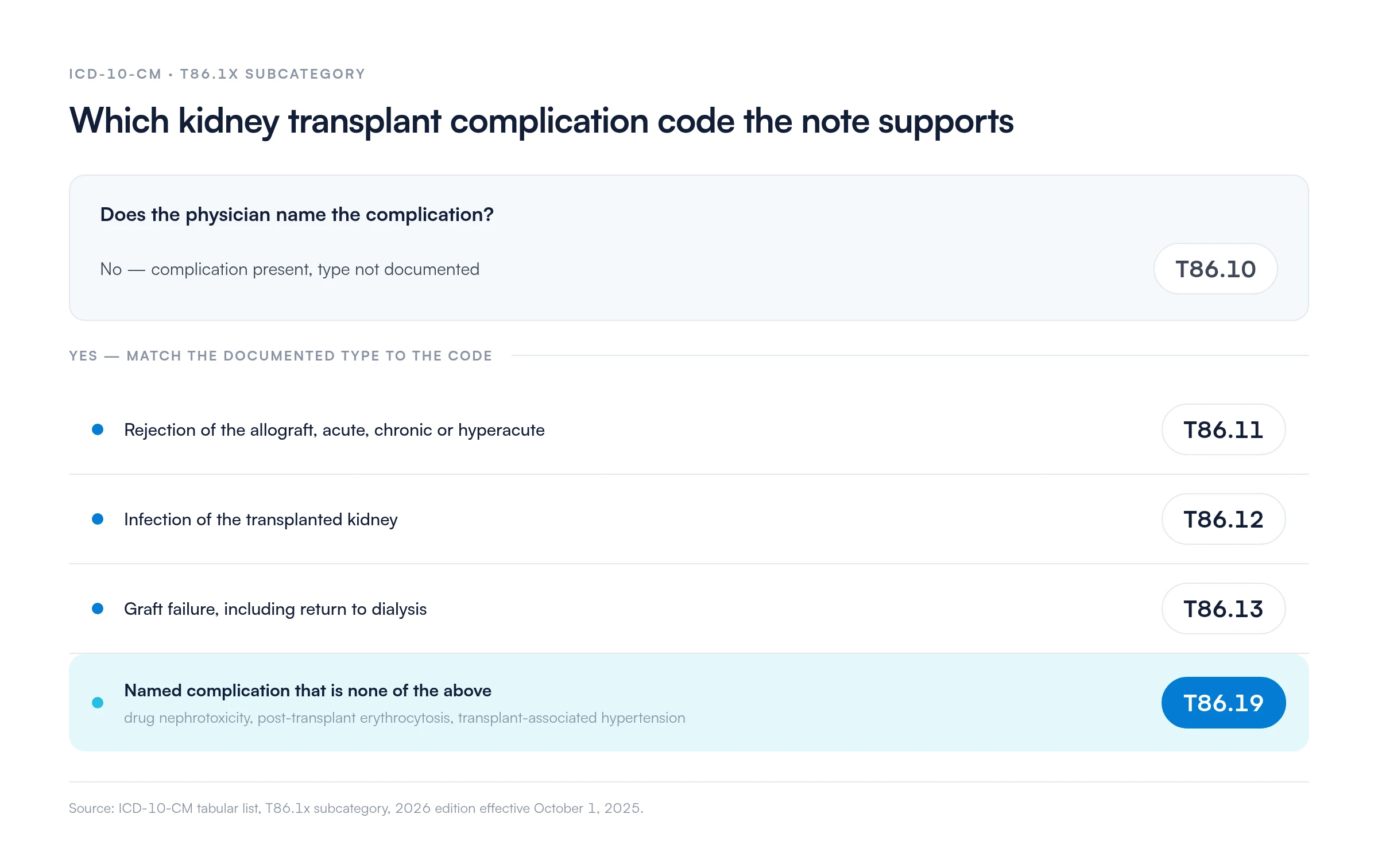
The key distinction is specificity vs. residual category. T86.10 (unspecified) is for cases where the physician acknowledges a complication exists but does not document its nature. T86.19 (other) is for cases where the physician has named the complication, but that complication does not fit rejection, infection, or failure.
T86.11 requires documented rejection, supported by biopsy findings or clinical criteria consistent with immune-mediated graft injury. T86.12 requires documented infection of the transplanted organ, with the causative organism coded additionally when identified. T86.13 applies when the graft has failed, often evidenced by return to dialysis or listing for re-transplant.
T86.19 carries the named complications the subcategory does not list separately. Immunosuppressant nephrotoxicity, post-transplant erythrocytosis, and allograft-associated hypertension all belong here once the physician documents them as complications of the graft. Primary non-function lands here too, where the graft never worked but the note avoids the word failure.
Once the note names failure, the correct code is T86.12, the ICD-10-CM entry for kidney transplant failure.
A query to the physician settles the ambiguous notes. The chart below walks the same decision in the order a coder meets it.
ICD-10 Code T86.19 requires physician documentation that does two jobs. The note must name the complication and tie it causally to the transplanted kidney.
The CMS ICD-10-CM coding guidelines are clear that coders may not infer specificity. If the record states only “kidney transplant complication,” T86.10 is the correct assignment. T86.19 is appropriate only when the complication is named.
When documentation is incomplete, CDI specialists should query the attending or transplant nephrologist. Queries should ask for the specific nature of the complication and whether rejection, infection, or graft failure is implicated. Adding this step before claim submission substantially reduces the risk of a denial based on lack of specificity.
T86.19 rarely stands alone. The ICD-10-CM guidelines for transplant complications direct coders to add companion codes that complete the clinical picture. The codes below are the ones that apply most often.
For claims submitted to US payers, Pabau, our practice management software, connects to the Claim.MD clearinghouse. That connection supports electronic remittance and eligibility checks across thousands of US payers. Checking eligibility before submission and reading the remittance afterwards surfaces the companion codes a particular payer expects. That remittance often shows whether a companion code decided payment or denial.
Three patterns account for most of the preventable errors on T86.19 claims. Each one responds to the approach set out in our guide to denial management strategies. Find the pattern, trace it to the root cause, then fix the upstream process rather than reworking claims one by one.
Coding accuracy on T86.19 protects revenue as much as it satisfies compliance. Denied claims need rework and resubmission, and an appeal consumes far more staff time than a pre-submission query.
The ICD-10-CM Official Guidelines for Coding and Reporting, co-published by CMS and CDC, address transplant complications in the injury and external cause chapter. The core principle is narrow.
A complication of a transplanted organ is coded only when the physician documents the complication and its relationship to that organ. A condition that merely occurs in a transplant patient is not automatically a transplant complication.
Verify the current wording of any T86.1x code against the CDC/NCHS ICD-10-CM tool before you submit. The tabular entry confirms billable status and shows the Excludes notes sitting above the subcategory.
Coding teams can build the Z94.0 check into the claims software billers use. A T86.19 claim missing its companion code then gets flagged before submission. Catching it there costs a minute of a coder’s time, while catching it after a denial costs an appeal.

Run a monthly report on T86.1x denials and filter by denial code. If most of them cite missing specificity or a missing companion code, the fix sits upstream. Work with the transplant team on documentation before you build another appeals workflow. One pattern caught across ten claims beats ten claims reworked one by one.
Transplant complication denials are often tracked in a spreadsheet rebuilt from remittance PDFs each month. The code that failed, the companion code that was missing, and the resubmission date sit in three separate places. The pattern surfaces only once the quarter closes.
Pabau keeps coding, claim submission, and remittance against the same patient record. Claims go out through the Claim.MD clearinghouse, and the remittance comes back against the encounter it belongs to. T86.19 denials can then be listed by code rather than hunted invoice by invoice.
Your billers see which companion code was missing on each denied claim. The documentation conversation with the transplant team then starts from a list of specific encounters.

Pabau’s claims management software connects to the Claim.MD clearinghouse and tracks denials by code. A missing companion code surfaces before the claim goes out.

T86.19 is the right assignment only when the physician names the complication and ties it to the graft. Where that sentence is missing from the note, the code is T86.10, whatever the clinical picture suggests.
Practices seeing repeated T86.19 denials should audit the three errors above before appealing another claim. A query template agreed with the transplant nephrologist resolves more of them than any change to the billing workflow. Book a demo to see how Pabau tracks T86.1x denials by code for your billing team.

Need a broader overview of transplant-related billing? What is medical billing explains the end-to-end claim lifecycle from encounter to payment posting.
Seeing high denial rates on complication codes? Denial management in healthcare covers how to categorize, track, and resolve denial patterns systematically.
Want to verify RCM metrics across your transplant coding team? What is revenue cycle management outlines the key performance indicators practices use to measure billing health.
ICD-10 Code T86.19 is a billable ICD-10-CM diagnosis code for other complication of kidney transplant. It represents post-transplant complications that are specifically documented but do not meet the criteria for rejection (T86.11), infection (T86.12), or graft failure (T86.13). It became effective October 1, 2025 under the 2026 ICD-10-CM edition.
Z94.0 (kidney transplant status) is the standard companion code and is widely recommended whenever any T86.1x code is assigned, though sequencing can vary by payer. CKD stage codes (N18.1-N18.6) are added when the physician documents post-transplant chronic kidney disease. Causative agent codes may apply for drug-induced nephropathy depending on ICD-10-CM adverse effects guidelines.
ICD-10-CM code T86.19 became effective October 1, 2025 as part of the 2026 ICD-10-CM edition. CMS publishes annual ICD-10-CM updates that take effect on October 1 each year to align with the federal fiscal year.
T86.13 applies when the graft has failed, typically evidenced by return to dialysis or relisting for transplant. T86.19 applies when the physician documents a specific complication that has not progressed to graft failure. It also applies where graft failure is not the documented outcome. The distinction depends on the physician’s clinical documentation, not the coder’s interpretation of lab values or clinical trajectory.