ICD-10 Code S42.444P: Medial epicondyle fracture, right humerus
ICD-10 Code S42.444P: full descriptor and code validity ICD-10 Code S42.444P car...

Last Updated: Oct 13, 2026
Billable Code Specific Code
T86.838 is the billable ICD-10-CM code for other complications of bone graft.
The code sits under the non-billable header T86.83, so it supplies the fifth character a claim needs. On an inpatient claim it also acts as a complication or comorbidity, which can move the case into a higher-paying MS-DRG.
Let Pabau's smart automation suggest the right codes, reduce claim denials, and keep your practice compliant—effortlessly.
Automate repetitive tasks and focus on what matters most—your patients.
Reduce coding errors and ensure compliance with the latest regulations.
Clean claims, fewer denials, and faster reimbursements.
Powerful insights and reporting to help your practice thrive.
HIPAA compliant SOC 2 certified GDPR-compliant Trusted by 4,000+ clinics worldwide

T86.838 is a billable ICD-10-CM code for other complications of bone graft, valid for FY2026 claims.
Use it only when the complication does not meet the criteria for rejection (T86.830), failure (T86.831), or infection (T86.832).
Documentation must name the graft type, the anatomical site, and the nature of the complication.
T86.838 counts as a complication or comorbidity on an inpatient claim, which can raise the MS-DRG tier.
Pabau’s claims management software validates ICD-10 codes before submission and routes claims through the Claim.MD clearinghouse.
The CDC/NCHS ICD-10-CM tool is the authoritative resource for confirming billable status against the current tabular list. Use the official tool rather than a third-party lookup database when you verify a code for submission. Commercial sites can lag behind the official updates.
T86.838 sits in a defined path in the ICD-10-CM tabular list. Reading that path is how coders pick the right level of specificity and stay off the non-billable header codes. The parent code T86.83 needs a fifth character before it can be billed at all.
The T86 category covers complications arising from transplanted organs and tissue, whether autologous or allograft in origin. Within it, T86.83 handles bone graft complications as a distinct subcategory, separate from kidney (T86.1) and heart (T86.2) complications. That placement reflects how bone grafts are classified as tissue transplants rather than solid organ transplants.
Bone graft has its own T86 subcategory, so T86.838 outranks the residual other-tissue code. A transplanted tissue with no subcategory of its own takes T86.898, other complications of other transplanted tissue.
Choosing a header code such as T86.83 instead of a billable child code gets the claim rejected. Payers want a code that is valid to the highest level of specificity the record documents, which on this subcategory means five characters.
The T86.83 subcategory contains five billable codes, each one a distinct type of bone graft complication. Which sibling you pick depends entirely on what the physician has documented in the medical record.
T86.838 and T86.839 are the two that get mixed up, and the distinction matters to auditors and payers. T86.838 applies when the complication is described but falls outside the three named categories. T86.839 applies when the complication type is genuinely unspecified.
Query the provider before defaulting to the unspecified code when the documentation hints at a particular type. The choice between an “other” code and an “unspecified” code is a common audit trigger. It also shapes how much denial management work lands on the billing team later.
Several clinical terms map to T86.838 in the ICD-10-CM index. Coders meet these descriptions in operative notes, discharge summaries, and clinic letters, and need to recognize that they point to this code.
T86.838 is usually the right code when a physician documents graft resorption, site pain, or hematoma without naming rejection, failure, or infection. The AAPC ICD-10-CM code lookup tool lists approximate synonyms alongside each code, which helps with documentation-to-code mapping.
Documentation review is still required. Synonyms are approximate rather than exact matches, and the final code depends on the clinical intent the physician wrote down.
Code selection inside the T86.83 family follows one rule: use the most specific code the documentation supports. T86.838 is the residual category for complications that are documented and clinically significant. None of the three named types fits them. The table below sorts all five codes by what the record actually says.
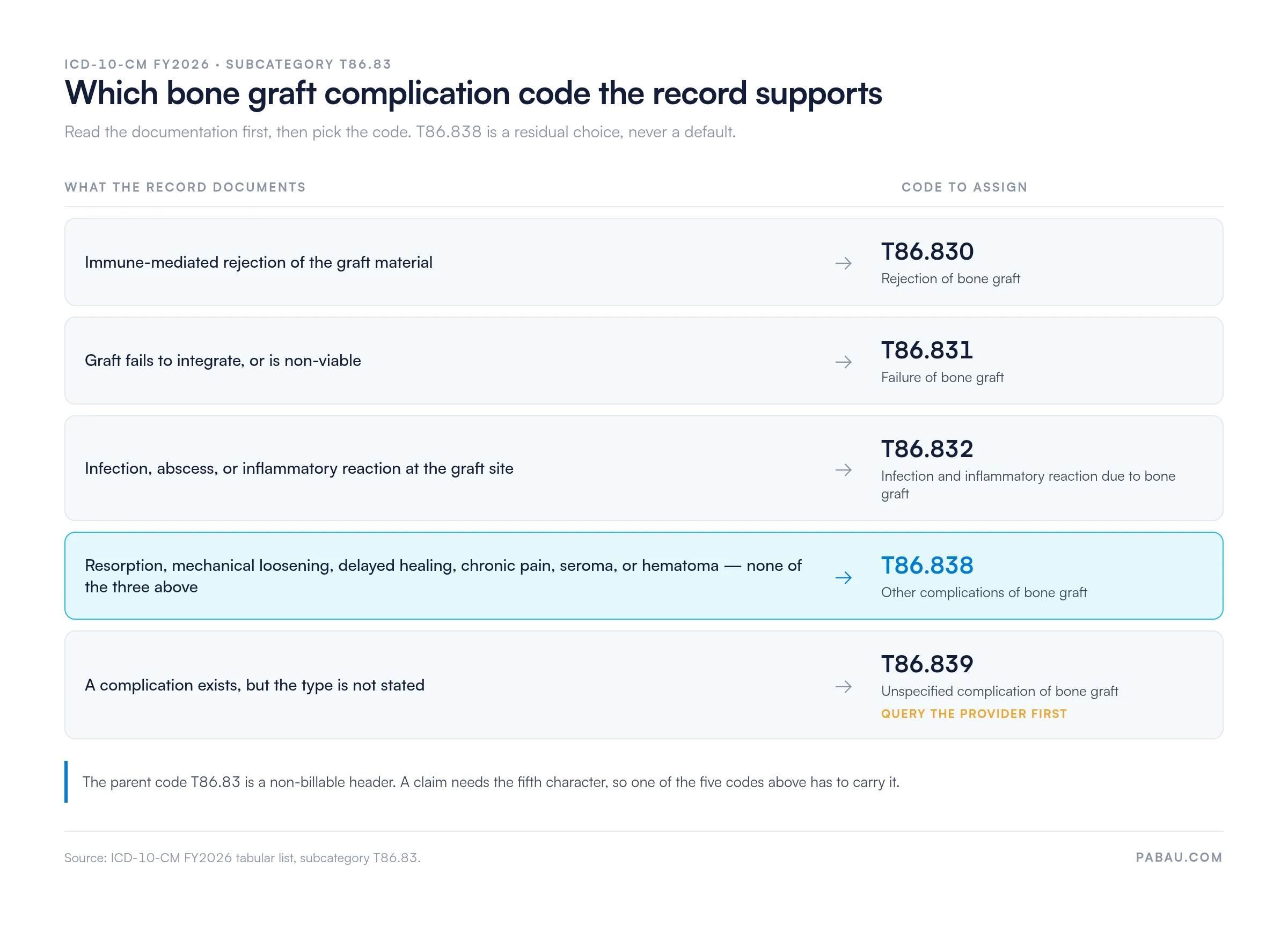
Use T86.838 when: the record describes graft resorption, mechanical loosening, delayed healing, chronic pain at the graft site, seroma, or hematoma formation. The provider must not have attributed it to rejection, infection, or outright failure.
Do not use T86.838 when: the documentation states rejection (use T86.830), graft failure or non-integration (use T86.831), or infection and inflammatory reaction (use T86.832). Reaching for the residual code when a more specific one is documented is a coding error that invites auditor scrutiny and recoupment requests.
Do not use T86.839 when: the provider has described a complication, even in general terms. T86.839 is a last resort, for cases where a provider query yields no further clinical detail. Payers and quality programs reward specificity, and the ICD-10-CM Official Guidelines for Coding and Reporting back querying the provider before an unspecified code goes out.
Before assigning T86.838, check the operative note, discharge summary, and any wound care documentation for language that could support a more specific sibling code. If the record mentions ‘infection’ or ‘failure,’ query the provider before defaulting to the residual category. A precise code reduces audit risk and supports medical necessity.
Accurate documentation is the foundation of a defensible T86.838 claim. Payers routinely request medical records for bone graft complication codes, and thin documentation is the leading cause of denials in this family. The diagnosis code has to be supported by physician documentation, never by coder inference.
The following elements should appear in the medical record before T86.838 is assigned:
Structured claims management software that validates ICD-10 code combinations before submission catches these documentation problems earlier in the revenue cycle. A check at the point of documentation costs a few seconds. Reworking a denied claim three weeks later costs a great deal more.
T86.838 maps to Medicare Severity Diagnosis Related Group (MS-DRG) version 43 for FY2026. CMS released v43.0 effective October 1, 2025, then updated it to v43.1 on April 1, 2026. The group an inpatient case lands in depends on the principal diagnosis and the procedures performed. It also depends on any complication or comorbidity (CC) or major complication or comorbidity (MCC) on the claim.
T86.838 counts as a CC when it appears as a secondary diagnosis on an inpatient claim. That designation can upgrade the DRG assignment for many orthopedic and surgical base DRGs. Reimbursement rises where the graft complication adds measurable resource use to the encounter.
Dollar amounts are not stated here because payer contracts and regional fee schedules vary widely. Verify payment expectations through your payer’s provider portal, or with the ICD List DRG grouper tool, which supports MS-DRG lookups by code combination.
For practices submitting claims electronically, Pabau routes ICD-10 coded claims through the Claim.MD clearinghouse to thousands of US payers. Real-time eligibility verification lets a practice confirm coverage before the encounter, which cuts rejections tied to plan-specific coding rules.
Claim.MD also processes electronic remittance advice (ERA/835). Denial reason codes then reach the billing team automatically, instead of being pulled out of payer portals by hand.
T86.838 has been in the ICD-10-CM tabular list since the T86.83 subcategory was introduced for bone graft complications. It has stayed valid through every annual update since. CMS and the National Center for Health Statistics (NCHS) co-maintain the code set and publish updates each October 1. The edition in force now took effect on October 1, 2025.
Check the CMS ICD-10 codes page at the start of each fiscal year to confirm that T86.838 is still active and unrevised. Past updates have rewritten code descriptions and restructured subcategories inside the T86 block. Ruling out a mid-cycle change is worth the two minutes before a batch of claims goes out.
A graft complication often needs a companion diagnosis on the claim. Our ICD-10 diagnosis codes library lists the billable codes around T86.838 and what each one requires.
In most practices, a coding problem surfaces only after the payer finds it. A claim goes out under the header code T86.83, or under a residual code the note does not support. The denial arrives weeks later, and someone has to reconstruct what happened.
Practice management software like Pabau checks the claim while it is still in the practice’s hands. The diagnosis code sits on the invoice beside the treatment note it came from. A coder can check the documentation behind T86.838 without opening a second system. Validation runs before submission, and the claim then leaves through the Claim.MD clearinghouse with eligibility already confirmed.
The payoff is fewer denials tied to hierarchy errors, and a shorter rework list at month end. Remittance advice comes back into the same system, so denial reason codes reach the billing team without a portal login.

Pabau connects to the Claim.MD clearinghouse for real-time eligibility checks, clean claim submission, and automated ERA processing. See how it handles bone graft complication coding in one platform.

Bone graft complications rarely arrive neatly labeled. What T86.838 asks of you is a judgment: does the record describe the complication well enough to rule out rejection, failure, and infection? That call belongs to whoever is reading the note, not to the code book.
So the discipline worth keeping is the provider query. A query costs a day. Defaulting to T86.839 costs the specificity that payers and quality programs reward, and it leaves an audit trail you would rather not explain. Every claim that goes out on a residual code should be one you could defend.
Pabau validates ICD-10 code combinations before claims reach the clearinghouse, which cuts denials tied to hierarchy errors and missing documentation. To see how it handles orthopedic and surgical billing end to end, book a demo.

Need to understand how coding errors turn into denials? Denial management in medical billing covers how to identify, appeal, and prevent claim denials from ICD-10 coding errors.
Want to check your ICD-10 submission process? Medical billing compliance requirements outlines the documentation and submission standards that support clean claims for complication codes.
Looking for guidance on revenue cycle workflows? Revenue cycle management processes explains how coding accuracy at the point of documentation reduces rework across the billing lifecycle.
New to the clearinghouse model? The Claim.MD electronic claims clearinghouse explains how coded claims reach payers and how remittance data comes back.
Want the wider billing picture? What is medical billing walks through the workflow that runs ICD-10 validation before a claim reaches the payer.
T86.838 is a billable ICD-10-CM diagnosis code for other complications of bone graft. Use it when a documented bone graft complication does not meet the criteria for rejection (T86.830), failure (T86.831), or infection (T86.832). It is valid for FY2026 claims with dates of service from October 1, 2025 through September 30, 2026.
Yes. T86.838 is a billable, specific ICD-10-CM code valid for reimbursement purposes. It provides the fifth-character specificity required for billing under its non-billable parent code T86.83. Confirm current billable status against the FY2026 CMS tabular list before each claim cycle.
T86.831 is for bone graft failure, specifically when the graft does not integrate or becomes non-viable. T86.838 covers other complications that do not fit failure, rejection, or infection. If the record documents graft failure, T86.831 is required. T86.838 applies only when the complication falls outside those defined categories.
Use T86.838 when the provider has described the complication, such as resorption, seroma, or mechanical loosening, and it does not match rejection, failure, or infection. Use T86.839 only when the complication type is genuinely unspecified after querying the provider. T86.838 signals a known complication type, while T86.839 signals thin documentation.
The parent code is T86.83 (Complications of bone graft), which is a non-billable header code. T86.83 requires a fifth character to become billable, and T86.838 provides that specificity for other bone graft complications that are not rejection, failure, or infection.
T86.838 groups within MS-DRG v43.1, the FY2026 version, as a complication or comorbidity (CC) when used as a secondary diagnosis. The specific DRG depends on the principal diagnosis, the procedures performed, and any other CCs or MCCs on the claim. Verify the grouping with a current MS-DRG definitions manual or grouper tool.