HCPCS code J7520: Sirolimus oral billing guide
HCPCS code J7520 covers oral sirolimus, one unit per milligram HCPCS code J7520 ...

Last Updated: Nov 12, 2026
86001 is the CPT code for allergen specific IgG quantitative or semiquantitative, each allergen. It reports a serum test that measures IgG antibodies to one named allergen, billed one unit per allergen tested.
It is not an IgE allergy test. Allergen-specific IgE is reported with 86003, 86005 or 86008. Many payers treat in-vitro IgG testing for allergy symptoms as not reimbursable, so check coverage before the specimen is drawn.
Let Pabau's smart automation suggest the right codes, reduce claim denials, and keep your practice compliant—effortlessly.
Automate repetitive tasks and focus on what matters most—your patients.
Reduce coding errors and ensure compliance with the latest regulations.
Clean claims, fewer denials, and faster reimbursements.
Powerful insights and reporting to help your practice thrive.
HIPAA compliant SOC 2 certified GDPR-compliant Trusted by 4,000+ clinics worldwide

CPT code 86001 reports allergen-specific IgG, measured quantitatively or semiquantitatively, and you bill one unit for each allergen tested.
It is not an IgE allergy test. Allergen-specific IgE goes to 86003, 86005 or 86008, depending on the method and allergen type.
The strongest clinical use is antigen-specific IgG in hypersensitivity pneumonitis and Aspergillus workups, where the payer reviews a lung diagnosis.
Many payers, including BCBS Oklahoma and Premera, treat in-vitro IgG testing for allergy symptoms as not reimbursable, so check coverage first.
For Medicare patients, get a signed ABN before drawing the specimen whenever an IgG allergy test is likely to be denied.
CPT code 86001 is the code for “Allergen specific IgG quantitative or semiquantitative, each allergen.” It reports a serum test that measures IgG antibodies to one named allergen or antigen. The American Medical Association (AMA) publishes the descriptor as part of the CPT code set.
The phrase “each allergen” drives the billing. A panel that reports IgG to six antigens is six units of 86001, not one. The code sits with the qualitative and semiquantitative immunoassays, next to the allergen-specific IgE codes it is often confused with.
The test starts with a standard venous blood draw. The laboratory then measures how much IgG in the serum binds to each antigen on the order. Results come back per antigen, usually in mg/L or as a semiquantitative class.
IgG antibodies show exposure and immune response to an antigen. They do not show the immediate, IgE-mediated reaction behind hay fever, hives or anaphylaxis. That difference is why most allergy societies and payers do not accept IgG results as evidence of allergy.
Use CPT code 86001 when the provider orders IgG antibodies to specific antigens and the record explains why. The claim holds up best when the question concerns a lung or immune condition, not a suspected allergy.
The American Academy of Allergy, Asthma and Immunology advises against IgG testing in the evaluation of allergy through its Choosing Wisely list. Keep that in mind before ordering 86001 for rhinitis, urticaria or food reactions. For those questions, skin prick testing under 95004 or a serum IgE test under 86003 or 86008 is the better fit.
Both codes bill one unit per allergen, so the unit count never tells them apart. The antibody class does. CPT code 86001 measures IgG, while 86003 measures IgE against a crude allergen extract. Read the lab report: An IgG result in mg/L belongs to 86001, and an IgE result in kU/L belongs to 86003 or 86008.
A lab report that lists IgE values per allergen never supports 86001. Billing IgE work as 86001 is a code mismatch, and payers reviewing it will deny the line. The decision path below starts from the antibody class printed on the report.
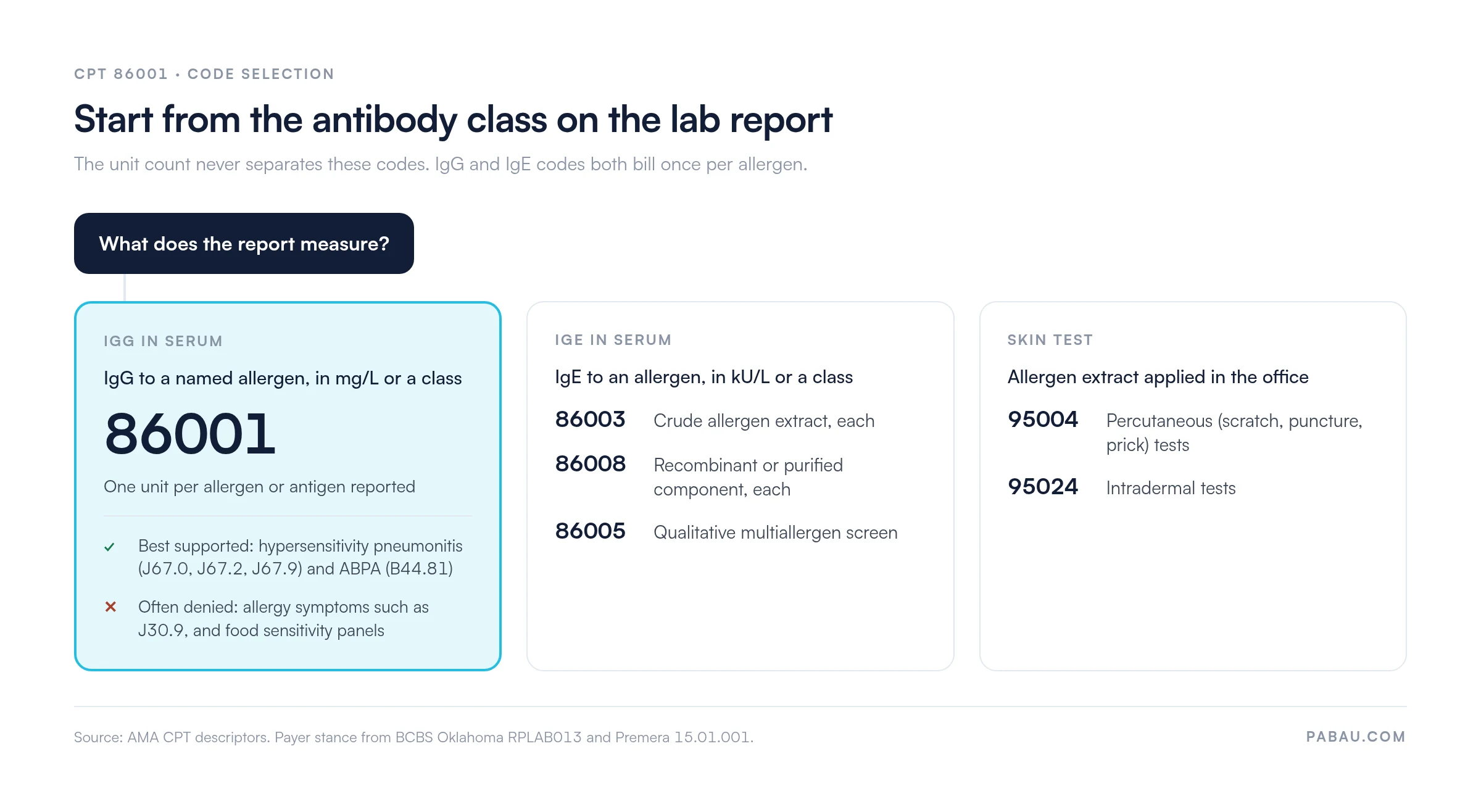
Every 86001 claim needs a diagnosis that explains why IgG to that antigen matters. Diagnoses tied to lung disease and immunotherapy carry the claim further than allergy symptom codes do. The table pairs common diagnoses with how payers tend to read them.
Check the payer’s policy and your MAC’s local coverage determination before you rely on any pairing. An allergy symptom code with 86001 is the combination most likely to come back denied.
Bill one unit of CPT code 86001 for each allergen or antigen the lab reports. A hypersensitivity pneumonitis panel with seven antigens is seven units, and the report should list all seven results. Panel contents change, so match the units to the antigens on the final report rather than an old requisition.
Payers also cap the number of allergen tests they pay for. BCBS Oklahoma and Premera, for example, limit specific IgE testing to 20 allergens a year. Keep the unit count tied to antigens the provider documented a reason to test.
Coverage for CPT code 86001 is narrow, and the clinical reason decides it. Commercial payers commonly treat in-vitro IgG allergy testing as not reimbursable. BCBS Oklahoma policy RPLAB013 lists IgG, IgA, IgM and IgD in-vitro testing as not reimbursable for patients with allergy symptoms. Premera medical policy 15.01.001 takes the same position.
Medicare pays only for tests that are reasonable and necessary for the patient’s condition. Check your MAC’s allergy testing LCD in the CMS Coverage Database before you submit 86001 for an allergy indication. Then confirm the patient’s plan through insurance eligibility verification before the specimen is collected.
Medicare pays CPT code 86001 under the Clinical Laboratory Fee Schedule (CLFS), not the Physician Fee Schedule. Lab codes on the CLFS carry no RVUs. Since 2018 the CLFS has set a single national payment rate per code, updated in CMS’s annual and quarterly files.
Payment is per unit, so the total on a claim scales with the number of antigens tested. Commercial rates follow each payer contract. A medical claims clearinghouse connected to your practice management system can flag payments that fall short of the contracted rate.
A payer reviewing 86001 wants to see why IgG to each antigen was worth measuring. Every claim should be backed by these elements in the medical record.
A clean claim submission means each of these elements is confirmed before the claim is filed, not after a denial.
Most 86001 denials fall into a few patterns. Use denial management workflows and the denial codes reference to work the remittances that do arrive.
Before you code an allergy lab result, check the antibody class printed beside each value. IgG results support 86001 per antigen, while IgE results support 86003 or 86008. One glance at the report prevents the most expensive mismatch on these claims.
These codes often appear in the same workup as CPT code 86001. Knowing their scope keeps each result on the right code.
In many practices, the lab order, the report and the claim live in different places. Someone at the billing desk counts antigens by hand and guesses whether the payer covers IgG. That is where unit errors and missing ABNs creep in.
Pabau keeps the order, the clinical note and the claim in one patient record. Claims management software in Pabau carries built-in CPT and ICD-10-CM catalogs, so the code and diagnosis are picked from the record. Claims go out through the Claim.MD clearinghouse integration to thousands of US payers.
Eligibility checks run before the encounter, and ERA remittances post against the claim automatically. Denial patterns on 86001 then show up in reporting, so you can fix the order workflow rather than chase each denial.

Pabau links clinical notes to claim submission and routes lab claims through the Claim.MD clearinghouse to thousands of US payers. See how it works for your allergy and immunology practice.

CPT code 86001 is an IgG code, billed once per antigen. Treating it as an IgE allergy screen sends claims out on the wrong code and the wrong unit count. The fix starts at the lab report: Read the antibody class, count the antigens, and code from what you see.
Coverage is the bigger risk. Many payers will not pay for IgG testing ordered for allergy symptoms, and an unsigned ABN leaves the practice absorbing the cost. Reserve 86001 for lung and immunotherapy questions, and route allergy questions to IgE testing. Book a demo to see how Pabau keeps lab orders, diagnoses and claims aligned for your practice.

Need to understand how clearinghouse submission works for lab claims? Our Claim.MD clearinghouse guide explains how electronic claim routing, real-time eligibility, and ERA remittances connect for specialty practices.
Getting CARC denial codes on 86001 remittances? The denial codes in medical billing reference breaks down the most common CARC codes and the correction actions that clear them.
Want to reduce manual re-entry between lab orders and billing? What is revenue cycle management covers the end-to-end workflow from encounter documentation through payment posting.
CPT code 86001 covers allergen-specific IgG testing, quantitative or semiquantitative, for each allergen. It reports a serum test that measures IgG antibodies to one named antigen. You bill one unit for every allergen tested.
No. CPT 86001 measures IgG, not IgE. Allergen-specific IgE is reported with 86003 for a crude allergen extract, 86005 for a qualitative multiallergen screen, or 86008 for a recombinant or purified component.
Both codes are billed per allergen, but they measure different antibodies. CPT 86001 reports IgG, while 86003 reports IgE against a crude allergen extract. The antibody class on the lab report decides which code applies.
Bill one unit for each allergen or antigen the lab reports. A panel of six antigens is six units. Payers may cap allergen tests per year, so check the payer policy before testing.
Often not for allergy symptoms. Payers such as BCBS Oklahoma and Premera treat in-vitro IgG allergy testing as not reimbursable. Coverage is more likely for lung conditions such as hypersensitivity pneumonitis, so confirm the policy first.
Get a signed Advance Beneficiary Notice from a Medicare patient when you expect the test to be denied. Collect it before the draw and append modifier GA. Without an ABN, the practice usually absorbs the denied charge.
Lung and immune diagnoses support it best, such as J67.2 for bird fancier’s lung, J67.9 for hypersensitivity pneumonitis, or B44.81 for allergic bronchopulmonary aspergillosis. Allergy symptom codes paired with 86001 are frequently denied.