ICD-10 code S61.201A: Open wound of left index finger without nail damage
ICD-10 code S61.201A covers a left index finger wound of unstated type ICD-10 co...

Last Updated: Oct 16, 2026
Billable Code Specific Code
T32.80 is the billable ICD-10-CM code for corrosions involving 80-89% of body surface with 0% to 9% third degree corrosion.
The code is complete at five characters, so no seventh character applies, and it must follow a Code First toxic-effect code from T51-T65 plus at least one T20-T25 site code. Confusing it with sibling codes T32.81 through T32.89, which record progressively higher third degree involvement, is the most common assignment error.
Let Pabau's smart automation suggest the right codes, reduce claim denials, and keep your practice compliant—effortlessly.
Automate repetitive tasks and focus on what matters most—your patients.
Reduce coding errors and ensure compliance with the latest regulations.
Clean claims, fewer denials, and faster reimbursements.
Powerful insights and reporting to help your practice thrive.
HIPAA compliant SOC 2 certified GDPR-compliant Trusted by 4,000+ clinics worldwide

ICD-10 Code T32.80 is a billable code for corrosions covering 80-89% TBSA with 0-9% third degree involvement, valid for FY2025 and FY2026.
The final digit distinguishes T32.80 from sibling codes T32.81-T32.89, each requiring progressively higher third degree TBSA documentation.
T32.80 is complete at five characters, so the A, D or S extension belongs to the companion T20-T25 site code instead.
Documentation must capture the causative chemical, the TBSA calculation method, and the degree breakdown, plus a Code First toxic-effect code from T51-T65.
Practice management software like Pabau carries the current ICD-10-CM catalog and submits corrosion claims through Claim.MD.
ICD-10 Code T32.80 is the billable ICD-10-CM diagnosis code for corrosions involving 80-89% of body surface with 0% to 9% third degree corrosion. It is complete at five characters, so no seventh character applies to it. On a claim it follows a Code First toxic-effect code from T51-T65, alongside at least one T20-T25 site code.
Corrosion codes in the T32 category are classified by total body surface area (TBSA) involvement rather than anatomical site. T32.80 sits within the T32.8 subcategory, which covers 80-89% TBSA. The final digit records that fewer than 10% of the affected area has reached third degree depth.
T32.80 describes corrosions involving 80-89% of body surface with 0% to 9% third degree corrosion. The code belongs to the ICD-10-CM classification maintained by the Centers for Medicare and Medicaid Services (CMS). The National Center for Health Statistics co-maintains the system. T32.80 is confirmed billable and specific for FY2025 and FY2026.
In ICD-10-CM terminology, “corrosion” refers specifically to chemical burns caused by a corrosive substance such as an acid, an alkali, or a caustic chemical. This distinguishes T32.80 from thermal burn codes in the adjacent T31 category, which use the same TBSA structure but apply to heat-related injuries. A chemical industrial accident affecting 85% of a patient’s body surface maps to T32.80. That holds as long as third degree involvement stays under 10% of the affected area.
The T32 category classifies corrosion injuries by the total percentage of body surface area involved. Two digits do the work. The first digit after the decimal gives the TBSA band, and the second gives how much of that area reached third degree depth. In T32.80, the 8 means 80-89% TBSA and the 0 means 0-9% third degree involvement.
The same two-digit logic applies across the whole T32 range. At 40-49% TBSA with 0-9% third degree depth, the code is T32.40.
TBSA in burn and corrosion coding is typically calculated using the Rule of Nines. The tool assigns approximate percentages to the body regions:
At the 80-89% band, virtually the whole body surface has been affected. Verify that the attending clinician’s TBSA estimate appears in the medical record before assigning T32.80.
The degree qualifier is equally precise. The 0 means that of the 80-89% body surface affected, fewer than 10% has reached third degree depth. Third degree means full-thickness destruction of the dermis. The remaining affected area may involve first degree or second degree corrosion. Assigning T32.81 instead, which requires 10-19% third degree involvement, would misrepresent clinical severity.
T32.80 is confirmed as a billable and specific ICD-10-CM code for reimbursement purposes. It can be used on claims submitted to Medicare, Medicaid, and most commercial payers. The code carries no parent-only restriction, so it can stand as the primary or secondary diagnosis on a CMS-1500 or UB-04 claim form.
T32.80 alone does not fully describe the patient’s condition. Payers expect a Code First toxic-effect code from T51-T65 identifying the chemical and intent, and at least one site-specific corrosion code from T20-T25. Submitting T32.80 on its own is a common reason for denial.
A clean claim carrying T32.80 therefore lists three elements: the T51-T65 toxic-effect code, the T32.80 extent code, and one or more T20-T25 site codes. Missing any of them typically triggers a request for medical records or an outright denial.
Sequence a T51-T65 toxic-effect code first to identify the chemical and the intent, then T32.80, then the T20-T25 site code. Claims carrying T32.80 as the only diagnosis routinely reject at the payer’s front-end edits. Y92 and Y93 codes record place and activity, not the substance.
The T32.8x subcategory covers corrosions affecting 80-89% TBSA and subdivides further based on the proportion of that affected area reaching third degree depth. Burn unit clinicians must document the total corrosion extent and the degree breakdown separately. That makes this the most demanding tier of T32 coding.
Third degree corrosion means full-thickness destruction through the epidermis and the entire dermis, often into subcutaneous tissue. At the T32.80 level, the 0-9% qualifier means the most severe tissue destruction stays limited. The injury remains life-threatening, but the depth distribution shapes reimbursement and care planning. The table below shows how the second digit changes across the T32.8x family.
The third degree percentage is calculated as a proportion of the corrosion-affected surface, not of the whole body. A patient with 85% TBSA corrosion and 7% third degree involvement maps to T32.80. The same patient with 12% third degree involvement maps to T32.81. This distinction directly affects DRG assignment and expected reimbursement for inpatient admissions.
T32.80 sits at the most specific level of a five-tier ICD-10-CM hierarchy. Understanding the full path helps coders confirm code validity and supports cross-referencing when payers query the diagnosis. The complete hierarchy is:
T32.8 itself is a non-billable header code. Only the five-character subcodes, T32.80 through T32.89, are specific enough for claim submission. Coders who stop at T32.8 will receive an invalid code rejection from clearinghouse edits. The AAPC ICD-10-CM code range reference sets the T20-T32 range apart from adjacent injury categories. Range selection is then straightforward, once the clinician documents whether the injury was thermal or chemical.
T32.80 shares its TBSA band with nine sibling codes, all covered in the table above. Coders working extensive corrosion cases should also know the adjacent T32 subcategories and the parallel T31 thermal burn structure. The full ICD-10-CM code index lists each of those entries in one place.
The distinction between T32 and T31 is clinically and legally significant. Both use the same TBSA percentage structure, and they are mutually exclusive. T32 applies only when a corrosive chemical caused the injury, as confirmed by the WHO ICD-10 classification. Coding a chemical burn as thermal, or the reverse, misrepresents the clinical event and may complicate legal documentation in industrial accident cases.
Accurate T32.80 assignment depends on four documented elements being present in the medical record. CMS compliance guidance requires the clinical documentation to support every component of the code before it reaches the claim form. Missing one element can produce a denial or, in post-payment review, a recoupment request.
The four required documentation elements are:
Practices handling complex inpatient cases should build a corrosion documentation checklist that prompts for all four elements at the point of note creation. Capturing the details during the encounter, rather than retrospectively, cuts provider queries and shortens the billing cycle.
T32.80 is an extent-of-injury code, not a complete diagnosis on its own. Under the ICD-10-CM Official Guidelines for Chapter 19, three companion codes complete the corrosion encounter:
The order matters as much as the selection. The sequence below shows where T32.80 sits on the claim, and which code carries the episode-of-care character.
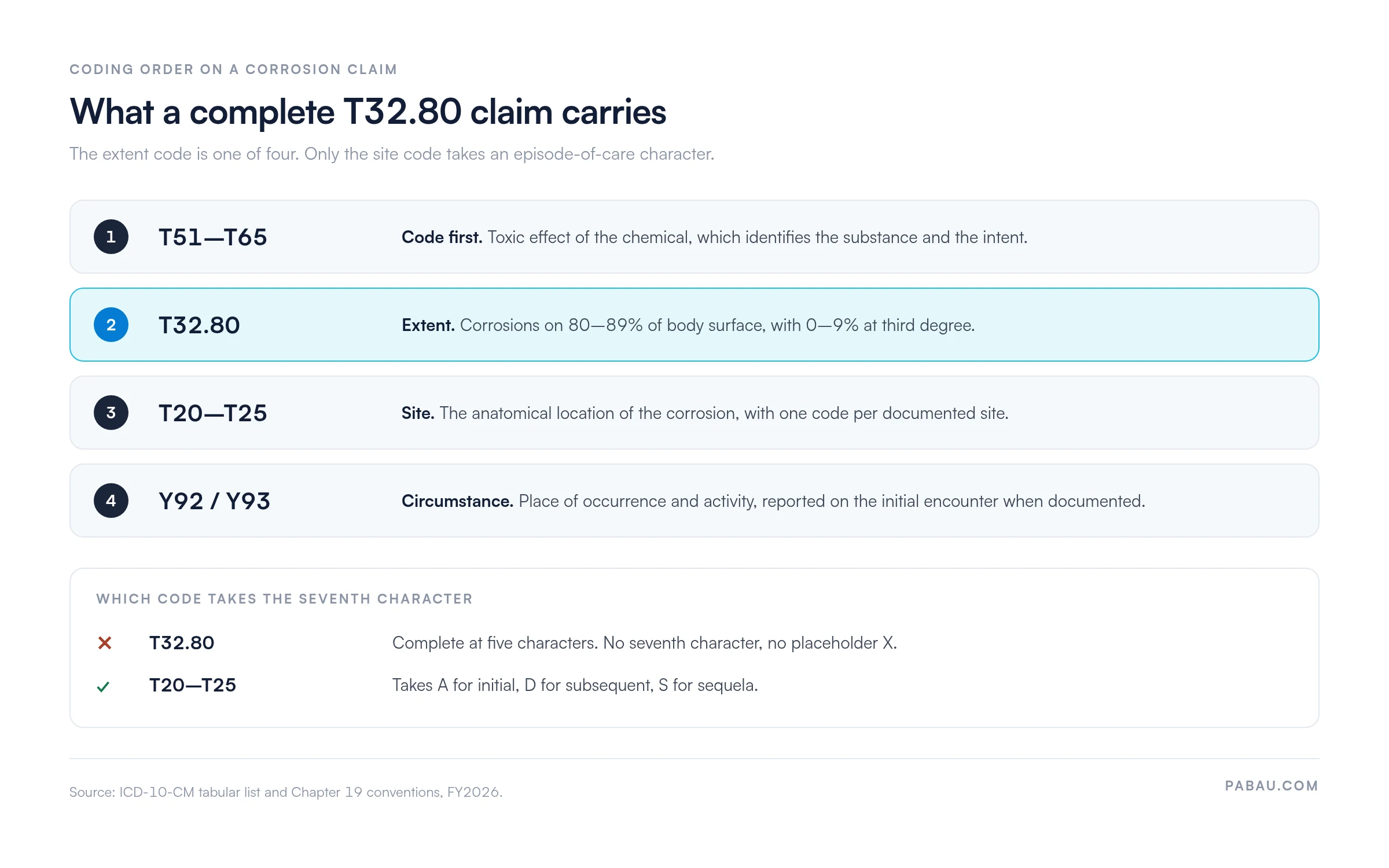
Denial management on burn and corrosion claims begins with this companion code structure. The most frequent denial reason on T32-series claims is the absence of a site-specific T20-T25 code. Many payer systems apply an edit requiring at least one site code whenever a T32 extent code appears.
T32.80 has been part of the ICD-10-CM tabular list since the US implementation of ICD-10-CM. The code has not been revised or deleted in recent annual update cycles. Its descriptor and hierarchy remain unchanged for FY2025 and FY2026.
Annual ICD-10-CM updates take effect each October 1, aligned with the federal fiscal year. T32 codes have been stable, because the TBSA-based structure changes only when the underlying clinical taxonomy does. Verify against the CMS annual release each September. The current and prior-year tabular lists are free through the CDC/NCHS ICD-10-CM web tool.
A billing system’s ICD-10-CM catalog should be updated each October to match the current fiscal year’s valid code set. An outdated catalog may flag T32.80 as unrecognized, or suggest a retired code in error, which delays claim processing.
Check the CMS ICD-10-CM annual update release every September before October 1. The T32 category has been stable. Confirming validity at the start of each fiscal year takes two minutes, and it keeps a retired code off the claim.
Corrosion claims fail on composition more often than on the extent code itself. A coder assigns T32.80 correctly, then the T51-T65 or T20-T25 companion never reaches the claim, and the payer’s front-end edit rejects the line.
Practice management software like Pabau keeps the current ICD-10-CM catalog inside the billing screen. A coder picks T32.80 from the live FY2026 set rather than a stale local list. Claims then go out electronically through our Claim.MD integration, which returns payer responses against the codes already on the record.
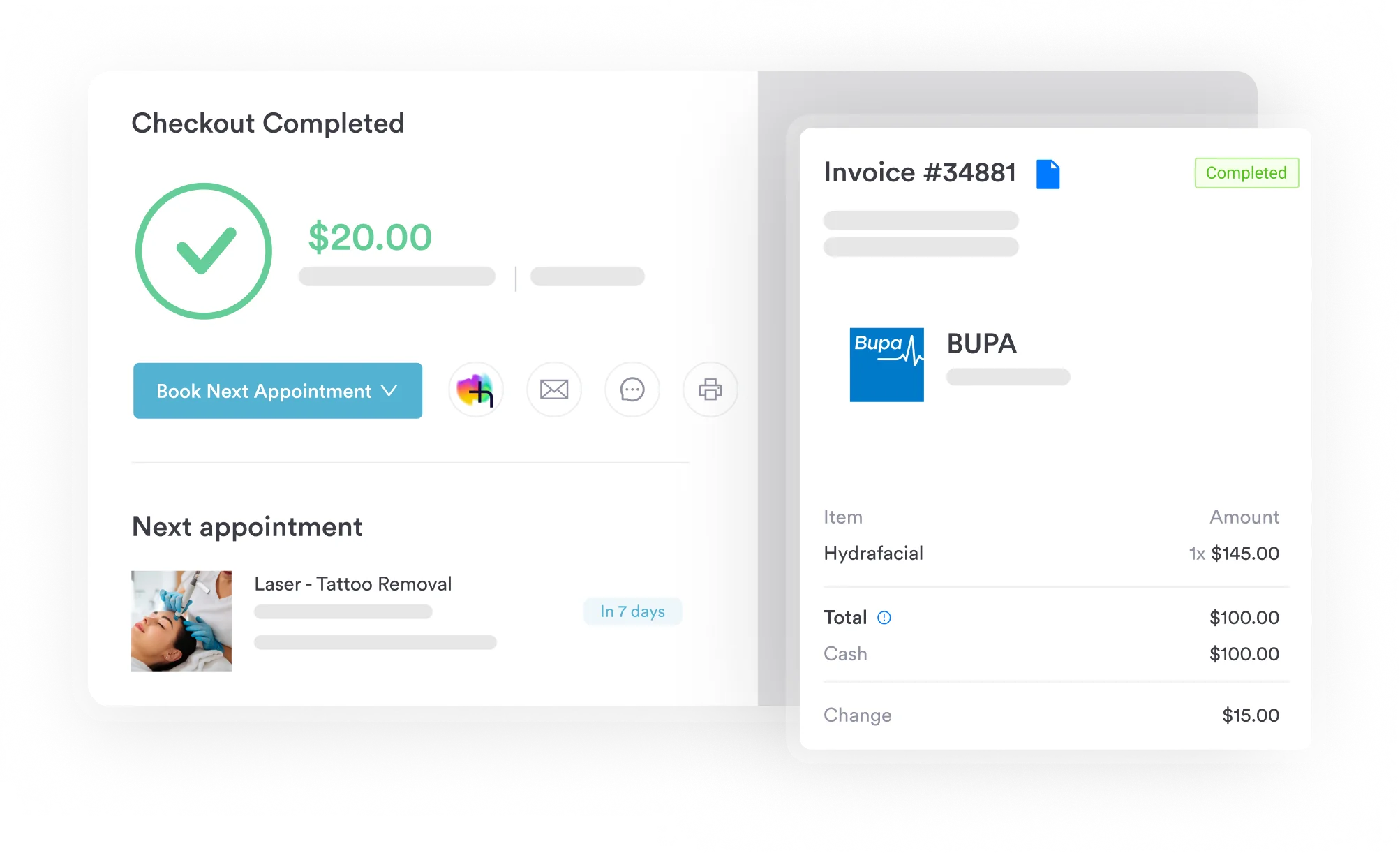
Because remittances land against the same record, recurring denials on one diagnosis code surface as a pattern rather than as separate write-offs. Medical claims management in Pabau keeps the code set, the claim, and the payer response in one place for a burn unit billing team.

Pabau carries the current ICD-10 and CPT catalogs, and submits claims electronically through our Claim.MD integration. Payer responses land against the same patient record, so denial patterns on a diagnosis code are visible without a separate report.

The extent code is the easy part of a T32.80 encounter. What decides the claim is whether the toxic-effect code, the site codes, and the episode-of-care character were each put where they belong. Get the sequence right and the claim clears on the first pass.
Build the check into the documentation step rather than the billing step. A burn assessment form that prompts for the chemical, the TBSA method, and the degree split leaves the coder with no query to raise.
Pabau keeps the code set, the claim, and the remittance on one record for high-acuity billing. Book a demo to see how a complex multi-code claim moves through it.

Need a structured approach to medical billing compliance? Medical billing compliance for clinics covers the audit triggers and documentation standards that affect complex inpatient coding.
Want to understand how clearinghouse submissions work? How a medical claims clearinghouse works explains the validation and payer routing process that catches companion code errors before they reach the payer.
Looking for denial management guidance? Denial codes in medical billing breaks down the most common CARC denial codes returned on complex diagnosis claims and how to resolve them.
ICD-10 Code T32.80 is the billable diagnosis code for corrosions involving 80-89% of body surface with 0% to 9% third degree corrosion. It belongs to the T32 category, which classifies corrosive chemical injuries by total body surface area (TBSA) extent rather than anatomical site.
Yes, T32.80 is a billable and specific ICD-10-CM code valid for FY2025 and FY2026. It can be used on CMS-1500 and UB-04 claim forms, but payer edits expect companion codes. Those are a Code First toxic-effect code from T51-T65 and a site-specific T20-T25 code.
In ICD-10-CM, burns (T31) result from heat, electricity, or radiation. Corrosions (T32) result from contact with a corrosive chemical substance such as an acid or an alkali. Both categories use the same TBSA percentage and degree structure, but they are mutually exclusive and must not be interchanged on claims.
T32.80 applies when the documented third degree corrosion involves less than 10% of the affected body surface. T32.81 applies when third degree involvement reaches 10-19%, and T32.82 when it reaches 20-29%. The secondary digit reflects the third degree percentage as a proportion of the corrosion-affected area, not of total body surface.
T32.80 needs a Code First toxic-effect code from T51-T65 identifying the chemical and intent, plus at least one T20-T25 site-specific corrosion code. The site code carries the seventh character for episode of care. T32.80 itself is complete at five characters and takes no extension.
TBSA for corrosion coding is typically calculated using the Rule of Nines. That tool assigns 9% to the head and neck, 9% to each arm, and 18% to each leg. The anterior trunk and the posterior trunk take 18% each, and the perineum takes 1%. The documented estimate must fall within 80-89% to support T32.80.