ICD-10 Code S42.361G: Displaced segmental fracture of right humeral shaft, delayed healing
What is ICD-10 code S42.361G? ICD-10 code S42.361G is the billable code for a di...

Last Updated: Oct 15, 2026
Billable Code Specific Code
T31.66 is the billable ICD-10-CM code for burns involving 60-69% of body surface with 60-69% third degree burns.
Most T31.66 denials trace back to two documentation failures. The physician note states total TBSA but omits the third-degree percentage, or the coder sequences T31.66 as principal when documented T20-T25 site codes should lead.
Let Pabau's smart automation suggest the right codes, reduce claim denials, and keep your practice compliant—effortlessly.
Automate repetitive tasks and focus on what matters most—your patients.
Reduce coding errors and ensure compliance with the latest regulations.
Clean claims, fewer denials, and faster reimbursements.
Powerful insights and reporting to help your practice thrive.
HIPAA compliant SOC 2 certified GDPR-compliant Trusted by 4,000+ clinics worldwide

T31.66 encodes two separate percentages: 60-69% of total body surface area burned, and 60-69% of that burned area being third degree.
The fifth character in T31.6x records the third-degree percentage, so reading it as a second total TBSA figure is the most common T31.66 error.
T31.66 is the principal diagnosis only when the burn site is not documented. Once T20-T25 site codes are assigned, T31.66 becomes a supplementary code.
Pabau’s claims management software integrates with Claim.MD to validate burn diagnosis codes, flag sequencing errors, and route T31.66 claims to the correct payer before submission.
ICD-10 code T31.66 is the billable diagnosis code for burns covering 60 to 69 percent of body surface.
Of that burned area, 60 to 69 percent must be third degree. It is valid for FY2026 discharges. It sits in Chapter 19, which covers injury, poisoning and certain other consequences of external causes. Its category, T31, classifies burns by extent of body surface rather than by anatomic site.
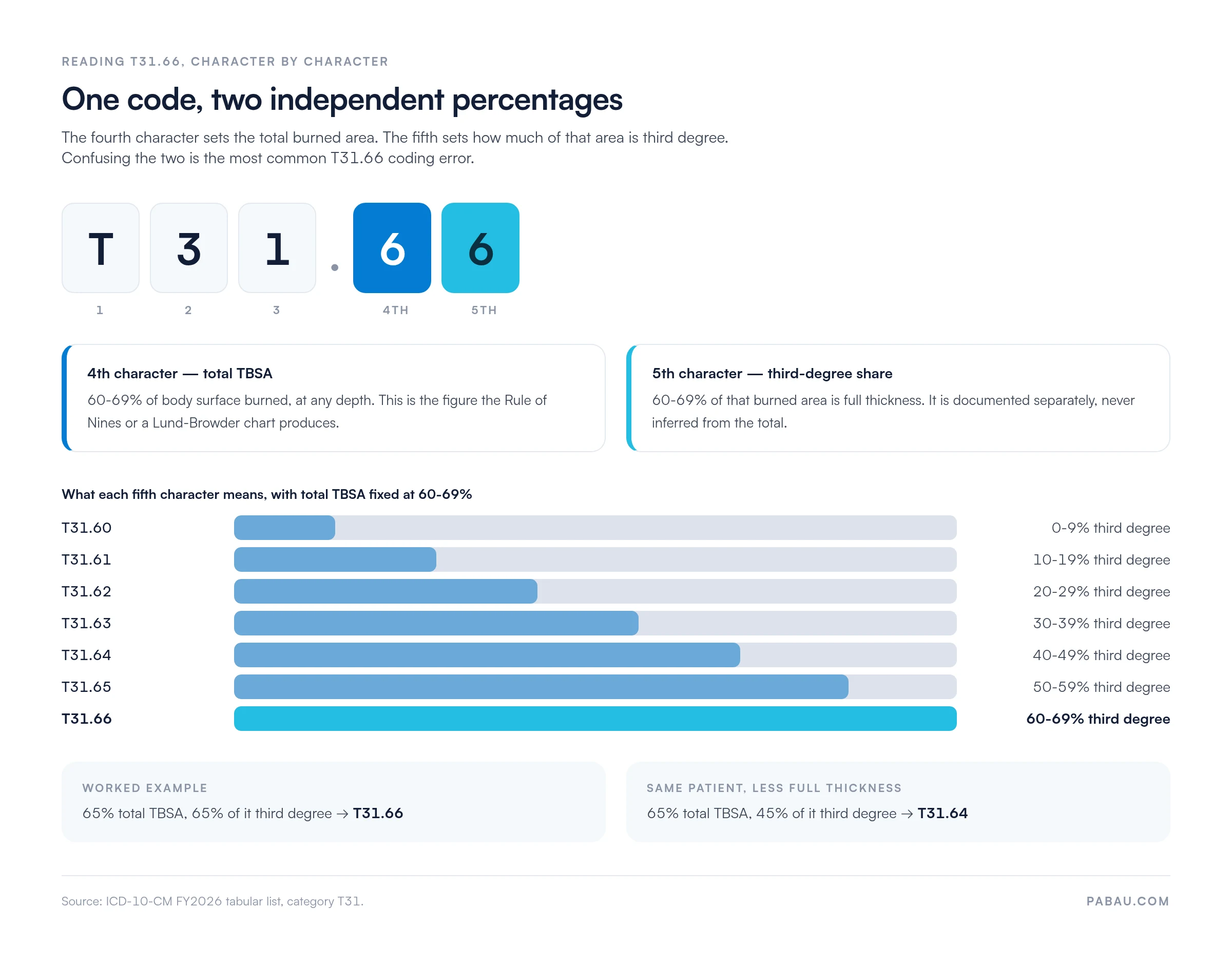
T31.66 captures two distinct clinical measurements simultaneously. The first is total TBSA: 60 to 69 percent of the patient’s body surface has sustained a burn injury of any depth. The second is third-degree TBSA. Of that total burned area, 60 to 69 percent involves full-thickness destruction of the skin down to or through the dermis. The diagram below shows where each of those percentages sits inside the code.
Clinically, burns at this threshold represent the severe end of the major burn category. Full-thickness burns across 60 to 69 percent of body surface typically require admission to a certified burn center. Treatment involves mechanical ventilation and multi-stage surgery, including excisional debridement and skin grafting. Mortality risk rises sharply above 60 percent TBSA, particularly in patients over 40 or with inhalation injury.
TBSA burn coding in ICD-10-CM relies entirely on physician-documented percentages, not coder estimation. Two methods appear most commonly in burn center notes: the Rule of Nines and the Lund-Browder chart.
The coder reads the physician’s documented TBSA value and confirms it falls in the 60-69% range. The separately documented third-degree percentage comes next. Both values must appear in the record before T31.66 can be assigned. A note that records only total TBSA, with no third-degree figure, cannot support T31.66. Query the physician before defaulting to T31.60, which asserts third-degree involvement of 9 percent or less.
T31.6x is the subcategory for all burns involving 60 to 69 percent of body surface. The fifth character specifies what percentage of that burned area is third-degree. T31.66 occupies the highest specificity within this subcategory.
A patient with 65% total TBSA and 65% of that area being third-degree maps to T31.66. If that same patient had only 45% third-degree burns within the 65% total, the correct code would be T31.64. The fifth character always reflects the third-degree proportion, never the total TBSA a second time.
T31 codes classify burns by extent (TBSA); T2x codes (T20-T25) classify burns by anatomic site and depth. For a patient with burns across multiple body regions, both code families are typically needed. The question is which leads as principal diagnosis.
The tabular list settles the order. The note under category T31 states that it is used as the primary code only when the site of the burn is unspecified. Where the site is specified, T31 is a supplementary code used with categories T20-T25. ICD-10-CM Official Guideline I.C.19.d.1 points the same way. It directs coders to sequence first the code that reflects the highest degree of burn when more than one burn is present. A multi-site major burn admission therefore leads with the T20-T25 site code for the deepest documented burn, and T31.66 follows as an additional diagnosis.
The UHDDS defines the principal diagnosis as the condition established after study to be chiefly responsible for the admission. For a 60-69% TBSA burn patient, that condition is the burn itself. The code that carries it is the T20-T25 code for the deepest documented site. T31.66 sits alongside it and records the extent of the injury, which is what drives the burn DRG and the level of care required.
ICD-10-CM Official Guideline I.C.19.d.6 tells coders to assign a code from category T31 when the burn site is not specified. It applies equally when the record needs extent data for burn mortality evaluation. The same guideline calls T31 advisable as an additional code whenever a third-degree burn covers 20 percent or more of body surface.
Before finalizing sequencing, confirm the physician’s note explicitly records two values. The first is the total TBSA percentage. The second is the third-degree TBSA percentage, written as a separate figure. If only one value appears, query the physician rather than inferring. A query-resolved note protects the claim and removes the most common T31.66 audit trigger.
Category T31 carries specific instructional notes from the ICD-10-CM tabular list that coders must apply before assigning T31.66. Paraphrasing these notes is a common source of coding error. The guidance below reflects the current tabular list structure.
The most frequent coding confusion involves T31.65 and T31.66. Both apply to 60-69% TBSA burns; only the third-degree percentage distinguishes them.
When a patient’s TBSA is documented as exactly 60% total with exactly 60% third-degree, T31.66 is correct. If re-assessment during the admission updates either value, the code should be reassigned to match the most accurate documented percentage.
Burns involving 60 to 69 percent TBSA nearly always trigger inpatient pre-authorization requirements. Many payers require clinical review before approving burn center admission for injuries above 40% TBSA, and virtually all require it above 60%.
Practice management software like Pabau helps burn center billing teams track pre-authorization status alongside the T31.66 claim. Its claims tools for practices stop a claim going out before the authorization confirmation is on file. Payer requirements vary by plan and state, so the points below reflect common practice rather than universal rules.
Burn admissions reported with T31.66 map to burn-related MS-DRGs under the CMS grouper. The extent code feeds that grouping even though a T20-T25 site code usually holds the principal position. The specific DRG assigned depends on whether a skin graft procedure is performed. It also depends on whether major complications or comorbidities (MCCs) or complications/comorbidities (CCs) appear in the claim.
MS-DRG relative weights change annually with each fiscal year update. Any reimbursement figures in this article reflect the general DRG structure. Verify current relative weights against the CMS ICD-10 codes and DRG definitions page for the applicable fiscal year. Practices running revenue cycle management should flag T31.66 claims for DRG validation before submission. A skin graft procedure code can shift the DRG by more than one category.
Submit T31.66 claims through a clearinghouse that validates burn DRG logic before transmission. That step reduces the risk of a claim coming back for DRG mismatch. Electronic claims through Claim.MD, Pabau’s US clearinghouse integration, carry built-in ICD-10 code validation and payer enrollment checks. Those checks catch T31.66 formatting or sequencing issues before the claim reaches the payer.
Major burn admissions generate multiple procedure codes alongside T31.66. The most common ICD-10-PCS and CPT procedures associated with 60-69% TBSA burns include the following.
Burn reconstruction procedures performed weeks or months after the acute admission require separate claims. They use the T20-T25 sequela codes (seventh character S) or the appropriate reconstructive codes rather than the active burn codes. See the AAPC Codify ICD-10-CM lookup to verify the correct PCS procedure codes alongside T31.66 for current-year submissions.
T31.66 denials cluster around documentation and sequencing errors. Identifying the exact cause before resubmitting is more efficient than appealing generically, since each denial type requires a different corrective action.
The denial codes a payer returns tell a billing team which appeal route a burn claim needs. The table below covers the most common denial triggers.
A pre-submission TBSA documentation review catches most of these errors before the claim leaves the practice. The remittance advice on a returned T31.66 claim then shows which kind of denial the team is facing. A coding issue arrives as CARC 4 or 5, a medical necessity issue as CARC 50 or 56. That split sends the appeal down the right track immediately.
The physician’s admission note and burn assessment documentation must contain specific elements for T31.66 to be supportable at audit. Missing any of the required elements does more than reduce the code’s specificity. An auditor can remove the TBSA code entirely, which eliminates the DRG weight that depends on it.
Recording both percentages at the point of care reduces the retrospective query burden. The checklist below reflects minimum documentation standards for T31.66 based on ICD-10-CM Official Guidelines and standard burn coding practice.
Refer to the CDC/NCHS ICD-10-CM coding tool for the official tabular list instructions that govern T31.66 in the current fiscal year. It carries the T31 category hierarchy and every applicable coding note. The principle underneath all of them is the same: the physician’s note, not the coder’s interpretation, drives code selection and specificity.
In most burn center billing teams, TBSA documentation is checked by hand. A coder opens the chart, hunts for both percentages, then opens the claim in a separate system to confirm the sequencing. The chart and the claim sit apart, so an addendum that never arrived surfaces only when the denial does.
Pabau keeps the clinical note and the claim inside one patient record. A coder sees the attending’s documented TBSA values next to the T31.66 line about to be submitted. Where the third-degree percentage is absent, the query goes out before the claim does. That is the difference between a five-minute addendum and a six-week appeal.
Claims then route through our Claim.MD integration, which validates ICD-10 codes and checks payer enrollment before transmission. Sequencing and formatting errors come back to the biller in minutes. Every subscription includes the full claims workflow, so a smaller burn unit runs the same validation as a regional center.

Pabau integrates with Claim.MD to validate ICD-10 codes, catch sequencing errors, and submit clean claims before they reach the payer. See how our claims management tools help burn center billing teams reduce denials.

Burns involving 60 to 69 percent TBSA are the most resource-intensive admissions in acute care. T31.66 is the only code that records how much of the body they cover. A coder who reads it as a single percentage will keep choosing the wrong fifth character.
The judgment worth carrying away is that the fifth character belongs to the physician, not to the coder. Query for the third-degree figure whenever it is missing, and let the T20-T25 site code lead the claim. Both habits cost minutes at coding and save weeks at appeal.
Build the two-percentage check into the coder’s routine rather than the auditor’s. Book a demo to see how Pabau keeps burn documentation and claim validation in one place for your billing team.

Need to understand how burn claim denials are categorized? Denial management in healthcare covers how to classify, track, and appeal claim denials by CARC reason code across inpatient and outpatient settings.
Looking for a clearinghouse that validates ICD-10 codes before submission? How Claim.MD clearinghouse integration works explains the real-time eligibility, claim validation, and ERA retrieval that keep burn center claims clean.
Need to read a returned burn claim faster? Electronic remittance advice explains how an ERA file reports each CARC reason code, so a billing team knows which appeal route a denial needs.
T31.66 is the billable ICD-10-CM diagnosis code for burns covering 60 to 69 percent of body surface area. Of that burned area, 60 to 69 percent must be third-degree (full-thickness). It belongs to category T31, which classifies burns by extent rather than anatomic site. Both TBSA values must be documented separately by the treating physician.
T31 codes classify burns by the extent of body surface involved (TBSA percentage), while T2x codes (T20-T25) classify burns by anatomic site and depth. T31.66 captures how much of the body is burned; T2x codes capture where and how deep. Major burn admissions commonly use both. When individual sites are documented, the T20-T25 code for the highest-degree burn is sequenced first and T31.66 is added as a supplementary code.
Yes, T31.66 is a valid, billable ICD-10-CM diagnosis code for FY2026. It can be submitted on both inpatient and outpatient claims. Verify the current-year status against the CDC/NCHS ICD-10-CM tabular list before submitting, as code validity is confirmed annually.
T31.66 is the principal diagnosis only when the site of the burn is not specified in the documentation. The note under category T31 restricts it to primary use in that one situation. Once T20-T25 site codes are assigned, T31.66 becomes a supplementary code, and guideline I.C.19.d.1 sequences the highest-degree site code first.
The physician’s note must separately document both (1) total TBSA in the 60-69% range and (2) third-degree TBSA in the 60-69% range. Nursing flow-sheet estimates and physical therapy assessments do not substitute for attending physician documentation. An external cause code identifying the burn agent is also required as an additional code alongside T31.66.
No. T31.66 is a diagnosis code and does not require a companion skin graft procedure code. However, if excisional debridement or skin grafting is performed during the admission, assign the appropriate ICD-10-PCS or CPT procedure codes alongside T31.66. Those procedure codes affect DRG assignment and reimbursement level significantly.