ICD-10 Code S42.444P: Medial epicondyle fracture, right humerus
ICD-10 Code S42.444P: full descriptor and code validity ICD-10 Code S42.444P car...

Last Updated: Oct 13, 2026
Billable Code Specific Code
T31.31 is the billable ICD-10-CM code for burns involving 30-39% of body surface with 10-19% third degree burns. Both percentages are measured against total body surface, never against the burned area. That single distinction decides the tier. Sequence T31.31 after a T20-T25 site code when the record names the burn site. Where no site is documented, T31.31 can be the primary code.
Coders confuse it most often with T31.30, which covers the same 30-39% total but caps the third-degree share at 9%. Payers read that tier straight off the fifth character to set burn severity and payment level. The sections below cover TBSA calculation, sequencing, and the documentation a burn claim needs.
Let Pabau's smart automation suggest the right codes, reduce claim denials, and keep your practice compliant—effortlessly.
Automate repetitive tasks and focus on what matters most—your patients.
Reduce coding errors and ensure compliance with the latest regulations.
Clean claims, fewer denials, and faster reimbursements.
Powerful insights and reporting to help your practice thrive.
HIPAA compliant SOC 2 certified GDPR-compliant Trusted by 4,000+ clinics worldwide

ICD-10 code T31.31 is billable and valid for the 2026 ICD-10-CM edition, effective October 1, 2025. It covers 30-39% TBSA burns with a 10-19% third-degree component.
Sequence T20-T25 site codes first and report T31.31 as an additional code for the extent. Where the burn site is not documented, T31.31 can be the primary code.
T31.30 is not a zero-third-degree code. It covers the same TBSA band with a third-degree component of 9% or less.
Both the total burned percentage and the third-degree percentage must be documented in the clinical record. Most burn units use the rule of nines or the Lund-Browder chart.
Practice management software like Pabau keeps the burn note and the claim in one record, so coders can confirm the TBSA figures before submission.
ICD-10 code T31.31 is a billable, specific ICD-10-CM diagnosis code for burns involving 30 to 39 percent of total body surface area.
Within that total, 10 to 19 percent of the body surface has sustained third-degree (full-thickness) burns. The 2026 edition of ICD-10-CM took effect on October 1, 2025, and T31.31 carries into the current code year unchanged.
The code belongs to the T31 category, which classifies burns by the extent of body surface involved rather than by anatomical location.
So T31.31 tells a payer how much of the body was burned and how severe the deepest burns were. Location, such as face, trunk, hand, or lower limb, is captured separately through T20-T25 codes. Those site codes are sequenced ahead of T31.31 whenever the record names the burn sites.
You can verify current billable status and code hierarchy using the CDC/NCHS ICD-10-CM web tool, which mirrors the official tabular list updated each October.
The CMS ICD-10 codes page also publishes the annual update files and coding guidelines used by Medicare and Medicaid payers.
Burns involving 30-39% of body surface count as a major burn injury by any clinical definition. The American Burn Association treats burns covering more than 20 percent TBSA in adults as major burns requiring burn center care. A T31.31 patient is therefore in the middle of a serious acute injury.
Within that 30-39 percent range, T31.31 specifies that 10 to 19 percent of the body surface has sustained third-degree burns.
The remainder, between 11 and 29 percentage points of total burn area, may be first or second degree. That layered specificity is what separates T31.31 from its siblings in the T31.3 subcategory.
The same dual-specificity logic runs through other traumatic injury codes. A primary descriptor captures the broad clinical fact, then a second numeric qualifier narrows the severity. With T31.31, both percentages have to appear in the physician’s note for the code to survive an audit.
TBSA for burn coding is calculated with one of two validated methods. The rule of nines covers adults, and the Lund-Browder chart is used for pediatric patients or when greater anatomical precision is needed.
ICD-10-CM Official Guidelines do not mandate one over the other. The clinical record does have to document which method was used and the percentages it produced.
The rule of nines divides the adult body into regions that each represent 9 percent of total surface area, or a multiple of it. The head and neck account for 9 percent, and so does each arm. The anterior trunk is 18 percent, the posterior trunk another 18 percent, and each leg 18 percent. The perineum is 1 percent.
Work a case through it. An adult with burns across the anterior trunk (18%) and one arm (9%) reaches 27 percent, which sits below the T31.31 threshold.
Add the second arm at 9 percent and the total climbs to 36 percent, inside the 30-39 percent band. Adding the posterior trunk instead would take the same patient to 45 percent, which is T31.4x territory rather than T31.3x.
The Lund-Browder chart adjusts surface area percentages for age. It recognizes that a child’s head is proportionally larger, and each leg proportionally smaller, than an adult’s.
For pediatric burn admissions coded under T31.31, the chart should be the primary documentation tool. Applying the adult rule of nines to a 5-year-old underestimates head area and overestimates leg area. That error can drop the coder into the wrong TBSA tier.
For billing purposes, the physician or advanced practice provider has to state the TBSA percentage and the third-degree percentage in the clinical note. “Extensive burns” or “large burns” without numeric documentation does not support T31.31.
Practices working in software that tracks claims beside the clinical note can settle that question before the claim leaves the building.

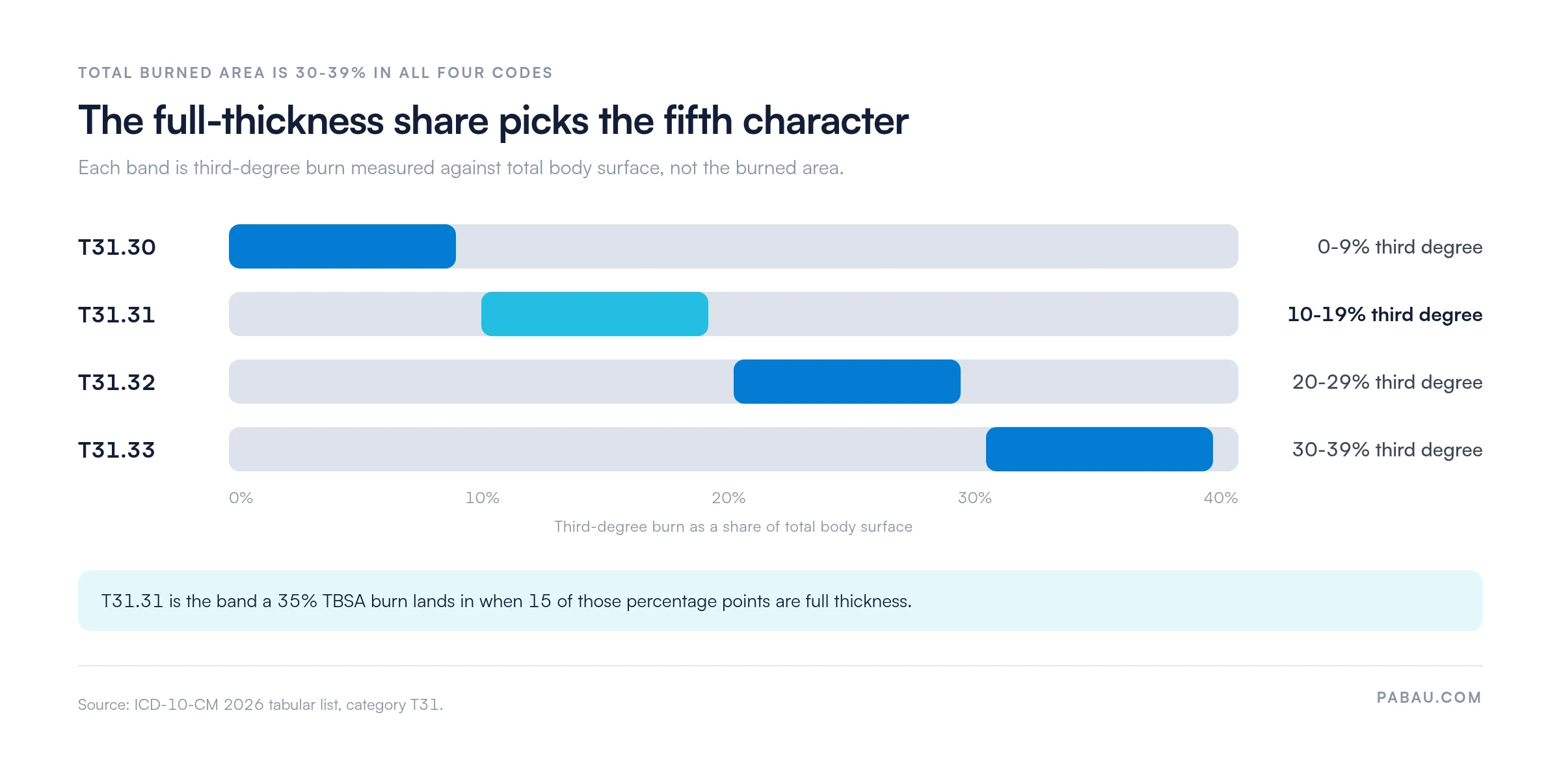
T31 runs from T31.0, burns involving less than 10% of body surface, through T31.9, burns involving 90% or more. Each subcategory covers a 10-point band of total burned surface.
The fifth character records how much of that total is third degree, and it never exceeds the band itself. T31.3 therefore subdivides into T31.30 through T31.33 only, and no T31.34 exists.
Each step up in the third-degree tier reflects greater full-thickness involvement, and usually a heavier resource burden for the care team. Payers and DRG groupers read that percentage directly off the fifth character. Selecting T31.30 when the documentation supports T31.31 is a coding error and an under-billing error at once.
Laid out on one scale, the four bands sit end to end like this.
The AAPC ICD-10-CM lookup lets coders cross-reference the full T31 hierarchy quickly when they are working through a complex burn case.
Third-degree burns, also called full-thickness burns, destroy the epidermis and the entire dermis, often reaching subcutaneous tissue. In T31.31, the 10-19% figure specifies that this destruction covers between one-tenth and just under one-fifth of the patient’s total body surface area. The denominator is the whole body, never the burned area alone.
That denominator trips up newer coders. Take a patient with 35% TBSA burns where 15% of the burned area is full thickness. At a glance that reads as 15% third degree.
But T31 coding requires the third-degree percentage relative to total body surface, so 15% of 35% works out at roughly 5.25% of the body. That case belongs in T31.30, not T31.31.
Physicians who write “15% full-thickness of the burn area” without naming the reference point leave the coder with an ambiguity. Clarifying the denominator is one of the most useful coaching points a coding team can take to a burn unit. One sentence in the note prevents a tier error that an auditor will find later.
The tabular list note under category T31 sets the rule in two halves. T31 is the primary code only when the site of the burn is unspecified. Where the site is documented, T31 is used as a supplementary code with categories T20-T25.
Section I.C.19.d.6 of the ICD-10-CM Official Guidelines adds a second trigger for the category. T31 is assigned for acute burns when the site is not specified, or when there is a need for additional data. Reporting it alongside site codes is described there as advisable rather than mandatory.
The guideline points most strongly at third-degree burns covering 20% or more of body surface. T31.31 sits below that threshold, so the site codes carry the sequencing and T31.31 carries the extent.
When the record names the burn sites, the claim is built in this order:
If the record documents the extent but never names a site, that order collapses to one step. T31.31 is reported as the principal or first-listed diagnosis, followed by the external cause codes, and the claim is complete without a T20-T25 code.
No Medicare Code Editor rule, NCCI edit, or published clearinghouse edit rejects a claim because T31.31 arrives on its own. T31.31 is a valid principal diagnosis and groups to a burn MS-DRG by itself. Site codes earn their place through clinical completeness and accurate DRG assignment, not through a payer edit waiting to fire.
Submitting the T20-T25 codes without T31.31 is compliant for outpatient encounters. On an inpatient burn admission it costs the record its severity detail, which feeds both DRG assignment and burn center resource tracking.
A claim carrying T31.31 has to be supported by a clinical record that documents all of the following. A missing element gives a payer auditor grounds to deny or downcode the claim.
Burn documentation queries are among the most common physician query scenarios in inpatient facilities. Compliance programs for burn units usually keep a standing query template for TBSA confirmation when the note is ambiguous.
The goal is specificity without leading the physician. Ask “what was the total TBSA, and what percentage was full thickness?” rather than “does the patient have T31.31?”
Run a quarterly audit of your T31 claims and pull every case where a T31.3x code was submitted with no T20-T25 site code. Some of those are correct, because the record never named a site. The rest point to notes that described the burn locations, which then dropped out of the coded claim and cost the case its severity detail. Pair the audit with a release checklist that requires TBSA %, third-degree %, and the assessment method.
Four errors do most of the damage on burn claims. Each one is worth a standing check before the claim goes out.
Practices that review burn claims before submission catch most of these at the front end. A few minutes of coder time costs far less than a post-payment audit finding on a burn case. Measuring the file against clean claim standards gives the team something concrete to validate before anything is transmitted.
Selecting the correct T31.3 sibling takes two confirmed figures from the clinical record: total TBSA and third-degree TBSA. Neither can be inferred or estimated for coding purposes. The table below maps the full T31.3 series, so coders can confirm the selection before submission.
Where the documentation does not clearly separate the tiers, query the provider before coding. A note reading “approximately 30% third-degree component” is one example. It never says whether that figure is of the burn area or of total body surface. Coding down to T31.30 to avoid the query is downcoding, and it carries its own compliance risk.
The ICD List free lookup tool helps coders cross-check the T31 subcategory tree while they review the documentation.
The sibling codes in the T31.3 series sit beside T31.31 in Pabau’s ICD-10-CM code library. Pulling up the neighboring tier is a quick way to settle a borderline case.
Before you submit any T31 code, run a three-question check. Does the note state a numeric TBSA percentage in the 30-39% range? Does it state the third-degree percentage against total body surface rather than against the burn area? Does it name the burn sites, so the T20-T25 codes can lead the claim? Any no is a provider query before billing. One clarification note costs minutes, and an audit finding costs weeks.
Burn cases generate documentation across several encounters, and the coder is usually reading a note written by someone else. When the TBSA figures sit in one system and the claim is built in another, confirming a percentage means opening both. The two versions do not always agree.
Pabau, practice management software built for healthcare practices, keeps the clinical record and the claim in the same place. Charting templates capture the TBSA percentage, the third-degree percentage, and the assessment method while the patient is still in front of the clinician.
Claim forms are then pre-filled from that record, with ICD-10-CM and CPT lookup libraries behind a search icon on the claim itself.
Claims go out through an integrated clearinghouse, and eligibility checks, remittance posting and claim-status updates return to the same patient file. Coders can check the burn note against the claim without switching systems, and billing leads can see which burn claims stalled and why.

Pabau keeps burn documentation and the claim it supports in one record. The claim form is pre-filled from that record. Every submission is tracked through to remittance, so your team can see where a burn claim stands.

T31.31 carries real reimbursement weight on burn cases, and the mistakes behind its denials are predictable.
The tier gets chosen from a percentage measured against the burn area instead of total body surface. The TBSA figure arrives as “extensive burns” rather than a number. Documented burn sites never reach the claim, which understates severity even though the claim still processes. Consistent pre-submission review catches all three.
Treat the two percentages as the code’s real content, and the rest of the burn claim follows. Pabau pre-fills the claim from the clinical record, checks that claim-required fields are complete before submission, and tracks each claim through to remittance. To see how that fits your burn coding workflow, book a demo.

Need to understand how clearinghouse edits catch burn code errors before submission? How a medical claims clearinghouse works explains the validation layer between your practice and the payer.
Want to reduce denial rates across your ICD-10 claims? Denial management in healthcare covers how to catch and correct claim errors before and after submission.
Looking for the billing document behind an accurate code set? What is a superbill walks through the structure that supports accurate ICD-10 code submission.
New to the revenue side of trauma and burn cases? What is medical billing sets out how a claim travels from the clinical note to payment.
Building a query and audit process around burn documentation? Medical billing compliance covers the controls that keep coded claims defensible on audit.
No. T31.31 is complete at five characters and takes no 7th-character extension. The encounter type is carried by the T20-T25 site codes and the external cause codes on the same claim. Those take A for initial, D for subsequent, and S for sequela. So the same T31.31 can appear on an initial admission and on a later follow-up claim.
No, on both counts. Sunburn is excluded from the burn categories and is coded to L55.-, however extensive it looks. Chemical injuries are corrosions, not burns, and belong in T32. The T32 series mirrors T31 character for character, so T32.31 is the corrosion equivalent of T31.31. The agent documented in the record decides which series applies.
Not on its own. Section I.B.14 of the Official Guidelines names a short list where another clinician’s documentation can drive code assignment. It covers items like BMI, pressure ulcer stage and coma scales. Burn extent and depth are not on that list. A nursing flowsheet is useful supporting detail, but the provider has to state the percentages.
Code the extent the provider documents for the acute burn. Burn wounds are often reassessed as they declare, and a revised percentage can move the case into a different T31 subcategory. Where the final documented assessment supports a different code, the claim should reflect it. Keep both assessments in the record so the change is traceable on audit.