ICD-10 Code Y76.0: Diagnostic obstetric and gynecological devices
ICD-10 Code Y76.0: Definition and billable status ICD-10 Code Y76.0 is a valid, ...

Last Updated: Oct 23, 2026
Billable Code Specific Code
T31.44 is the billable ICD-10-CM code for burns involving 40-49% of body surface with 40-49% third degree burns.
The two percentages are measured separately, and both have to land in the 40-49% band. Choosing correctly between T31.40 and T31.44 sets the MS-DRG, the reimbursement weight, and how closely a payer reads the chart.
Let Pabau's smart automation suggest the right codes, reduce claim denials, and keep your practice compliant—effortlessly.
Automate repetitive tasks and focus on what matters most—your patients.
Reduce coding errors and ensure compliance with the latest regulations.
Clean claims, fewer denials, and faster reimbursements.
Powerful insights and reporting to help your practice thrive.
HIPAA compliant SOC 2 certified GDPR-compliant Trusted by 4,000+ clinics worldwide

T31.44 is a billable ICD-10-CM code covering 40-49% TBSA burns where 40-49% of that area is third-degree injury, valid from October 1, 2025.
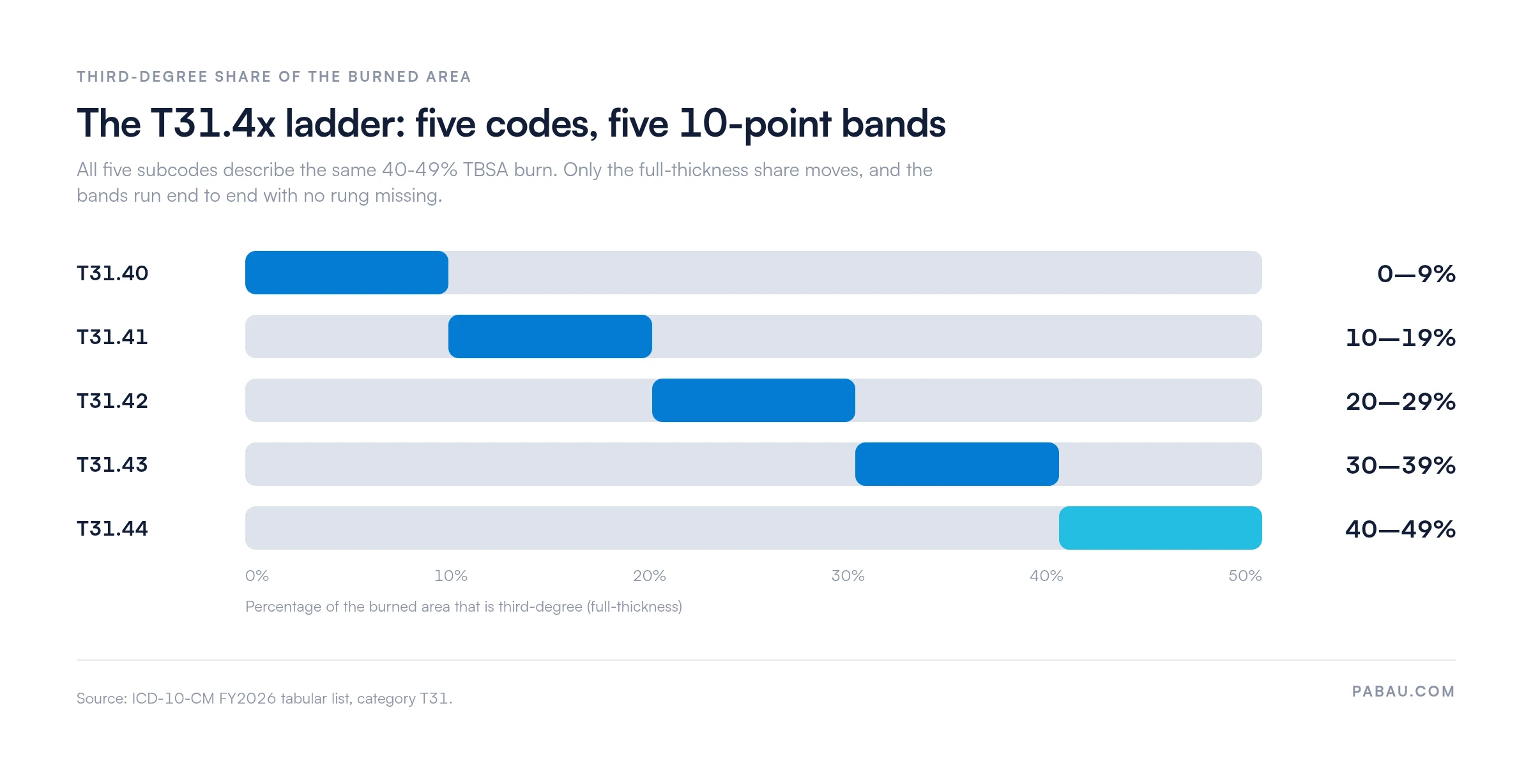
The fourth digit reports the third-degree share of the burned area in 10-point bands. T31.40 covers 0-9%, T31.41 covers 10-19%, and T31.44 covers 40-49%.
TBSA is calculated with the Rule of Nines for adults. The Lund-Browder chart is preferred for pediatric patients, whose body proportions differ by age.
T31 codes cover thermal burns classified by extent, and T32 codes cover corrosions. The mechanism of injury, not the depth, decides which category applies.
The table below covers the core reference data coders and clinicians need before billing or documenting a T31.44 encounter. All details reflect the FY2026 ICD-10-CM edition.
ICD-10 code T31.44 means the patient has thermal burns across 40-49% of total body surface area. Of that burned area, 40-49% is third-degree injury. Third-degree burns destroy the epidermis, dermis, and underlying subcutaneous tissue. They present as dry, leathery, or waxy wounds that are insensate at the burn site, because the sensory nerve endings have been destroyed.
The clinical picture at T31.44 is a major burn injury requiring intensive care. Patients typically need fluid resuscitation calculated from the Parkland formula, surgical debridement, and skin grafting over large surface areas. Wound-depth mapping has to be captured at each surgical encounter. The code at discharge can differ from the admission code once depth assessments are refined during treatment.
Two clinical distinctions matter for coding accuracy. First, third-degree burns are distinct from deep partial-thickness (deep second-degree) burns. Deep partial-thickness burns spare some dermal appendages and may be moist with reduced sensation, while third-degree burns spare none. Conflating the two changes the fourth digit.
Second, the 40-49% band has to be met twice over. The total burn extent and the third-degree subset must each fall inside it before T31.44 applies.
The T31 category organizes burn diagnoses by the percentage of body surface area involved rather than by anatomical location. That is what separates T31 from the anatomically specific burn codes in T20-T25. When a burn spans several body regions, T31 gives a single code for overall severity based on extent.
The first digit after the decimal sets the TBSA range, in 10-point steps. T31.0 covers less than 10% TBSA, T31.4 covers 40-49%, and the series runs up to T31.9 for 90% or more. A recount that puts the total at 50-59% leaves the T31.4 group, and with 30-39% third degree the code is T31.53.
The Rule of Nines assigns a fixed percentage of body surface area to each anatomical region for adult patients. Clinicians sum the involved regions to obtain TBSA. The standard adult assignments are:
One route to 45% TBSA is the full posterior trunk at 18%, both upper extremities at 18%, and half of one lower extremity at 9%. The Lund-Browder chart is preferred for patients under 15, because head-to-leg proportions shift a great deal during development. In young children the Rule of Nines overstates head involvement and understates the legs. Any TBSA figure in the record should name the tool used, per CMS ICD-10-CM coding guidelines.
The fourth digit in the T31.4x subcategory specifies what proportion of the established TBSA burn is third-degree injury. The percentage is nested. It applies to the burned area only, not to the patient’s total body surface.
Take a 45% TBSA burn where 20 of those 45 points are third-degree. That is roughly 44% of the burned area, so T31.44 applies. If only 10 of the 45 points are third-degree, the share drops to 22% and T31.42 applies instead.
The five subcodes tile the range in continuous 10-point bands, so every third-degree proportion up to 49% has exactly one code. A calculated share of 35% lands in T31.43, and 41% moves the same claim to T31.44. The ladder below shows where each band sits.
T31 and T32 are parallel code categories. T31 covers thermal burns classified by extent, and T32 covers corrosions, meaning chemical burns, classified the same way. The mechanism of injury decides the category, not the wound depth or the TBSA.
A frequent coding error is applying T31.44 to a chemical plant injury where a corrosive agent caused the wound. The clinical appearance can be identical to a flame burn, but the ICD-10-CM Official Guidelines make the mechanism decide the category. Check the emergency department note or the incident report for language like “acid exposure,” “alkali splash,” or “chemical burn.” Any of those routes the claim to T32.44 instead.
Review the emergency department triage note and incident history before assigning T31.44. If the documentation mentions a chemical agent rather than heat or flame, T32.44 is the correct code. A mismatch between mechanism of injury in the record and the T31 code family can trigger a payer audit.
Supporting T31.44 through a claim takes documentation that goes well beyond the code description. Most burn coding denials come from missing TBSA measurement detail or thin burn-depth characterization, not from picking the wrong code. The clinical record has to answer five questions before the claim leaves the facility.
Depth estimates are often revised between admission and discharge, which is clinically normal as edema resolves and the wound demarcates. The discharge summary should explain any change from the admission code. The code that goes out on the claim has to match the discharge summary, not the emergency department triage note.
A downward revision can change both percentages at once. A patient remeasured at 35% total with 10-19% third degree no longer sits in T31.4, and the claim becomes ICD-10-CM code T31.31.

T31.44 maps to MS-DRG groups in the burn injury family under Medicare’s Inpatient Prospective Payment System (IPPS). Burns are among the highest-cost DRG categories, because of the ICU stays, repeat surgeries, and long rehabilitation they usually involve. Three things decide which MS-DRG a T31.44 encounter lands in. They are the procedure codes billed alongside the diagnosis, the discharge disposition, and any Major Complication or Comorbidity (MCC).
Under IPPS grouping logic, extensive burns with a large third-degree component commonly fall in MS-DRG 927. That group covers extensive or full-thickness burns with 96 or more ventilator hours plus a skin graft. Related burn DRG pairs pick up the rest, depending on ventilator hours and grafting performed. Weights and payment amounts are updated annually in the CMS IPPS Final Rule, so verify the current year before relying on any published figure.
Billing teams should expect payer requests for clinical records whenever the MS-DRG weight is this high. Three checks before submission:
Those secondary diagnoses shift DRG assignment, and some of them qualify as MCCs on their own. On the procedure side, surgical preparation of the burn wound before grafting is reported with CPT code 15002. The operative note behind it has to agree with the burn diagnosis on the same claim.
T31.44 is a valid, active ICD-10-CM code for FY2026. It became effective October 1, 2025, under the annual update cycle maintained by CMS and the National Center for Health Statistics (NCHS). The FY2026 update made no revisions to the T31.44 descriptor or its position in the T31 hierarchy.
The ICD-10-CM code set is updated every October 1. Checking the current edition against the CDC/NCHS ICD-10-CM web tool before billing confirms billable status and surfaces new inclusion or exclusion notes. T31.44 has kept the same description across recent editions. Coding guidelines, payer policies, and MS-DRG assignments can still change around a code that does not.
Coders working across the wider ICD-10-CM code set will recognize conventions that apply system-wide, such as seventh-character extensions for injury sequencing. T31.44 does not take a seventh character. The site-specific burn codes in T20-T25 do, using A for an initial encounter, D for a subsequent encounter, and S for sequela.
Several clinical and administrative terms map to T31.44. Coders meet them in physician notes, operative reports, and trauma documentation, and should read them as equivalent expressions of the same diagnosis.
Where the record says “full-thickness” rather than “third-degree,” the terms are interchangeable for coding purposes and ICD-10-CM accepts both. “Deep partial-thickness” and “deep second-degree” are not synonyms for third-degree. Neither supports T31.44 unless a physician recharacterizes the wound as full-thickness on a later assessment.
A burn admission produces one diagnosis code on day one and a revised one after the first debridement. In most facilities those revisions sit in the operative notes, and the billing team finds out about them by reading the chart at discharge.
Practice management software like Pabau keeps the code, the wound-mapping note, and the claim on one patient record. Pabau’s software for billing teams flags encounters where the diagnosis changed mid-stay. The version that reaches the payer is then the one the discharge summary supports.
Coders can then open the documentation behind a T31.44 claim without logging into a second system. Denials that turn on TBSA detail get caught before submission rather than after the remittance arrives.

Pabau links every diagnosis code to the clinical encounter behind it and flags mid-stay code changes. Billing teams get the documentation a payer will ask for, without a second system.

The hard part of T31.44 is not finding the code. It is producing a record that shows two separate percentages, measured with a named tool, and revised in writing when the wound demarcates.
Practices that treat the wound-mapping diagram as a billing document spend less time answering payer record requests on high-weight burn claims. The diagram is what connects a percentage to an anatomical location, and it is the first thing a reviewer asks for.
Fix the documentation and the code follows. Book a demo to see how Pabau keeps burn diagnosis codes and their supporting notes on one record from admission through payment.

Need to understand how burn claims move through the clearinghouse? Claim.MD clearinghouse overview explains how electronic claims submission works for complex inpatient diagnoses.
Want to reduce burn coding denials before they happen? Denial codes in medical billing covers the most common CARC denial reasons and how to address them at the documentation stage.
Looking for a reference on the 837 claim format used for inpatient billing? 837 file guide walks through the electronic claim format that carries T31.44 and other inpatient diagnoses to payers.
ICD-10 code T31.44 is a billable ICD-10-CM diagnosis code for burns covering 40-49% of total body surface area. Within that burned area, 40-49% must be third-degree (full-thickness) injury. It is valid for FY2026 encounters on or after October 1, 2025. It is used mainly for inpatient reimbursement in burn unit and trauma settings.
Yes, T31.44 is a billable, specific ICD-10-CM code valid for diagnosis reporting and reimbursement. It meets the specificity requirement for claim submission and needs no additional code or extension character to be complete.
T31.43 applies when 30-39% of the 40-49% TBSA burn is third-degree. T31.44 applies when 40-49% of the burned area is third-degree. The TBSA range is identical for both codes, so only the full-thickness proportion separates them. Using T31.43 when the third-degree component reaches 40% undercodes the case and lowers the DRG reimbursement weight.
T31 codes apply to thermal burns caused by heat, flame, radiation, electricity, or friction. T32 codes apply to corrosions caused by chemical agents such as acids or alkalis. The wound can look identical either way. The mechanism of injury documented in the clinical record decides the correct category.
T31.44 most commonly groups to burn MS-DRGs such as 927. That group covers extensive or full-thickness burns with 96 or more ventilator hours plus a skin graft. Related pairs apply depending on the procedure codes billed and the discharge disposition. Verify the current-year weight in the CMS IPPS Final Rule, since weights update annually.
For adults, TBSA is calculated with the Rule of Nines. Head and neck count 9%, each upper extremity 9%, the anterior trunk 18%, the posterior trunk 18%, each lower extremity 18%, and the perineum 1%. For pediatric patients under 15, the Lund-Browder chart is preferred, because it accounts for age-related differences in head-to-limb proportions. The tool used has to be named in the clinical record.