

ICD-10 code S61.201A: Open wound of left index finger without nail damage
ICD-10 code S61.201A covers a left index finger wound of unstated type ICD-10 co...

Last Updated: Oct 16, 2026
Billable Code Specific Code
T23.421S is the billable ICD-10-CM code for corrosion of unspecified degree of single right finger (nail) except thumb, sequela.
The 2 in the middle of T23.421S is a site character, not a laterality character. As a result, a coder who reads it as laterality will reach for this code on a whole-hand injury that belongs to T23.401S.
Corrosion sequela visits usually land months or years after the chemical injury itself. The patient comes back for scar release, a nail deformity, or hand therapy. Even so, the coder still has to pin down the site and the encounter phase.
Let Pabau's smart automation suggest the right codes, reduce claim denials, and keep your practice compliant—effortlessly.
Automate repetitive tasks and focus on what matters most—your patients.
Reduce coding errors and ensure compliance with the latest regulations.
Clean claims, fewer denials, and faster reimbursements.
Powerful insights and reporting to help your practice thrive.
HIPAA compliant SOC 2 certified GDPR-compliant Trusted by 4,000+ clinics worldwide

T23.421S is the ICD-10-CM code for corrosion of unspecified degree of single right finger (nail) except thumb, sequela.
It codes one finger, not the whole right hand. A whole-hand corrosion sequela takes T23.401S instead.
In T23.4 the fifth character carries the site and the sixth character carries laterality. The 2 means single finger except thumb.
The 7th character S means the acute chemical injury has resolved and the visit treats what it left behind.
The tabular entry says code first (T51-T65) to identify the chemical and the intent. There is no X40-X49 block in ICD-10-CM.
Y92 codes the place of occurrence and Y93 codes the activity. Both are reported once, at the initial encounter.
T23.421S is a billable, valid-for-submission ICD-10-CM diagnosis code for corrosion of unspecified degree of single right finger (nail) except thumb, sequela. In particular, it is effective for FY2025 (October 1, 2024) and FY2026 (October 1, 2025).
The code sits in Chapter 19, which covers injury, poisoning and certain other consequences of external causes (S00-T88). In practice, report it when a patient is treated for a lasting effect of an earlier chemical injury to one right finger other than the thumb.
The table below summarizes the attributes coders check before they submit T23.421S. Note the code-first row, because the corrosion code is never complete on its own.
Every element of T23.421S carries a specific clinical and coding meaning. As a result, misreading any one of them produces the wrong code and a likely denial. Per the CMS ICD-10-CM official code listings, the description breaks down as follows.
This is the single most common source of error on T23.4 claims. Specifically, the fifth character carries the anatomical site, and laterality arrives only at the sixth character. Reading T23.421S from left to right gives corrosion of unspecified degree of wrist and hand, then single finger except thumb, then right, then sequela.
The panel below maps that reading position by position, next to the whole-hand alternative.
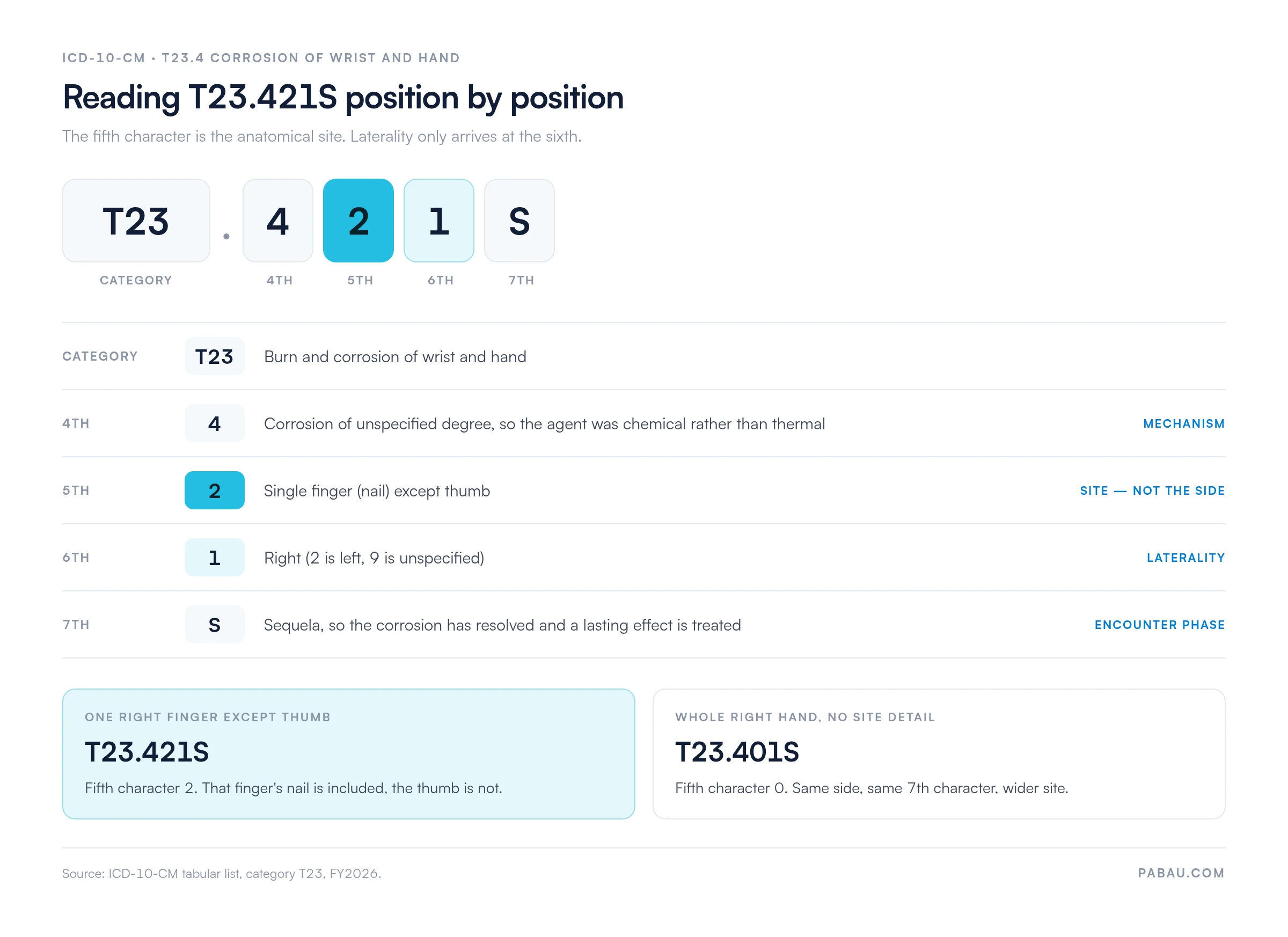
Several approximate clinical synonyms route to this code. For example, late effect of chemical burn of a right finger, and sequela of corrosive injury to the right index finger. Both index here only when the degree was never documented.
The 7th character decides which encounter phase you are billing, so payers watch it closely. Section I.C.19.a of the ICD-10-CM Official Guidelines for Coding and Reporting sets out three options for injury codes. A, D, and S map to different covered services, which is why the wrong character reads as a mismatch on the claim.
One practical test settles most cases. Do not use S if the wound is still open, still healing, or still under active care. Use S only once the corrosion has resolved and the visit treats what the injury left behind.
The procedure codes on the same claim are a useful cross-check. A finger still covered by a membrane wrap billed under HCPCS code Q4205 is under active care, so use A or D.
Name the finger in the note, not just the hand. A record that says chemical burn to the right hand supports T23.401S, not T23.421S. When the surgeon documents the right index finger and its nail bed, the single-finger code is defensible and the site edit clears.
Corrosive agents keep damaging tissue until they are neutralized or diluted, so a single finger can end up with deep injury from a small exposure. Fingers also carry very little soft tissue over the tendon sheath and the nail bed. The residual findings that bring these patients back are therefore mechanical and sensory, not just cosmetic.
T23 covers both mechanisms, and the fourth character tells them apart. Specifically, thermal, electrical, friction, and radiation injuries are burns and take T23.0 through T23.3, while chemical injuries are corrosions and take T23.4 through T23.7.
The thermal equivalent of T23.421S is T23.021S, which covers a sequela of a thermal burn to the same finger site. Check the mechanism in the original note before you pick the fourth character.
T23.421S sits inside a clean parent-child chain under Chapter 19. In practice, following that chain is the fastest way to confirm you are on the right site before you add laterality and the 7th character.
The codes below are the ones most often confused with T23.421S. Specifically, the first group varies the encounter phase and the side, the second group varies the site, and the third varies the documented degree. The AAPC ICD-10-CM code lookup carries the full T23 range for cross-referencing.
The T23 range stops at the wrist. A corrosion sequela higher up the arm moves to T22, so a third degree right elbow takes T22.721S instead. The original note has to name the site clearly enough to place it on one side of that boundary.
The corrosion code is never complete on its own. Instead, the tabular entry at T23.4 carries a code-first instruction for the chemical agent, and Chapter 20 supplies the rest of the chain.
Section I.C.20 of the Official Guidelines requires external cause codes whenever the cause of the injury is documented. Missing companion codes are a recurring source of rejections, which our guide to denial codes works through.
One correction worth flagging: there is no X40-X49 block in ICD-10-CM. The X chapter jumps from X39 straight to X50, so X46 and X49 are not valid codes and never were. Any instruction to report them for a corrosive substance is therefore wrong. Instead, chemical identity and intent live in T51-T65.
Y92, Y93, and Y99 are each reported once, at the initial encounter for the injury. They are not repeated on later visits, so a clean sequela claim usually carries the residual condition, the T51-T65 chemical code, and T23.421S.
Practice management software like Pabau keeps the note, the codes your coder assigns, and the invoice on one patient record. The original encounter’s detail is then still there when the sequela visit arrives.
Pabau’s claims management software submits and tracks claims through our Claim.MD integration. As a result, your team sees where each sequela claim sits without logging into a separate portal. Coding decisions stay with your coder. The software carries them to the payer and brings the response back.

Sequela encounters follow their own sequencing rules. Section I.B.10 covers sequelae in general and Section I.C.19.d covers burns and corrosions specifically. The CDC ICD-10-CM official tool is the place to confirm a descriptor before you submit.
The documentation problems that block clean claim submission on these encounters are consistent. For instance, coders see notes that record a prior chemical burn without naming the residual condition. They see the whole hand documented when the treated site was one finger. They also see records with no chemical agent anywhere in the chart, which leaves the code-first instruction unmet.
Build a three-point pre-submission check for every T23.4 sequela claim. First, confirm that a residual condition code sits ahead of the corrosion code. Second, confirm that a T51-T65 chemical code is present with a matching 7th character. Third, confirm that the documented site is one finger rather than the hand. Those three checks clear most corrosion sequela denials before the claim leaves the practice.
T23.421S is only defensible when the chart supports each element of the descriptor. The list below is what an auditor looks for on a corrosion sequela encounter. Most of it comes from the original injury record rather than today’s note, which is why continuity of the chart matters so much.
Almost every T23.421S problem traces back to one of the six errors below. In fact, the first two are the same mistake seen from different angles, and together they account for most of the misuse of this code.
Legacy systems and retrospective research databases still reference ICD-9-CM. Per the General Equivalence Mappings published by the Centers for Medicare and Medicaid Services, T23.421S maps to the code below. The mapping is approximate in one direction only, because ICD-9-CM had no separate late-effect code for corrosions and no finger-level detail.
T23.421S has no reported revisions for FY2025 or FY2026. It has been valid and billable since ICD-10-CM was adopted, and it remains active with no change to its descriptor.
Practices that handle chemical injury aftercare should still confirm the descriptor each October. The fiscal year update can change wording without retiring a code, so an annual check belongs in the coding calendar.
Dermatology, plastics, and hand therapy caseloads carry most of these encounters. Keeping a current code list in the system that produces the claim reduces the chance of submitting a descriptor that no longer matches the chart.
A sequela claim depends on a record written months or years earlier. Practices that keep the acute encounter in one system, the operative note in another, and the billing detail in a spreadsheet lose that trail. The coder then guesses at the site, picks the safer unspecified code, and the claim comes back.
Pabau keeps the clinical note, the diagnosis codes your coder assigns, the invoice, and the payer response on the same patient record. When the patient returns for scar release two years later, the original chemical agent and the finger involved are one click away.
Claims go out and come back through our Claim.MD integration, so your team follows each one to remittance without leaving the record. Coding decisions stay with your coder throughout.
The outcome is fewer unspecified codes, fewer rework hours, and less waiting between the visit and the payment. Every Pabau subscription includes the full feature set, so claims tooling is never an upgrade you buy later.

Pabau holds the clinical note, the diagnosis codes your coder assigns, the invoice, and the payer response together. Claims go out and come back through our Claim.MD integration, so your team follows each one to remittance.

The site character is what makes or breaks a T23.4 sequela claim. When the note describes the whole right hand, T23.401S is the correct choice. Specifically, when it names one right finger other than the thumb, T23.421S is defensible and specific.
Around that code, the claim needs the residual condition sequenced first. It also needs a T51-T65 chemical code with a matching 7th character, and no leftover X46 or X49 entries. Get those three right and corrosion sequela claims stop bouncing.
The harder part is the chart rather than the code. In practice, a sequela visit two years out is only codeable if the original encounter’s detail survived, which makes this a records problem first. Book a demo to see how Pabau keeps that detail on one patient record.

Need another corrosion sequela reference? ICD-10 code T22.462S walks through the same 7th character rules for the scapular region.
Coding a burn rather than a corrosion? ICD-10 code T31.61 covers the body surface extent codes that pair with burn claims.
Working through repeat rejections? Denial management in healthcare explains how missing companion codes turn into denials and how to work them back.
T23.421S is the billable ICD-10-CM code for corrosion of unspecified degree of single right finger (nail) except thumb, sequela. Use it when a patient is treated for a lasting effect of an earlier chemical injury to one right finger other than the thumb. Typical residual conditions include scarring, a contracture, or nail deformity.
No. T23.421S codes a single right finger other than the thumb. The whole right hand with no site detail takes T23.401S instead. In the T23.4 family the fifth character carries the anatomical site and the sixth carries laterality. The 2 in T23.421S therefore means single finger except thumb, not right.
Yes. T23.421S is a billable, valid-for-submission ICD-10-CM code for FY2025 and FY2026. It already carries a 7th character, so it needs no further expansion to reach full specificity.
No. The descriptor excludes the thumb. A right thumb corrosion sequela takes T23.411S. Multiple right fingers without the thumb take T23.431S, and multiple right fingers including the thumb take T23.441S.
T23.421A applies while the patient is receiving active treatment for the corrosion. T23.421D applies to routine care during the healing phase. T23.421S applies only after the corrosion has resolved and the visit treats a lasting effect such as scarring or nerve damage.
The tabular entry at T23.4 says code first from T51-T65 to identify the chemical and the intent. An accidental corrosive acid sequela is T54.2X1S. There is no X40-X49 block in ICD-10-CM, so X46 and X49 are not valid codes. Y92 codes the place of occurrence and Y93 codes the activity, both at the initial encounter only.
Sequence the residual condition first, such as L90.5 for a scar. Follow the code-first note with the T51-T65 chemical code carrying the S 7th character, then add T23.421S to identify the original injury. Do not repeat the Y92, Y93, or Y99 codes on the sequela visit.
Yes. T23.421S is valid for FY2025, effective October 1, 2024, and for FY2026, effective October 1, 2025. Neither update cycle reported a description change or a deletion for this code.



