ICD-10 Code S42.444P: Medial epicondyle fracture, right humerus
ICD-10 Code S42.444P: full descriptor and code validity ICD-10 Code S42.444P car...

Last Updated: Oct 13, 2026
Billable Code Specific Code
S94.10XD is the billable ICD-10-CM code for injury of medial plantar nerve, unspecified leg, subsequent encounter.
Let Pabau's smart automation suggest the right codes, reduce claim denials, and keep your practice compliant—effortlessly.
Automate repetitive tasks and focus on what matters most—your patients.
Reduce coding errors and ensure compliance with the latest regulations.
Clean claims, fewer denials, and faster reimbursements.
Powerful insights and reporting to help your practice thrive.
HIPAA compliant SOC 2 certified GDPR-compliant Trusted by 4,000+ clinics worldwide

S94.10XD is a billable ICD-10-CM code for injury of the medial plantar nerve, unspecified leg, at a subsequent encounter.
The 7th character D means the patient has finished definitive treatment and is now receiving aftercare.
The FY2026 edition took effect October 1, 2025, so the code is valid for reimbursement this fiscal year.
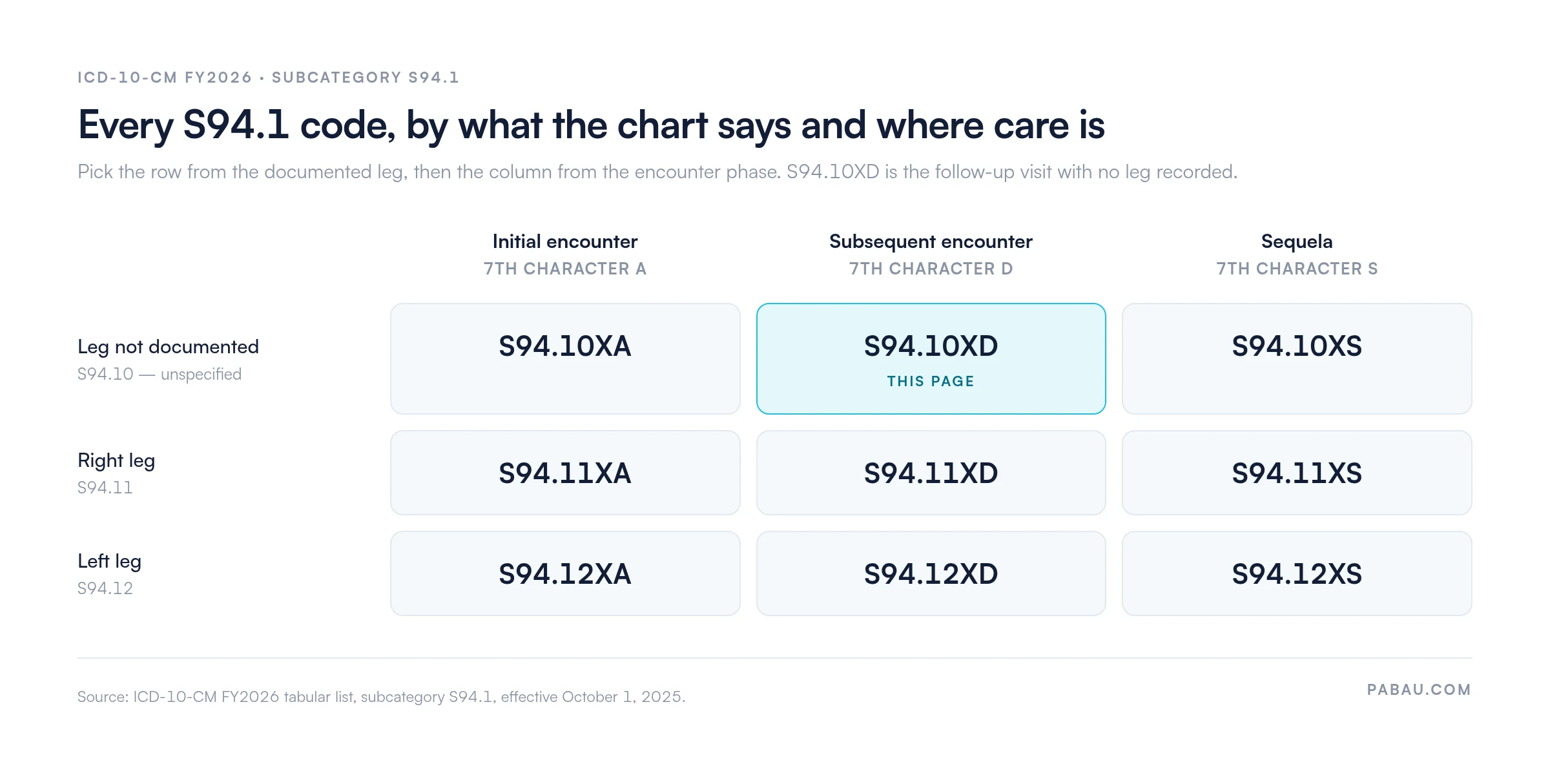
If the chart names the injured leg, code S94.11XD for the right or S94.12XD for the left.
Practice management software like Pabau puts ICD-10-CM lookup inside the client record, so coders stop switching systems mid-visit.
S94.10XD is a billable, specific ICD-10-CM code valid for reimbursement in fiscal year 2026. The table below gives the at-a-glance detail coders need before selecting it.
The medial plantar nerve is the larger of the two terminal branches of the tibial nerve. It runs along the medial side of the sole. It supplies sensation to the medial two-thirds of the plantar surface, plus motor innervation to several intrinsic foot muscles.
Nerve injuries higher up the leg leave the S94 category altogether. A right-leg sciatic nerve injury at hip and thigh level takes ICD-10 code S74.01XA during active treatment. Both the side and the 7th character differ from S94.10XD, so neither carries across.
Injuries to it usually arise from compression, laceration, or traction at the ankle or mid-foot. Sports trauma, crush injuries, and post-surgical complications account for most of them.
In ICD-10-CM, injuries to this nerve sit in the S94 category, which covers nerve injuries at ankle and foot level. S94 belongs to the S90-S99 block for injuries to the ankle and foot. That block is part of the wider S00-T88 injury chapter.
S94.10XD sits at the bottom of a six-level hierarchy in ICD-10-CM. Coders working from the tabular list can follow the path below. The CDC/NCHS ICD-10-CM web tool carries the official year-specific list for verification.
Note the placeholder “X” in position six. ICD-10-CM uses a dummy character so the code reaches the required seven characters. It carries no clinical meaning, and it must be included exactly as shown.
The 7th character is the most error-prone element when coding S94.10XD. All three options are available for every code in the S94.1 subcategory. Choosing the wrong one creates a claim that does not match the clinical record, which is a common trigger for medical necessity denials.
Claim rejections often trace back to assigning S94.10XA past the initial treatment phase. Per CMS ICD-10-CM guidance, “A” applies while the patient is receiving active, definitive treatment for the injury.
Once care shifts to follow-up management, the encounter becomes “D.” That covers physical therapy visits, orthotic adjustment, and monitoring appointments. The treating provider’s notes have to show that transition. If the note describes a wound check or a PT session after initial treatment, assign D rather than A.
Read the treating clinician’s note before assigning a 7th character. The words ‘follow-up’ or ‘continued PT’ tell you D applies. If the note describes active intervention for the acute injury, such as suturing or a nerve block, then A still applies. Misapplying A on a follow-up visit is one of the top denial triggers for S94 series codes.
ICD-10-CM requires laterality specificity wherever the chart documents it. S94.10XD covers the unspecified leg scenario. If the record identifies which leg is injured, a more specific code is required. Using the unspecified variant when laterality is charted may trigger payer-level code edits.
In practice, most notes for an ankle or foot injury name the affected leg. Query the treating provider before defaulting to the unspecified code. Practices using claims management software with built-in ICD-10-CM lookups can flag unspecified laterality before submission, which cuts rework later.
Laterality and encounter phase are two separate decisions, and together they produce nine codes. A left-leg injury still under active treatment, for example, lands on S94.12XA. The grid below lays out all of them.
Clinical documentation often uses different language for the same condition. The terms below all map to S94.10XD when the encounter is a follow-up visit and laterality is unspecified.
Idiopathic or degenerative medial plantar neuropathy that does not follow an acute injury maps to a different code. S94.10XD is for traumatic injuries, coded during the aftercare phase.
Correct use of S94.10XD depends on a handful of rules in the ICD-10-CM Official Guidelines. The five below cover the situations that generate most queries on S94 claims.
Denials on S94 series claims usually come down to the encounter character rather than a coverage problem. Working through your denial management process for injury codes will show whether that pattern holds in your practice. You can verify code-level detail through the AAPC ICD-10-CM lookup.
S94.10XD sits in a tidy group of sibling codes. The table below lists the adjacent ones worth knowing. Reach for them when a different nerve is injured at the same site, or when the provider names a leg. The wider ICD-10-CM code library follows the same conventions across every chapter.
Most S94.10XD denials trace back to thin or ambiguous documentation rather than the wrong code. The checklist below covers what the record needs to support this code without a coder query.
Practices handling post-surgical foot and ankle cases should build laterality and encounter-type prompts into their intake and progress note templates. A prompt in the template moves the decision to the clinician, where it belongs, instead of leaving it to the coder.
Before the claim goes out, verify insurance eligibility and attach the external cause code that supports medical necessity. Confirm too that the payer accepts codes from the current fiscal year. Many states require provider-authenticated notes within a set timeframe, so check payer and state rules before finalizing.
Build a laterality prompt into your foot and ankle progress note template. A checkbox reading ‘Right leg / Left leg / Not determined’ takes two seconds to complete. It removes the most common reason S94.10XD claims come back as unspecified-laterality edits. Laterality is a clinical call, so the note has to drive it, never the coder.
In most practices the note lives in one system and the code lookup lives in another. A coder reads the clinician’s note, switches to a lookup tool, finds S94.10XD, then types it into the claim. Each switch is a chance to carry the wrong 7th character across.
Practice management software like Pabau keeps the two together. The diagnosis code is picked inside the client record that already holds the visit, so note and code stay together. Coders can see the encounter type and the documented leg while they choose the code.
Billing runs from that same record. When the claim goes out, the diagnosis, the encounter type, and the payer details all come from the visit the clinician documented. So you get fewer rekeyed codes, and fewer follow-up visits billed as initial encounters.


Pabau links the clinical note to the diagnosis code and the claim, so encounter type and laterality carry through untouched. See how it works for foot and ankle aftercare.

An S94.10XD claim rests on three decisions. Is the visit follow-up care? Is the leg genuinely undocumented? And does the note say enough to stand without a payer query?
The first two are quick once you know the rules. The third is where practices lose money, because a note written for the clinician rarely answers what the payer asks. Fix the template and the coding decisions mostly make themselves.
Book a demo to see how Pabau ties the progress note to the diagnosis code for foot and ankle aftercare.

Want to know what a payer checks before it processes a claim? Clean claim standards in medical billing covers the code and documentation elements that get a claim paid first time.
Need to read the remittance after an S94 claim is processed? Electronic remittance advice in medical billing explains 835 files and the denial reason codes that appear on them.
Curious how a clearinghouse validates codes before submission? Medical claims clearinghouse workflow shows where laterality and 7th character errors get caught before the payer sees them.
Coding a different nerve at the same anatomical site? ICD-10 code S94.20XA covers deep peroneal nerve injury at the ankle for an initial encounter.
S94.10XD is a billable ICD-10-CM diagnosis code meaning “Injury of medial plantar nerve, unspecified leg, subsequent encounter.” It applies when a patient with a traumatic medial plantar nerve injury is receiving aftercare during the healing phase. It is the right pick only when the affected leg is not specified in the clinical documentation.
Use D when the patient has already received initial, definitive treatment and is now in the aftercare phase. That covers follow-up physical therapy, cast or splint changes, wound re-evaluation, and medication management during healing. Switch from A to D as soon as the provider’s note reflects management of healing rather than active intervention for the acute injury.
S94.10XA is the initial encounter, used while the patient is receiving active, definitive treatment for the acute injury. That includes the emergency department visit, the initial surgical repair, and the first specialist evaluation. S94.10XD is the subsequent encounter, used once that acute phase is complete and aftercare has begun. The note’s language decides it: “follow-up,” “continued PT,” or “wound check post-repair” all indicate D.
Yes. S94.10XD is a billable, specific ICD-10-CM code valid for reimbursement in fiscal year 2026, effective October 1, 2025. It can be used as a stand-alone diagnosis code on a claim form. The documentation still has to support the injury type, the encounter type, and the level of specificity.
The immediate parent is S94.10, injury of medial plantar nerve, unspecified leg. One level up is S94.1, injury of medial plantar nerve. The category is S94, injury of nerves at ankle and foot level, inside the S90-S99 block for injuries to the ankle and foot.
Key related codes include S94.11XD for the right leg, S94.12XD for the left leg, S94.10XA for the initial encounter, and S94.10XS for a sequela. Nearby nerves have their own codes, including S94.01XD for the lateral plantar nerve of the right leg and S94.20XD for the deep peroneal nerve. Select on the laterality and encounter type documented in the record.
No. S94.10XD is specifically for traumatic injuries to the medial plantar nerve. Degenerative, idiopathic, or disease-related neuropathy of that nerve maps to a different code category. If the condition arose from an external cause such as a fall, sports trauma, or a surgical complication, S94.10XD fits the subsequent encounter phase.