ICD-10 Code Y76.0: Diagnostic obstetric and gynecological devices
ICD-10 Code Y76.0: Definition and billable status ICD-10 Code Y76.0 is a valid, ...

Last Updated: Oct 23, 2026
Billable Code Specific Code
S92.811B is the billable ICD-10-CM code for other fracture of right foot, initial encounter for open fracture.
The code is valid from October 1, 2025 through September 30, 2026. It belongs to the FY2026 code set maintained by the Centers for Medicare and Medicaid Services and the National Center for Health Statistics.
The "other fracture" designation captures right foot fractures that do not fit a more specific S92 subcategory. A documented calcaneus or talus fracture, for example, has its own code. Open fracture status and right-side laterality are both encoded within the full seven-character code string.
Coders apply S92.811B only when the provider's documentation confirms an open wound at the fracture site on the right foot. It also has to be the first encounter for active treatment.
Let Pabau's smart automation suggest the right codes, reduce claim denials, and keep your practice compliant—effortlessly.
Automate repetitive tasks and focus on what matters most—your patients.
Reduce coding errors and ensure compliance with the latest regulations.
Clean claims, fewer denials, and faster reimbursements.
Powerful insights and reporting to help your practice thrive.
HIPAA compliant SOC 2 certified GDPR-compliant Trusted by 4,000+ clinics worldwide

ICD-10 Code S92.811B covers an other fracture of the right foot, initial encounter for open fracture. It is valid for FY2026, October 1, 2025 through September 30, 2026.
The 7th character B is mandatory, and it designates an initial encounter for an open fracture only. Using B for a closed fracture is a coding error.
S92.811B is a billable, specific ICD-10-CM code inside the S92.8 subcategory. Its approximate ICD-9-CM equivalent is 825.39, other fracture of tarsal and metatarsal bones, open.
Pabau’s claims software submits S92.811B and its paired CPT codes electronically through the Claim.MD clearinghouse, which reaches thousands of US payers.
S92.811B sits within the ICD-10-CM chapter covering injury, poisoning, and certain other consequences of external causes (S00-T88). The full hierarchy runs from chapter down to the specific seven-character code. Each segment helps coders verify placement and avoid rejections tied to an incomplete code string.
Read from the top down, every character added to the string narrows the diagnosis further. The last two do the work a payer scrutinizes most.
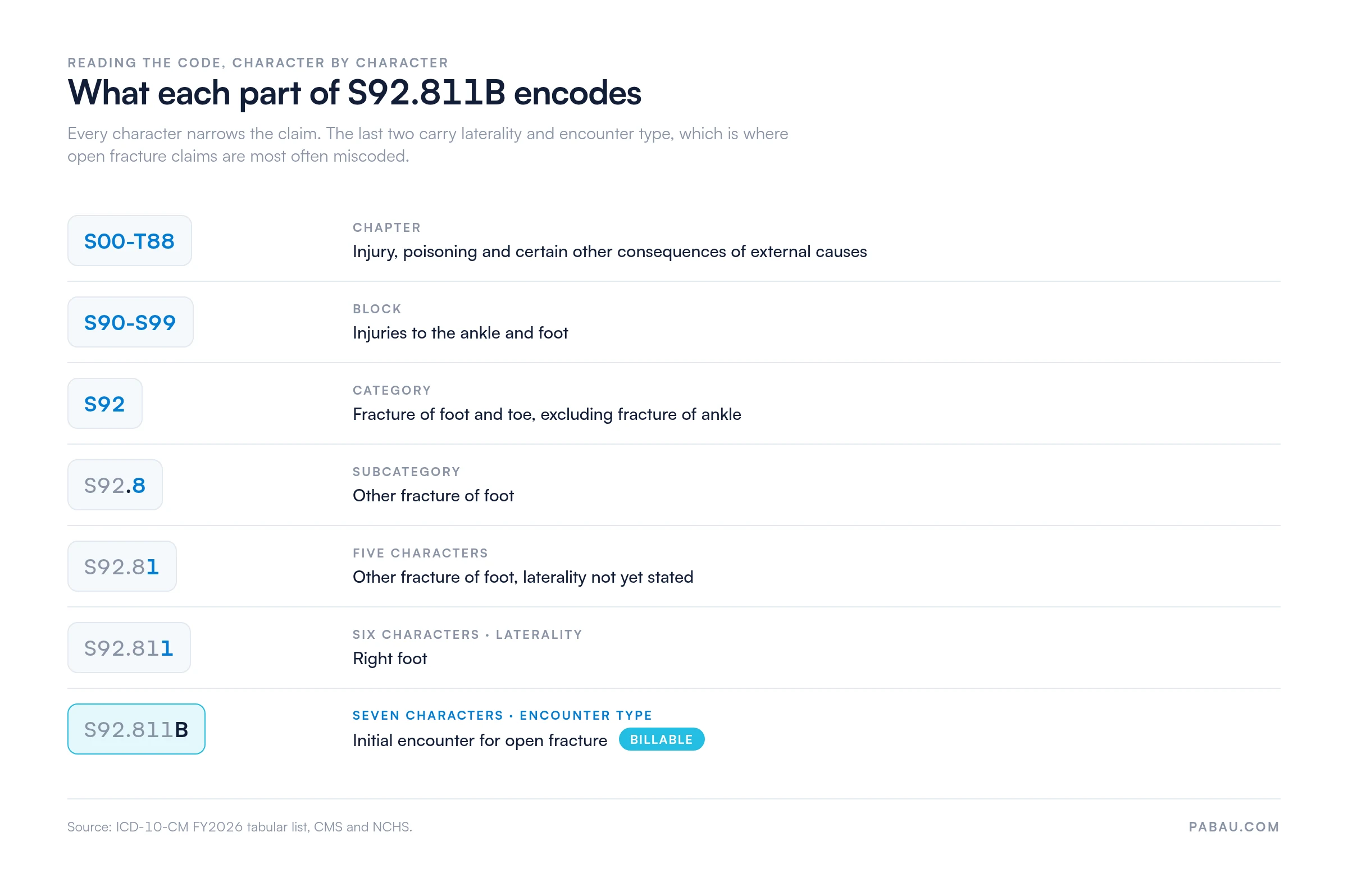
The S92 category excludes fractures of the ankle, which code to S82. Confirm the fracture sits in the foot rather than the ankle joint before assigning any S92 code.
Character B designates the initial encounter for an open fracture, and it carries no other meaning. The 7th character is not optional on fracture codes in category S92. Applying the wrong one is a coding error that can trigger a denial or an audit flag.
“Initial encounter” means the patient is receiving active treatment for the condition. That is typically the first visit to an emergency department or an orthopedic surgeon.
“Open fracture” means the bone has broken through the skin, or an open wound communicates with the fracture site. The treating provider must document both conditions before a coder can select B.
A common error is using B at follow-up visits when the fracture was correctly coded B at the initial encounter. Subsequent visits use D for routine healing, G for delayed healing, K for nonunion, or P for malunion. The provider’s documented healing status decides which one applies.
Audit any claim submitted with 7th character B after the initial treatment visit. Payers flag repeat submissions with B as potential upcoding. Pull the provider note and confirm open fracture status was documented at the first active-treatment encounter before resubmitting.
Several clinical terms appear interchangeably with the S92.811B code description in provider documentation and electronic health records. Recognizing these synonyms helps coders map the right diagnosis to the right code without requesting an unnecessary clarification addendum.
Note that “compound fracture” is a lay synonym for open fracture in common clinical use. When provider notes use this term alongside right foot laterality and an initial encounter date, S92.811B is the appropriate assignment.
S92.811B belongs to a tightly defined family of sibling codes, all of them inside the wider ICD-10-CM code library. The table below covers the complete S92.811 group plus the left-foot equivalents in S92.812. Compare them whenever you are verifying laterality on a bilateral injury claim.
When both feet are fractured in the same event, report both codes. S92.811B covers the right foot, and S92.812B covers the left. Sequencing follows the ICD-10-CM injury coding guidelines. Sequence the code for the most severe condition first, as the provider documented it.
You can verify a sibling code’s current description with the AAPC ICD-10-CM lookup tool before the claim goes out.
Practices running legacy billing systems or reconciling historical claims need an approximate ICD-9-CM mapping. ICD-9-CM used less granular laterality and fracture-type distinctions than ICD-10-CM. No one-to-one equivalent exists, so treat the crosswalk below as a guide rather than a rule.
The ICD-9 code 825.39 did not distinguish right versus left laterality. When converting legacy claims, note which foot was involved. Then confirm the payer’s crosswalk logic accepts the approximate mapping. Do not treat this as an exact equivalent for clinical or audit purposes.
Several ICD-10-CM Official Guidelines for Coding and Reporting rules affect how S92.811B is applied. Coders should review Section I.C.19.c, Coding of Traumatic Fractures, before assigning any fracture code in category S92.
Coding teams should read both the tabular list and the ICD-10-CM Official Guidelines before assigning a fracture code. Orthopedic denial management work frequently traces back to 7th character errors on S92 codes, which makes a periodic audit of these claims worthwhile. The full official guidelines are available through the CDC ICD-10-CM web tool.
Open fractures of the right foot usually require surgical or procedural treatment. The CPT codes paired with S92.811B depend on what the surgeon documented and performed. The table below reflects common pairings in orthopedic and emergency settings. CPT selection must match the documented procedure, never the diagnosis code.
These pairings reflect common clinical contexts, not a promise of payment. Actual code selection depends on the documented procedure and the payer’s policy.
Run a monthly audit of S92.811B claims that were submitted with surgical CPT codes such as 28485 and 97597. Confirm the operative note documents open fracture treatment, not just the diagnosis. Payers increasingly request operative reports for high-value open fracture claims. A mismatch between the CPT and the note is a common source of post-payment audits.
In most orthopedic billing teams, the 7th character gets checked by hand. A coder opens the operative note and confirms the fracture was open. Then they type S92.811B into a claim form that carries no link back to the encounter.
Pabau, practice management software for medical and aesthetic practices, includes claims software for practices that pairs the diagnosis with the procedure inside the patient record. Built-in ICD-10 and CPT catalogs mean a coder picks S92.811B from the same screen that holds the note. Eligibility checks run in real time, before the claim leaves the practice.
Claims then submit electronically through the Claim.MD clearinghouse, which reaches thousands of US payers. So a 7th character mismatch surfaces while the coder still has the chart open, rather than six weeks later on a remittance advice.


Pabau’s claims tools hold the ICD-10 and CPT catalogs inside the patient record, run eligibility checks before submission, and route claims through the Claim.MD clearinghouse. Coders catch 7th character errors before a payer does.

Open fracture claims get denied for a short list of reasons. The 7th character is wrong, or the encounter type changed without a code update. The third reason is a paired CPT code that does not match the operative note.
S92.811B is precise and billable, but only when the provider’s note confirms an open fracture of the right foot. That confirmation has to sit in the initial-encounter note. Every subsequent visit then requires a different 7th character.
Audit a month of S92.811B claims against the operative notes behind them, and you will find the 7th character errors before a payer does. Book a demo to see how Pabau pairs the diagnosis and the procedure before a trauma claim goes out.

Need a reference on medical billing workflows? What is revenue cycle management covers the end-to-end process from diagnosis coding through payment posting.
Concerned about claim denial patterns? Denial codes in medical billing explains the most common CARC denial codes and how to resolve them.
Want to understand clearinghouse submissions? Medical claims clearinghouse guide walks through how 837P files move from practice management software to payer adjudication.
ICD-10 Code S92.811B is the billable ICD-10-CM diagnosis code for an other fracture of the right foot at the initial encounter for an open fracture. It is valid during FY2026, October 1, 2025 through September 30, 2026. It falls within the S92.8 subcategory for other fractures of the foot.
Yes. S92.811B is a billable, specific ICD-10-CM code confirmed as valid for submission by CMS and NCHS for the FY2026 code set. It can be submitted directly on a claim for reimbursement when provider documentation supports it.
S92.811A designates an initial encounter for a closed fracture of the right foot. S92.811B designates an initial encounter for an open fracture. The only difference is the 7th character, which changes the claim’s clinical meaning entirely. Using B for a closed fracture is a coding error and may trigger an audit or denial.
The 7th character B identifies the initial encounter for an open, or compound, fracture. It must be supported by provider documentation stating the fracture is open. That means bone has broken through the skin, or an open wound communicates with the fracture site. It applies only at the first active-treatment visit.
The approximate ICD-9-CM equivalent is 825.39, other fracture of tarsal and metatarsal bones, open. This is an approximate crosswalk only. ICD-9 did not capture right-versus-left laterality, so the mapping is not exact and should not be used as a direct clinical equivalent.
Assign ICD-10-CM Code S92.811B when the treating provider documents an open, or compound, fracture of the right foot at the initial visit for active treatment. Pair it with an external cause code describing the mechanism of injury. Then select the CPT procedure code that matches the documented treatment.
Common CPT codes paired with S92.811B include 28485 for open treatment of a metatarsal fracture with internal fixation. Others are 97597 for debridement of an open wound and 99285 for a high-complexity emergency department visit. The specific CPT code must match the documented procedure. Pairing suggestions do not guarantee payer reimbursement.