ICD-10 Code S42.444P: Medial epicondyle fracture, right humerus
ICD-10 Code S42.444P: full descriptor and code validity ICD-10 Code S42.444P car...

Last Updated: Oct 13, 2026
Billable Code Specific Code
S92.332A is the billable ICD-10-CM code for displaced fracture of third metatarsal bone, left foot, initial encounter for closed fracture.
The parent subcategory S92.3 covers fractures of the metatarsal bones broadly. S92.332 is the six-character base code for a displaced fracture of the third metatarsal, left foot. The appended seventh character A narrows that to the initial encounter for a closed fracture.
Per CMS ICD-10-CM guidance, a code that requires a 7th character is not valid for billing without it. Submit S92.332 on its own and the claim comes back invalid.
Let Pabau's smart automation suggest the right codes, reduce claim denials, and keep your practice compliant—effortlessly.
Automate repetitive tasks and focus on what matters most—your patients.
Reduce coding errors and ensure compliance with the latest regulations.
Clean claims, fewer denials, and faster reimbursements.
Powerful insights and reporting to help your practice thrive.
HIPAA compliant SOC 2 certified GDPR-compliant Trusted by 4,000+ clinics worldwide

S92.332A is a billable ICD-10-CM code for a displaced fracture of the third metatarsal bone, left foot, initial encounter for closed fracture.
It is valid for the FY2026 edition of ICD-10-CM. The 7th character A marks the initial encounter, and six extensions cover the care continuum through sequela.
Documentation must specify four elements: Displacement, laterality, bone, and encounter type. Missing any one of them invites a denial or a downcode.
Practice management software like Pabau keeps the clinical note, the invoice, and the electronic claim in one system. The specificity in the note then carries through to the payer.
The table below provides the complete reference snapshot for S92.332A. Use it for quick verification during coding, auditing, or payer correspondence.
S92.332 requires a 7th character on every claim. The character captures the encounter phase and, at follow-up visits, the healing status of the fracture. Picking the wrong one is a common audit finding in orthopedic billing. The same logic runs through every traumatic injury category in Chapter 19, including ICD-10-CM fracture sequela coding for other body regions.
Per the ICD-10-CM Official Guidelines, “initial encounter” applies each time the patient receives active treatment for the condition. It is not limited to the first calendar visit.
Say a patient fractures the foot on Monday and sees a primary care physician on Tuesday. She then sees an orthopedic surgeon on Thursday for cast application. Both visits take 7th character A, because a treatment decision is made at each one.
For 7th character A, active treatment is the deciding factor. The CDC/NCHS ICD-10-CM tool defines it as any encounter where the provider makes a treatment decision for the current fracture. That covers closed reduction, casting, splinting, surgical planning, and a referral for surgery.
Practices that rely on clean claim submission workflows can build these 7th character rules into the note template itself. Catching an incorrect encounter type at the point of documentation beats catching it at the clearinghouse.
Four documentation elements are required to support ICD-10 code S92.332A. Leave one out and the payer can downcode the claim or deny it outright. The rules for ICD-10-CM documentation specificity work the same way in every category. The code is only as defensible as the note behind it.
Practices handling a steady volume of foot fractures get more from a structured note template than from coder training alone. With Pabau’s orthopedic claims management tools, you can build custom form templates that ask for displacement, laterality, and bone before the note is signed off.
Most patients with a displaced third metatarsal fracture need several follow-up visits. Each visit after active treatment moves to a subsequent encounter code. The healing status documented at that visit decides which extension applies.
Rehabilitation usually runs alongside the orthopedic follow-ups. Look for physical therapy practice management platforms that carry the ICD-10 code into the treatment plan. The coding then stays consistent across the whole episode.
Set against the healing timeline, the six extensions fall into three phases: Active treatment, follow-up, and late effect.
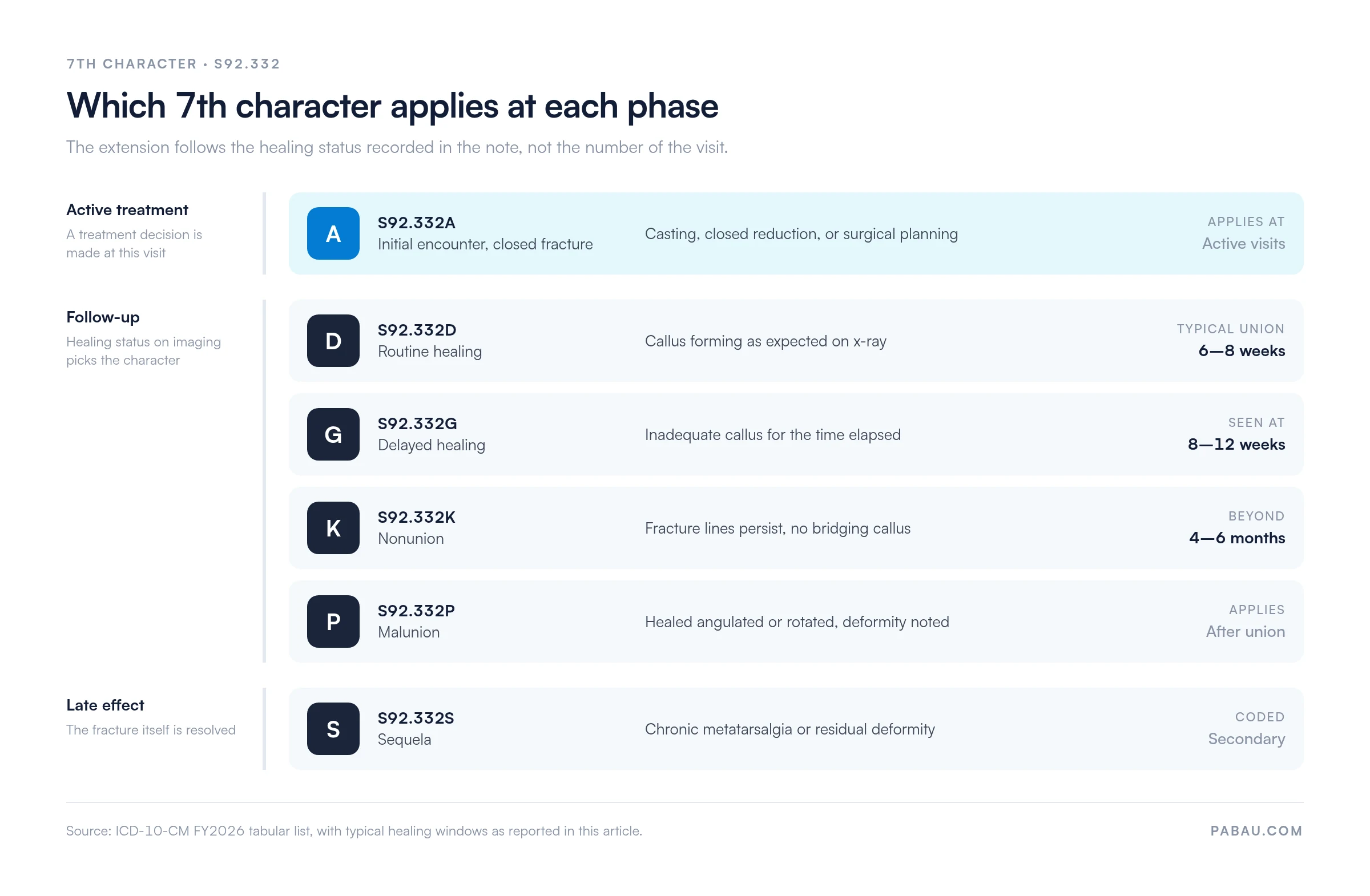
When sequela coding applies, code the sequela condition first and list S92.332S second. The external cause code for how the fracture happened also takes 7th character S where it applies. The AAPC ICD-10-CM lookup carries the full tabular context for sequela conventions under S92.
S92.332A sits within a structured family of metatarsal fracture codes. Knowing the adjacent codes helps you pick the most specific option available. It also gives you something to cross-check against when the laterality or the displacement status differs. The ICD List carries a free searchable tabular view of the full S92.3 subcategory.
The same habit pays off on any ICD-10 diagnostic code reference: Start at the subcategory, then work down to the billable seventh character.
The CPT code you bill alongside S92.332A depends on the management approach chosen at the initial encounter. Get the pairing wrong and the claim stalls. Practices submitting through a medical claims clearinghouse get CPT-to-ICD-10 edit checks that flag a mismatched procedure and diagnosis before submission.
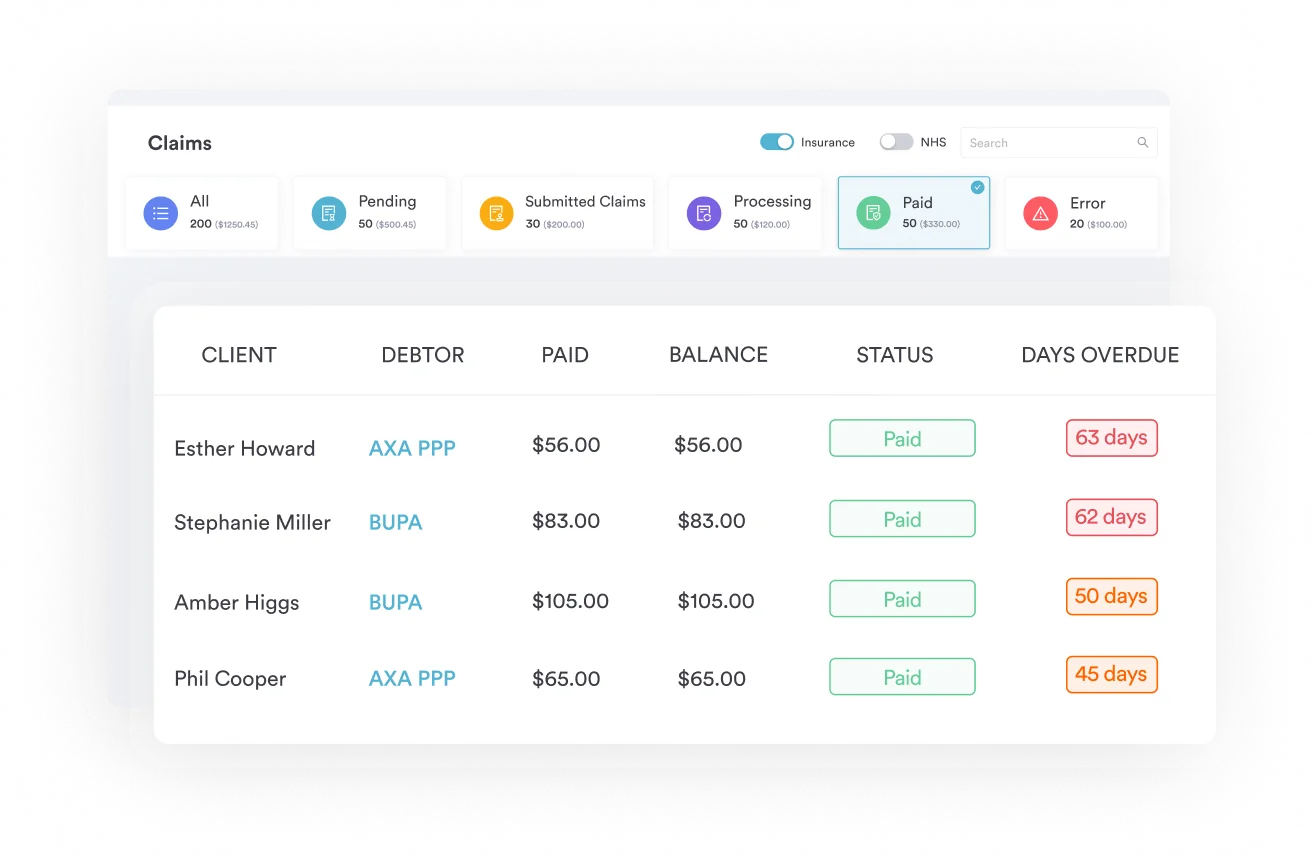
Verification note: The descriptions above reflect commonly cited pairings for closed metatarsal fracture treatment. Confirm each descriptor against the current AMA CPT manual before you submit, because descriptors and bundling rules change with the annual update. Pabau handles electronic claims via Claim.MD, with real-time payer eligibility checks and claim status tracking. A rejection shows up in the same dashboard you submitted from.
Knowing where S92.332A sits in the hierarchy speeds up parent-code lookups and crosswalk work. It also explains payer policies that bite at the category or subcategory level. The ResDAC ICD codes in Medicare data resource explains how these hierarchy levels appear in Medicare claims files.
Audit your imaging reports alongside the clinical notes. Radiologists often write “third metatarsal fracture with displacement” in their report. If the clinician’s assessment leaves the displacement qualifier out, the coder cannot assign S92.332A. Ask clinicians to reconcile their diagnosis with the radiology impression at every visit.
The third metatarsal sits in the middle of the forefoot column, between the second and fourth metatarsals. Fractures here typically follow a direct crush injury, repeated stress loading, or a twisting mechanism. Fifth metatarsal fractures turn on which zone the break falls in. Third metatarsal fractures turn on the degree of displacement and the patient’s activity demands.
Legacy billing systems, research databases, and payer correspondence sometimes require mapping S92.332A to its ICD-9-CM predecessor. The mapping is approximate. ICD-9-CM cannot represent laterality, displacement, or bone-level detail the way ICD-10-CM does. Sound medical billing workflows include knowing when a crosswalk approximation is appropriate and when it is not.
Important: The crosswalk above is approximate only, derived from CMS General Equivalence Mapping (GEM) conventions. Never assert it as a legally equivalent code for an audit, an appeal, or a legal matter. Verify the specific mapping against the current CMS GEM files before you rely on it.
Displaced third metatarsal fractures generate a predictable set of coding mistakes. Specificity errors are a well-known cause of first-pass rejections on musculoskeletal codes, which is why denial management teams watch them closely. Catching one before submission is faster and cheaper than working the denial.
Run a monthly audit of every claim submitted with S92.332A or any S92.33x code. Pull the denied and downcoded claims, then sort them by error type. Fix the two or three reasons that repeat, in the documentation template and in the coder checklist. That is where the recurring errors go away.
In most orthopedic practices the note lives in one system and the claim lives in another. A coder reads the note, picks S92.332A, and types it into a billing tool. Whatever the note left out gets discovered later, by the payer.
Pabau is practice management software that keeps both in the same record. The treatment note, the invoice, and the electronic claim all sit against the patient file. The coder reads the note the clinician wrote at the visit, rather than a summary of it.
You can build the note template around the four elements S92.332A needs. Displacement, laterality, bone, and encounter type each get their own field, so a half-documented note never reaches billing. In the US, claims then go out through Claim.MD, with real-time eligibility checks and claim status tracking in the same dashboard.
The payoff is fewer corrected claims, and less time spent chasing a missing qualifier three weeks after the visit.

Pabau keeps the treatment note, the invoice, and the electronic claim against one patient record. Orthopedic and sports-medicine practices use it to submit claims through Claim.MD and track every one through to payment.

The hard part of S92.332A is not finding the code. It is making sure the note says displaced, says left, says third metatarsal, and shows a treatment decision at this visit. Get those four into the template once and the code looks after itself.
The 7th character is where the ongoing work sits. Every follow-up is a fresh choice between D, G, K, P, and S, and it has to match what the imaging showed that day. Review a quarter of your own denials and you will usually find the same one or two extensions going out wrong. Fixing the template beats fixing the claims.
Pabau’s claims management software keeps the note, the invoice, and the claim against one patient record. The specificity you documented is then the specificity you bill. To see how that works across a multi-provider orthopedic practice, book a demo with our team.

Need to understand how clearinghouse submissions work for fracture claims? Pabau’s Claim.MD clearinghouse guide explains how electronic claim submission, payer edits, and ERA processing work end to end.
Want to reduce claim denials across your orthopedic billing team? Denial codes in medical billing covers the most common CARC and RARC denial patterns and how to address each one.
Looking for guidance on insurance eligibility verification before treatment? Insurance eligibility verification outlines how to check coverage and benefits before the patient’s initial fracture visit.
ICD-10 code S92.332A is the billable diagnosis code for a displaced third metatarsal fracture of the left foot, initial encounter for a closed fracture. It is valid for FY2026 under the ICD-10-CM classification maintained by CMS and NCHS, effective October 1, 2025.
Yes. S92.332A is a billable, specific ICD-10-CM code valid for direct submission for reimbursement. All seven characters must be present on the claim. Submitting the six-character base code S92.332 without the A returns an invalid-code rejection.
S92.332A is used for the initial encounter, meaning the visit where active treatment (casting, reduction, surgical planning) is provided. S92.332D applies to subsequent encounters during which the fracture is healing as expected, such as routine cast checks or weight-bearing progression visits. Active treatment determines A. Routine follow-up care uses D.
Use S92.332K for a subsequent encounter where the third metatarsal fracture has failed to unite. Nonunion is typically confirmed radiographically when fracture lines remain visible without bridging callus beyond the expected healing window, often after 4-6 months. Documentation must explicitly reference nonunion or failed union to support this code.
The most commonly paired CPT codes are 28470 (closed treatment without manipulation), 28475 (closed treatment with manipulation), and 28476 (percutaneous skeletal fixation). The appropriate CPT depends on the treatment performed at the initial encounter. Confirm each against the current AMA CPT manual, as descriptors and bundling rules are updated annually.
Four elements must appear in the clinical note. Displacement confirmed, laterality stated as left foot, bone specified as third metatarsal, and encounter type documented as active treatment. Missing any element prevents accurate assignment of S92.332A and may trigger a payer documentation request or denial.