ICD-10 code S61.201A: Open wound of left index finger without nail damage
ICD-10 code S61.201A covers a left index finger wound of unstated type ICD-10 co...

Last Updated: Oct 16, 2026
Billable Code Specific Code
S92.152B is the billable ICD-10-CM code for displaced avulsion fracture (chip fracture) of left talus, initial encounter for open fracture.
Verified as billable in the CDC/NCHS ICD-10-CM web tool and confirmed in the CMS ICD-10 code files for FY2026. Laterality is fixed at the left talus, so the record has to name the side before the code is assigned.
Let Pabau's smart automation suggest the right codes, reduce claim denials, and keep your practice compliant—effortlessly.
Automate repetitive tasks and focus on what matters most—your patients.
Reduce coding errors and ensure compliance with the latest regulations.
Clean claims, fewer denials, and faster reimbursements.
Powerful insights and reporting to help your practice thrive.
HIPAA compliant SOC 2 certified GDPR-compliant Trusted by 4,000+ clinics worldwide

ICD-10 code S92.152B describes a displaced avulsion fracture (chip fracture) of the left talus, initial encounter for open fracture.
The talus is the ankle bone. ICD-10-CM still files its fractures under S92, Fracture of foot and toe, except ankle, not under the S82 ankle block.
S92.152B is a billable ICD-10-CM code valid for FY2026 (October 1, 2025 through September 30, 2026) and accepted for HIPAA-covered transactions.
The 7th character ‘B’ specifies an open fracture at initial encounter, which affects DRG assignment and reimbursement. Confusing ‘A’ (closed) with ‘B’ (open) is a common coding error.
There is no S92.159. The displaced, unspecified-side code is S92.153, because the sixth character carries side and displacement together.
Pabau’s claims management software integrates with Claim.MD to support accurate ICD-10 code submission and real-time eligibility verification for US practices.
S92.152B sits at the sixth level of the ICD-10-CM hierarchy. Each level adds clinical specificity. The full path from chapter to billable code shows which character carries which fact.
S92.152 (without the 7th character) is the parent code and is not billable on its own. A 7th character is mandatory for every S92 fracture code. Submitting S92.152 without the encounter character returns an invalid code error from most payers.
The talus forms the lower half of the ankle joint, so coders reasonably expect to find it in the S82 ankle block. It is not there. ICD-10-CM classifies the talus as a tarsal bone and files every talar fracture under S92, Fracture of foot and toe, except ankle. S92 carries an Excludes2 note for fracture of ankle and fracture of malleolus, both of which point to S82.
The 7th character is the most clinically and financially significant element of ICD-10 code S92.152B. It records the encounter type and the fracture classification. Both feed directly into DRG assignment and reimbursement rates.
‘B’ applies when the patient presents at initial encounter with an open fracture, meaning the bone has penetrated or been exposed through the skin. That is a materially different clinical and surgical scenario from S92.152A (closed). Open talar injuries carry a high infection risk, usually go to urgent debridement, and attract their own CPT procedure codes alongside the ICD-10 diagnosis.
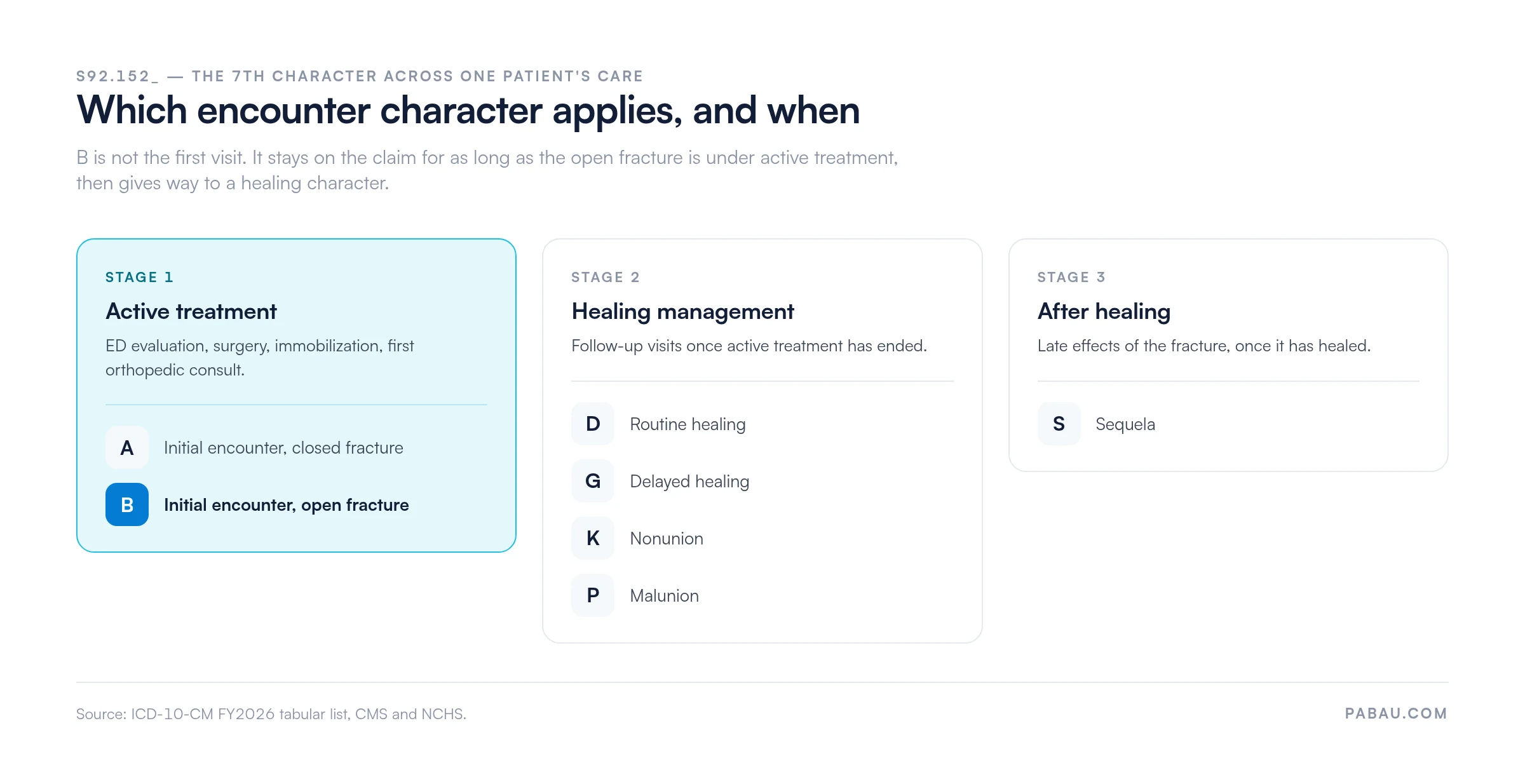
‘Initial encounter’ means the patient is receiving active treatment, not that it is literally the first visit. Under ICD-10-CM Official Guidelines, coders use ‘B’ for every visit during which the fracture is receiving active treatment. Emergency department evaluation, surgical care, and the first orthopedic consultation all qualify. Once care shifts to healing management, the encounter character changes to D, G, K, or P depending on healing status. The sequence below maps each character to the stage of care it belongs to.
A displaced avulsion fracture of the talus is a chip of bone that a ligament or joint capsule has pulled off the talus. The fragment has moved out of position. The talus is the ankle bone. It sits between the tibia above and the calcaneus below, and it transfers body weight from the leg into the foot. Articular cartilage covers most of its surface, and no muscle attaches to it.
Most talar avulsion fractures follow a forced inversion or plantar flexion injury, so the presenting story is often an ankle sprain or a fall. The anterior capsule and the lateral ankle ligaments are the usual culprits. A small chip is easy to miss on a first radiograph, which is why many of these are documented only after repeat imaging.
Displacement matters clinically as well as for billing. The talus has a fragile blood supply, and displaced talar fractures carry a significant risk of avascular necrosis. Orthopedic and physical therapy teams pick these patients up during rehabilitation, where the encounter character moves from B to D or G.
Laterality is not optional. ICD-10-CM requires the coder to specify which talus is fractured. Three codes cover displaced avulsion fractures of the talus at initial encounter for open fracture:
Use S92.153B only when the clinical record genuinely does not document which side is injured. It is not a fallback for incomplete notes. Querying the physician before defaulting to ‘unspecified’ is standard practice under ICD-10-CM guidelines.
The sixth character in the S92.15 group encodes two facts at once. Characters 1, 2, and 3 mean displaced (right, left, unspecified). Characters 4, 5, and 6 mean nondisplaced, in the same order.
This trips up coders who expect a trailing 9 to signal unspecified laterality, as it does in many other ICD-10-CM groups. There is no S92.159, and a claim carrying it will reject as an invalid code. The displaced, unspecified-side code is S92.153, and the nondisplaced equivalent is S92.156.
Coders working from physician notes, emergency department reports, or operative dictations meet several alternative descriptions that map to ICD-10 code S92.152B. Recognizing these synonyms prevents under-coding or defaulting to a less specific code.
In the ICD-10-CM alphabetic index, locate this code under: Fracture, traumatic, talus, avulsion, displaced, left. The index path leads to S92.152 before the 7th character is applied. Always confirm the 7th character against the tabular list or the AAPC Codify ICD-10-CM lookup.
Accurate coding often means choosing from a family of closely related codes. The table below lists the encounter variants of S92.152 plus the sibling and adjacent codes that get confused with it most often.
Wider subcategories in the S92.1 family cover the rest of the bone. They are S92.10 (unspecified fracture of talus), S92.11 (neck), S92.12 (body), S92.13 (posterior process), S92.14 (dome), and S92.19 (other fracture of talus). Check a sibling code against the CDC/NCHS web tool linked above, which carries the FY2026 files. The alphabetic index remains the most reliable way to tell these subcategories apart.
When a patient moves from active fracture treatment to follow-up care, update the 7th character. B (initial, open) becomes D (subsequent, routine healing) or G (subsequent, delayed healing), depending on what the physician documents. Continuing to bill S92.152B at routine follow-up visits is a common audit trigger. Review the visit note before each claim cycle.
ICD-10-CM Official Guidelines, published by CMS and the NCHS, govern how S92.152B is applied across clinical settings. They decide which characters the coder assigns, and what the record has to say to support each one.
S92.152B has been stable in the ICD-10-CM tabular list for several fiscal years. The S92.15 group entered the classification as a new code group for FY2016. The 2026 edition, effective October 1, 2025, carries S92.152B without modification, with no description change and no new exclusion notes.
HIPAA-covered transaction rules require every diagnosis code on a claim to be valid for the date of service, not the date of billing. Submitting S92.152B for a date of service before October 1, 2025 using FY2026 files would be an incorrect submission. Match the ICD-10-CM edition to the fiscal year of the service date.
Open talar fractures often need prolonged orthopedic care, so a single case can straddle two fiscal years. Confirm that your billing system is running the edition matching each visit date. Denials that spike through October usually trace to old-year codes sitting on new-year dates of service. A clean claim on first submission avoids the rework that open fracture coding errors tend to generate.
Check your billing software’s ICD-10-CM edition setting on October 1 each year. A practice still running the prior edition can submit descriptions that no longer match the current files, which triggers payer edits. Confirm the setting before the first claim batch of the new fiscal year goes out.
In most practices the coder reads the operative note in one system and keys S92.152B into another. Side, displacement, and the 7th character get re-typed at every hand-off. A follow-up visit that should have moved to D goes out as B, because nobody re-read the note first.
Practice management software like Pabau keeps the diagnosis code on the same record as the note it came from. Pabau’s integrated claims management cross-references ICD-10 codes against payer-specific coverage policies at the point of charge entry. A documentation mismatch surfaces while the coder can still fix it.
Claims then go out through Claim.MD, Pabau’s US clearinghouse partner, which reaches thousands of US payers. Real-time eligibility verification runs before submission. Your team spends the follow-up visit updating the encounter character instead of reworking a denial.
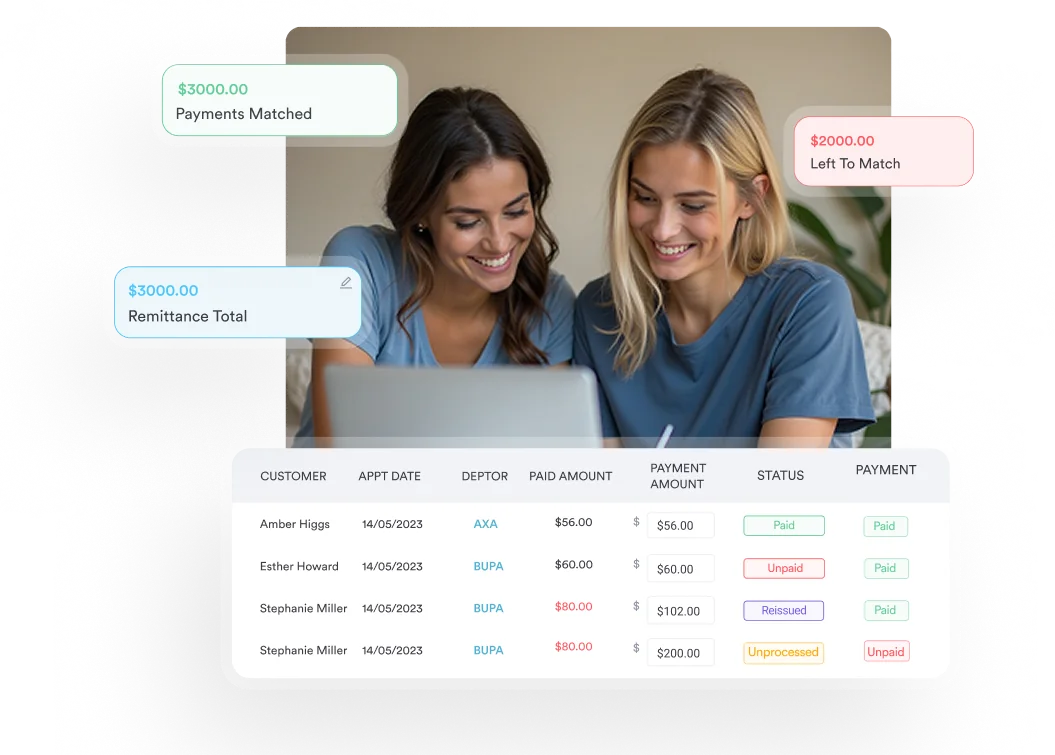

Pabau connects your clinical documentation to Claim.MD for real-time eligibility checks and clean claim submission to thousands of US payers. Your team spends less time reworking denied fracture claims.

Talus fracture coding turns on four variables: the site within the bone, laterality, displacement status, and encounter type. ICD-10 code S92.152B is billable and valid for FY2026, but it fits only a left-sided, displaced, open avulsion fracture at initial encounter. Every one of those qualifiers has to be documented by the treating clinician before a coder can assign it.
Check the physician’s documentation for all four qualifiers before you assign S92.152B. Then re-check the encounter character at every follow-up visit. That single habit prevents most of the denials this code family generates. Book a demo to see how Pabau moves an ICD-10-coded encounter into a clean claim submission.

Working with denial patterns on fracture claims? Denial codes in medical billing covers the most common CARC denial reasons affecting orthopedic claims and how to resolve them.
Need to verify insurance before a fracture encounter? Insurance eligibility verification explains how real-time eligibility checks reduce same-day claim rejections.
Building clean claims for ICD-10-coded encounters? Superbill documentation walks through the components that make a diagnosis-coded claim payer-ready from submission.
S92.152B is a billable ICD-10-CM diagnosis code for a displaced avulsion fracture (chip fracture) of the left talus at initial encounter for open fracture. Hospitals, emergency departments, and orthopedic practices use it to identify and bill this specific injury on HIPAA-covered transactions.
Yes. S92.152B is a billable, specific ICD-10-CM code valid for FY2026 (October 1, 2025 through September 30, 2026). It is accepted for HIPAA-covered transaction submissions. It can be reported as a principal or secondary diagnosis, depending on the clinical context.
No. The talus is the ankle bone, sitting between the tibia above and the calcaneus below. The calcaneus is the heel bone, and its fractures code to S92.0-, not S92.1-. Assigning a talus code to a heel injury, or the reverse, is a documentation-to-code mismatch that payers and auditors do catch.
The 7th character ‘B’ designates an initial encounter for open fracture, meaning the bone has breached the skin and the patient is receiving active treatment. It separates this encounter from ‘A’ (initial encounter, closed fracture). It also separates it from the subsequent encounter characters D, G, K, P, and S, which apply once active treatment has ended.
S92.152A covers an initial encounter where the fracture is closed and the skin is intact. S92.152B covers the same injury when the fracture is open, with the skin broken and bone potentially exposed. Both describe a displaced avulsion fracture of the left talus at initial encounter. The distinction affects DRG assignment, surgical coding, and reimbursement.
The sixth character in the S92.15 group carries both displacement and side, so the group runs 1 to 6 rather than ending in 9. Characters 1, 2, and 3 are displaced right, left, and unspecified. Characters 4, 5, and 6 are the nondisplaced equivalents. The displaced, unspecified-side code is S92.153, and a claim carrying S92.159 will reject.
‘Chip fracture’ is the plain-language synonym for an avulsion fracture. A ligament or joint capsule pulls a small fragment of bone off the talus under traction, usually during a forced inversion or plantar flexion injury. The official code description prints ‘chip fracture’ in parentheses beside ‘avulsion fracture’ so coders recognize both terms in clinical notes.
CPT selection depends on the procedure performed, not on the diagnosis code. Open surgical treatment of a talus fracture is reported with CPT 28445, open treatment of talus fracture including internal fixation when performed. Debridement of the open wound is coded separately. Verify every pairing against the operative report and the payer’s medical necessity policy before billing.