

ICD-10 code S61.201A: Open wound of left index finger without nail damage
ICD-10 code S61.201A covers a left index finger wound of unstated type ICD-10 co...

Last Updated: Oct 16, 2026
Billable Code Specific Code
S92.135K is the billable ICD-10-CM code for nondisplaced fracture of posterior process of left talus, subsequent encounter for fracture with nonunion.
Let Pabau's smart automation suggest the right codes, reduce claim denials, and keep your practice compliant—effortlessly.
Automate repetitive tasks and focus on what matters most—your patients.
Reduce coding errors and ensure compliance with the latest regulations.
Clean claims, fewer denials, and faster reimbursements.
Powerful insights and reporting to help your practice thrive.
HIPAA compliant SOC 2 certified GDPR-compliant Trusted by 4,000+ clinics worldwide

S92.135K is a billable ICD-10-CM code for a nondisplaced fracture of the posterior process of the left talus, subsequent encounter for fracture with nonunion.
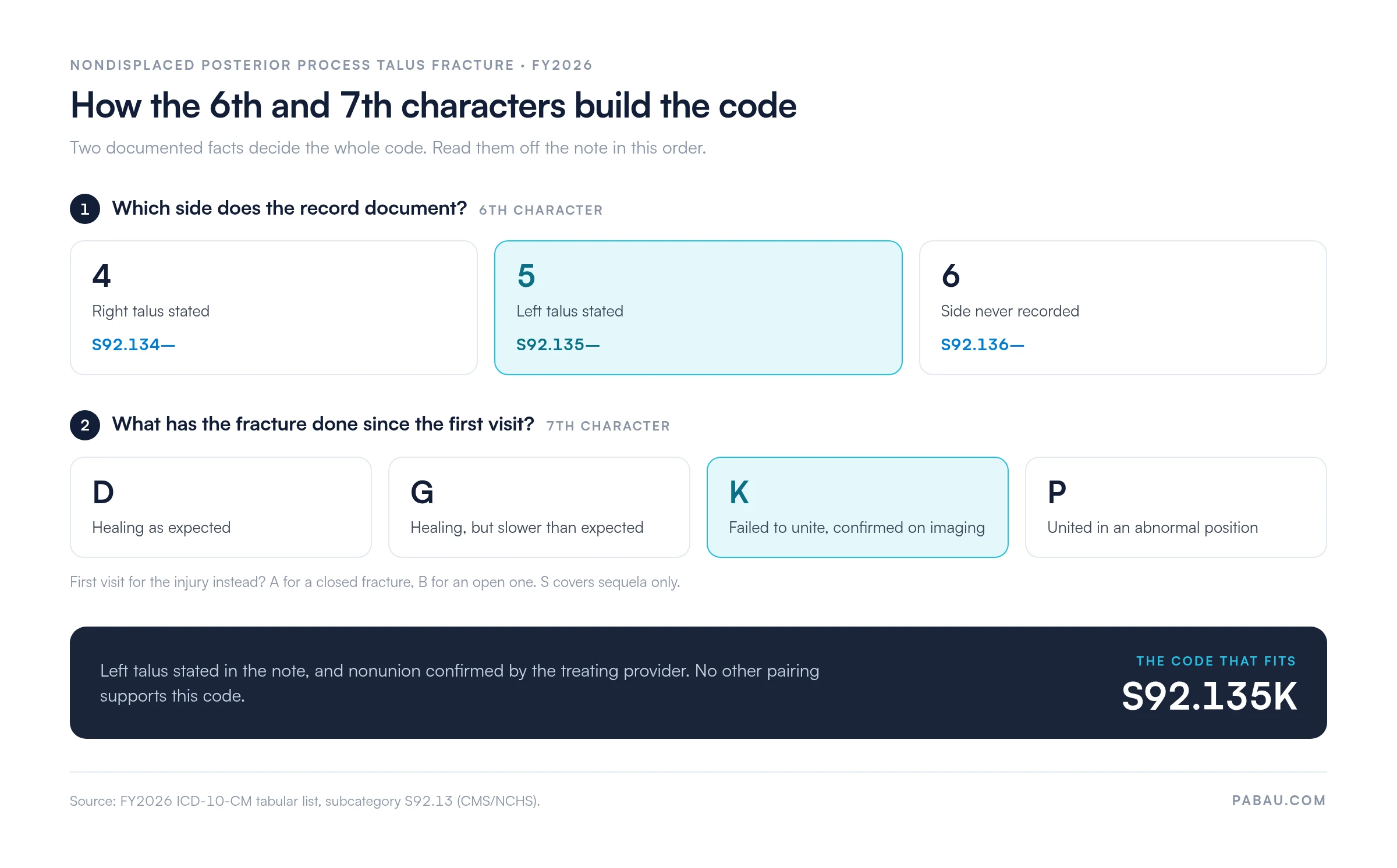
Laterality sits in the 6th character. For a nondisplaced posterior process fracture, 4 is right, 5 is left, and 6 is unspecified.
The 7th character K covers subsequent encounters where the fracture has failed to heal. Nonunion must be confirmed by the treating provider, not assumed.
Coders commonly confuse K (nonunion) with D (routine healing) or G (delayed healing). The wrong suffix triggers payer denials and audit flags.
Practice management software like Pabau validates ICD-10 claims before submission and tracks denial patterns for orthopedic and podiatric practices.
Each segment of S92.135K carries precise clinical and coding information. Misreading any component, particularly laterality or the 7th character, produces an incorrect code that payers will reject. Here is what each alphanumeric position means.
The 6th character carries displacement and laterality together, which is where most laterality errors on this code start. For a displaced posterior process fracture, 1 is right, 2 is left, and 3 is unspecified. For a nondisplaced fracture, 4 is right, 5 is left, and 6 is unspecified.
So S92.135K is the left-sided code, S92.134K is its right-sided counterpart, and S92.136K covers a documented nondisplaced fracture where the side was never recorded. Bilateral injuries are uncommon with this fracture pattern. When they do occur, code each side separately rather than reaching for the unspecified option.
The 7th character is where most billing errors occur, so the section below covers it in detail. For the official tabular list and index, the CDC/NCHS ICD-10-CM web tool is the primary source.
The 7th character in ICD-10-CM fracture codes is not optional or interchangeable. Each value defines the stage of care, and the wrong selection changes the clinical meaning of the code entirely.
Per the ICD-10-CM Official Guidelines for Coding and Reporting, maintained by CMS and NCHS, the provider’s documentation must support whichever character is assigned.
Critical distinction: K (nonunion) and P (malunion) are not the same. Nonunion means the fracture has not healed at all. Malunion means it healed in the wrong position. Payers audit these closely.
K also differs from G (delayed healing), because G implies active, ongoing healing with a positive prognosis. K is assigned only when the provider explicitly documents that union has failed, usually backed by radiographic evidence.
Those two characters get read off the note in a fixed order, which the diagram below traces.
The posterior process of the talus is a small bony projection at the back of the talar body. It serves as an attachment point for the posterior talofibular ligament and the flexor hallucis longus tendon. Fractures here are often missed on initial X-ray, which is one reason nonunion develops more frequently than with other talus fractures.
S92.135K is a specificity-heavy code. Every element in its description must be supported by the clinical record before it can be assigned. Missing or ambiguous documentation is the most common reason this code triggers a denial.
Run a chart audit on any claim using S92.135K before submission. Confirm the note explicitly states all four: left talus, nondisplaced, subsequent encounter, and nonunion with radiographic support. A single missing element converts a billable claim into a pending denial.
S92.135K sits within the S92 family of foot fracture codes. Coders working with talus fractures meet several sibling and parent codes, and the table below maps the closest ones.
Sibling codes for other injury sites sit in the same ICD-10-CM code library. For broader code navigation, the AAPC Codify ICD-10-CM lookup provides a searchable database.
Coding S92.135K correctly is the first step. Getting the claim paid also takes clean submission practices and a process for the denials that nonunion codes attract. The CMS ICD-10 codes page holds the official guidelines and the annual FY code update files.
Running submissions through validation-first claims management catches a wrong 6th character before the claim leaves the practice. For US practices, practice management software like Pabau connects to Claim.MD for electronic claims. That link covers thousands of US payers, with real-time eligibility checks and ERA processing.
In an orthopedic or podiatric practice, the laterality and encounter-type checks on a code like S92.135K usually happen in someone’s head. A biller reads the note and picks the 6th character from memory. The mistake then surfaces weeks later as a remittance line.
Rework costs staff time twice. Someone hunts down the original note, then resubmits the claim. Pabau moves those checks upstream instead. Structured note templates capture the side, the displacement status, and the nonunion finding as discrete fields.
The coder then reads data instead of interpreting prose. Claims pass through validation before they go out to Claim.MD, and denials come back into one queue with the reason codes attached.
The outcome is a shorter cash cycle and fewer K-suffix write-offs. Your team sees which payers reject nonunion claims and why, so the same denial does not repeat across a quarter of follow-up visits.

Pabau’s claims management tools integrate with Claim.MD to validate ICD-10 codes before submission, track denial patterns, and process ERAs. Your billing team spends less time on rework and more time on patient care.

S92.135K is a narrow code, and the narrowness is the point. It is only correct when the note states the left talus, a nondisplaced posterior process fracture, a subsequent encounter, and a failed union. Change any one of those and the code changes with it.
The trade-off worth remembering is that specificity cuts both ways. A note that never records the side leaves you with S92.136K, the least specific option available. Chasing the provider for one word costs less than reworking the claim twice.
Validating the code at the point of submission is what stops a K-suffix denial from becoming a month of rework. Book a demo to see how Pabau fits your orthopedic billing workflow.

Looking for guidance on clean claim submission for ICD-10 codes? Submitting clean claims outlines the pre-submission checks that prevent the most common billing errors.
Want to understand how clearinghouse integration works for orthopedic practices? Medical claims clearinghouse explains how electronic claim routing connects practices to payers.
S92.135K is a billable ICD-10-CM diagnosis code for a nondisplaced fracture of the posterior process of the left talus. It applies at a subsequent encounter where the provider has confirmed nonunion. Every element must appear in the clinical record, including the anatomical site, the displacement status, the left side, and the encounter type. Without that specificity, the claim is not reimbursable.
The 7th character K signifies a subsequent encounter for a fracture with nonunion. The patient is returning for follow-up care, and the treating provider has determined that the fracture has failed to heal. K is distinct from D (routine healing), G (delayed healing), and P (malunion). The provider’s note and supporting imaging must confirm nonunion before K is assigned.
Yes, S92.135K is a billable, specific ICD-10-CM diagnosis code valid for HIPAA-covered transactions. It is active for FY2026, effective October 1, 2025. Verify it against the current CMS ICD-10-CM tabular list at the start of each fiscal year. Annual updates can revise or retire codes.
All three describe the same fracture, a nondisplaced fracture of the posterior process of the left talus, and differ only by encounter type. S92.135A covers the initial encounter for a closed fracture, during active treatment. S92.135D applies to subsequent encounters where healing is progressing normally. S92.135K is reserved for subsequent encounters where the provider has confirmed that the fracture failed to heal.
Select the fracture code that matches the anatomical site, the displacement status, and the laterality. Then append the 7th character K, which is only valid for subsequent encounters rather than initial visits. The provider must explicitly document that union has failed, usually supported by radiographic evidence. Without that documentation, the claim is at high risk of denial on audit.
The closest relatives are the sibling 7th characters for the same fracture, namely S92.135A, S92.135B, S92.135D, S92.135G, S92.135P, and S92.135S. The right-sided counterpart is S92.134K, and S92.136K covers a nondisplaced posterior process fracture where the record does not state a side. For a displaced fracture on the left side, S92.132K applies. Confirm any sibling code against the current CMS ICD-10-CM tabular list before you submit.



