

ICD-10 code S61.201A: Open wound of left index finger without nail damage
ICD-10 code S61.201A covers a left index finger wound of unstated type ICD-10 co...

Last Updated: Oct 16, 2026
Billable Code Specific Code
S92.131D is the billable ICD-10-CM code for displaced fracture of posterior process of right talus, subsequent encounter for fracture with routine healing.
Pick the wrong character and the claim bounces, even though the diagnosis itself was right.
Let Pabau's smart automation suggest the right codes, reduce claim denials, and keep your practice compliant—effortlessly.
Automate repetitive tasks and focus on what matters most—your patients.
Reduce coding errors and ensure compliance with the latest regulations.
Clean claims, fewer denials, and faster reimbursements.
Powerful insights and reporting to help your practice thrive.
HIPAA compliant SOC 2 certified GDPR-compliant Trusted by 4,000+ clinics worldwide

S92.131D covers a displaced fracture of the posterior process of the right talus at a follow-up visit with routine healing.
The 7th character is mandatory, so the parent code S92.131 cannot be submitted for reimbursement on its own.
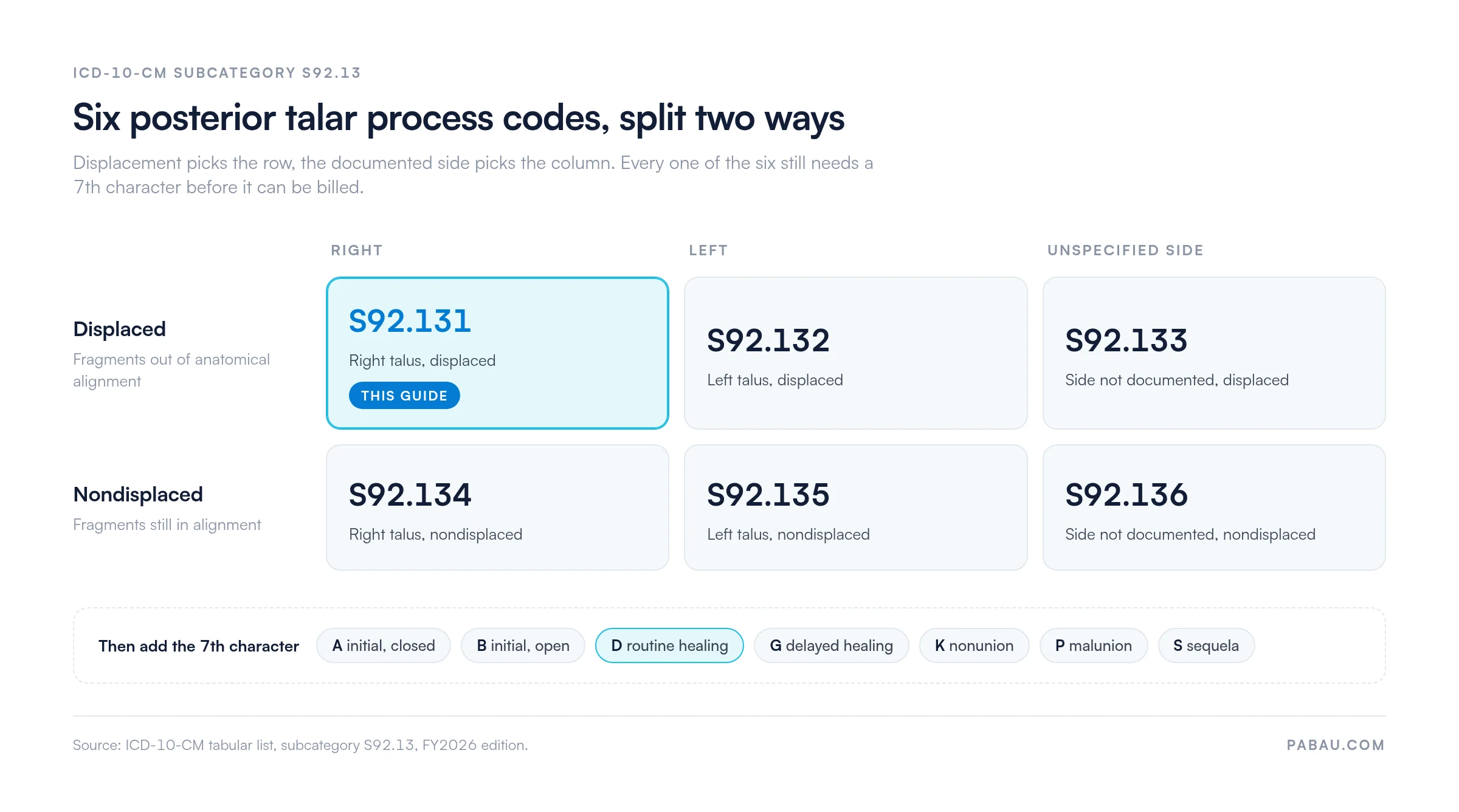
Nondisplaced right talus is S92.134, not S92.133, which reports a displaced fracture with the side left undocumented.
Your note must confirm the site, the right side, displacement, and routine healing, or the code cannot be defended.
Pabau’s claims management software pre-fills the claim from the record and submits it to thousands of US payers through Claim.MD.
S92.131D is a valid, billable ICD-10-CM diagnosis code. Payers accept it in every HIPAA-covered transaction. Both the CDC/NCHS ICD-10-CM web tool and the CMS ICD-10 codes page list it as a complete code.
Its official description runs long for a reason. Displaced fracture of posterior process of right talus, subsequent encounter for fracture with routine healing.
Every clause in that string has to be matched by something in the chart. That means site, side, displacement, encounter type, and healing status all have to appear before you can use it.
D says two things at once. Active fracture treatment has finished, and the bone is knitting the way it should, with no delayed union, nonunion or malunion on record. The AAPC’s ICD-10-CM code reference puts it plainly. D applies while the patient is still receiving care after that active phase has closed.
Misapplying the character is one of the most common fracture coding errors. Leaving A on a follow-up visit, or reaching for D when the radiograph shows delayed union, both trip automated payer edits.
Section I.C.19 of the ICD-10-CM Official Guidelines for Coding and Reporting governs how these characters get assigned for traumatic fractures.
On its own, S92.131 is a placeholder. Add one of the seven characters below and it becomes something you can put on a claim.
The posterior process is a small bony projection at the back of the talar body. Two tubercles, medial and lateral, sit either side of the groove that carries the flexor hallucis longus tendon.
These fractures turn up far less often than talar neck or body fractures, and they are easy to miss on plain film. The posterior tibiotalar joint and the tendon both run past the fragment, so an overlooked injury often becomes chronic posterior ankle pain.
Displaced means the fragments have moved out of anatomical alignment. That one word is what separates the S92.131x codes from the nondisplaced ones, which start at S92.134 for the right side.
Three conditions have to hold before D is correct. Active treatment has finished, the fracture is healing as expected, and no complication is documented. If any one of them fails, a different character applies instead.
One nuance is worth flagging. The switch from S92.131A to S92.131D is not a calendar event, and no fixed number of days triggers it. It happens when the treating clinician documents that active treatment has ended and routine monitoring has begun.
Coders should follow that documented intent rather than overriding it with a rule of thumb.
Flag every fracture claim for a 7th character check before it leaves the practice. Build an internal edit that rejects any S92.131 submitted bare. Most clearinghouses catch it anyway, but catching it first saves the rework and protects your clean claim rate.
Laterality and displacement between them generate six separate codes inside S92.13, and two pairs get swapped often enough to be worth memorizing. The grid below lays all six out at once.
Outside the posterior process, the talus carries its own neck, body and dome codes, and the calcaneus sits in a separate subcategory altogether. The table below covers the siblings that show up most often on fracture follow-up claims, all shown with the D character for comparison.
Walking the tabular list from the top explains why the parent code is unbillable. Specificity has to run all the way to the bottom of the branch before a payer will take it.
S92.131 without a 7th character cannot go on a claim at all. Payers running ICD-10-CM validation edits reject it long before a human reviewer sees it. The same drill-down governs every family in our ICD-10-CM code library. So when you code fractures at several sites, work from the tabular list rather than from memory.
S92.131D lands on subsequent-encounter claims, so the CPT codes beside it describe follow-up care rather than the original repair. The procedure performed at that visit decides which one you report.
Most of these visits land on 99213, so it pays to know where that level sits under the current medical decision-making rules. The codes for the original repair are a different matter.
Open treatment of a talus fracture is 28445, not 28455, which explicitly excludes the talus and calcaneus. Neither one pairs with S92.131D at a follow-up visit unless a fresh procedure is performed that day.
Supporting S92.131D on review means the note confirms every clause of the description. Miss one, and a post-payment audit can claw the money back months after the claim was paid.
Add a healing status field to your fracture follow-up note template. One line with three options, yes, no, or undetermined, removes the ambiguity for the coder. It also cuts the queries going back to the provider.
Fracture claims fail for a short list of reasons, and every one of them is catchable before the claim leaves the practice. Run this pass over each S92.131D line.
From there, the claim follows the usual path. The charge line carries the CPT code and the diagnosis pointer. The clearinghouse then runs its ICD-10-CM validation edits, and the payer applies its own medical necessity rules on top.
The two failure modes behave very differently. A 7th character error usually dies within minutes, at the clearinghouse. A displacement or laterality error sails through, gets paid, and only surfaces in an audit a year later.
Mechanical errors are the ones claims management software should catch for you, so the coder’s attention stays on the clinical judgment.
In a lot of practices, the fracture gets coded in one place and the claim goes out from another. The note sits in the chart, the code gets keyed into a billing screen, and nobody compares the two until a denial lands.
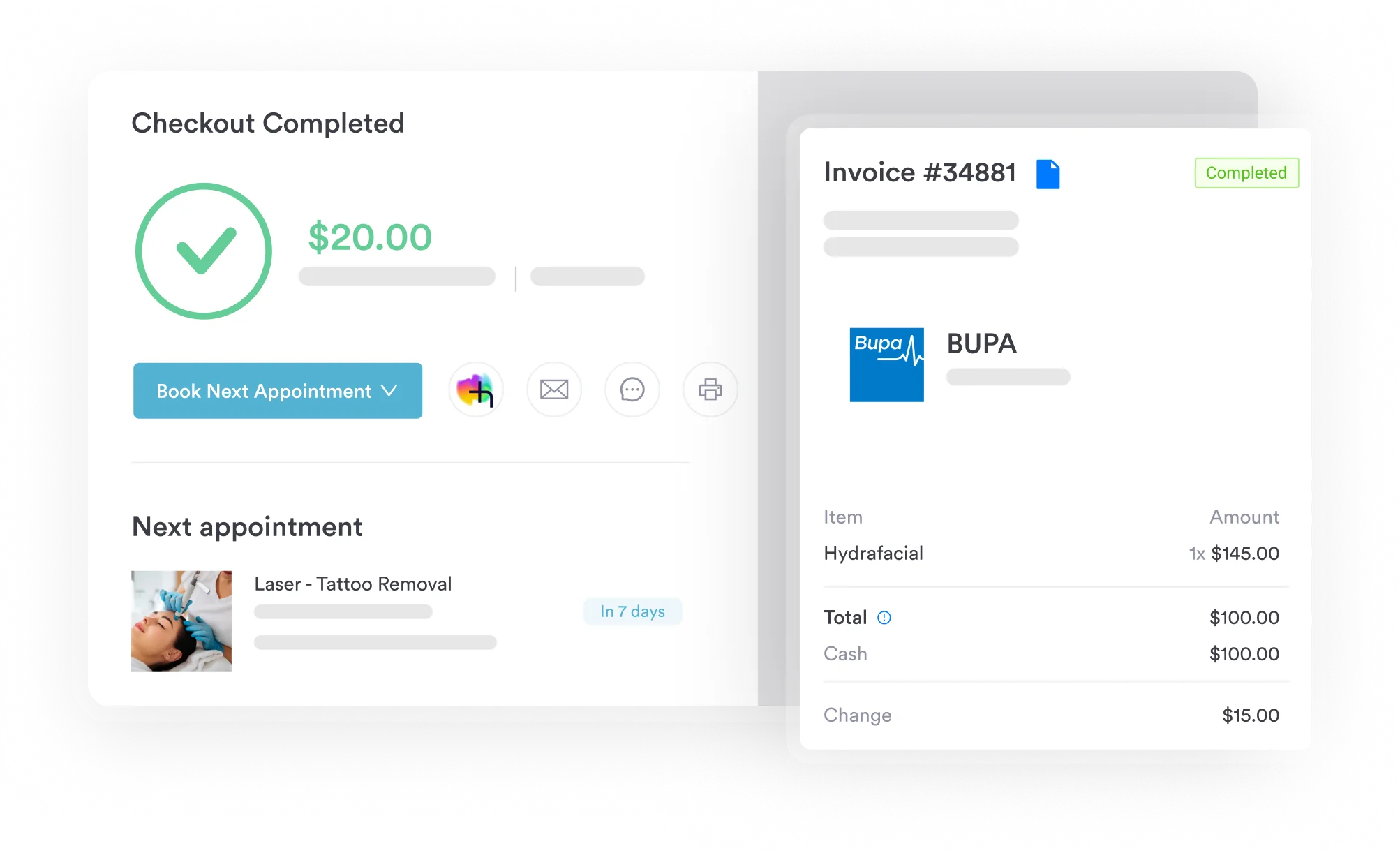
Practice management software like Pabau closes that loop. Pabau’s claims management software pre-fills the CMS-1500 straight from the record. The CPT code attached to the service lands on the charge line. ICD-10 slots are seeded from the client’s recorded problem list.
Built-in ICD-10-CM and CPT lookup libraries sit behind a search icon on the claim. A coder can check S92.134 against S92.133 without leaving the screen. Before the send button unlocks, Pabau confirms that the claim’s required fields are all complete.
From there, US practices submit through Claim.MD to thousands of US payers. Eligibility checks, claim status tracking and remittance posting all come back down the same pipe. Fewer fracture claims bounce for something the record already answered.

Pabau’s claims management software pre-fills the claim from the patient record, checks the required fields, and submits through Claim.MD to thousands of US payers. Fewer fracture claims come back for a coding detail the chart already held.

Four facts decide whether S92.131D survives a review, and they are site, side, displacement and healing status. Build all four into your fracture follow-up template as structured fields, and the coder stops guessing.
The trade-off worth remembering is that a 7th character error is cheap and a laterality error is expensive. The first bounces back the same day. The second gets paid, sits quietly, and turns up in a post-payment audit a year later.
A chart in one system and a billing screen in another is exactly how that second error survives. Book a demo to see how Pabau pulls the note, the code and the claim into one record.

Coding a talus fracture that stopped healing? ICD-10 code S92.145K walks the same 7th character logic through a nonunion encounter.
Need the higher E/M level for a complex follow-up? CPT code 99214 sets out when a visit earns moderate medical decision-making.
Want to know what a payer counts as a clean claim? Clean claim submission standards lists what has to be present before a claim can pay first time.
Fracture claims coming back denied? Denial management in healthcare covers the workflow for catching coding errors before they cost revenue.
Building the encounter record your coder works from? Superbill documentation explains which fields belong on the form and why encounter type matters.
No. ICD-10-CM files the talus under S92, fracture of foot and toe, and an Excludes1 note sends fractures of the ankle itself to S82. The talus forms part of the ankle joint, but the code set treats it as a foot bone.
Usually not. Routine follow-up inside the 90-day global period after open treatment is already paid for in the surgical fee. You still report S92.131D as the diagnosis, and modifier 24 applies only when the visit is unrelated to the fracture.
For as long as the record documents routine healing. ICD-10-CM sets no day limit on the D character. Move to G, K or P as soon as the clinician documents delayed healing, nonunion or malunion.
There is no national mandate for external cause reporting. Some payers and state agencies ask for it anyway. When you do report one at a follow-up visit, give it the matching subsequent-encounter 7th character.
No. Laterality already lives inside the diagnosis code, so the ICD-10 line needs no modifier. RT and LT are CPT modifiers, and they belong on the procedure line when the payer asks for them.
S92.134D covers a nondisplaced fracture of the posterior process of the right talus at a subsequent encounter with routine healing. The left-sided version is S92.135D. S92.133D is a displaced fracture with the side left undocumented.



