ICD-10 code S61.201A: Open wound of left index finger without nail damage
ICD-10 code S61.201A covers a left index finger wound of unstated type ICD-10 co...

Last Updated: Oct 16, 2026
Billable Code Specific Code
S91.255A is the billable ICD-10-CM code for open bite of left lesser toe(s) with damage to nail, initial encounter.
According to the Centers for Medicare and Medicaid Services (CMS), ICD-10-CM codes are updated annually on October 1. The 2026 edition took effect October 1, 2025, and S91.255A remains valid and billable under that edition.
Let Pabau's smart automation suggest the right codes, reduce claim denials, and keep your practice compliant—effortlessly.
Automate repetitive tasks and focus on what matters most—your patients.
Reduce coding errors and ensure compliance with the latest regulations.
Clean claims, fewer denials, and faster reimbursements.
Powerful insights and reporting to help your practice thrive.
HIPAA compliant SOC 2 certified GDPR-compliant Trusted by 4,000+ clinics worldwide

ICD-10 Code S91.255A covers an open bite of the left lesser toe(s) with damage to nail, initial encounter. It is billable and valid for HIPAA-covered transactions under the 2026 edition.
The 7th character ‘A’ designates an initial encounter, meaning active treatment. Use ‘D’ for subsequent encounters and ‘S’ for sequela. Choosing the wrong character is the most common error on this code.
Documentation must state laterality, wound mechanism, nail involvement, and encounter type. Missing any one of the four risks a claim denial.
Practice management software like Pabau attaches ICD-10 codes to the treatment record itself, so the code reaches the claim without a copy-paste step.
S91.255A describes an open bite of the left lesser toe(s) with damage to nail, at the initial encounter. The CDC/NCHS ICD-10-CM lookup tool confirms it is billable and specific, so it can go on a claim without further specification.
An open bite in ICD-10-CM means a wound caused by a bite, animal or human, that breaks the skin and leaves it open. A puncture wound codes to the S91.235A family instead, and a laceration to S91.215A. The “lesser toe(s)” qualifier covers toes 2 through 5, and the great toe has its own code family.
Nail damage must be present and documented for this code to apply. Without it, the correct code is S91.155A, an open bite of the left lesser toe(s) without damage to nail.
S91.255 is the base code, and it is non-billable on its own. A 7th character must be appended to every claim submission. Each character signals a distinct clinical scenario. Using the wrong one is the most common reason this code family gets denied.
Use S91.255A while the patient is still receiving active treatment for the wound. “Initial encounter” does not mean the patient’s first visit to any provider. Active treatment covers debridement, wound repair, antibiotic initiation, and initial assessment. A patient seen by their primary care physician three days after an ER visit still takes the A suffix.
Reading the ICD-10 classification hierarchy prevents the most common structural error in this family. Coders pick a parent category code, which is not billable, instead of the fully specified child. S91.255A sits at the end of a six-level chain, and every level above it is non-billable.
The same logic runs through every injury chapter in the coder’s ICD-10-CM reference. The further down the tree you go, the more specific the code, and only the deepest level is billable. Submitting S91.255 or S91.25 without a 7th character triggers an automatic rejection for HIPAA-covered transactions.
Clinical documentation rarely uses the exact ICD-10-CM phrase. The index entries below are the terms that map to S91.255A in the ICD-10-CM Alphabetic Index. Any of these descriptions in a chart note should route the coder to this code.
In ICD-10-CM, “open bite” means a bite wound that remains open. A closed bite injury, such as bruising with no break in the skin, codes elsewhere. The note must say the wound is open, not only that a bite occurred.
Every element of this code must be traceable in the medical record. Missing a single qualifier leaves the code and the note saying different things, which is what an audit looks for. Run this checklist against the encounter note before you code.
Laterality and encounter type are the two fields most often missing from emergency department and urgent care notes. Two templated prompts in the clinical note fix most of that: “Laterality: ___” and “Nail involved: Y/N”. Both take a second to complete and save the coder a query later.
The AAPC ICD-10-CM code guidelines and the CMS official coding guidelines flag several recurring mistakes in the S91 family. Each one below has a documentation fix behind it.
Correcting a code after a denial costs more than getting it right the first time. The claim has to be reworked, resubmitted, and tracked again. Every error above is catchable with the documentation checklist, before the claim leaves the practice.
Flag open wound bite cases at intake with a structured note prompt. Ask for laterality, wound type, nail involvement, and whether the source was human or animal. Those four fields map onto the four ICD-10-CM specificity requirements for S91.255A, so the note reaches the coder complete.
S91.255A sits in a grid of adjacent codes that each differ from it by one field. Change the laterality, the nail damage status, or the wound mechanism, and a different code applies.
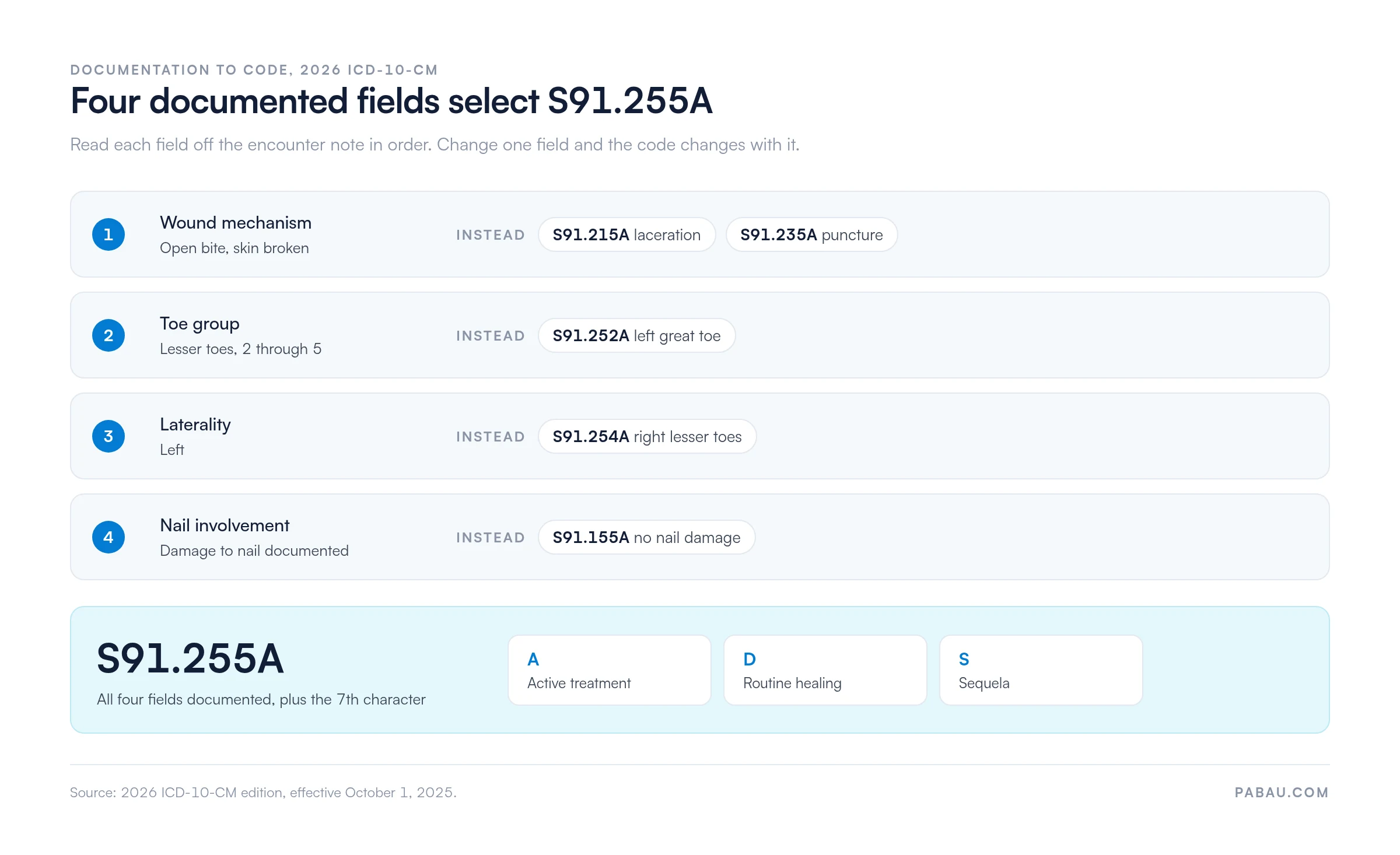
The same laterality and encounter-type logic runs across the whole S00-T88 injury block. A coder who can read one of these code families can read the rest.
S91.255A is a diagnosis code. A claim also needs a paired CPT code describing what was done. Simple closure of a small bite wound reports under 12001, and the table below lists the other CPT codes commonly submitted alongside S91.255A. Verify payer medical-necessity requirements before submission, because coverage policies vary.
For a bite wound, the CPT code chosen has to match the wound severity described in the note. Debridement, repair, and nail avulsion are not interchangeable, and a mismatch between the note and the procedure billed is a denial waiting to happen.
Practices auditing legacy claims, or working with data from before October 1, 2015, may need to cross-reference S91.255A against the predecessor ICD-9-CM system. The CMS General Equivalence Mappings (GEMs) provide the official crosswalk. ICD-9-CM open wound codes carried no laterality and no nail-damage qualifier, so a one-to-one mapping does not exist.
The crosswalk is approximate because ICD-9-CM code 893.1 covered open toe wounds without specifying laterality, nail involvement, or bite mechanism. For historical billing reconciliation, record the mapping basis and note the difference in specificity. It matters most for payers still processing legacy claims from encounters before 2015.
A lookup tool gives you the code. Getting that code onto a clean claim is a separate job. Transcription slips, wrong 7th characters, and missing external-cause codes all creep in when someone copies a code by hand into a separate billing system.
Practice management software like Pabau closes that step. Pabau’s claims software for coders lets clinicians and coders search ICD-10-CM codes inside the clinical record. The code attaches to the encounter, drives the invoice, and flows into the claim with no copy-paste step.
For S91.255A, laterality, nail status, and encounter type all have to agree between the note and the claim. Every manual transfer you remove is one fewer place for them to disagree.
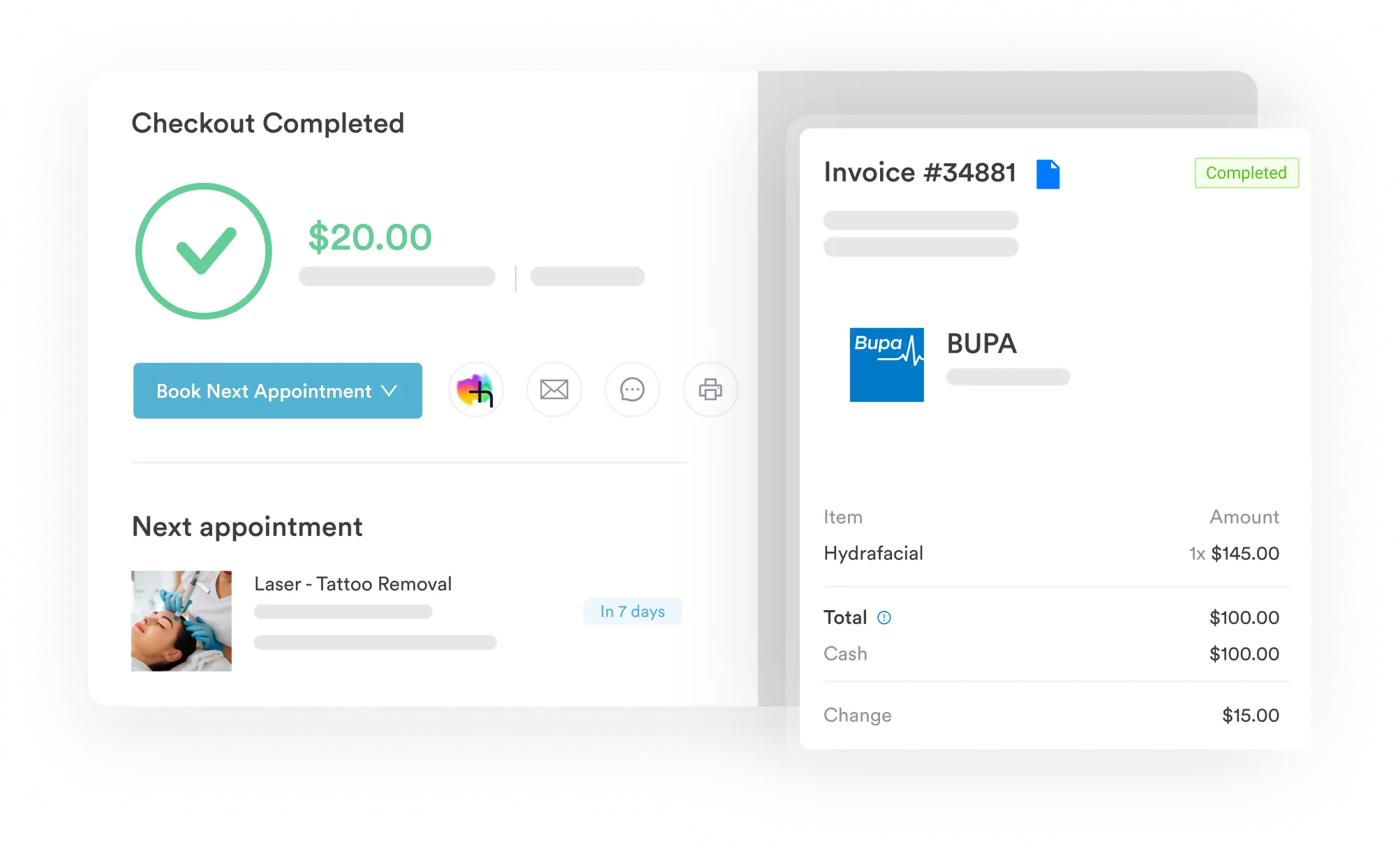
Claims submitted through Pabau’s Claim.MD clearinghouse integration are validated against payer edits before they transmit.
A wrong laterality, a non-billable parent code, or a missing external-cause pairing gets flagged on screen, not in a remittance report three weeks later. For a practice coding wound care at volume, that check removes most of the rework before it starts.

Pabau connects ICD-10-CM codes directly to treatment records and invoices, so your team spends less time correcting denials and more time delivering care. See how integrated claims management works for your practice.

Four fields decide this code, and the note has to carry all four. Most denials on S91.255A trace back to the 7th character, then laterality, then nail damage the clinician saw but never wrote down. Fix the note template once and the code follows.
If your coders are still retyping codes from a lookup tool into a billing system, that is the step to close first. Book a demo to see how Pabau carries an ICD-10 code from the treatment note to the submitted claim.

Need help with claim submission and clearinghouse integration? Medical claims clearinghouse guide covers how electronic claim submission works and what to look for in a clearinghouse partner.
Want to understand denial patterns for injury codes? Denial codes in medical billing explains the most common CARC and RARC codes your team will encounter on rejected wound care claims.
Looking for guidance on revenue cycle compliance? Medical billing compliance outlines the documentation and submission standards that protect against audits on injury coding.
S91.255A is the ICD-10-CM code for an open bite of the left lesser toe(s) with damage to nail, initial encounter. It is billable and valid for HIPAA-covered transactions under the 2026 ICD-10-CM edition, effective October 1, 2025. All four descriptors have to be documented: left side, bite wound, nail damage, and initial encounter.
Yes. S91.255A is a billable, specific ICD-10-CM code valid for submission on HIPAA-covered transactions. The base code S91.255 without a 7th character is non-billable and will be rejected. The 7th character, A, D or S, is required on any claim.
The three codes describe the same wound at different stages. S91.255A covers the initial encounter, while the patient is receiving active treatment. S91.255D covers follow-up visits once the wound is healing routinely. S91.255S covers late effects such as nail deformity or scarring from the original bite injury.
The clinical record must document all four specificity elements. Laterality must read as left, the wound mechanism as an open bite with the skin broken, and the encounter type as initial. Nail damage or nail involvement must be stated explicitly. Missing any one element creates a mismatch between the code and the documentation.
Use S91.255A any time the clinician is actively treating the wound, including initial assessment, wound cleaning, debridement, or repair. Switch to S91.255D once active treatment is complete and the patient returns only for routine healing management, such as dressing changes or suture removal. Multiple providers can each use S91.255A independently while they are providing active treatment.
The closest ICD-9-CM approximate equivalent is 893.1, open wound of toe(s), complicated, per the CMS General Equivalence Mappings (GEMs). The mapping is approximate because ICD-9-CM did not capture laterality, nail damage status, or bite mechanism with the specificity of ICD-10-CM S91.255A.