ICD-10 code S61.201A: Open wound of left index finger without nail damage
ICD-10 code S61.201A covers a left index finger wound of unstated type ICD-10 co...

Last Updated: Oct 16, 2026
Billable Code Specific Code
S91.212S is the billable ICD-10-CM code for laceration without foreign body of left great toe with damage to nail, sequela.
Two details decide whether the code is right. The 7th character has to match the healing stage, so a patient still in active wound care takes S91.212D instead. The nail qualifier has to match the operative note, because S91.112S covers the same wound with the nail intact.
Let Pabau's smart automation suggest the right codes, reduce claim denials, and keep your practice compliant—effortlessly.
Automate repetitive tasks and focus on what matters most—your patients.
Reduce coding errors and ensure compliance with the latest regulations.
Clean claims, fewer denials, and faster reimbursements.
Powerful insights and reporting to help your practice thrive.
HIPAA compliant SOC 2 certified GDPR-compliant Trusted by 4,000+ clinics worldwide

ICD-10 Code S91.212S describes a laceration without foreign body of the left great toe with damage to nail, sequela. It is a billable FY2026 code valid October 1, 2025 through September 30, 2026.
Nail damage is what separates this code from S91.112S. S91.2 codes cover open wounds of the toe with damage to nail; S91.1 codes cover the same wounds without nail damage.
The 7th character S (sequela) means the encounter addresses a condition caused by the original toe laceration. Active treatment of that laceration must already be complete.
Sequela (S) and subsequent encounter (D) are the most commonly confused 7th characters. D applies while the injury is still being actively treated; S applies to late effects after healing.
Pabau, our practice management software, helps practices submit S91.212S claims through the Claim.MD clearinghouse, with ICD-10 code catalogs and eligibility checks built in.
ICD-10 Code S91.212S is a billable, specific diagnosis code in the 2026 ICD-10-CM classification maintained by CMS and NCHS. It describes a laceration without foreign body of the left great toe with damage to nail, sequela. As a billable code, S91.212S can be used on its own to report a diagnosis in HIPAA-covered reimbursement transactions.
The FY2026 edition of the code took effect on October 1, 2025. S91.212S has carried the same description in earlier fiscal years, so the risk at a fiscal year boundary is administrative rather than clinical. Verify the active date range when you submit claims for services rendered on either side of October 1.
The S91.212 code family requires a mandatory 7th character to specify the episode of care. Without it, the code is incomplete and rejects on submission. Three variants exist, each with a distinct clinical meaning.
All three variants carry the same description: laceration without foreign body of left great toe with damage to nail. The 7th character changes only the episode of care, never the anatomy or the qualifiers.
The 7th character does not reflect who is treating the patient or how many times they have been seen. It reflects the healing stage of the injury at the time of the encounter. A patient seen by a specialist for the first time while still in active wound care receives the D character, not A.
The ICD-10-CM Official Guidelines maintained by CDC/NCHS set the test for the sequela character. S applies when the encounter treats a condition that is the direct result of the original injury, and active treatment of that injury is finished. The sequela condition itself is coded first, followed by S91.212S as the cause.
This distinction is a frequent source of claim rejections in S91 coding. The two characters look similar in practice but describe different clinical situations.
Use S91.212D (subsequent encounter) when:
Use S91.212S (sequela) when:
Here is how that looks in practice. A patient cut the left great toe three months ago through the nail bed. The wound has healed, but the nail now grows in ridged and lifts away from the bed. The nail dystrophy is coded first, and S91.212S follows to identify the underlying cause.
The two decisions run in a fixed order. The nail finding comes first, then the healing stage.
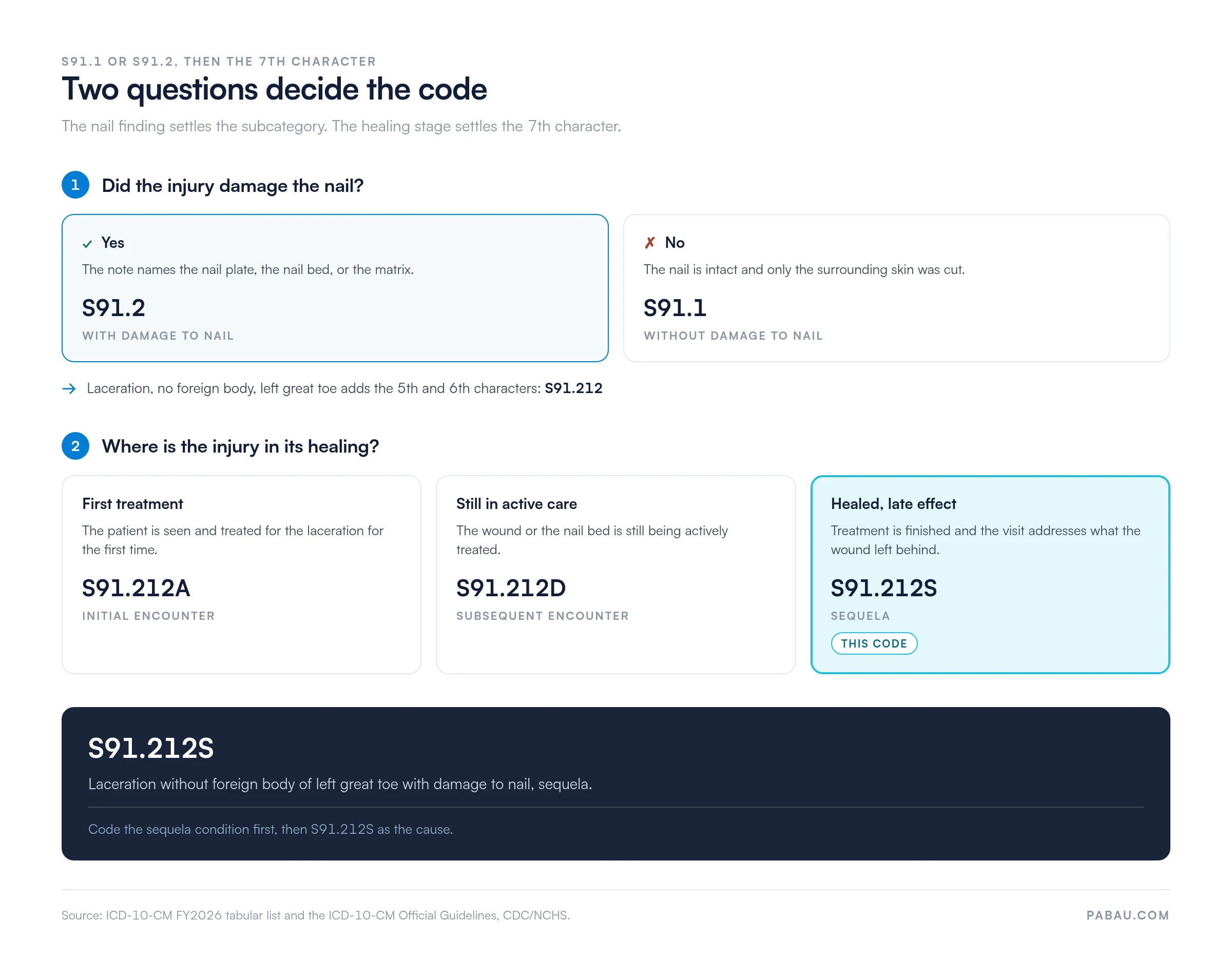
Document the sequela condition separately. S91.212S should never appear alone on a claim. It identifies the original injury as the cause, so the condition being treated at this encounter must be coded first. A missing primary condition code is a frequent trigger for a denial on this code.
The code description carries four clinically significant qualifiers, and the medical record has to support each one. Get any single qualifier wrong and a different code applies.
The nail qualifier is easy to overlook, because it sits at the fourth character rather than the sixth. S91.1 covers open wounds of the toe without damage to nail. S91.2 covers the same wounds with damage to nail. A provider who writes “laceration of left great toe” and stops there has not told you which family the code belongs to.
So the note needs to name the nail finding explicitly. Useful documentation says the nail plate was lacerated or avulsed, the nail bed was repaired, the matrix was involved, or a subungual hematoma was drained. Any one of those places the code in S91.2.
The “without foreign body” qualifier also has to be explicit rather than inferred. If the provider never documented that they looked for a foreign body and found none, a payer may treat the qualifier as unsupported.
Those qualifiers all assume the injury is a laceration. A left great toe that is sprained rather than cut sits outside S91, because S93 covers joint and ligament injuries at toe level. A follow-up visit for a metatarsophalangeal sprain on that side is ICD-10 S93.522D.
S91.212S sits at the bottom of a six-level path through the classification. Walking that path is the fastest way to confirm you are at the right level of specificity. It also surfaces any coding note a parent category passes down.
Two branch points decide the code. Nail damage enters at the fourth character, which is why S91.1 and S91.2 split before laterality is ever mentioned. Laterality and toe specificity enter at the sixth character, which is why S91.21 carries no side and S91.212 does.
Nothing between S91.2 and S91.212 is billable. Submitting a parent code such as S91.2 or S91.21 rejects automatically for lack of specificity. The same specificity rule runs through the rest of the diagnostic codes guide, across every injury category.
Sequela coding carries a heavier documentation burden than initial or subsequent encounter coding. The provider has to establish a causal chain between the original injury and the current condition. Practices without a clear protocol for sequela encounters see a disproportionate share of denials on these codes.
The medical record supporting S91.212S must contain all of the following:
Nail status is worth capturing at intake rather than at coding. When the history form asks whether the nail was involved, the coder has the S91.1 versus S91.2 answer on file. That happens before anyone builds the claim.

Coding software and electronic health records usually allow lookup by synonym as well as by official description. The following terms map to S91.212S and may appear in clinical documentation.
Each of these is clinically equivalent to the official description. When a provider writes “late effect of nail bed laceration, left great toe”, the correct code is S91.212S. Note that every one of these phrasings names the nail. Drop the nail reference and the same lookup lands on S91.112S instead.
S91.212S is paired with CPT codes that reflect the care delivered at this encounter. Because it is a sequela code, the visit usually involves evaluation and management or nail work rather than acute wound repair.
One pairing to watch is CPT 11760, the nail bed repair code. It belongs to the initial encounter rather than to a sequela claim. If it appears alongside S91.212S, either the procedure code or the 7th character is wrong. A nail bed under repair is still under active treatment.
CPT pairing is payer- and context-dependent. A pairing that is clinically accurate in one scenario can trigger a medical necessity review under another payer’s policy. Verify against the applicable Local Coverage Determination before submitting.
S91.212S sits within the S91.2 subcategory, which covers open wounds of the toe with damage to nail. Coders frequently need adjacent codes from the same family to compare laterality, toe specificity, or episode of care.
The AAPC Codify entry for S91.212S and the wider AAPC ICD-10-CM code lookup give you the full S91.2 subcategory for side-by-side comparison.
Two rows in that table deserve a second look. S91.219S covers an unspecified toe rather than an unspecified great toe, so it is a wider code than its number suggests. The unspecified great toe code is S91.213S.
S91.112S is the row that costs practices money. It differs from S91.212S by one qualifier and one digit, and both codes pass a format check. Only the operative note tells you which one is right. Clearinghouse validation confirms that a submitted code is billable and complete. It cannot confirm that the qualifier matches the chart, which is why a documentation review belongs alongside the automated checks.
The S91.211S row differs from S91.212S by laterality alone. For a right great toe wound seen during routine healing rather than as a late effect, the code is S91.211D. That code swaps both the side and the 7th character, so it covers neither the left toe nor the sequela phase.
To look up S91.212S in the ICD-10-CM alphabetical index, follow the path from the main term through its modifiers. This lookup path helps coders verify a code when they are working from a clinical narrative rather than from memory.
The nail modifier comes before the foreign body modifier in the index, which mirrors the code structure. Nail damage decides the subcategory; foreign body decides the fifth character. Take the “without damage to nail” branch at that same step and the path ends at S91.112S.
The index can also be entered under “Wound, open” followed by “toe(s)” and the same qualifier chain. The CDC/NCHS ICD-10-CM web tool offers an interactive index search that mirrors this path.
S91.212S is valid for HIPAA-covered claim submission, but the code alone does not guarantee reimbursement. Payers read the supporting documentation to confirm that the sequela condition is documented, causally linked to the original laceration, and separately coded. Three billing considerations matter most for this code family.
First, sequela codes are almost always submitted alongside a code for the condition being treated. S91.212S in isolation, with no companion code for the nail dystrophy or the nerve complication, is a common reason payers request records. That sequencing check belongs ahead of submission rather than after a denial.
Second, specificity matters for adjudication on two axes here, not one. Payers may reject S91.219S when the record clearly names the left great toe. An auditor may recoup S91.212S when the record never mentions the nail. A pre-submission check on laterality and nail status catches both.
Third, sequela coding is governed by the sequencing rules in Section I.B.10 of the ICD-10-CM Official Guidelines. S91.212S identifies the original injury, and the condition it caused is sequenced first. Reverse that order and the claim reads as though the practice treated a laceration that had already healed.
Errors on this code cluster in three places, and each one has a workflow fix.
Software that ties coding to clinical documentation handles the first two. When the intake or treatment note prompts for nail involvement and prior injury details, the billing module can pull that answer through. The coder then sees the clinical picture before choosing between S91.1 and S91.2.
Pabau is practice management software with medical claims management built in, and it handles the third. It integrates with Claim.MD, a US medical claims clearinghouse, and runs a pre-submission check for format compliance, billable status, and completeness.
S91.212 with no 7th character is flagged there rather than by the payer. The same integration processes electronic remittance advice files, so the claim-to-payment workflow stays in one system.

Pabau integrates with Claim.MD to validate ICD-10 codes, check eligibility in real time, and process remittance advice. Sequela coding errors get caught before they cost you a rejected claim.

Sequela coding errors on S91.212S are preventable, and they come down to two questions the chart has to answer. Was the nail involved, and is active treatment finished? Answer both in the note and the code assignment follows.
The trade-off worth remembering is that a wrong answer still passes a format check. S91.112S and S91.219S are both valid codes, so a clearinghouse will pass them through. Either one contradicts a record that names the left great toe and its damaged nail. That mismatch is what auditors look for.
Pabau’s claims workflow validates ICD-10-CM codes, sequela assignments included, before a claim reaches the payer. Book a demo to see how a coding check runs before your claims go out.

Dealing with repeated claim denials on injury codes? Denial management in healthcare explains how to spot denial patterns and build workflows that catch errors before submission.
Want to understand how clearinghouse submission works end to end? Clean claim best practices covers the validation steps that prevent rejections on ICD-10 injury codes.
Comparing codes across the wider injury range? The ICD-10-CM code library collects the reference pages for adjacent categories and their laterality rules.
ICD-10 Code S91.212S is a billable diagnosis code for a laceration without foreign body of the left great toe with damage to nail, sequela. It applies when a patient presents for a late effect or complication caused by that toe laceration. The original wound must have healed and active treatment must be complete.
Yes. S91.212S sits under S91.2, which covers open wounds of the toe with damage to nail. The record must therefore describe an injury to the nail plate, nail bed, or nail matrix. If the nail was intact, the correct code is S91.112S, under the S91.1 group for wounds without nail damage.
Yes, S91.212S is a billable and specific ICD-10-CM code valid for HIPAA-covered transactions during FY2026, which runs October 1, 2025 through September 30, 2026. It can be used directly as a diagnosis code for claim submission, provided the documentation meets payer requirements for sequela coding.
All three describe a laceration without foreign body of the left great toe with damage to nail, and only the episode of care differs. S91.212A covers the initial encounter, when the patient is first treated. S91.212D covers subsequent encounters while active treatment continues. S91.212S covers a late effect once the wound has healed.
A subsequent encounter (7th character D) means the patient is still receiving active treatment for the original injury. A sequela (7th character S) means active treatment is complete and the encounter addresses a resulting condition, such as a nail deformity or chronic pain. The two are mutually exclusive: once treatment ends, D no longer applies.
The record must document laterality, meaning the left foot and the left great toe. It must also name a laceration as the original injury, record the absence of a foreign body, and identify the nail structure that was damaged. It then needs confirmation that the wound has healed, the sequela condition being treated, and a statement linking that condition to the prior laceration. The sequela condition is coded separately as the primary diagnosis.
Two errors dominate. The first is using S91.212S while the wound is still under active treatment, where D applies. The second is confusing it with S91.112S when the nail was not involved. Coders also submit S91.212S with no companion code for the sequela condition, or omit the causal statement linking the two. A fourth error is falling back on an unspecified toe code when the left great toe is clearly documented.