ICD-10 code S99.102P: Left metatarsal physeal fracture with malunion
ICD-10 code S99.102P flags a malunited growth plate fracture ICD-10 code S99.102...

Last Updated: Oct 28, 2026
Billable Code Specific Code
S90.842A is the billable ICD-10-CM code for external constriction, left foot, initial encounter. It applies when a band, ring, tourniquet, cast or wrapped hair squeezes the left foot. The patient must still be in active treatment.
The 7th character A is required, because the parent S90.842 is not billable. Claims for this code tend to fail on three points: the wrong body region, a missing side, or an A billed after active care ends. This guide shows how to tell the foot from the ankle and toes, and what the note must show. It ends with a pre-submission checklist and the denial triggers to watch.
Let Pabau's smart automation suggest the right codes, reduce claim denials, and keep your practice compliant—effortlessly.
Automate repetitive tasks and focus on what matters most—your patients.
Reduce coding errors and ensure compliance with the latest regulations.
Clean claims, fewer denials, and faster reimbursements.
Powerful insights and reporting to help your practice thrive.
HIPAA compliant SOC 2 certified GDPR-compliant Trusted by 4,000+ clinics worldwide

S90.842A codes external constriction of the left foot at the initial encounter, while the patient is in active treatment.
The foot code excludes the ankle and toes, which have their own codes, such as S90.542A for the left ankle.
The 7th character is mandatory, and the parent code S90.842 is not billable on its own.
A 7th-character mismatch or missing laterality is a frequent denial trigger, so check both against the note before you submit.
Pabau, a practice management platform, pre-fills claims from the patient record and checks required fields before they go out.
ICD-10 code S90.842A is the billable code for external constriction of the left foot at the initial encounter. Use it when something tight, such as a band, ring, tourniquet or cast, has injured the left foot.
The patient must still be in active treatment. The code is valid for the current fiscal year, FY2027.
Read S90.842A from left to right, and each step narrows the injury. Misread one step and you land on a different code.
External constriction is a superficial injury caused by a band, ring, tourniquet, cast or similar agent encircling the limb. The pressure damages skin and soft tissue where the agent sits.
These are the sources that turn up in foot notes:
Wound care, podiatry and emergency teams should record the agent itself. The note has to name it for the code to hold at audit. A note that says only “foot injury” does not support S90.842A.
ICD-10-CM also has external cause codes for the agent, in category W49.0-. W49.01- covers hair, W49.02- string or thread, W49.03- rubber band and W49.04- ring or other jewelry.
There is no national requirement to report external cause codes. Some states and payers do ask for them, so add the matching W49.0- code where yours does.
Every injury code in Chapter 19 needs a 7th character, and S90.842A is no exception. The parent S90.842 has none, so payer front-end edits reject it. The CMS ICD-10 code files list only the complete seven-character code as valid for claims.
Here is how the error looks in practice. A patient returns for a third wound check after the ED removed a tight bandage. Active treatment has ended, so this visit takes S90.842D, not S90.842A. The reverse mistake happens too, when S90.842D lands on an ED visit with the band still in place.
Document the encounter type explicitly in every note for a constriction injury. Write ‘Initial encounter for active treatment of external constriction injury, left foot’ rather than just ‘follow-up visit.’ This one sentence justifies the 7th character and heads off a frequent payer audit query on S90.842A claims.
S80.842A and S90.842A share a descriptor except for one word: lower leg versus foot. The ankle and the toes add two more neighbors, so site errors are easy to make.
The clinical cue fits on one line. Above the ankle: S80.842A. At the ankle: S90.542A. On the foot: S90.842A. On a toe: S90.442A or S90.445A. Code the site where the agent sits and the note records the injury.
The chart below puts the four sites and the three 7th characters side by side.
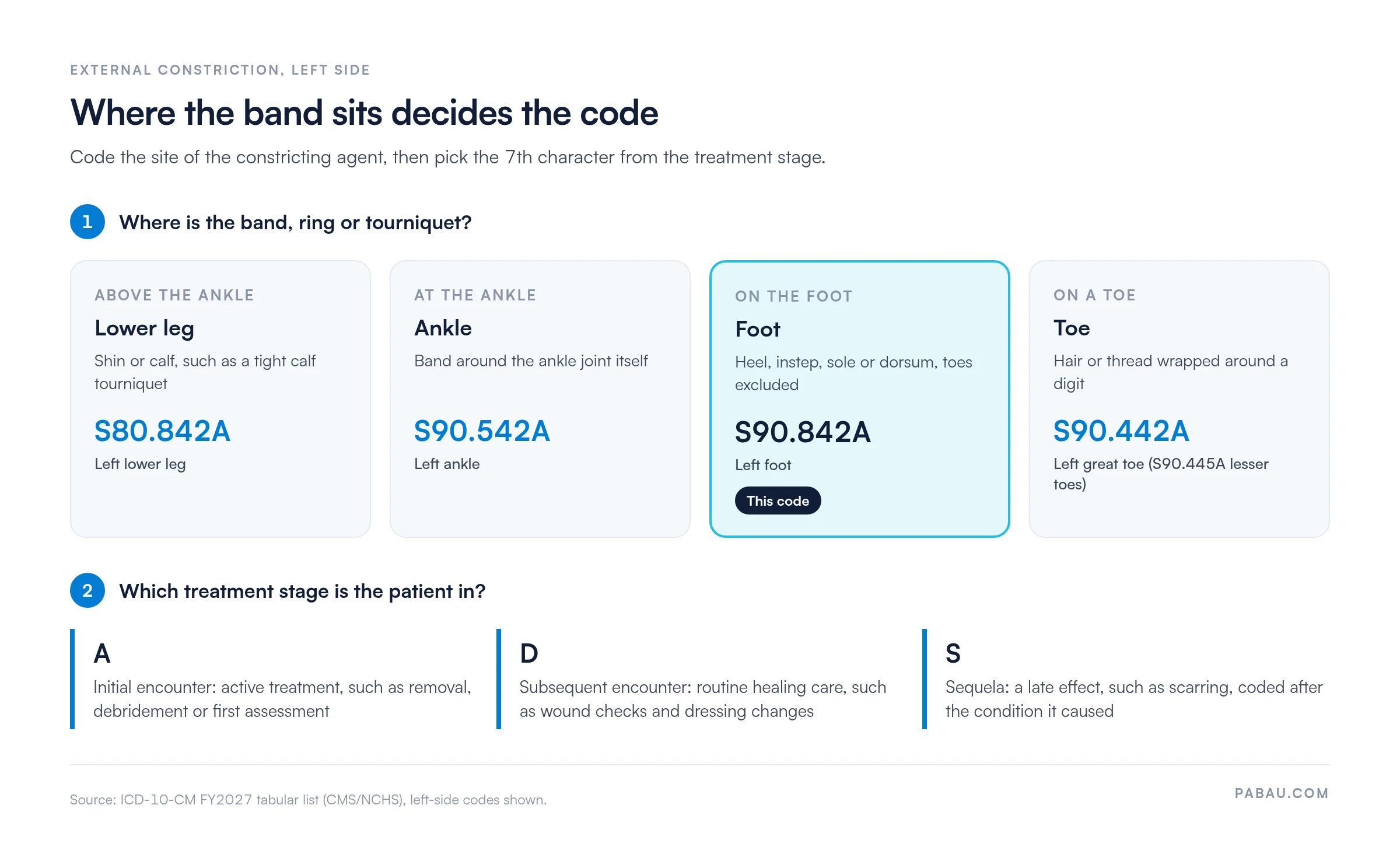
ICD-10-CM gives the foot three laterality options. Billing S90.849A (unspecified foot) when the note clearly says left foot is a coding error, not a safe choice. Payers often deny or downcode unspecified codes when a specific one was available. Policies vary by payer and plan type.
The CDC/NCHS ICD-10-CM tool shows laterality options when you look up injury codes. Before you submit, confirm the side in the note matches the code.
S90.842A is valid and billable for the current fiscal year, FY2027, which began October 1, 2026. Its status has not changed since FY2024. CMS releases an updated ICD-10-CM code set every year, effective October 1.
Checking code validity each October belongs in any medical billing workflow, because codes can be revised, split or deleted.
For a claim near a fiscal year boundary, check the code set for the date of service. Also check any Local Coverage Determination (LCD) your payer applies to foot injury care.
The lower leg mix-up is not the only one. Each code below produces a wrong claim when picked in error, and each has a clear trigger.
To hold up at audit, the record needs four elements. Missing any one of them is grounds for denial or recoupment. Sound billing compliance best practices say to query the provider when an element is missing, rather than falling back to a vaguer code.
Structured digital forms at the point of care make these elements harder to miss than free text written later. When each element has its own field, the clean claim rate for injury codes tends to rise.
Knowing the path shows you where a claim can stall. A typical outpatient claim for this code moves through six stages.
With this code, trouble usually shows up at stage 4 or 5. A missing 7th character fails the scrub, while a site or encounter mismatch fails payer review.
Run these checks before the claim leaves the practice. Each one lines up with a denial reason in the next section.
Claims for S90.842A tend to fail for five predictable reasons, and each can be caught before submission. Good denial management workflows flag these patterns for review before the claim goes out.
When a denial does come back, the reason code on the remittance tells you why. Our guide to medical billing denial codes maps each CARC to its fix.
The right CPT code depends on what was done at the visit. Neither CMS nor the AAPC Codify lookup sets universal CPT pairings for this code. Payers can also add limits through LCD policies.
The pairings below are clinically common, so check your payer’s coverage policy before you submit.
If the visit included debridement, review the rules for 97597 before you add its add-on code.
The General Equivalence Mappings (GEMs) link S90.842A to ICD-9-CM only approximately. The closest ICD-9 code is 917.8, other and unspecified superficial injury of foot and toes, without infection. ICD-9 had no laterality, so the left-foot detail has no match.
CMS describes GEMs as approximations, not exact equivalents. Use them for historical data and legacy claims research, never as proof of clinical or billing equivalence. The WHO ICD-10 browser gives context on the international structure behind ICD-10-CM.
When you pull historical claims for a similar injury from before October 2015, treat the GEM as a flag only. Audit the clinical record to confirm the ICD-9 code reflected the same mechanism as S90.842A before you draw any comparison.
Foot injury claims often stall on small details: the side, the site, the 7th character, a missing field. When staff retype codes from the note into a separate billing system, each retype adds another chance for error.
Pabau starts the claim from the patient record instead. Its claims management software pre-fills the claim form from the record. Built-in ICD-10-CM and CPT/HCPCS lookup libraries help staff find the exact code. Required fields are checked before the claim can be sent.
In the US, claims go out through Claim.MD with real-time eligibility checks. ERA posting and claim tracking then show which claims paid and which need follow-up, so denials surface quickly.

Pabau pre-fills claims from the patient record and checks required fields before sending. Claims go out through Claim.MD with eligibility checks, ERA posting and claim tracking.

S90.842A is a narrow code, and that narrowness works in your favor. When the note names the left foot, the agent and active treatment, the code is easy to defend. When any of those is vague, coding skill cannot rescue the claim.
So fix the note before you fix the code. Build the side, the agent and the encounter stage into your intake and wound templates. The checklist then becomes a quick confirmation rather than a hunt, and a few extra fields cost far less than reworking a denial.
Pabau, our practice management platform, builds each claim from the patient record, so what you document is what you bill. Book a demo to see how it carries injury claims from the note through to payment.

Need to understand how denials are coded and resolved? Denial codes in medical billing maps each CARC reason code to its resolution path.
Submitting claims electronically for foot and ankle injuries? Claim.MD clearinghouse overview explains how claims reach payers through the clearinghouse.
Want fewer claims bounced back for rework? What makes a clean claim covers what a payer-ready claim needs before it goes out.
Want to benchmark your practice’s billing performance? Revenue cycle management explained covers the process from code selection through payment posting.
Yes. S90.842A is a valid, billable ICD-10-CM code in the FY2027 code set, effective October 1, 2026. Its descriptor has not changed from earlier years.
Use S90.841A for the initial encounter on the right foot. S90.841D covers subsequent encounters, and S90.841S covers sequela.
Code the toe, not the foot. Use the S90.44- code for the side and toe, such as S90.442A for the left great toe. Where your payer wants an external cause, add W49.01XA for hair.
Yes, when treating the constriction injury is the main reason for the visit. Sequela works differently, because S90.842S follows the code for the late effect itself.
S90.842A is for active treatment, such as removing the agent or debriding the wound. S90.842D is for routine healing care afterward, such as wound checks and dressing changes.