ICD-10 Code S52.541M: Smith’s fracture of right radius with nonunion (open type I or II)
ICD-10 Code S52.541M: Definition and billable status ICD-10 Code S52.541M is the...

Last Updated: Oct 15, 2026
Billable Code Specific Code
S90.463S is the billable ICD-10-CM code for insect bite (nonvenomous), unspecified great toe, sequela.
The S suffix marks a sequela, meaning the acute bite has healed and the patient is being treated for what it left behind. A visit for a bite that is still healing takes S90.463D instead. The code is used when the note does not record which great toe was bitten.
Let Pabau's smart automation suggest the right codes, reduce claim denials, and keep your practice compliant—effortlessly.
Automate repetitive tasks and focus on what matters most—your patients.
Reduce coding errors and ensure compliance with the latest regulations.
Clean claims, fewer denials, and faster reimbursements.
Powerful insights and reporting to help your practice thrive.
HIPAA compliant SOC 2 certified GDPR-compliant Trusted by 4,000+ clinics worldwide

S90.463S is the billable ICD-10-CM code for a nonvenomous great toe insect bite at a sequela encounter.
The 7th character S marks a sequela, so the scarring or chronic pain must trace directly to the healed bite.
Documentation must link the current complaint to the prior bite, and an actively healing bite uses S90.463D instead.
When the note records a side, S90.461S or S90.462S is the more specific code.
Pabau’s claims management software validates ICD-10-CM codes before submission, which cuts S-suffix denials.
ICD-10 Code S90.463S is a specific, billable ICD-10-CM diagnosis code that describes insect bite (nonvenomous) of unspecified great toe, sequela.
It sits within chapter 19 of ICD-10-CM, which covers injury, poisoning and certain other consequences of external causes. The code is valid on claims submitted to Medicare, Medicaid, and commercial payers for HIPAA-covered transactions.
S90.463S appears in the current FY2026 edition of ICD-10-CM, which took effect on October 1, 2025. That edition is maintained by the Centers for Medicare and Medicaid Services (CMS). The code itself is not new. Its S90.46x family has sat in the tabular list since the mid-2010s, and the FY2026 update changed nothing structural about it.
The 7th character “S” designates sequela, meaning a residual condition that results directly from an earlier injury. ICD-10-CM Official Guidelines Section I.C.19.a defines it that way, and it applies only once the acute phase has resolved. For S90.463S, the sequela is the condition the patient presents with now — scarring, chronic pain, numbness, or skin changes. It has to trace back to a nonvenomous great toe bite treated at an earlier encounter.
Three 7th character options apply to S90.463. Coders must select the one that reflects the current encounter, not the original injury date.
The most common coding error is applying “S” when “D” (subsequent encounter) is correct. If the bite wound is still open, infected, or actively being treated, the encounter is subsequent. The suffix rules hold across every injury chapter, so the deciding factor is what the clinical note records about wound status.
S90.463S sits within the S90 block, which covers superficial injuries of the ankle, foot, and toes. Understanding the hierarchy helps coders quickly locate adjacent codes and verify specificity. Bites at other sites route to their own blocks. A healed nonvenomous insect bite of the nose takes ICD-10 code S00.36XS.
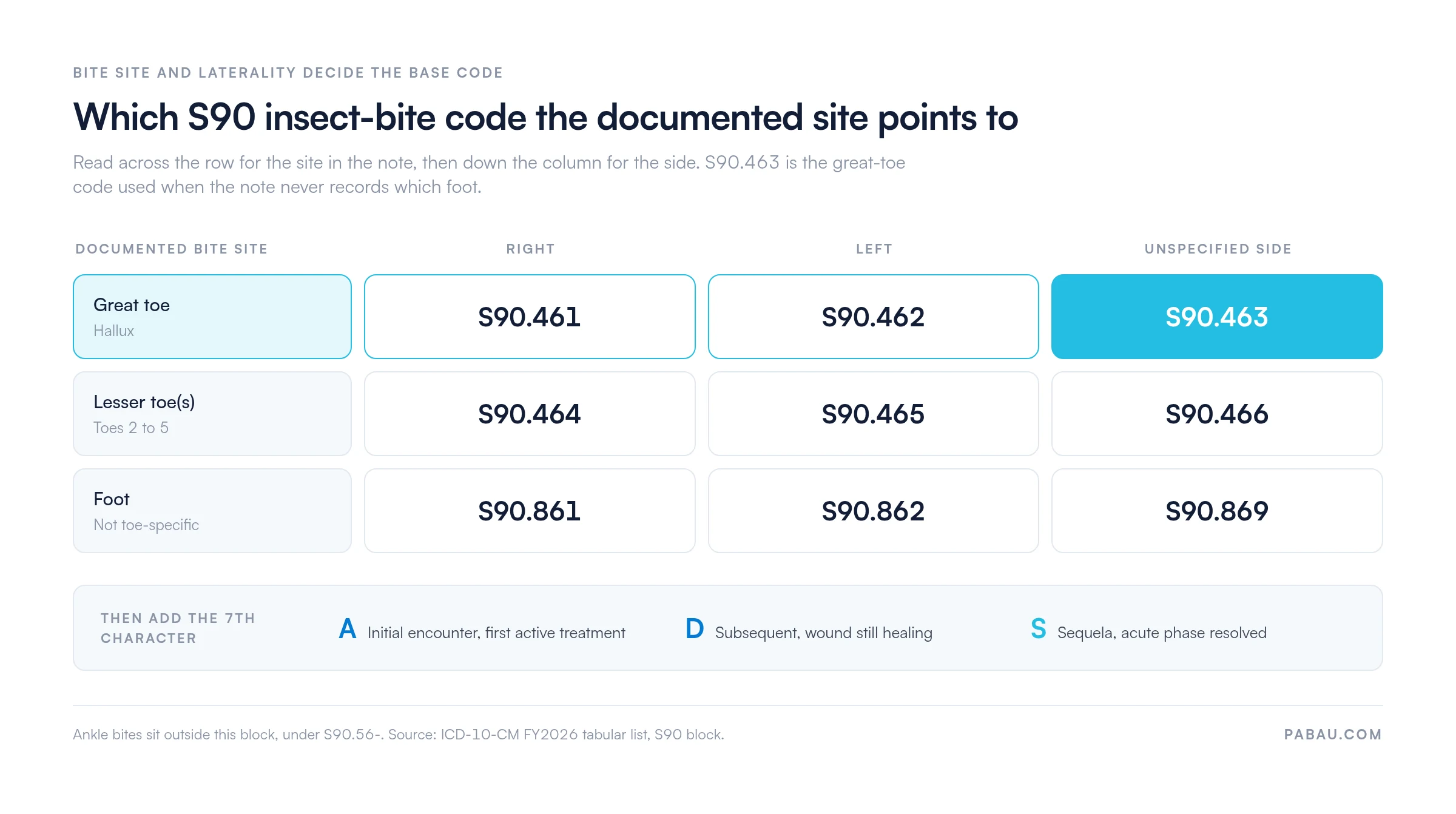
The “unspecified” designation at S90.463 means the note does not record which great toe was bitten. When a side is documented, a more precise code applies. S90.461 covers the right great toe and S90.462 the left, and each takes the same A, D, or S 7th character. The grid below maps every bite site in this block to its three laterality codes.
S90.463A, S90.463D, and S90.463S describe the same anatomical injury at three different treatment phases. Selecting the wrong encounter type is the primary reason these claims are denied.
Coding guidelines from the CDC/NCHS ICD-10-CM official tool set two conditions for sequela coding. The original injury must have fully resolved its acute phase. The condition being treated now must be a direct consequence of that injury. Meeting both in the note is what separates a clean sequela claim from a denial.
A nonvenomous insect bite is a bite from an insect that injects no venom or toxin capable of causing systemic effects. Common culprits coded under S90.463S include flies, gnats, bedbugs, ants, and mosquitoes biting the great toe (hallux) or the skin around it.
Sequelae of a great toe bite usually take one of the following forms.
When coding these residual conditions, note that S90.463S reports the cause of the sequela. The manifestation — the scar, the pain, the pigment change — may need its own code under ICD-10-CM multiple-coding guidelines. AHA Coding Clinic guidance on injury sequela coding reinforces that dual-code approach.
Document the sequela encounter in two parts. First, record the current residual condition, such as a hypertrophic scar of the great toe skin. Second, record the causal history: resulting from a nonvenomous insect bite sustained in a stated month or year. Payers need both to accept S90.463S without manual review.
ICD-10-CM Official Coding Guidelines Section I.C.19.a govern how sequela codes are applied to injury codes, including S90.463S. Following these steps reduces claim denials and audit risk.
The same five-step framework applies to every injury sequela code in chapters 13 and 19. What the note has to record differs by code, while the sequela rules stay the same.
Incomplete documentation is the most audited weakness in injury-code billing, which puts sequela claims squarely in an auditor’s path. The rules on medical billing compliance set out what a note has to carry to survive that review.
S90.463S is a billable code valid for submission on CMS-1500 and 837P claim forms. Billing it carries one recurring problem. Payers often auto-pend sequela claims for review because the injury date does not match the current date of service, which trips a date-mismatch edit.
Preventing that denial comes down to two dates on the claim. The original injury date, or an approximate period, and the current date of service for the sequela visit both belong in their own fields. Practices running claims management software can flag an empty injury-date field while the claim is still being built.
Practice management software like Pabau integrates with Claim.MD, a US claims clearinghouse that validates ICD-10-CM codes against the current CMS tabular list before transmission. A claim carrying S90.463S runs through the same 837P validation path as any other injury code, with eligibility checks and remittance posting handled automatically.
Sequela documentation errors surface late in the billing cycle. The claim clears initial submission edits, because the code is valid and billable. It then fails medical necessity review, because the note never supports the “S” designation. A documentation protocol for sequela visits catches that before the claim goes out.
Three denial patterns appear consistently when S90.463S claims are rejected.
The medical billing denial codes reference lists which CARC reason codes turn up on rejected sequela claims. Two appear often. CARC 4 means the procedure code is inconsistent with the modifier used, or a required modifier is missing. CARC 97 means the benefit for the service is included in the payment or allowance for another service already adjudicated.
Routing these claims through a clearinghouse with pre-submission ICD-10-CM validation catches suffix mismatches before they reach the payer.
Run a quarterly audit on all S-suffix injury codes your practice submits. Pull the date of service, the original injury date, and the denial rate together. If S-suffix claims deny at more than twice the rate of A or D claims, your sequela documentation template needs a mandatory causation field.
Several codes in the S90 block are commonly referenced alongside S90.463S. The table below covers the most clinically relevant adjacent codes.
When the note records a side, use S90.461S or S90.462S instead of S90.463S. The AAPC Codify ICD-10-CM lookup carries the full laterality breakdown for the S90.46x codes, sequela variants included.
Laterality errors tend to cluster in one part of a denial report, which makes them quick to fix in a documentation template. One added field for the side turns a recurring rejection into a one-time change.
A sequela visit can be coded correctly and still lose the claim on a missing field. The coder picks S90.463S, the note describes the scar, and the original injury date never reaches Box 14. The rejection then arrives weeks later, long after the encounter closed.
Pabau keeps the ICD-10-CM catalog current inside the system. S90.463S and its A and D siblings are selectable while the coder is still in the note. Claim validation runs before submission through the Claim.MD integration, and remittance advice posts back against the original claim automatically.
For a coding team, that means fewer sequela claims sitting in a payer’s manual review queue. Denials that do come back arrive with a CARC code attached to the claim they belong to. The appeal then starts from the record rather than a spreadsheet.

Pabau’s built-in claims management and Claim.MD integration keeps ICD-10-CM codes current and validates claims before submission. Remittance advice posts automatically, so your team spends less time chasing denials.

S90.463S is easy to select and easy to lose. What decides the claim is whether the note proves the bite healed and that the condition left behind came from it. Add a causation line and the original injury date to your sequela template, and the suffix stops being a denial risk.
That change costs one field in a documentation template and pays back on every S-suffix claim afterwards. The trade-off worth remembering is specificity. When the side is documented, S90.461S or S90.462S is the better code, and S90.463S becomes a fallback rather than a habit.
Pabau’s Claim.MD integration validates ICD-10-CM codes at claim build, routes 837P transmissions through a US clearinghouse reaching thousands of payers, and posts remittance advice automatically. Book a demo to see how your coding team would track S-suffix denial patterns in Pabau.

Need to understand how sequela claims route through a clearinghouse? Claim.MD clearinghouse overview explains how 837P submissions, eligibility checks, and ERA posting work together in a single billing pipeline.
Want to reduce denial rates across your injury-code claims? Denial management in healthcare covers how to build a systematic review process using CARC codes and clearinghouse rejection data.
Looking for guidance on submitting clean claims with accurate ICD-10 codes? What is a clean claim outlines the documentation and coding standards that prevent payer edits before the claim is adjudicated.
ICD-10 Code S90.463S is the billable ICD-10-CM diagnosis code for insect bite (nonvenomous) of unspecified great toe, sequela. The “S” suffix indicates a sequela encounter. The patient is being treated for a residual condition, such as scarring or chronic pain. That condition must have resulted from a nonvenomous insect bite of the great toe. The original acute injury must have fully resolved.
Yes, S90.463S is a billable, specific ICD-10-CM code valid for claim submission on HIPAA-covered transactions. It appears in the FY2026 ICD-10-CM edition, effective October 1, 2025. Medicare, Medicaid, and commercial payers accept it, subject to applicable Local Coverage Determinations.
S90.463A is the initial encounter code, used when the patient first receives active treatment for the insect bite. S90.463D is the subsequent encounter code, used for follow-up visits while the bite is still healing. S90.463S is the sequela code. It applies only after the acute injury has fully resolved and a residual condition remains.
Code the residual condition (manifestation) first with its appropriate ICD-10-CM code, then list S90.463S as the cause per ICD-10-CM sequela sequencing guidelines. The clinical note must state that the current condition results from a prior healed insect bite of the great toe. The original injury date, or an approximate period, belongs in Box 14 of the CMS-1500 claim form.
Use S90.463S only when the original bite wound has completely healed and the visit addresses a residual condition rather than ongoing wound care. If any active treatment of the bite wound is still occurring, such as wound checks, dressing changes, or antibiotics for infection, S90.463D applies. Applying S90.463S while the wound is still open is the most common cause of sequela-code denials.
The S90.46x block covers nonvenomous insect bites of the toes. Great toe bites use S90.461 (right), S90.462 (left) and S90.463 (unspecified), each with an A, D or S suffix. Lesser toe bites use S90.464 (right), S90.465 (left) and S90.466 (unspecified). For a bite to the foot rather than a specific toe, S90.86x applies. That covers S90.861 (right), S90.862 (left) and S90.869 (unspecified). Venomous bites and stings sit in different code categories outside S90.