ICD-10 code S61.201A: Open wound of left index finger without nail damage
ICD-10 code S61.201A covers a left index finger wound of unstated type ICD-10 co...

Last Updated: Oct 16, 2026
Billable Code Specific Code
S89.002G is the billable ICD-10-CM code for unspecified physeal fracture of upper end of left tibia, subsequent encounter for fracture with delayed healing.
The G 7th character marks a follow-up visit where the physician documented that the fracture is healing more slowly than expected. Choosing between D and G at that visit changes what the payer expects to see in the record.
Let Pabau's smart automation suggest the right codes, reduce claim denials, and keep your practice compliant—effortlessly.
Automate repetitive tasks and focus on what matters most—your patients.
Reduce coding errors and ensure compliance with the latest regulations.
Clean claims, fewer denials, and faster reimbursements.
Powerful insights and reporting to help your practice thrive.
HIPAA compliant SOC 2 certified GDPR-compliant Trusted by 4,000+ clinics worldwide

S89.002G is a billable 2026 ICD-10-CM code for an unspecified physeal fracture of the upper end of the left tibia. It applies at a subsequent encounter where the physician documented delayed healing.
The 7th character G separates delayed healing from routine subsequent encounters, which take the D suffix. Physician documentation of impaired fracture progression has to support it.
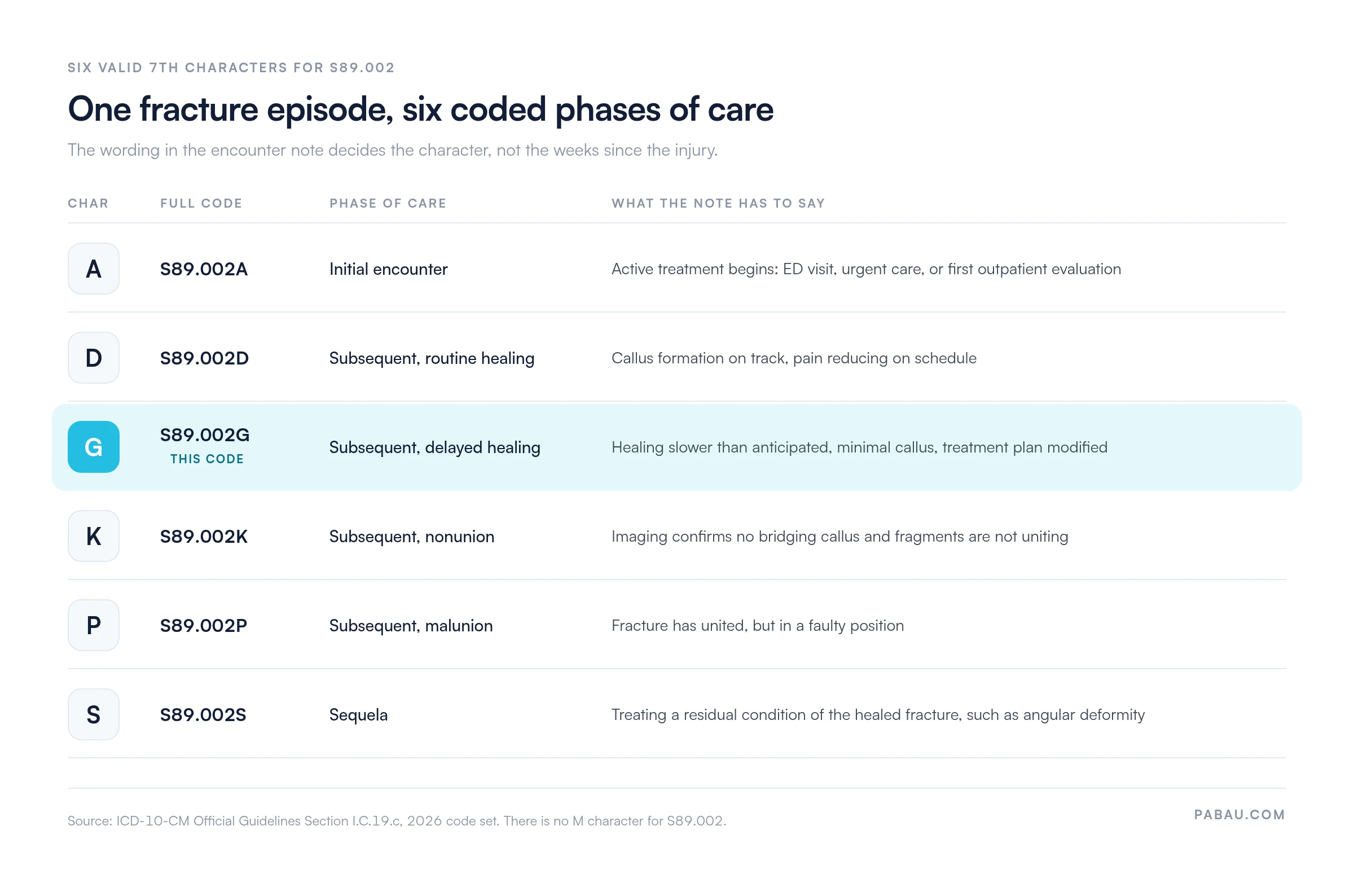
Only six 7th characters are valid for S89.002: A, D, G, K, P and S. There is no M character in this subcategory.
S89.002G cannot be coded for the right leg or an initial encounter. Laterality and encounter type must match the clinical record exactly.
Practice management software like Pabau validates ICD-10 codes through a clearinghouse before submission, so laterality and 7th character errors surface early.
ICD-10 code S89.002G is an alphanumeric code where every character position carries clinical meaning. Misreading one segment produces a wrong-laterality or wrong-encounter code that a clearinghouse or payer rejects on first pass.
The “unspecified” designation in S89.002G means the Salter-Harris fracture type has not been documented. A more specific code within the S89.0 family applies when the notes or imaging report a Salter-Harris classification. Use S89.002 and its 7th character extensions only when the Salter-Harris type is absent from the record.
Laterality is non-negotiable. S89.002G is left-leg only, and assigning it to a right-leg fracture is a coding error even when the claim happens to pay. The same laterality logic runs through the whole S00-T88 injury chapter.
Per the ICD-10-CM Official Guidelines Section I.C.19.c, the 7th character defines the phase of care at each encounter, not the severity of the injury. For S89.002, six 7th character options exist. Knowing which one applies at a given follow-up visit is where most coding errors happen.
The G suffix requires physician documentation stating that healing is progressing more slowly than expected for the fracture type and patient profile. ICD-10-CM sets no specific number of weeks as the threshold for delayed healing. The clinical judgment belongs to the physician, and the coder reflects that judgment in the code selection.
Use D when the follow-up note shows healing on track, with callus formation visible on imaging and pain reducing on schedule. Use G when the physician documents concerns about the healing rate, orders extra imaging, or modifies the treatment plan.
A note reading “fracture healing well” points to the D suffix. A note reading “minimal callus at eight weeks, healing slower than anticipated” points to G instead. P applies further down the same episode, when the note documents malunion. That means the fracture united in a faulty position.
Read the six characters as one episode rather than a lookup list. The chart below pairs each character with the phrase the encounter note has to carry.
A physeal fracture, also called a growth plate fracture, involves disruption of the cartilaginous growth plate at the end of a long bone. In the proximal tibia, that area sits just below the knee and drives longitudinal bone growth.
These injuries occur mostly in skeletally immature patients, because the growth plate is weaker than the surrounding bone before ossification finishes. Adults rarely sustain physeal injuries, since the adult equivalent tends to involve ligamentous structures instead.
Physeal fractures of the proximal tibia often involve extended rehabilitation after immobilization. That multi-encounter arc is why the ICD-10-CM 7th character system exists. Each visit, from the ED through the last follow-up, gets coded for its current phase of care.
Accurate coding at each stage supports continuity of care documentation and appropriate reimbursement for the distinct services provided across the healing timeline.
Knowing where S89.002G sits in the hierarchy helps when laterality or encounter type differs from the standard scenario. The wider ICD-10-CM code index follows the same structure across the S00-T88 chapter, so one trauma family teaches the rest.
Laterality sibling codes: S89.001 covers the right leg and S89.009 covers unspecified laterality. Each carries the same six 7th character options (A, D, G, K, P, S). Check the patient’s chart for left versus right before selecting the code.
Delayed-healing claims face more scrutiny than routine subsequent encounters, because payers look for documentation that justifies the distinction. An S89.002G claim submitted without supporting notes tends to draw a request for records or a medical necessity denial.
Practice management software like Pabau keeps that documentation attached to the claim. Pabau’s claims management software routes ICD-10 diagnosis codes through Claim.MD clearinghouse validation before submission. Laterality mismatches and missing 7th characters surface there, not in a rejection weeks later.
When a claim does reject, the electronic remittance advice feeds the denial reason back into the workflow. Staff can then correct the documentation and resubmit without rebuilding the claim from scratch.
The same principle holds across ICD-10-CM injury codes. The 7th character reflects the treating clinician’s current assessment, not the passage of time. Six weeks post-fracture is not automatically a subsequent encounter with delayed healing.
Billing teams that see repeated 7th character rejections can work backward from the reason code. A denial management process turns those reason codes into a pre-submission checklist for S89.002G claims.
Before submitting an S89.002G claim, check the encounter note for three elements. It needs an explicit statement that healing is delayed, findings that support that assessment, and any resulting treatment change. Miss one and the claim is exposed to a medical necessity denial.
Choosing the correct S89.002 code at each visit means matching the physician’s documentation to the encounter type each 7th character represents. The table below covers the five variants coders reach for most often.
The distinction between G and K is the degree of healing failure. Delayed healing (G) means slowed but potentially recoverable progress. Nonunion (K) means the process has stalled, usually confirmed by imaging showing no callus bridging well past the expected window. The physician’s note should make that distinction explicit.
ICD-10-CM guidelines require external cause codes alongside injury diagnosis codes when the information is available. These secondary codes do not affect reimbursement directly. They support injury surveillance, workers’ compensation claims, auto liability cases, and population health analytics.
S89.002G is a subsequent encounter code. External cause codes reported alongside it should carry a D or G 7th character to match. Do not re-report initial-encounter external cause codes at follow-up visits.
At subsequent encounters, report the injury code first, followed by any applicable external cause status codes. Place-of-occurrence codes are not reported at subsequent encounters.
Check the patient’s original ED or initial visit record before coding a subsequent encounter. Mechanism of injury, laterality, and Salter-Harris type should stay consistent across every encounter for the same fracture episode. Inconsistency between the initial and subsequent records is a common audit flag.
In most practices, the coder picks the 7th character from the encounter note, and nobody checks it again until the payer responds. A laterality slip or a missing character then costs weeks of rework.
Pabau puts the check before the submission. Diagnosis codes travel from the clinical note into the claim without retyping, and Claim.MD clearinghouse validation runs payer-specific edits on the way out. A right-leg code on a left-leg record fails there, in seconds, at no cost.
The remittance side closes the loop. Electronic remittance advice posts the payer’s reason codes against the original claim, so the billing team sees which delayed-healing claims keep failing and why. Every Pabau subscription includes claims management, so the workflow does not depend on which plan the practice is on.

Pabau routes ICD-10-CM diagnosis codes through Claim.MD clearinghouse validation before submission, catching 7th character mismatches and laterality errors before they reach the payer. See how it works for your billing team.

The G suffix is a documentation decision before it is a coding decision. If the encounter note does not say healing is delayed, the claim belongs on D, whatever the calendar says.
So the useful change sits upstream of the coder. Ask the treating physician to state healing status in plain words at every follow-up. The 7th character then stops being a judgment call for billing staff.
One trade-off is worth remembering. G reimburses the extra clinical work only when the record shows that work happened. Book a demo to see how Pabau validates injury codes before your claims reach the payer.

Need to understand what happens when an ICD-10 claim rejects? Denial codes in medical billing explains the CARC reason codes tied to ICD-10 errors and how to clear them on resubmission.
Coding another fracture with delayed healing? Femur fracture ICD-10 codes walks the S72 family through the same 7th character logic.
Want fewer rejections across every code you submit? Clean claim sets out what a payer needs to see on first pass.
Looking at the whole billing lifecycle? Revenue cycle management covers the path from encounter to ERA reconciliation.
S89.002G is the 2026 ICD-10-CM code for an unspecified physeal fracture of the upper end of the tibia, left leg. It applies at a subsequent encounter where the physician documented that the fracture is healing with delay. The G character separates that visit from a routine healing follow-up, which takes the D suffix. It also requires documentation of impaired healing progress in the record.
The 7th character G means subsequent encounter for fracture with delayed healing, per ICD-10-CM Official Guidelines Section I.C.19.c. It applies when the patient returns after the initial active treatment phase. The treating physician has to document that the fracture is not healing at the expected rate. G is distinct from D (routine healing) and K (nonunion), which describe different trajectories.
Yes, S89.002G is a billable ICD-10-CM diagnosis code valid for claim submission in the 2026 code year. Codes with a complete 7th character are billable. The parent codes S89.0, S89.00 and S89.002 carry no 7th character, so they are non-billable header codes used for navigation only.
S89.002A is for the initial encounter, when active treatment begins. S89.002D is for subsequent encounters where the fracture is healing normally. S89.002G is for subsequent encounters where the physician documented delayed healing. All three describe the same injury at different phases of care. The 7th character changes with each encounter based on the current clinical assessment, not the original injury date.
It is a break through or involving the growth plate at the proximal tibia, just below the knee joint. These fractures occur mostly in children and adolescents, because growth plate cartilage is weaker than the surrounding bone until skeletal maturity. The Salter-Harris system grades them by anatomy. The “unspecified” designation in S89.002G applies when the Salter-Harris type is not documented.
Select the base injury code for the fracture, then apply the G 7th character rather than the D suffix. The claim needs a physician encounter note that explicitly states healing is delayed or impaired. A reference to imaging findings strengthens it. Per CMS ICD-10-CM guidelines, G reflects the physician’s clinical judgment at the encounter, not a specific elapsed timeframe.