

HCPCS code E0198: Water pressure pad billing guide
HCPCS code E0198 is a water pad for a standard mattress HCPCS code E0198 is the ...

Last Updated: Oct 13, 2026
Billable Code Specific Code
S82.65XA is the billable ICD-10-CM code for nondisplaced fracture of lateral malleolus of left fibula, initial encounter for closed fracture.
Let Pabau's smart automation suggest the right codes, reduce claim denials, and keep your practice compliant—effortlessly.
Automate repetitive tasks and focus on what matters most—your patients.
Reduce coding errors and ensure compliance with the latest regulations.
Clean claims, fewer denials, and faster reimbursements.
Powerful insights and reporting to help your practice thrive.
HIPAA compliant SOC 2 certified GDPR-compliant Trusted by 4,000+ clinics worldwide

ICD-10 code S82.65XA covers a nondisplaced fracture of the lateral malleolus of the left fibula, initial encounter for closed fracture.
S82.65XA is billable and specific, so it is valid on CMS-1500 and UB-04 claim forms.
The 2026 edition of the code took effect on October 1, 2025.
The 7th character A applies for the whole active-treatment period, not only the day of injury.
Use S82.65XD for a subsequent encounter and S82.65XS for sequela, because a wrong 7th character is a common audit trigger.
Each segment of S82.65XA carries its own clinical and administrative meaning. Misread one character and the code stops being valid, so the payer rejects the claim.
The placeholder X is not optional. Without it the 7th character A cannot sit in position seven, and the code fails validation. Clearinghouse edits usually catch this before the claim reaches the payer.
The lateral malleolus is the bony prominence on the outer side of the ankle, formed by the distal end of the fibula. It forms the lateral wall of the ankle mortise and stabilizes the joint. A nondisplaced fracture means the bone has cracked but the fragments stay in normal alignment.
Clinicians often apply the Ottawa Ankle Rules to decide whether imaging is warranted. When X-ray or CT confirms a nondisplaced pattern, conservative management is usually enough. Casting, a walking boot, or crutches carry most patients through healing. Surgery is not indicated unless secondary injury or instability is present.
S82.65XA states laterality explicitly, and it applies to the left side only. Using S82.64XA for a left-sided injury is a laterality error. It triggers claim rejection and can prompt a medical record audit.
An incorrect 7th character is one of the most common fracture coding errors, and a consistent audit trigger. The ICD-10-CM Official Guidelines for Coding and Reporting specify when each extension applies. One question about the encounter settles the choice, as the chart below shows.
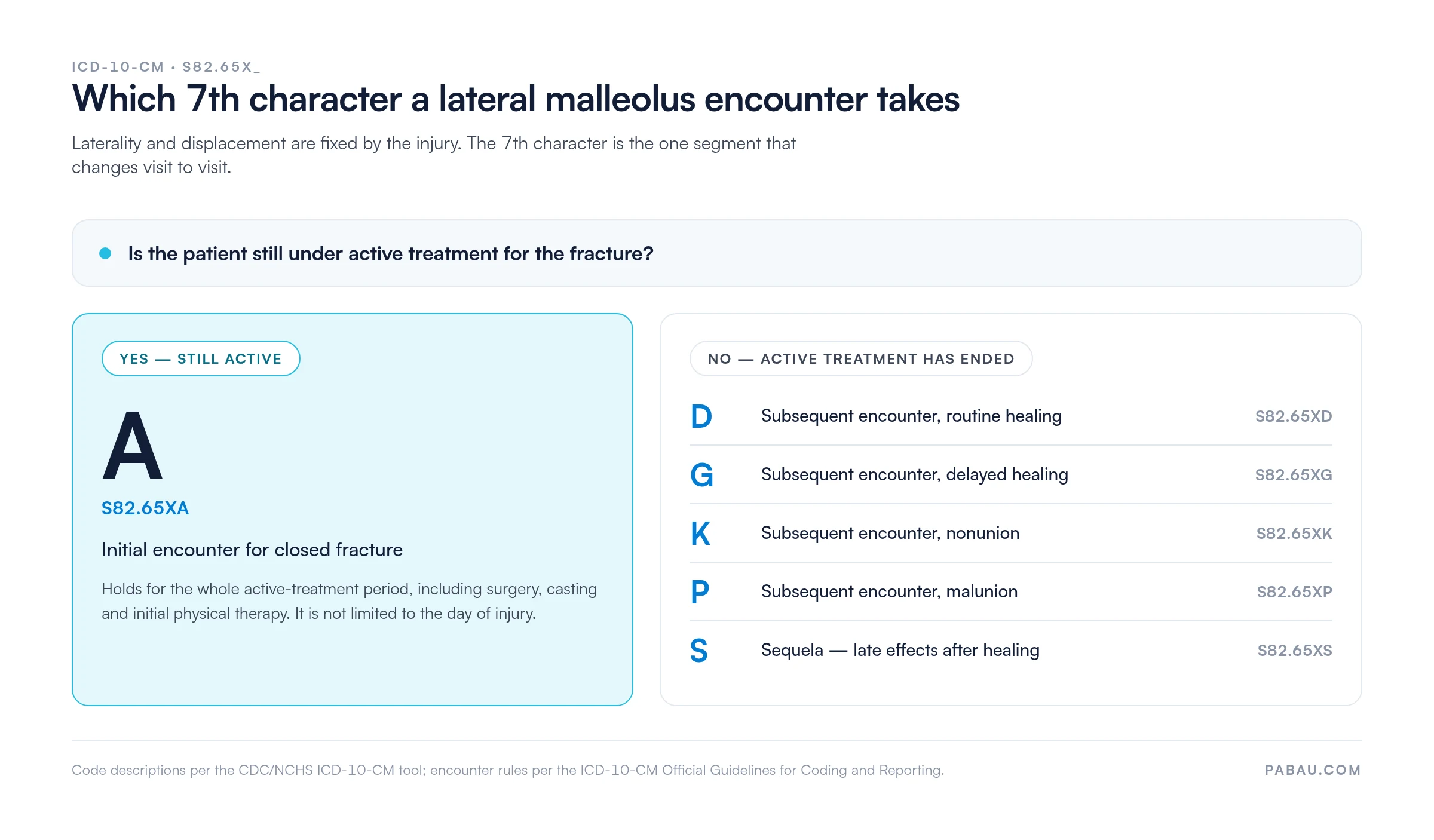
Character A applies even when the patient is not seen on the day of injury. It covers the whole period of active treatment, including surgery, casting, and initial physical therapy. Switch to D once active treatment ends and follow-up care begins.
S82.65XA is billable and specific under the CMS ICD-10-CM code set, which CMS maintains jointly with the National Center for Health Statistics. HIPAA requires ICD-10-CM on every claim a covered entity submits.
Practice management software like Pabau records the ICD-10-CM code on the encounter itself, so the biller never rekeys it. Pabau’s claims management software validates claim fields in real time, which surfaces problems before submission.
For US practices, Pabau integrates with the Claim.MD clearinghouse. Claim.MD processes CMS-1500 and 837P electronic claims for thousands of US payers, and returns electronic remittance advice (ERA/835 files) for reconciliation.
Flag encounters where you use 7th character A beyond 90 days from injury. Some payers query active-treatment extensions at this threshold. Document clearly that active clinical management is still ongoing. A casting change, an imaging review, or supervised rehabilitation all qualify.
Knowing the parent codes helps you navigate the tabular list and see the scope of each subcategory. The wider ICD-10-CM code set follows the same chapter, block, and category pattern throughout. Per the CDC/NCHS ICD-10-CM web tool, the full hierarchy for S82.65XA is:
ICD-10-CM recognizes several clinically equivalent descriptions for S82.65XA. These terms appear in the ICD-10-CM Alphabetic Index, and coding is accepted when the documentation uses any of them:
Map any of these descriptions to S82.65XA when the encounter type is initial. The operative term is the clinical description in the provider note, not the patient’s self-report. If the note says “left ankle fracture” without naming the malleolus or the displacement status, query the provider first.
Laterality, displacement status, and encounter type each produce a distinct code inside the S82.6- subcategory. The table below covers the codes most often confused with S82.65XA. Check each one against the AAPC Codify ICD-10-CM lookup to confirm the current edition.
Legacy billing systems and historical record comparison sometimes need S82.65XA mapped back to ICD-9-CM. According to ResDAC guidance on ICD codes in Medicare files, the CMS General Equivalence Mappings provide the official forward and backward maps.
Verify any crosswalk against the current GEM files before applying it to a legacy claim.
ICD-9-CM 824.2 is the closer match of the two. ICD-9 did not capture laterality or displacement at the specificity ICD-10-CM requires, so every crosswalk here is approximate.
Documentation is the primary defense against claim denials and medical necessity audits. S82.65XA is a high-granularity code, so every element of its description has to appear explicitly in the medical record.
Record the point at which active treatment ends and routine follow-up begins. That one note prevents 7th character errors on every subsequent encounter you bill for the same fracture. It is also the difference between a clean claim and an avoidable resubmission.
Run a quarterly audit on every S82.65XA claim submitted with the 7th character A extension. Pull the encounters dated 90 or more days after the injury date, and check that the documentation supports ongoing active treatment. Nonunion (K) and malunion (P) are often missed when coders default to D instead of querying the provider.
In many practices the diagnosis code lives in the clinical note, and the claim gets built somewhere else. A coder types S82.65XA into a billing screen, then a biller retypes it into a clearinghouse portal. The denial lands in a third inbox weeks later.
Pabau keeps the code, the encounter, and the claim on one record. The diagnosis you assign at the visit is the diagnosis that goes on the CMS-1500 or the 837P file. Field validation runs before submission, and eligibility checks run before the visit, so fewer claims come back.
When the payer responds, the ERA posts back against the same invoice. Your team reconciles inside the system it already works in. That matters most in high-volume musculoskeletal coding, where one repeated 7th character habit shows up across a whole quarter of claims.

Pabau integrates with Claim.MD to submit ICD-10-CM fracture codes on 837P claims to thousands of US payers. Real-time eligibility verification and ERA remittance processing sit inside the same practice management platform.

Assigning S82.65XA is straightforward once the imaging report is in front of you. What takes judgment is deciding when the encounter stops counting as initial treatment.
Build that decision into the workflow rather than the coder’s memory. Put the active-treatment question in the fracture template, and record the date treatment ends. Every subsequent claim then has an answer to point at, and an auditor has a note to read.
Book a demo to see how Pabau keeps the diagnosis code, the claim, and the remittance on one record for musculoskeletal billing.

Managing insurance claims inside your practice software? Claim.MD clearinghouse guide explains how the clearinghouse integration handles 837P claim submission, eligibility checks, and ERA returns for US payers.
Want to reduce denials on musculoskeletal claims? Denial management in healthcare covers how to identify, appeal, and prevent the most common fracture code rejection patterns.
Reconciling payments after a claim clears? Electronic remittance advice explains how 835 files post back against the claims you submitted, and what each adjustment code means.
ICD-10 Code S82.65XA is the billable ICD-10-CM diagnosis code for a nondisplaced fracture of the lateral malleolus of the left fibula. It applies to the initial encounter for a closed fracture. Each segment is specific: S82 (lower leg fracture category), .65 (nondisplaced, left lateral malleolus), X (placeholder), A (initial encounter, closed fracture). It is valid for submission on CMS-1500 and UB-04 claim forms.
Yes, S82.65XA is a billable/specific ICD-10-CM code confirmed valid for reimbursement purposes. The 2026 edition became effective October 1, 2025. It can be submitted on both CMS-1500 (professional) and UB-04 (facility) claim forms under standard ICD-10-CM billing requirements.
S82.65XA (7th character A) designates the initial encounter – meaning the patient is receiving active treatment for the fracture. S82.65XD (7th character D) designates subsequent encounters during routine healing, after active treatment has concluded. Using A at a follow-up visit where only healing monitoring occurs is a common coding error that auditors flag.
The correct code depends on which bone is fractured and the displacement status. For a nondisplaced lateral malleolus fracture of the left fibula at initial encounter, use S82.65XA. For a displaced lateral malleolus fracture of the left fibula, use S82.62XA. Bimalleolar and trimalleolar fractures of the left ankle use separate S82 subcategory codes. Always confirm the specific fracture site and displacement status from imaging before code selection.
The approximate ICD-9-CM equivalent is 824.2 (fracture of lateral malleolus, closed). ICD-9-CM 824.8 (fracture of ankle, unspecified, closed) is a less specific fallback. ICD-9 lacked the laterality and displacement granularity that ICD-10-CM provides, so all crosswalks are approximate. Verify using the CMS General Equivalence Mappings (GEMs) for payer-specific requirements.
CPT codes paired with S82.65XA vary by treatment approach and setting. Closed treatment of a distal fibular fracture is CPT 27786 without manipulation, or CPT 27788 with manipulation. An emergency department encounter adds evaluation and management codes such as CPT 99283 to 99285. Rehabilitation visits use physical therapy evaluation codes CPT 97161 to 97163, billed against 7th character D on the diagnosis. Pairings depend on payer policy, setting, and the procedures actually performed.



