ICD-10 code S61.201A: Open wound of left index finger without nail damage
ICD-10 code S61.201A covers a left index finger wound of unstated type ICD-10 co...

Last Updated: Oct 16, 2026
Billable Code Specific Code
S89.019S is the billable ICD-10-CM code for salter-Harris Type I physeal fracture of upper end of unspecified tibia, sequela.
Salter-Harris fractures happen in skeletally immature patients, so the sequela encounter often arrives months or years later. A child may return with growth plate arrest, angular deformity, or chronic pain traced back to the original injury. S89.019S is the code for that visit.
Let Pabau's smart automation suggest the right codes, reduce claim denials, and keep your practice compliant—effortlessly.
Automate repetitive tasks and focus on what matters most—your patients.
Reduce coding errors and ensure compliance with the latest regulations.
Clean claims, fewer denials, and faster reimbursements.
Powerful insights and reporting to help your practice thrive.
HIPAA compliant SOC 2 certified GDPR-compliant Trusted by 4,000+ clinics worldwide

ICD-10 Code S89.019S is billable for FY 2026 and covers a Salter-Harris Type I physeal fracture of the upper tibia, sequela.
The 7th character S means the visit treats a complication of a healed fracture, never the active fracture itself.
Laterality is unspecified in S89.019S, so use S89.011S for the right tibia and S89.012S for the left when the record says which.
Practice management software like Pabau validates codes before submission, so sequela claims leave with the 7th character and secondary code in place.
S89.019S is a valid, billable ICD-10-CM diagnosis code for FY 2026, effective October 1, 2025. It covers the sequela encounter for a Salter-Harris Type I physeal fracture of the upper tibia, with laterality unspecified. The CDC/NCHS ICD-10-CM web tool confirms the code is active for the 2026 edition.
S89.019 without a 7th character is not billable, so append the encounter-type character before the claim goes out. The parent code exists only to anchor the hierarchy. Practices running medical claims management can build a validation rule that flags any submission missing a required 7th character.
S89.019S breaks into five parts: category, fracture site, Salter-Harris type, laterality, and the 7th character. Each one carries a specific clinical meaning, and misreading a single segment produces the wrong code.
The digit 9 in the laterality position is what marks this code as unspecified. When the record documents right or left, use the laterality-specific sibling code instead. Submitting the unspecified code against a documented side invites a payer query and delays payment.
A Salter-Harris Type I fracture runs entirely through the growth plate, with no extension into the metaphysis or epiphysis. It is the simplest of the five Salter-Harris patterns and generally the most favorable for future growth.
Salter and Harris described the classification in 1963, sorting physeal fractures by where the fracture line sits relative to the physis, metaphysis, and epiphysis. At the proximal tibia, the upper growth plate drives a large share of the bone’s length growth. Damage there risks growth disturbance, especially when the fracture goes unrecognized at the first visit.
The Salter-Harris type is built into the code number, so it decides which ICD-10-CM code applies. A Type II fracture at the same site takes S89.029S, not S89.019S. Assigning the wrong type contradicts the operative or imaging report and creates audit exposure.
The 7th character records what the visit is treating. A covers active fracture treatment, D covers routine healing follow-up, and S covers a complication of a fracture that has already healed. Coders who default to D at every visit after the first miss that distinction, and fracture codes are where it costs the most.
Per the CMS ICD-10 coding guidelines, a sequela encounter usually takes two codes. S89.019S identifies the injury behind the complication, and a second code names the condition being treated.
A patient with post-fracture growth arrest and a varus deformity needs both codes on the claim. Leaving the condition code off is the omission that most often prompts payer review. The panel below turns the whole rule into one question per encounter type.
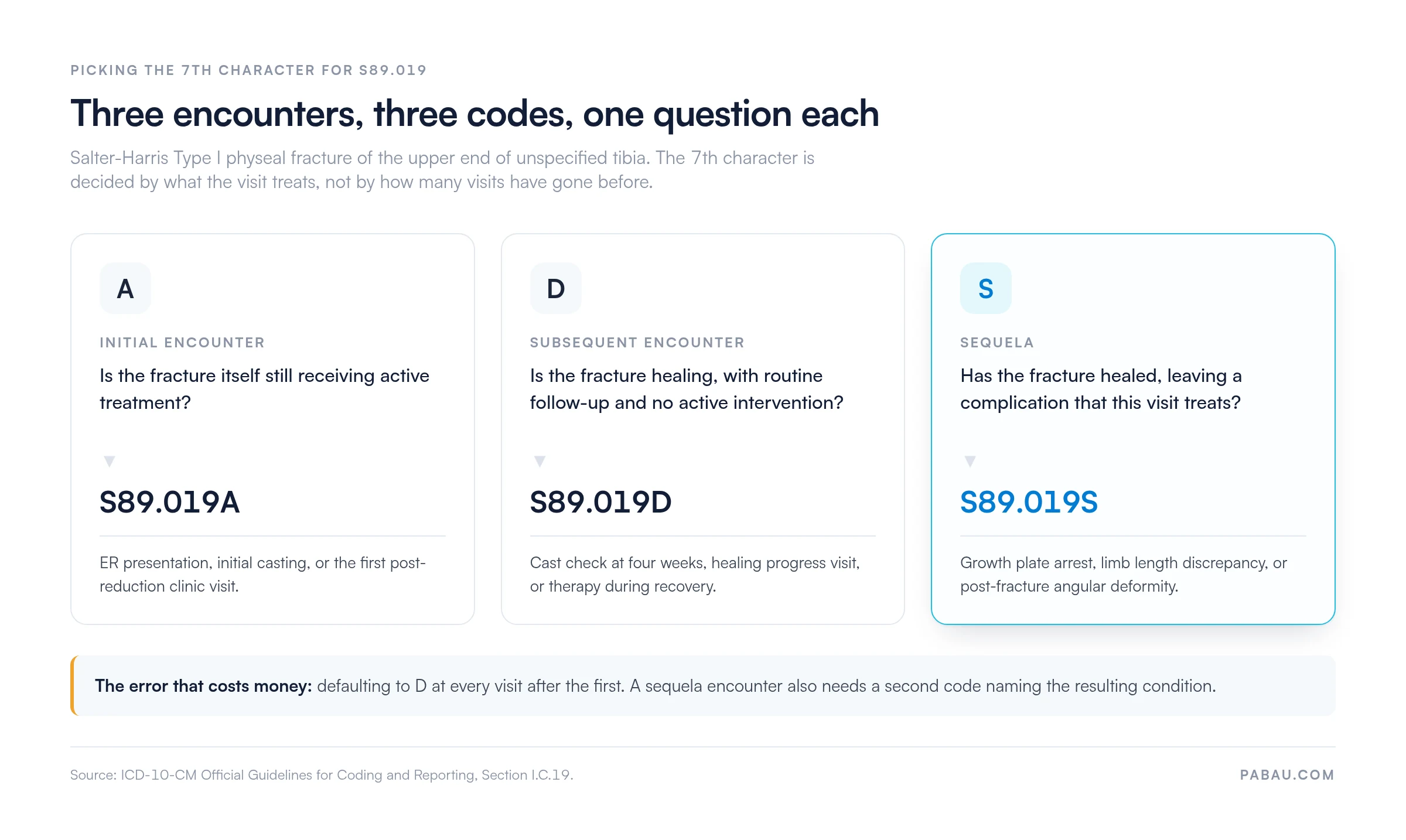
Check the encounter’s documentation before you assign the 7th character. Use A when the note describes casting, splinting, surgical fixation, or repeat reduction of the fracture. Use S when it describes growth disturbance or chronic pain that appeared after the fracture healed.
The upper end of the tibia means the proximal tibial epiphysis and its growth plate. That is the cartilage zone where the bone lengthens in children and adolescents. Standard orthopedic references put the proximal tibial physis at roughly 55 to 57 percent of total tibial length growth.
Across the S89 codes, upper end always means that proximal physeal region. The distal tibial growth plate sits in the S89.1x series instead, so the two are never interchangeable.
Laterality is the field most often left blank at the first visit and never corrected. Recording right or left in the original encounter note removes the need for an unspecified code years later at the sequela visit.
The sibling codes are where laterality errors get caught. The table below maps the S89.01x family and the parent code above it. The wider ICD-10-CM code archive carries the same 7th character logic across every injury chapter.
The AAPC ICD-10-CM code lookup gives a searchable view of the full S89 category for quick cross-reference during an encounter.
Sequela fracture coding turns on what the note says. The list below follows the ICD-10-CM Official Guidelines for Coding and Reporting, Section I.C.19, which governs injury sequela coding. Miss one element and a clean claim becomes a denial.
Pre-submission validation catches these errors cheaply. A clearinghouse check can flag a missing 7th character or an absent secondary code before the claim reaches the payer.
Practices tightening their denial management usually find sequela claims near the top of the list. Payers examine the link between the sequela code and the condition code closely.
When you code a Salter-Harris sequela, ask for the imaging report and operative notes from the original encounter. Those documents confirm the Salter-Harris type and the tibia involved. Coding from the follow-up note alone risks the wrong type number or the wrong side.
Coding references list several clinical terms that map to S89.019S. Recognizing them in a note helps confirm this code rather than a broader sibling.
Growth plate fracture is the term that shows up most in lay summaries and patient letters. It does not carry the Salter-Harris type, so confirm the classification from the orthopedic or radiology report before you finalize the code.
Most practices catch a 7th character error after the remittance comes back. The claim goes out, the payer rejects it, and someone reworks it weeks later. By then the patient’s follow-up has moved on.
Practice management software like Pabau puts the check before the send. Clinical notes, diagnosis codes, and claims live in one record. The code assigned at the visit is the code that reaches the payer, and validation rules flag a submission missing its 7th character.
For an orthopedic or physical therapy practice tracking a Salter-Harris injury across years, that continuity matters. The original encounter note stays attached to the client record, so laterality and fracture type are still there when the sequela visit happens.

Pabau brings scheduling, clinical notes, and claims into one platform. Practices coding Salter-Harris follow-up visits can check the 7th character and the secondary code before submission. Fewer sequela claims come back.

The code itself is easy to assign. The claim stands or falls on the note behind it. That note has to say the fracture healed and name what it left behind.
Get laterality into the original encounter record and the sequela visit never needs the unspecified code. Then ask what the visit is treating, and the answer picks the 7th character for you.
Coders who make those two habits routine spend far less time reworking denied musculoskeletal claims. Book a demo to see how Pabau validates ICD-10 codes before a sequela claim leaves your practice.

Coding another fracture sequela? S82.036S applies the same 7th character rules to a nondisplaced transverse patella fracture.
Need the wider S89 category? S89.92XA covers an unspecified injury of the left lower leg at the initial encounter.
Want fewer claims coming back? Clean claims in medical billing sets out what a payer needs to process a claim first time.
Submitting through a clearinghouse? Medical claims clearinghouse guide explains how electronic submission and validation cut denial rates.
New to the billing cycle? What is medical billing? walks through the full path from encounter to payment.
S89.019S is a billable ICD-10-CM code for a Salter-Harris Type I physeal fracture of the upper end of an unspecified tibia, sequela. The visit treats a complication or late effect of a fracture that has already healed. It is valid for FY 2026 claims, effective October 1, 2025.
Yes. S89.019S is a specific, billable ICD-10-CM code valid for reimbursement in FY 2026. The parent code S89.019 cannot be submitted on a claim without a 7th character. Adding S makes it specific enough for payer processing.
Initial encounter (A) applies while the fracture is under active treatment. Subsequent encounter (D) applies during routine healing follow-up. Sequela (S) applies once the fracture has healed and the visit treats a complication it caused, such as growth arrest or deformity.
Use a sequela code when the original fracture has healed and the encounter treats a complication it caused. Limb length discrepancy, angular deformity, and chronic pain traced to the physeal injury all qualify. Section I.C.19 of the ICD-10-CM guidelines asks for a second code naming the resulting condition.
A Type I fracture passes entirely through the growth plate without reaching the metaphysis or epiphysis. The type is embedded in the code number itself, so Type I maps to the digit 1 and Type II to 2. Assigning the wrong type contradicts the imaging or operative report and creates audit exposure.
The closest are S89.011S for the right tibia and S89.012S for the left, both sequela. S89.019A and S89.019D cover the initial and subsequent encounters for the unspecified side. The Type II equivalent at the same site is S89.029S, and the non-billable parent is S89.019.
Salter-Harris fractures happen at open growth plates, which close in the mid to late teenage years. The classification does not apply once the physes are closed. Confirm age and skeletal maturity from the record before applying S89.019S to an adult, or expect a payer query.