ICD-10 Code S42.444P: Medial epicondyle fracture, right humerus
ICD-10 Code S42.444P: full descriptor and code validity ICD-10 Code S42.444P car...

Last Updated: Oct 13, 2026
Billable Code Specific Code
S09.11XS is the billable ICD-10-CM code for strain of muscle and tendon of head, sequela.
The code tells a payer that the original injury has healed and that the clinician now manages a lasting deficit or chronic symptom. S09.11XA covers the initial encounter and S09.11XD the subsequent one. Two documentation failures cause most denials: no evidence of the original injury encounter, or a still-active strain coded as a sequela.
Let Pabau's smart automation suggest the right codes, reduce claim denials, and keep your practice compliant—effortlessly.
Automate repetitive tasks and focus on what matters most—your patients.
Reduce coding errors and ensure compliance with the latest regulations.
Clean claims, fewer denials, and faster reimbursements.
Powerful insights and reporting to help your practice thrive.
HIPAA compliant SOC 2 certified GDPR-compliant Trusted by 4,000+ clinics worldwide

S09.11XS is the billable ICD-10-CM code for a residual condition left behind after a head muscle or tendon strain has healed.
The seventh character ‘S’ applies only once the injury phase is over. Use ‘A’ during active treatment and ‘D’ for routine follow-up while the strain heals.
The record must link a prior S09.11XA or S09.11XD encounter to the condition being treated today. A missing link is the leading audit trigger.
Most payers want the residual condition coded first, with S09.11XS sequenced after it as the cause.
Practice management software like Pabau tracks denials by code, so a recurring S09.11XS rejection shows up before it becomes a pattern.
ICD-10 Code S09.11XS carries the official descriptor “Strain of muscle and tendon of head, sequela” in the CMS ICD-10-CM tabular list. It is fully billable and reportable, rather than a header or category placeholder. As a result, it can sit on a claim as the primary or secondary diagnosis without a more specific child code. The table below covers the reference data coders need before assigning it.
The S09 block covers “Other and unspecified injuries of head.” S09.11 addresses strains of the head’s musculotendinous structures. The placeholder character X sits in position six because S09.11 has no further anatomical subdivision. In effect, that structure is what lets a coder trace S09.11XS on a remittance back to the right category.
The seventh character position turns one base code into three clinically distinct encounters. Choosing the wrong one is the fastest route to a medical necessity denial. The same seventh-character system runs across the whole injury chapter (S00-T88), so what you learn here carries over to every trauma code.
Per the CDC/NCHS ICD-10-CM Official Guidelines, Section I.B.10, the sequela code is sequenced after the code for the residual condition in most circumstances. So S09.11XS often appears as a secondary code, with the presenting problem coded first.
For instance, that presenting problem might be chronic neck-head pain, or reduced cervical flexion. Sequencing S09.11XS as the sole primary code, while a distinct residual condition is present, risks a rejection on that basis alone.
S09.11XS applies when three conditions hold at once. The original head muscle or tendon strain has healed, so the acute and healing phases are over. A residual functional deficit or chronic symptom from that strain remains. And the provider is treating that residual condition at the current encounter.
The code is wrong in three other situations. Skip it while the original strain is still under active treatment. Similarly, skip it when the presenting complaint is a new and separate injury. Skip it, too, where a more specific code describes the residual condition on its own.
The ICD-10-CM guidelines set no minimum or maximum number of weeks after injury before S09.11XS can be applied. Instead, the determining factor is clinical. Has the original injury resolved?
Coders should not try to set a time threshold of their own. The provider’s documentation has to state that the acute phase has ended, and that the current problem is a sequela of the prior injury.
The S09 category carries excludes notes that affect which adjacent codes can be used alongside S09.11XS. Review them before assigning the code, especially where the patient also has a concussion or intracranial injury in the record. The table below sets S09.11XS against the codes it is most often confused with.
S09.11XS carries no Excludes1 note that would prohibit concurrent coding with sequela codes from other injury categories. Coders may assign it alongside a related sequela code, such as a concurrent cervical sprain sequela, where the documentation supports each code independently.
Never assign S09.11XS alongside S09.11XA or S09.11XD for the same condition. Those three codes are mutually exclusive encounter-type designations for one injury.
In fact, missing documentation causes most sequela code denials. The record has to do two things that many clinical notes do only partially. It must confirm the original injury existed, and it must connect the current complaint to it. A clean S09.11XS claim rests on the five elements below.
Build a sequela checklist into your EHR note template for head injury follow-ups. Give it five fields. Record the date of the original injury, confirmation that the acute phase has resolved, and the named residual condition. Add the causal statement and the diagnosis pointer. A structured template catches a missing element before the claim goes out.
Medicare maintains no national coverage determination that addresses S09.11XS for outpatient rehabilitation. Consequently, coverage runs through Local Coverage Determinations (LCDs) issued by each Medicare Administrative Contractor (MAC). Acceptance criteria therefore vary by geography and by service type. Verify the applicable MAC’s LCD for therapeutic services before billing a sequela code as the primary diagnosis.
Some payers want a residual condition code alongside S09.11XS. The sequela code names the origin of the problem, while the residual condition code names what the clinician treats today. Adding a code for the functional or symptomatic residual condition satisfies that requirement. For example, a pain code or a limited-range-of-motion code usually does the job.
In any case, check whether the payer’s policy mandates dual coding before the claim goes out. An eligibility check at the point of booking will often surface the requirement in time to act on it.
Sequela codes fail more often for documentation and sequencing errors than for payer-policy reasons. The patterns below recur across practice types and payer categories, and each has a straightforward prevention strategy. Reading the denial codes on the remittance tells you which Claim Adjustment Reason Code (CARC) maps to which root cause.
Each of the three encounter-type codes covers a distinct phase of the same injury. Coders who know the clinical transition points can pick the seventh character without re-verifying it at every visit. The flow below sets out the three phases, the visits that typically sit in each, and what moves a patient on.
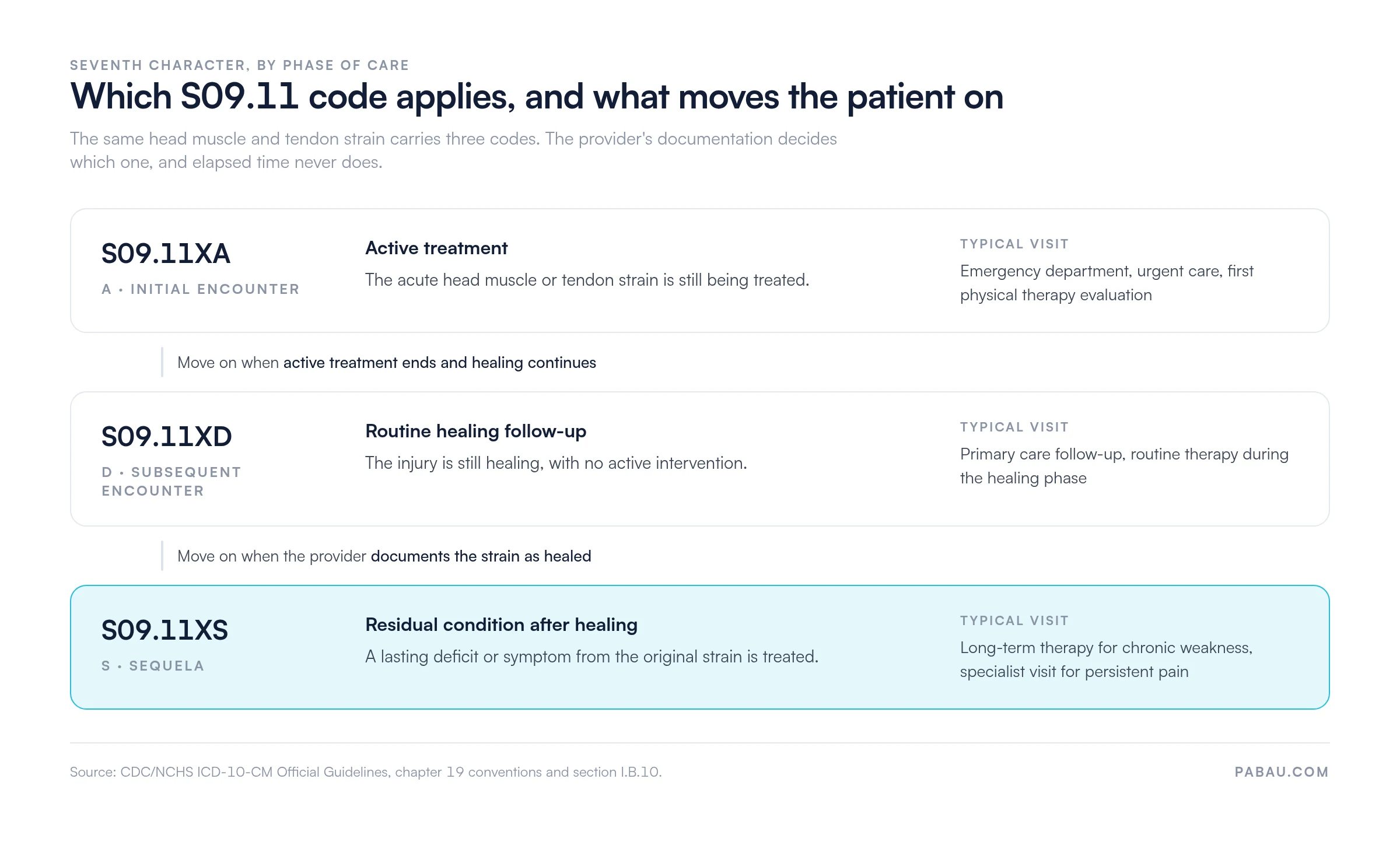
So when does a patient move from XD to XS? The transition happens once the provider documents that the original injury is clinically resolved. Notably, there is no automatic time-based trigger.
A patient still healing eight months after the injury correctly remains on XD. A patient whose strain healed in six weeks, but who has since developed chronic muscle weakness, moves to XS. The documentation drives the code, and the calendar does not.
S09.11XS is active and billable for FY2025, which runs from October 1, 2024 through September 30, 2025. It stays active for FY2026, through September 30, 2026. The AAPC ICD-10-CM code reference and the official CMS tabular list both confirm that status. Neither annual update changed the descriptor or the billable classification.
ICD-10-CM updates publish annually, so practices should audit their code sets against the new fiscal year addenda each fall. So far, codes in the S09 block have been stable across recent update cycles. Do not assume that stability holds year to year without checking the official addenda files.
Set a calendar reminder for October 1 each year to audit S09.11XS and related codes against the new ICD-10-CM fiscal year addenda. CMS publishes the official update files by August. That leaves a two-month window to update EHR code sets and coder training material before the new edition activates.
In most practices the sequela check happens twice, by hand. A biller reads the note to judge whether the strain has healed. Weeks later, that same biller reads the remittance to find out why the claim bounced. The two readings sit in different systems, so the second one rarely improves the first.
Pabau’s claims management software holds the code sets your team works from, carries the diagnosis pointer through to the claim, and submits it electronically. The seventh character still comes from the provider’s note, and no software changes that. Pabau keeps the note, the code and the claim in one record, so nobody rebuilds the history from memory.
Then, denials come back tagged by code. A run of S09.11XS rejections at one payer reads as a pattern instead of five separate write-offs. Your billers fix the note template once, rather than appealing the same rejection every month.
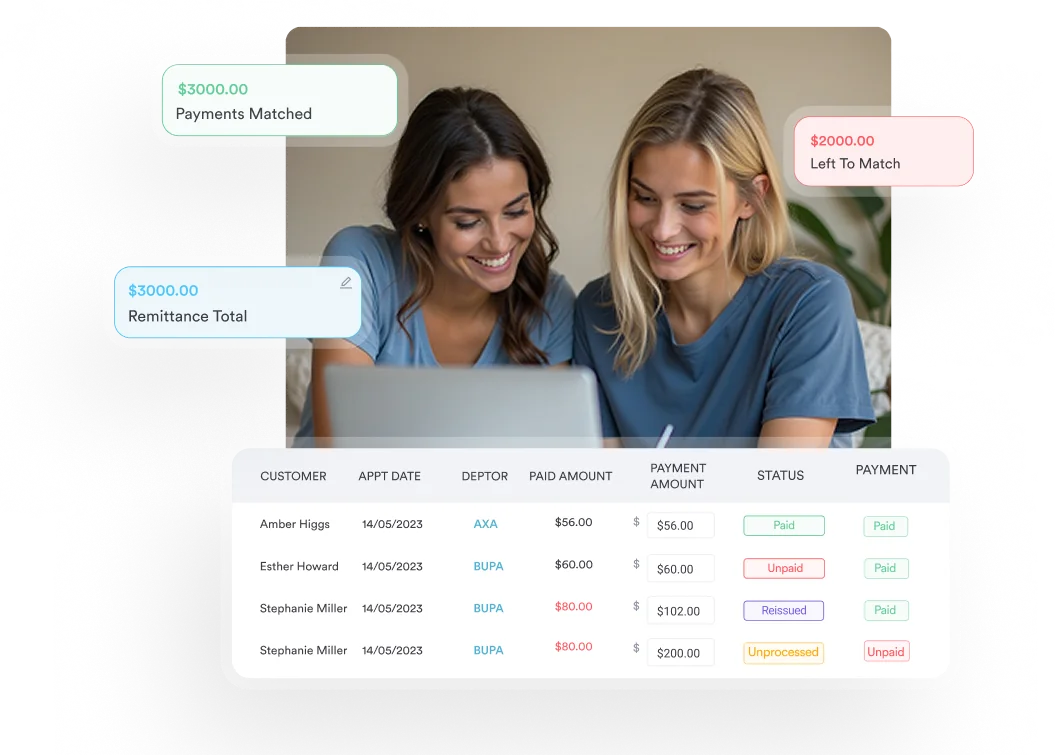

Pabau stores the ICD-10 and CPT code sets your team works from, submits claims electronically, and tracks denials by code. Recurring S09.11XS rejections surface early, while the notes are still fresh.

ICD-10 Code S09.11XS is simple in concept and easy to misapply. It fits only after the original head muscle or tendon strain has healed, and only where a distinct residual condition is present. The note also has to carry the causal chain from the original injury to today’s complaint.
Get the seventh character right and sequence the residual condition first, and most denials in this family never reach you. The rest is a documentation habit, and it is cheapest to build into the note template now.
For practices handling head injury sequela billing at volume, structured note templates and pre-submission scrubbing cut the rework. Book a demo to see how Pabau tracks sequela-coded claims from the note through to the remittance.

Managing denial codes in rehabilitation billing? Denial codes in medical billing covers CARC and RARC codes, common rejection patterns, and how to structure an effective appeals workflow.
Need a clearinghouse overview before submitting ICD-10 claims? Medical claims clearinghouse explains how electronic claim routing, scrubbing, and ERA retrieval work end-to-end.
Looking for denial management strategies beyond individual code appeals? Denial management in healthcare provides a systematic framework for reducing claim rejection rates across your practice.
ICD-10 Code S09.11XS is the billable diagnosis code for strain of muscle and tendon of head, sequela. It covers a residual condition, or late effect, that persists after the original head muscle or tendon strain has healed. The ‘S’ seventh character marks the sequela, separating this code from S09.11XA (active treatment) and S09.11XD (routine healing follow-up).
Use ‘S’ once the provider documents that the original head strain has healed. It applies where the patient is now treated for a residual condition caused by that injury. Use ‘A’ while active treatment of the acute strain continues. Use ‘D’ for routine follow-up during the healing phase. The provider’s clinical documentation determines the suffix, and the time elapsed since the injury does not.
Yes, in some circumstances. The ICD-10-CM guidelines and many payer policies want the residual condition sequenced first, with S09.11XS following it as the etiology code. Verify the payer’s LCD or coverage policy before billing S09.11XS as the sole primary diagnosis. Requirements vary by Medicare Administrative Contractor and by commercial plan.
The clinical record must show five things. It needs evidence of a prior head muscle strain encounter, either S09.11XA or S09.11XD. It needs a provider statement that the acute phase has resolved, plus the specific residual condition being treated. It needs a causal link between the current complaint and the original injury. Finally, it must show that the billed procedure is medically necessary for that residual condition.