

HCPCS Code Q4185: Cellesta flowable amnion billing guide
HCPCS Code Q4185: definition and official descriptor HCPCS Code Q4185 is the Lev...

Last Updated: Nov 20, 2026
37722 is the CPT code for ligation, division, and stripping, long (great) saphenous vein from saphenofemoral junction to knee or below. It reports open surgery on one leg, in which the surgeon ties off the vein at the groin and pulls it out with a stripper.
Most denials trace back to three problems: missing prior authorization, thin documentation of failed compression therapy, and the wrong code for the vein treated. Ligation without stripping is 37700, and stripping of the short saphenous vein is 37718.
Let Pabau's smart automation suggest the right codes, reduce claim denials, and keep your practice compliant—effortlessly.
Automate repetitive tasks and focus on what matters most—your patients.
Reduce coding errors and ensure compliance with the latest regulations.
Clean claims, fewer denials, and faster reimbursements.
Powerful insights and reporting to help your practice thrive.
HIPAA compliant SOC 2 certified GDPR-compliant Trusted by 4,000+ clinics worldwide

CPT code 37722 reports ligation, division, and stripping of the great saphenous vein from the saphenofemoral junction to the knee or below, on one leg.
Ligation without stripping is 37700, and stripping of the short saphenous vein is 37718.
A 90-day global period applies, covering all related post-operative visits and services within that window.
Medicare and most commercial payers require documented conservative therapy failure plus duplex ultrasound confirming venous reflux before approving this code.
In 2026, Medicare values 37722 at 12.70 total RVUs, about $424 nationally at the standard conversion factor.
CPT code 37722 reports “Ligation, division, and stripping, long (great) saphenous vein from saphenofemoral junction to knee or below.” CMS’s October 2026 fee schedule file lists it as an active surgical code with a 90-day global period. The American Medical Association places it in the Surgery section under Arteries and Veins (34001-37799), and each unit covers one limb.
The code applies only when the operative note shows two things. The great saphenous vein (GSV) was ligated at the saphenofemoral junction, and it was then physically stripped out. Procedures on the lesser saphenous vein, or ligation without stripping, use different codes.
Ligation and stripping of the great saphenous vein is an open surgical procedure. Coders need to know the operative steps to confirm the documentation supports 37722 rather than a sibling code.
The operative note must name the great saphenous vein explicitly, confirm junction ligation, and state the length of vein stripped. Without these elements, payers may downcode to 37700 or deny the claim outright.
Diagnosis coding for saphenous vein incompetence centers on the I83 category for varicose veins of the lower extremities. Selecting the wrong specificity level is one of the most common reasons CPT 37722 claims are returned.
Always code to the highest level of specificity the documentation supports. I83.90 describes asymptomatic varicose veins, so it sits awkwardly with a medical necessity claim and invites review. Payer acceptance varies by Local Coverage Determination (LCD) jurisdiction. Check the applicable MAC LCD before you bill I83.90 as the primary diagnosis.
These three sibling codes cover overlapping surgical territory, but each describes a distinct vein or technique. A code that doesn’t match what the operative report documents is an audit flag.
The choice comes down to two questions about the operative note, and the RVU gap between the answers is wide.
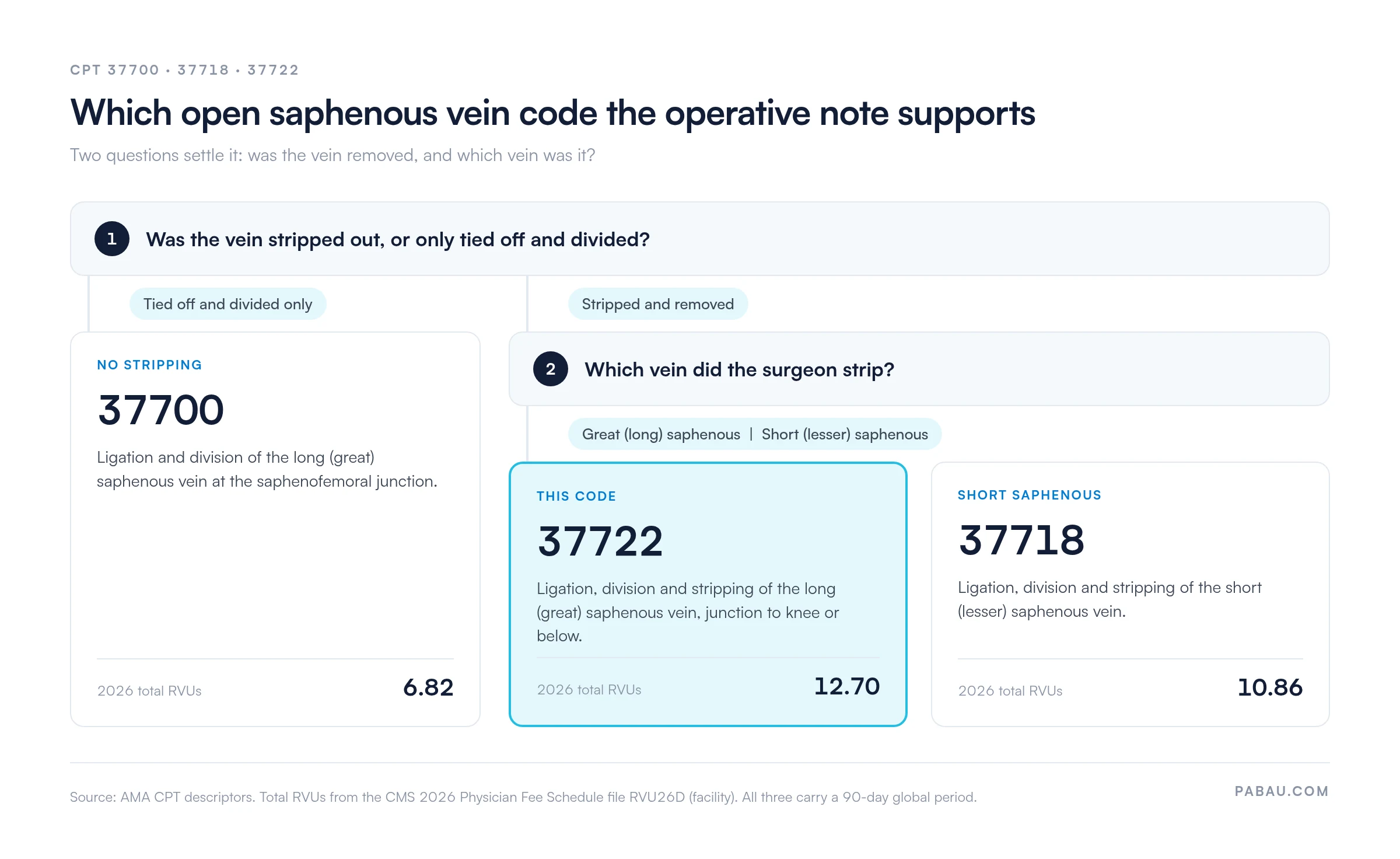
The most common upcoding error is billing 37722 when the operative report describes only ligation at the junction without documented stripping. That procedure is 37700. Reviewers check the operative note for the word “stripped,” the stripper device used, and the number of incisions made.
Endovenous ablation has largely replaced open stripping in vascular practice, with comparable outcomes and faster recovery. Coders therefore see 37722 less often than a decade ago, but the code remains valid when open surgery is performed.
37722 is the right choice over an ablation code when the record shows one of these:
Billing 37722 and an ablation code such as 36475 on one vein and date usually triggers a National Correct Coding Initiative (NCCI) bundling edit. If both procedures were performed on distinct vein segments, modifier -59 may apply. Payers then expect documentation confirming separate anatomical sites, and the same goes for sclerotherapy billed under 36471.
Before appending modifier -59 to unbundle 37722 from an ablation code, confirm the operative note explicitly names the separate vein segments treated. Check the modifier indicator for the pair in the current NCCI edit table, because an indicator of 1 is what allows -59. Submit without it and you may receive a denial. Submit with it unsupported and you risk an overpayment audit.
Under the 2026 Medicare Physician Fee Schedule, CPT 37722 carries 7.96 work RVUs and 12.70 total RVUs. At the standard conversion factor of $33.4009, the national payment is about $424.19. Qualifying APM participants are paid at $33.5675, or about $426.31. Your MAC locality’s geographic adjustments move the final figure, so check the CMS Physician Fee Schedule lookup tool before you quote a rate.
The 90-day global package includes the surgery, all routine post-operative visits, and complications not requiring a return to the operating room. Services outside the global package, such as treatment of a new unrelated condition during the 90-day window, can be billed separately with the appropriate modifier.
Medicare coverage for varicose vein surgery under CPT 37722 is not automatic. LCDs from MACs including Novitas Solutions, CGS Administrators, and National Government Services set the documentation requirements. Requirements vary by jurisdiction, so check the applicable LCD directly.
Common criteria across most LCDs include:
Commercial payers often mirror Medicare LCD criteria but may specify different compression therapy durations or require additional imaging. Verify the payer’s policy before scheduling the procedure whenever prior authorization is needed.
Most commercial payers require prior authorization for CPT 37722. Get it even where it isn’t mandated, because a denial is harder to recover after surgery than an approval is to get beforehand.
A standard pre-authorization package includes:
A complete package cuts the back-and-forth requests for more information that push vein authorizations past the payer’s stated turnaround. The duplex study itself is billed under 93971, separately when it runs on a different date from the surgery.
Documentation for CPT 37722 goes beyond naming the code. Auditors reviewing claims for this procedure expect the operative note to contain each of these elements explicitly.
An operative report that says “varicose vein surgery performed” without naming the GSV or confirming stripping will not support 37722 on appeal. Post-operative notes and discharge summaries are not acceptable substitutes for the operative report when a claim is under review.
Because CPT 37722 is a unilateral code, bilateral procedures and same-session distinct services each need specific modifier handling.
Several codes appear on the same claim as CPT 37722 in routine vascular surgical billing. Each pairing has its own NCCI edit status, so check the current edit table before you bill a pair together.
When billing a phlebectomy code such as 37766 alongside 37722, the operative report must separate the GSV stripping site from the tributary incision locations. Without that distinction, the phlebectomy counts as part of the primary procedure and is bundled. The clean claim rules for surgical procedures require each separately billed service to meet the distinct procedure standard.
Denial patterns for CPT 37722 are consistent enough that most can be prevented with pre-submission review. The denial management process for surgical vein codes should start before the operative date, not at the remittance.
Denials that still get through come back on the remittance as CARC and RARC codes. The denial codes guide maps each one to the correction it calls for.
Run a quarterly audit of all 37722 claims submitted in the previous 90 days. Pull every denial by reason code and sort them into the six categories above. The category that shows up most often in your practice is the step your pre-submission workflow skips. A checklist attached to surgical scheduling prevents three of the six outright.
Vein surgery billing usually runs across three places. The authorization sits in a payer portal, the operative note in the chart, and the claim in a clearinghouse. A lapsed authorization or a wrong-side approval often surfaces only when the denial arrives.
Pabau, the practice management software we build, keeps those steps on one patient case. The authorization code, its dates and its approved sessions sit on the case, and Pabau warns the team when an authorization is missing. Its insurance claims tools for practices then send the CMS-1500/837P claim through Claim.MD, after an eligibility check.
Remittances post back as ERAs, so a 37722 denial lands on the same record as the operative note that has to answer it. Your billers spend their time on corrections instead of chasing paperwork across systems.
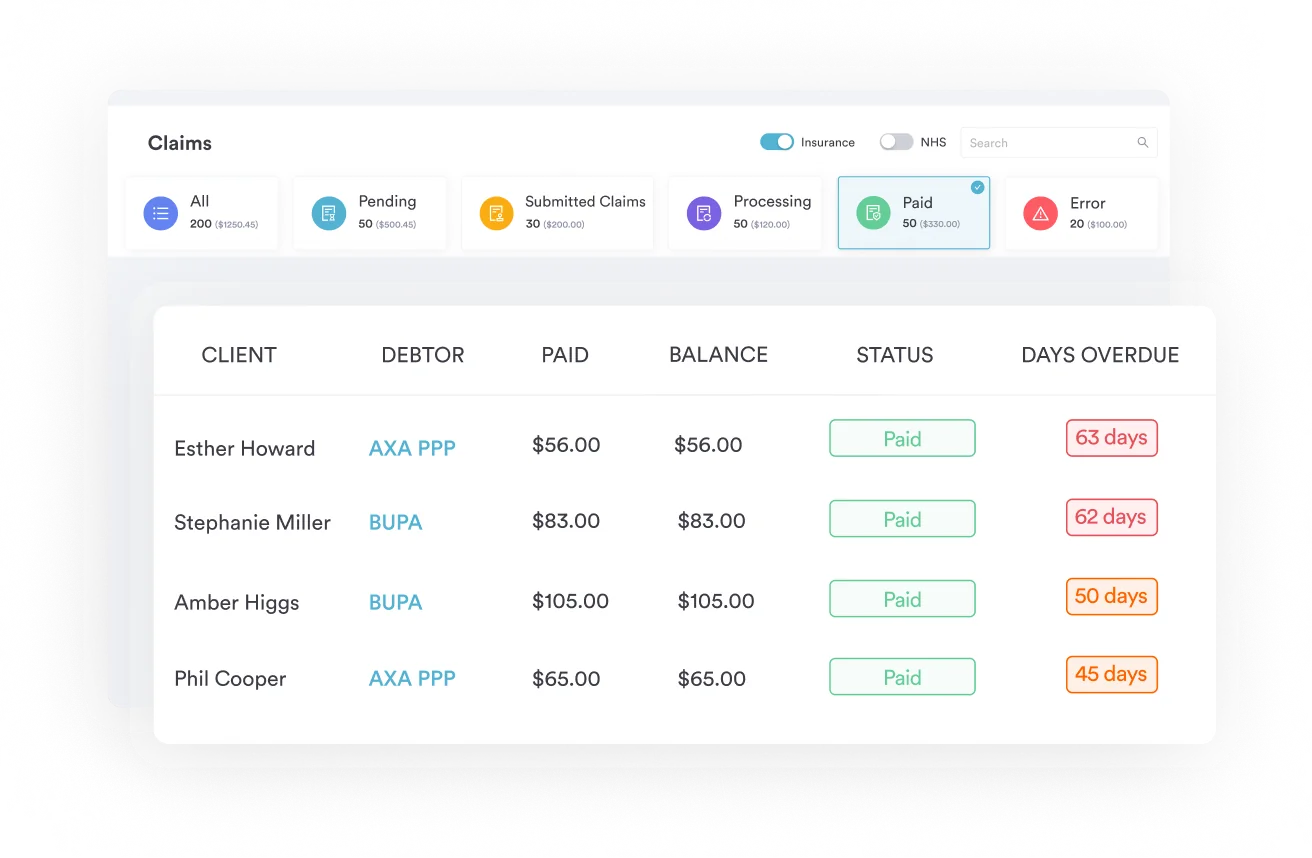

Pabau tracks prior authorization codes and dates on the patient case, then sends claims through Claim.MD with eligibility checks and ERA posting. Your team sees each 37722 claim from authorization to payment.

CPT 37722 pays for one specific act: stripping the great saphenous vein after ligating it at the junction. Before you submit, read the operative note for that word, the vein’s name, and the side. If any of the three is missing, query the surgeon rather than downcoding by guesswork.
The 2026 payment of about $424 per leg leaves little room for rework, so the authorization and the compression-therapy record deserve the same check. Get them right before the surgery date and most denials on this code never happen.
Book a demo to see how Pabau links each vein surgery authorization to the claim it supports.

List Item #1
List Item #2
CPT code 37722 covers ligation, division, and stripping of the long (great) saphenous vein. It is a unilateral surgical procedure for symptomatic varicose veins and venous insufficiency. The code includes junction ligation at the saphenofemoral junction and physical removal of the vein by stripping. It does not cover endovenous ablation, ligation alone, or procedures on the lesser saphenous vein.
CPT 37722 covers ligation and stripping of the great (long) saphenous vein; CPT 37718 covers ligation, division, and stripping of the lesser (short) saphenous vein. The correct code depends on which vein is treated, not the technique. If the operative report names the great saphenous vein, use 37722. If it names the lesser saphenous, use 37718. Billing the wrong code based on technique alone is an audit flag.
Yes, Medicare covers CPT code 37722 when medical necessity criteria are met under the applicable Local Coverage Determination. Typical requirements include failed compression therapy for the period the LCD sets, duplex ultrasound confirming pathologic venous reflux, and documented symptoms. Coverage varies by MAC jurisdiction, so confirm the specific LCD for your region.
The primary ICD-10-CM codes that support CPT 37722 are in the I83 series. I83.11 and I83.12 (varicose veins with inflammation, right and left) are the most broadly accepted. I83.10 (unspecified laterality) is accepted but less specific. I83.90 (asymptomatic varicose veins, unspecified limb) may trigger additional review under some LCDs. I87.2 (venous insufficiency) is used as a secondary or supporting code alongside the primary I83 code.





