ICD-10 Code S42.444P: Medial epicondyle fracture, right humerus
ICD-10 Code S42.444P: full descriptor and code validity ICD-10 Code S42.444P car...

Last Updated: Oct 13, 2026
Billable Code Specific Code
S85.131A is the billable ICD-10-CM code for unspecified injury of anterior tibial artery, right leg, initial encounter.
Injury type is the detail that trips this code up. Pick the wrong type or the wrong 7th character, and the payer sends the claim back.
Let Pabau's smart automation suggest the right codes, reduce claim denials, and keep your practice compliant—effortlessly.
Automate repetitive tasks and focus on what matters most—your patients.
Reduce coding errors and ensure compliance with the latest regulations.
Clean claims, fewer denials, and faster reimbursements.
Powerful insights and reporting to help your practice thrive.
HIPAA compliant SOC 2 certified GDPR-compliant Trusted by 4,000+ clinics worldwide

S85.131A is a billable ICD-10-CM code for an unspecified injury of the right anterior tibial artery.
Use it only when the record names the vessel and the side but not the injury type.
The 7th character A means active treatment, so it can cover more than one visit.
S85.141A covers a laceration of the same vessel, and S85.151A covers other specified injury.
S85.131A crosswalks to ICD-9-CM code 904.51, which carries no laterality or encounter detail.
S85.131A is a specific, billable ICD-10-CM code. It goes on the claim as it stands, with no extra digits and no more detailed child code underneath it. It is valid for HIPAA-covered transactions submitted in fiscal year 2026.
The code took effect on October 1, 2025 and runs through September 30, 2026.
Because the code is already specific, no payer will bounce it for lack of detail. It can still come back for the wrong detail, which is what the rest of this page is about.
The anterior tibial artery supplies the front compartment of the lower leg and the top of the foot. It branches off the popliteal artery below the knee and runs down the front of the interosseous membrane. At the ankle it becomes the dorsalis pedis.
That matters when the documented injury sits at or below the ankle. Trauma to the dorsal artery of the right foot falls in category S95, where a healing-phase visit takes S95.001D.
“Unspecified injury” describes the type of trauma, not the vessel. The record does name the anterior tibial artery, and it does name the right leg. It simply never says whether the artery was cut, crushed, or damaged some other way.
For that same vessel and that same leg, ICD-10-CM offers two more specific initial-encounter codes:
So use S85.131A when an operative note or imaging report documents injury to that artery without naming the injury type. If a later note describes a laceration, query the provider and move to S85.141A instead of leaving the unspecified code in place.
The CDC/NCHS ICD-10-CM web tool carries the official tabular list. Confirm the wording there at the moment you assign the code.
Query the provider whenever a note says ‘vascular injury’ with no injury type attached. A specific code carries a lower medical-necessity denial risk, and it supports accurate DRG assignment on the inpatient side.
Every code in the S80-S89 block needs a 7th character, and S85.131 takes only three of them. A, D, and S are the full set, so there is no P, K, or G to worry about here.
Per the ICD-10-CM Official Guidelines for Coding and Reporting, “A” applies while the patient is under active treatment. It does not mean the patient’s first visit to a particular provider.
A transfer to a second hospital for further surgical management of the same artery still codes with “A.” The letterhead changed, but the phase of care did not.
The switch to “D” comes when active treatment ends and routine healing care begins. After an arterial repair, that point usually follows wound closure and stable perfusion. The treating provider’s care plan decides it, not the calendar.
“S” is different again. It covers a late effect traced back to the original trauma, such as chronic ischemia in the foot. Sequence the late effect first, then S85.131S.
Coders search the phrase in the note, not the phrasing in the tabular list. All of these land on S85.131A once the right leg and an initial encounter are documented.
One phrase that does not belong on that list is “injury of right tibial artery.” Without the word anterior, the index sends you to S85.101A instead.
In the alphabetic index of most ICD-10-CM code lookup tools, the path runs Injury, Blood vessel, Tibial, Anterior, Right. Confirm the side against the operative or imaging report before you assign. Laterality is the most common mismatch across the S85 codes.
S85.131A sits seven levels down the S00-T88 injury chapter. Reading the chain from the top is the fastest way to spot a code that was truncated somewhere along the way.
S85, S85.1 and S85.13 are all parent codes. None of them is billable, so a claim carrying one comes straight back as invalid.
Two subcategories sit beside S85.13 at the same level. S85.14 is laceration of the anterior tibial artery, and S85.15 is other specified injury of the same vessel.
Two details in the note decide the code: which vessel the record names, and which injury type it describes. Miss one of them and you land three codes away from the right answer.
The grid below maps the whole right-leg set.
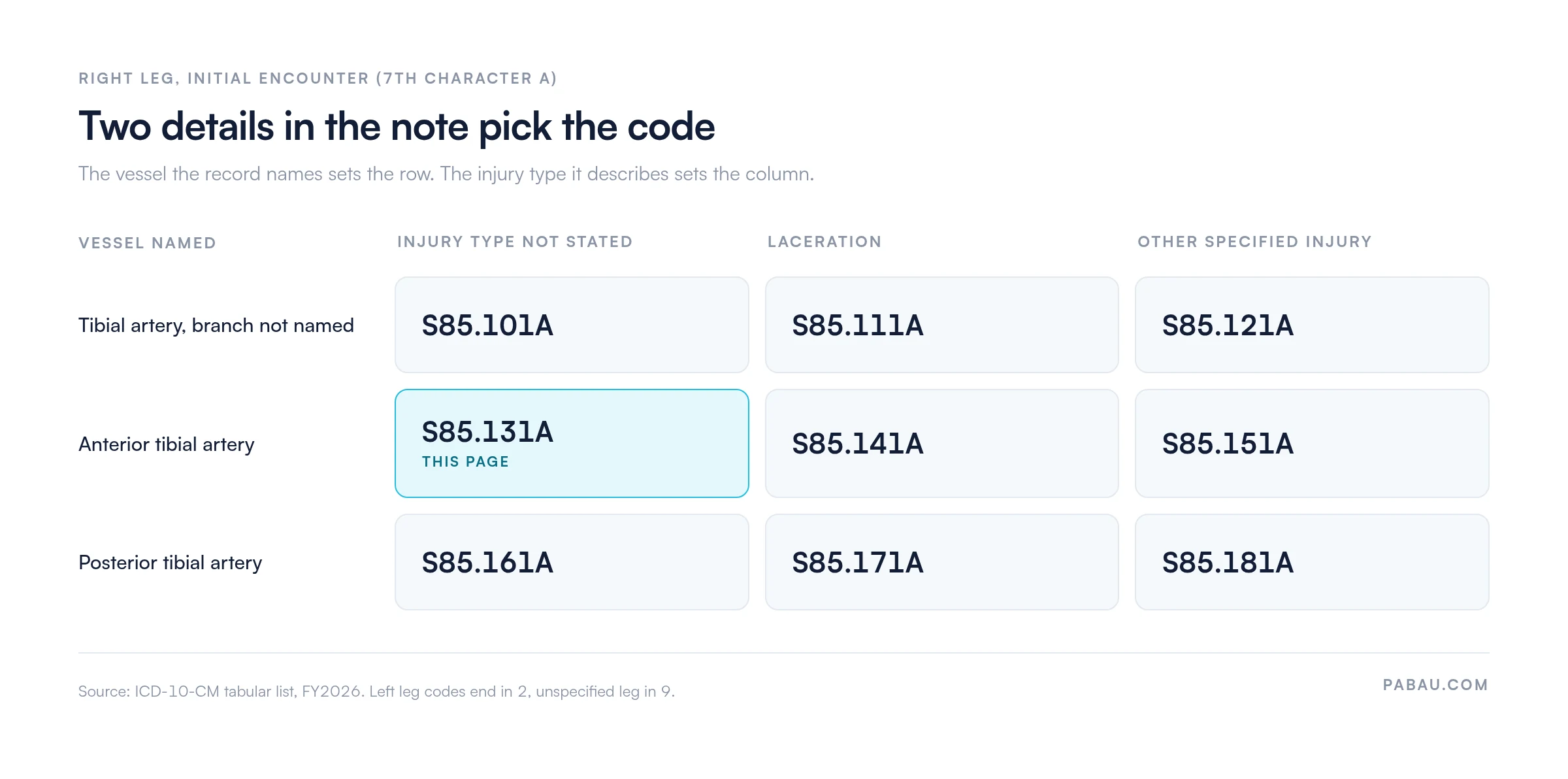
S85.111A and S85.121A are the two that catch people out. Both sit in the unspecified-vessel group, so neither one belongs on a chart that names the anterior tibial artery.
The table adds the left-leg, unspecified-leg and later-encounter options to the same picture.
When the note never states a side, use S85.139A rather than guessing. A laterality code that contradicts the operative report is one of the easiest denials to earn.
That kind of mismatch usually comes back with a claim adjustment reason code attached. Reading the denial codes tells you whether to send a corrected claim or open an appeal.
Legacy systems and a few older payer contracts still reference ICD-9-CM. The approximate equivalent for S85.131A is 904.51, injury to anterior tibial artery.
The mapping is approximate for a reason. 904.51 carries no laterality and no encounter type, so both details are lost on the way across.
That matters if the ICD-9-CM code is ever mapped back. S85.131A, S85.132A and S85.139A all collapse into the same legacy code, and none of them can be recovered from it.
Before you apply the crosswalk, check whether the payer still wants it. Most now accept the ICD-10-CM code directly, and the conversion only adds a step where somebody can lose the side.
Three elements have to be in the record before this code is safe to assign. They are the side, the vessel, and the care being delivered. Two more apply depending on the case.
Run these five questions over the claim while the chart is still open. Each one takes seconds, and each one prevents a rework that takes days.
Four errors account for most returned S85.131A claims, and all four are visible in the chart before submission.
A clearinghouse will catch the last one, because a missing 7th character is a structural error. It cannot tell you that the surgeon repaired the posterior vessel.
Clearing the other three is most of what separates a clean claim from a rework.
Add the external cause code alongside S85.131A whenever the mechanism of injury is documented. A missing V-code is a routine audit finding on inpatient vascular trauma charts, and it can affect DRG accuracy.
In a lot of practices the chart lives in one system and the claim is built in another. A coder reads the note, retypes the diagnosis into a billing screen, and the two records drift apart from there.
Practice management software like Pabau builds the claim from the record instead. The service already carries its CPT code, so that lands on the charge line. ICD-10 slots are seeded from the problem list held on the client record.
Pabau’s claims software for coders keeps ICD-10-CM and CPT lookup libraries inside that claim screen, refreshed with each official release. Search “anterior tibial artery,” confirm S85.131A, and drop it in without opening a second tab.
Those libraries are reference tools, so the code choice stays with the coder. What Pabau does check is that the claim’s required fields are complete before the send button unlocks. Membership and authorization numbers are the usual culprits.
On the US pipeline through Claim.MD, Pabau runs real-time eligibility checks, tracks claim status, and posts electronic remittance advice.
When a payer denies a line, the claim adjustment reason code arrives with it. The stated reason shows on screen instead of sitting inside an 835 file.

Pabau seeds the claim from the client’s own chart and keeps ICD-10-CM and CPT lookup libraries inside the claim screen. Your coders stop retyping diagnosis codes between two systems.

S85.131A is a narrow code doing a narrow job. It says the anterior tibial artery in the right leg was injured, and that the record never said how.
Three checks keep it clean. The note names the side, the note names the vessel, and the 7th character matches the care given on that date.
Treat it as a placeholder rather than a destination. The moment a note describes the injury type, move to S85.141A or S85.151A and leave the unspecified code behind.
Most of that work happens in the note, long before anyone opens a billing screen. Book a demo to see how Pabau carries the diagnosis from the clinical record into the claim without a retype.

Need the whole picture of how a claim moves? What is medical billing follows the process from code assignment through submission and payment posting.
Working on denial prevention for trauma claims? Denial management in healthcare covers the common denial triggers and how to build an appeals workflow that sticks.
Wondering what a clearinghouse checks before a payer sees your claim? Medical claims clearinghouse explains what happens between code assignment and payer receipt.
Need the diagnosis and procedure codes on one document? What is a superbill breaks down each field and who relies on it.
S85.131A is used when the record names the anterior tibial artery. S85.101A is used when it only says tibial artery, with no branch specified. Both describe an unspecified injury type in the right leg at an initial encounter.
Repair codes for a lower extremity vessel are the usual pairing. Common examples are 35226 for a direct repair and 35256 for a repair using a vein graft. Match the procedure code to the same vessel and side as the diagnosis.
There is no national mandate for external cause reporting in ICD-10-CM. Many payers and several states ask for it anyway. Check the rule that applies to you before you drop the external cause code.
Yes, when the arterial injury is the reason the patient was admitted. Where several injuries are treated, sequence the most severe one first, using the provider’s own documentation to decide.
S85.131 takes A, D or S, and no other 7th character. Fracture characters like B, G, K or P do not apply to vascular injury codes, so a claim carrying one is rejected.