ICD-10 Code Y76.0: Diagnostic obstetric and gynecological devices
ICD-10 Code Y76.0: Definition and billable status ICD-10 Code Y76.0 is a valid, ...

Last Updated: Oct 23, 2026
Billable Code Specific Code
S95.001D is the billable ICD-10-CM code for unspecified injury of dorsal artery of right foot, subsequent encounter. It applies once active treatment is complete and the patient is receiving routine care while the injury heals.
Denials on this code most often trace back to documentation. If the clinical note does not confirm that initial active treatment is over, the payer may question whether D or A (initial encounter) applies.
Let Pabau's smart automation suggest the right codes, reduce claim denials, and keep your practice compliant—effortlessly.
Automate repetitive tasks and focus on what matters most—your patients.
Reduce coding errors and ensure compliance with the latest regulations.
Clean claims, fewer denials, and faster reimbursements.
Powerful insights and reporting to help your practice thrive.
HIPAA compliant SOC 2 certified GDPR-compliant Trusted by 4,000+ clinics worldwide

S95.001D is a valid, billable ICD-10-CM code for subsequent encounters after a right-foot dorsal artery injury whose type is not further specified.
The 7th character D means active treatment is complete and the patient is in the healing phase. Using D while active surgical care is ongoing is a common denial trigger.
Laterality and injury type must both appear in the clinical note. If either is ambiguous, payers may downcode or deny the claim.
Pabau’s claims management software checks patient eligibility in real time and flags missing payer details before an S95.001D claim is sent.
ICD-10 Code S95.001D is the billable code for an unspecified injury of the dorsal artery of the right foot at a subsequent encounter.
Use it once active treatment is complete and the patient returns for routine healing-phase care.
The table below summarizes the code’s key attributes for FY 2027. Codes are updated each October 1, so confirm validity against the CDC/NCHS ICD-10-CM web tool before submitting claims.
The dorsal artery of the foot, also called the dorsalis pedis artery, runs along the top of the foot. It supplies blood to the dorsum of the foot and the toes. An injury to this vessel can reduce blood flow to the forefoot, and a severe one can threaten tissue viability.
The “unspecified” in S95.001D applies when the clinical documentation does not characterize the injury type further. It is the correct code when the provider has not documented whether the vascular injury is a laceration or another specified type.
The 7th character D in S95.001D means the patient has completed active treatment. The FY 2027 ICD-10-CM Official Guidelines reserve D, in section I.C.19.a, for encounters after active treatment. At that point the patient is receiving routine care during the healing or recovery phase.
The three 7th character options for S95.001 are often confused. This table shows when each one applies.
A frequent documentation failure is billing S95.001D while surgical or invasive vascular treatment is still ongoing. If the provider is still debriding, repairing or actively treating a fresh injury, S95.001A is correct, however many visits have occurred.
Six neighboring codes sit close enough to S95.001D to cause coding errors. Check them in a fixed order: injury type first, then laterality, then the encounter stage. The path below shows how those three checks narrow the S95.0- subcategory down to one code.
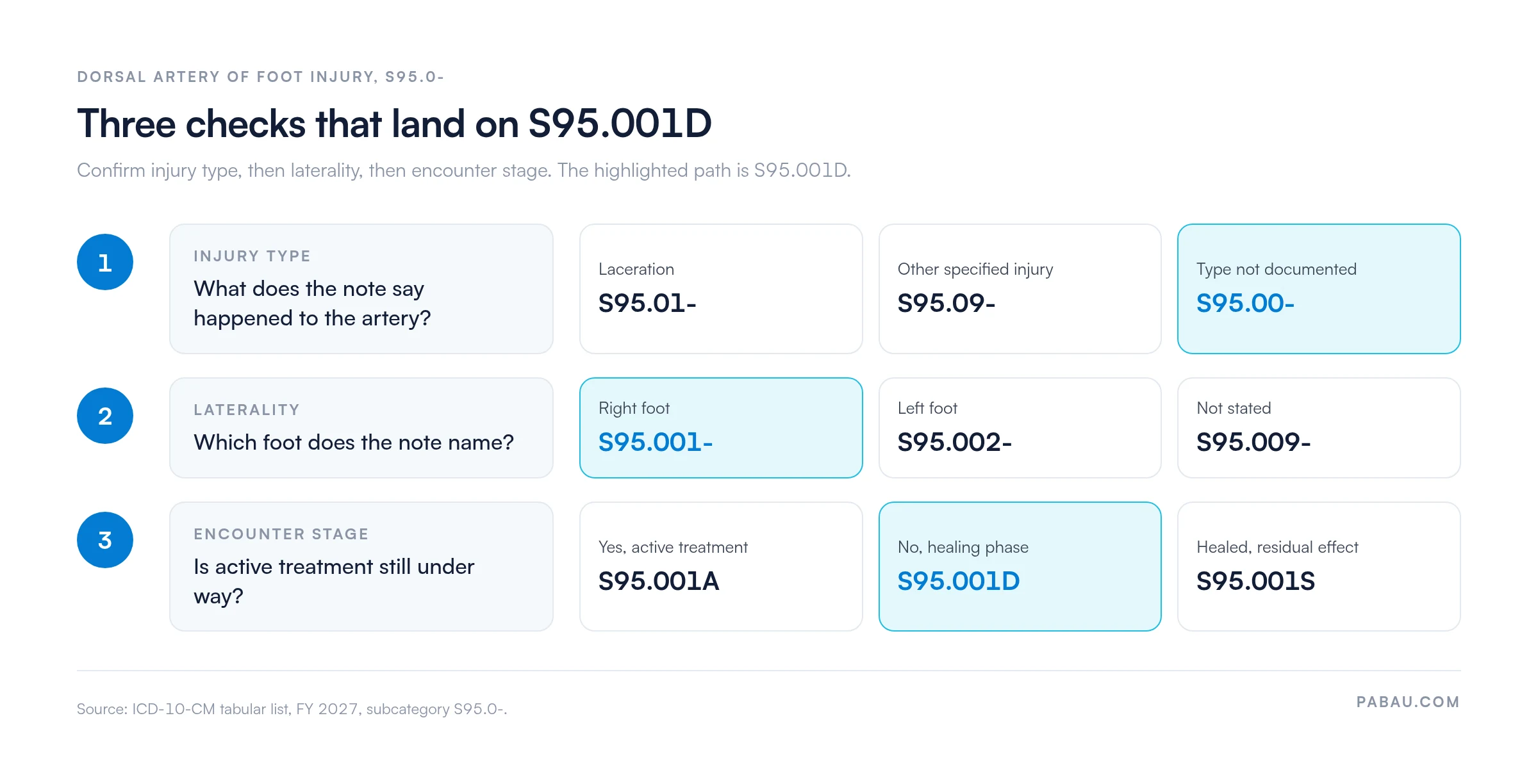
The table below sets out what separates S95.001D from each neighbor.
The S95 category covers injury of blood vessels at ankle and foot level. Check its boundaries before you select S95.001D.
Check whether the vascular injury came with an open wound at the same visit. If the note documents both, report S95.001D for the vascular injury and the matching S91.- code for the wound. Leaving out the wound code understates what was treated at the encounter.
Payers reviewing an S95.001D claim look for five elements in the clinical note. A missing element can trigger a records request or an outright denial. Meeting clean claim standards before submission costs far less than appealing a denial.
Running insurance eligibility verification before the visit also shows whether the plan requires prior authorization for a vascular injury follow-up.
S95.001D denials tend to follow a predictable set of errors. When one slips through, the payer’s remittance explains it with a claim denial code. Practices with strong denial management workflows catch these errors before the claim goes out.
S95.001D is a valid ICD-10-CM code for Medicare and commercial claims. No National Coverage Determination (NCD) or Local Coverage Determination (LCD) is known to specifically address S95.001D. Verify in the CMS Medicare Coverage Database for your Medicare Administrative Contractor (MAC) jurisdiction.
Practices with active billing compliance programs benefit from periodic audits of subsequent-encounter codes. Matching a sample of S95.001D claims to their notes confirms that the team applies the D suffix correctly. Our medical billing compliance guide covers how to structure those audits.
Run a quarterly audit on all trauma codes billed with the D suffix. Pull 20 random claims and match the CPT code at each visit against the 7th character. Any D-suffix claim paired with a CPT in the surgical or interventional range is worth a deeper review before the payer finds it first.
Practices reviewing legacy records or older payer correspondence may need the ICD-9-CM equivalent. The ICD-9-CM index classified dorsalis pedis artery injuries under 904.7.
Treat this crosswalk as approximate. ICD-9-CM had no encounter character, so 904.7 does not show the subsequent-encounter phase that the D captures. It also had no laterality, so the same code covered both feet. Use it for historical record review, never as the basis for current claim coding.
Confirm any mapping against the CMS General Equivalence Mapping (GEM) files before you rely on it. The AAPC ICD-10-CM lookup tool offers further references for the S95 family.
Follow-up claims for a healing injury often go out through a separate clearinghouse login, with eligibility checked by phone. A missing authorization number then surfaces only when the payer rejects the claim.
Pabau, the billing software for practices that we build, turns a visit’s invoice into an electronic CMS-1500 claim. It sends the claim through Claim.MD, our US clearinghouse partner, and checks patient eligibility in real time.
Before a claim goes out, Pabau checks that the details insurers need, such as membership numbers and authorization codes, are in place. Claim statuses and electronic remittances come back into the same dashboard. A denied S95.001D follow-up is visible as soon as the payer responds.

The result is fewer rejected follow-up claims and less of your team’s week spent resubmitting them.

Pabau checks patient eligibility in real time and flags missing payer details before a claim leaves the practice. Claims then go out electronically through Claim.MD.

Treat the D suffix as a claim the note has to prove. Before you bill S95.001D, check that the note names the earlier treatment, describes healing and records no active intervention. It also has to say right foot.
If one of those elements is missing, query the provider before you code. An addendum takes minutes, while an appeal can hold up payment for weeks.
Book a demo to see how Pabau checks eligibility and payer details before your follow-up claims reach the payer.

Need a framework for managing claim denials systematically? Denial management in healthcare covers the audit and appeal workflows practices use to recover denied revenue.
Want to understand how electronic claims reach payers? 837 file submission explains the EDI transaction format used to transmit ICD-10-coded claims to clearinghouses.
Looking to improve your overall billing compliance posture? What is revenue cycle management provides a full overview of the end-to-end billing process that subsequent-encounter codes like S95.001D fit into.
ICD-10 Code S95.001D is the billable diagnosis code for an unspecified injury of the dorsal artery of the right foot at a subsequent encounter. The patient is past the active treatment phase and receiving routine healing-phase care. It belongs to category S95, which covers injuries of blood vessels at ankle and foot level.
S95.001A applies to every encounter where the patient is receiving active treatment for the injury. S95.001D applies after active treatment is complete, when the patient is in the healing phase. Using D while the provider is still performing surgical or vascular intervention is a common coding error on this pair.
Yes, S95.001D is a valid, billable ICD-10-CM code for FY 2025, FY 2026 and FY 2027. It carries all seven characters, so it can be reported on a claim as written. Verify current-year validity each October 1 against the CDC/NCHS release.
The clinical note must confirm that prior active treatment occurred and describe the current healing status. It must also show that no invasive treatment is provided at this visit, state right foot, and record that the injury type is unspecified. Missing any of these elements creates a payer audit risk.
S95.001S applies when the dorsal artery injury has healed but a residual condition persists as a direct consequence. Examples include chronic foot pain, decreased perfusion or scar tissue. At that point the visit is an encounter for the sequela, not a subsequent encounter for the injury. Report the code for the residual condition alongside S95.001S.
Common denial triggers include using the D suffix while active treatment is ongoing and leaving right-foot laterality out of the note. Others are choosing the unspecified code when a laceration is documented, and pairing S95.001D with a CPT code that implies surgical intervention.