

ICD-10 Code S42.444P: Medial epicondyle fracture, right humerus
ICD-10 Code S42.444P: full descriptor and code validity ICD-10 Code S42.444P car...

Last Updated: Oct 13, 2026
Billable Code Specific Code
S80.912A is the billable ICD-10-CM code for unspecified superficial injury of left knee, initial encounter.
The unspecified qualifier applies when the record confirms a superficial wound to the left knee. It is used where the note does not name the injury type, such as an abrasion, blister, or insect bite. Most denials on this code come from two errors. The 7th character is wrong, or the laterality is not documented.
Let Pabau's smart automation suggest the right codes, reduce claim denials, and keep your practice compliant—effortlessly.
Automate repetitive tasks and focus on what matters most—your patients.
Reduce coding errors and ensure compliance with the latest regulations.
Clean claims, fewer denials, and faster reimbursements.
Powerful insights and reporting to help your practice thrive.
HIPAA compliant SOC 2 certified GDPR-compliant Trusted by 4,000+ clinics worldwide

S80.912A is the billable ICD-10-CM code for an unspecified superficial injury of the left knee during active treatment. It does not cover contusions, sprains, or right-knee injuries.
The 7th character A applies only while the patient is receiving active treatment. Switch to D for routine healing visits and S for residual conditions.
Laterality must be explicit in the note. Unspecified-side codes are a last resort and attract closer payer scrutiny on workers compensation and Medicare claims.
Practice management software like Pabau checks the 7th character and the laterality digit before a claim is submitted, so injury-code denials get caught in-house.
ICD-10 Code S80.912A describes an unspecified superficial injury of the left knee treated at an initial encounter.
It sits inside ICD-10-CM Chapter 19 (S00-T88), in block S80-S89 for injuries to the knee and lower leg. The parent category is S80, the subcategory is S80.9, and the subcode is S80.91. The final digit 2 fixes laterality to the left knee, and the 7th character A confirms an active treatment visit.
Superficial injuries captured by this code include abrasions, blisters (non-thermal), insect bites, and superficial foreign bodies where the documentation does not specify which type. According to the CMS ICD-10-CM code files, coders should assign the most specific code supported by the medical record. S80.912A applies only when the record confirms a superficial injury to the left knee. The note must also lack the detail needed to select a more specific subcode.
Three injury types sit outside this code entirely, and each one has its own category:
Selecting S80.912A for a documented contusion is a coding error that triggers medical necessity review.
Understanding the parent-to-child hierarchy helps coders identify when a more specific code is available and when S80.912A is the correct terminal choice.
The CDC/NCHS ICD-10-CM web tool confirms S80.912A as a valid billable code for the current fiscal year. Always verify the annual update files before filing, as subcategory additions and descriptor changes do occur across code chapters. Neighboring codes in the S80 range are indexed in the ICD-10-CM code library, which helps when the note points at a different injury type.
Every code in ICD-10-CM Chapter 19 requires a 7th character to capture the episode of care. Choosing the wrong character is the most common denial trigger on S80.912A claims. It usually happens when a provider keeps billing character A past the active treatment phase.
Initial encounter does not mean the patient’s first-ever visit for any condition. It means the patient is still receiving active treatment for this specific injury. A patient can be on their third appointment with the same provider and still use character A, provided active wound care continues. The character switches to D once active treatment stops and the patient moves into a healing or monitoring phase.
The provider note has to say which phase of treatment the visit represents. That gives the coder what they need to assign the character without inferring it from the rest of the record.
A patient returns for a wound check and the provider writes ‘healing well, no further treatment needed.’ That visit takes 7th character D (S80.912D), because active treatment has ended. Flag for pre-submission review any claim whose note says ‘resolved’ or ‘healing’ while the code still carries character A.
The S80 category carries coding notes that govern what may and may not be coded alongside S80.912A. Misreading these notes causes unbundling errors and payer rejects.
There are no Excludes1 notes at the S80.912A level that would prevent simultaneous coding with another Chapter 19 code for a different body region. Always verify the tabular list for the current fiscal year, because CMS publishes annual addenda.
Several codes in the S80 and S83 ranges are close enough to S80.912A that miscoding is routine. The table below covers the codes coders most frequently confuse with this one.
Laterality errors are straightforward to prevent when the note names the side clearly. Documentation reading “left knee abrasion” coded as S80.911A leaves a right-knee code on a left-knee claim. The payer’s edit system catches that mismatch against imaging reports and prior claim history. Checking the digit against the AAPC ICD-10-CM lookup or the CDC tool takes seconds before submission.
Injury type, laterality, and treatment phase decide the code in that order. The routing below follows each branch from the wording in the note to the code it produces.
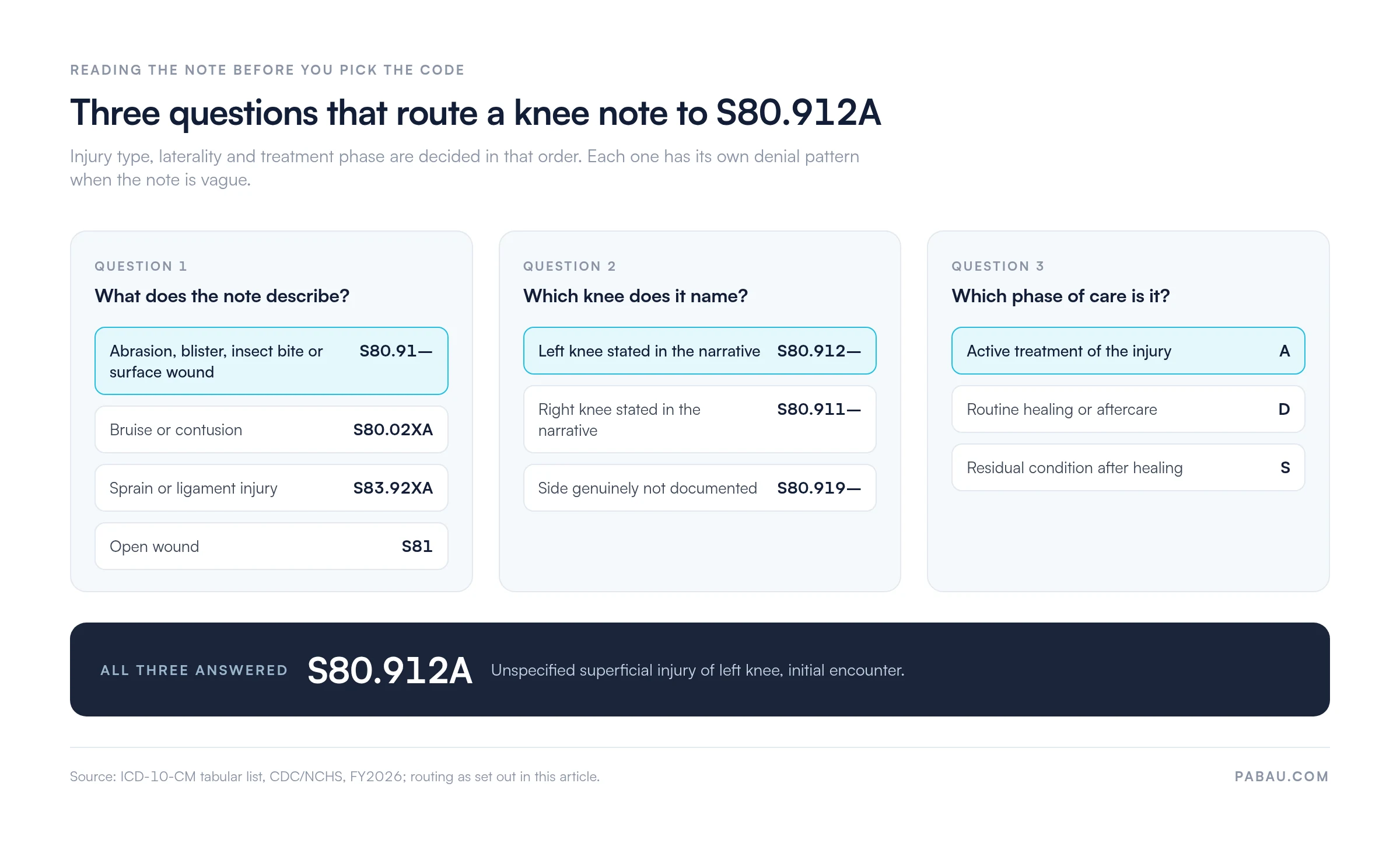
Payers auditing a claim with ICD-10 Code S80.912A look for five documentation elements. Missing any one of them can trigger a request for records or an outright denial.
Vague provider notes force coders to work from inference. That carries audit risk even when the coder’s choice is clinically reasonable, because the record cannot show how the choice was reached.
Most superficial knee injuries billed under ICD-10 Code S80.912A are low-acuity. Major payers rarely require prior authorization for the E&M or minor wound care services that accompany this diagnosis. Specific payer contexts change the picture, though.
Medicare: CMS does not require prior authorization for routine office visits or minor wound care associated with superficial knee injuries. Medicare does scrutinize claims where the documentation fails to support medical necessity for the level of service billed alongside S80.912A. An established-patient office visit (99213) is typically appropriate. A higher-complexity visit needs documented justification beyond the superficial injury alone.
Workers compensation: WC payers apply jurisdiction-specific rules that vary by state. Most require a completed first-report-of-injury form with the mechanism of injury and the time and date of the incident. Coding rules for WC in some states diverge from standard ICD-10-CM guidelines. Coders handling WC claims should confirm state-specific requirements before finalizing the diagnosis code, because generalizing across states is a compliance risk.
Commercial plans: High-deductible plans may require more detailed documentation before processing, because the patient bears more of the cost and is more likely to appeal. A complete note protects both the practice and the patient in those situations. Where several practitioners document injuries in one practice, inconsistent note standards produce inconsistent claim patterns, which is what triggers a payer audit.
Training clinical staff to record laterality, mechanism, and treatment phase in every note costs far less than reworking denials one claim at a time.
ICD-10 Code S80.912A is a low-complexity code, but it attracts predictable denials when injury-coding discipline breaks down. The five patterns below account for most preventable rejections.
Rejected S80.912A claims come back carrying CARC and RARC codes that name the reason. Reading them line by line tells a billing team whether to correct the code, the modifier, or the note itself.
Structured denial management workflows sort those rejections by reason code, which separates two very different problems. A systemic pattern points at documentation training. A transactional one means a single note missed the laterality.
Run a quarterly audit filtering all S80.912A claims by denial reason. If more than 20% of denials carry a medical-necessity reason code, the problem is documentation. If most carry a code-mismatch reason, the problem is coder training on the contusion versus superficial injury distinction.
Building a complete claim requires pairing S80.912A with CPT codes that reflect the services actually rendered. The table below covers the most common procedure code pairings for a left knee superficial injury visit.
Pabau builds claims software for practices that stores procedure-to-diagnosis pairing rules on the claim. S80.912A is then checked against every CPT code filed with it, so unbundling risks and missing modifiers surface before submission.
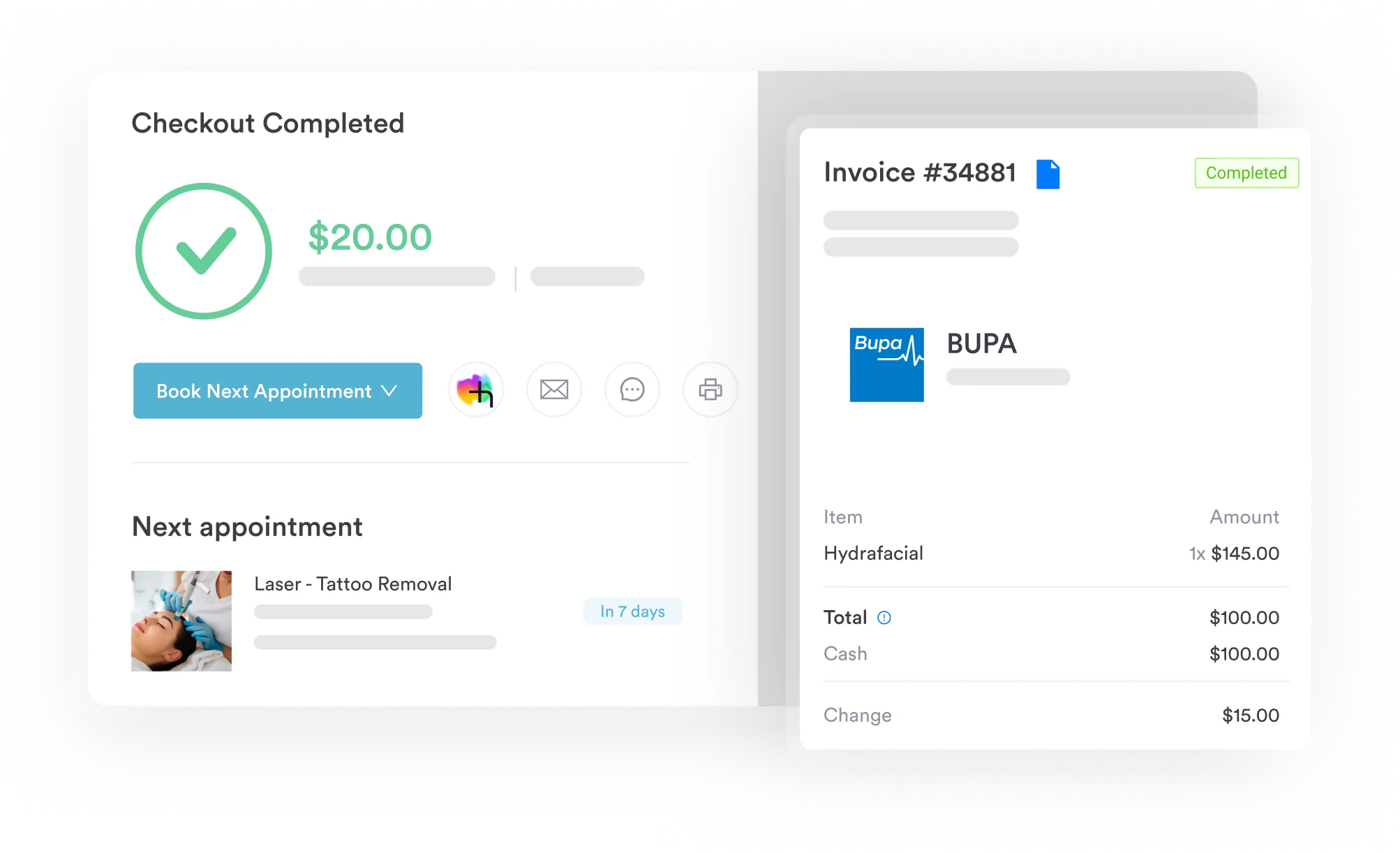
When a payer adjusts or denies one of these CPT pairings, the electronic remittance advice comes back structured and machine-readable. Billing staff can action the denied line items the same day instead of waiting for a paper EOB.
Practices handling appeals for older dates of service occasionally need the ICD-9-CM equivalent for a current ICD-10-CM code. The crosswalk for S80.912A is approximate. CMS General Equivalence Mappings use one-to-many relationships, because ICD-9-CM carried no laterality and far less injury-type detail.
Crosswalk accuracy depends on the context of the claim. Confirm the mapping against the CMS GEM files for the specific appeal you are filing. Never treat a GEM crosswalk as a definitive equivalency without reviewing the original ICD-9 documentation first.
Practices billing injury codes meet the same three preventable errors over and over. The episode character is wrong, the laterality is missing, or the documentation does not match the code that was filed.
Pabau is practice management software with claims tools built in. It validates ICD-10-CM codes before submission and surfaces 7th character and laterality problems while the claim can still be fixed. The check runs against the note that sits in the same patient record, so nobody re-keys a code to verify it.
Claims go out in the CMS-1500 and 837P formats through the clearinghouse integration. Eligibility is verified in real time, and ERA (835) remittances land back in the same record. The denial reason is visible at line-item level on the day the payer responds.
For a team filing a steady volume of minor injury claims, that pre-submission edit does the checking a manual review tends to skip. Clean claim rates on codes like S80.912A move once laterality and episode-character errors are caught in-house.

Pabau checks the 7th character and the laterality digit on every S80.912A claim before it reaches the payer. Book a demo to see it run against your own coding workflow.

ICD-10 Code S80.912A is a straightforward code that generates avoidable denials when the note skips laterality, treatment phase, or the nature of the injury. Most rejections trace back to two root causes. Either character A was applied past the active treatment phase, or a contusion was coded as an unspecified superficial injury.
Fix the documentation first, because no software can infer a side the provider never wrote down. Once the note is right, the checking is mechanical and belongs in the system rather than in someone’s memory. Book a demo to see how Pabau validates injury codes before the claim leaves your practice.

Need to see the D character in a live example? Adductor muscle injury ICD-10 S76.202D shows what the same injury looks like once treatment moves past the active phase.
Coding an injury that turned out to be a fracture? Femur fracture ICD-10 codes covers the wider 7th-character set that fracture codes use.
Want to stop denials rather than rework them? Denial management in healthcare sets out a process for tracing a rejection back to its root cause.
Got a rejection code you cannot read? Denial codes in medical billing decodes the top 20 CARC codes and what each one asks you to fix.
Filing the claim on the paper form? CMS-1500 form guide and free template explains every field and gives you a form to download.
S80.912A is the billable ICD-10-CM code for an unspecified superficial injury of the left knee at an initial encounter. It covers abrasions, nonthermal blisters, nonvenomous insect bites, and superficial foreign bodies when the note does not say which type.
Yes. S80.912A is a billable, specific ICD-10-CM code, and the CDC/NCHS ICD-10-CM web tool confirms it as valid for the current fiscal year. The 7th character A is what completes it, because S80.912 on its own cannot be filed.
Use character A while the patient is still receiving active treatment for the injury, such as wound cleaning and dressing. Switch to S80.912D once active treatment ends and the visit becomes routine healing or monitoring. S80.912S applies to a residual condition, such as scarring that persists after the wound resolves.
S80.912A covers a superficial injury such as an abrasion, blister, or skin break. S80.02XA covers a contusion of the left knee at an initial encounter. If the note documents a bruise or contusion, S80.02XA is correct, and S80.912A creates a mismatch payers catch on medical review.
S80.919A covers an unspecified superficial injury of an unspecified knee at an initial encounter. Use it only when the record genuinely does not state a side. Unspecified-side codes are a last resort and draw closer payer scrutiny on workers compensation and Medicare claims.




