ICD-10 Code S42.444P: Medial epicondyle fracture, right humerus
ICD-10 Code S42.444P: full descriptor and code validity ICD-10 Code S42.444P car...

Last Updated: Oct 13, 2026
Billable Code Specific Code
S83.096A is the billable ICD-10-CM code for other dislocation of unspecified patella, initial encounter.
The word "other" in the description is significant. Within S83.0 (patellar dislocations), the ICD-10-CM tabular list defines specific directions: Anterior dislocations fall under S83.01x, medial under S83.02x, and lateral under S83.03x. S83.096A applies when the record describes a dislocation that fits none of those directional categories, or when the direction is not specified at all.
Let Pabau's smart automation suggest the right codes, reduce claim denials, and keep your practice compliant—effortlessly.
Automate repetitive tasks and focus on what matters most—your patients.
Reduce coding errors and ensure compliance with the latest regulations.
Clean claims, fewer denials, and faster reimbursements.
Powerful insights and reporting to help your practice thrive.
HIPAA compliant SOC 2 certified GDPR-compliant Trusted by 4,000+ clinics worldwide

ICD-10 code S83.096A describes other dislocation of unspecified patella, initial encounter. It is billable for FY2026, effective October 1, 2025.
The seventh character A confirms active treatment. Switch to D for follow-up visits and S for sequela conditions.
Use unspecified laterality only when the clinical note genuinely omits the side, never as a default shortcut.
S83.091x and S83.092x classify subluxation, so a documented right or left dislocation takes S83.094x or S83.095x instead.
Practice management software like Pabau carries built-in ICD-10 catalogs, so orthopedic and sports medicine practices submit S83.096A claims accurately.
Knowing where S83.096A sits in the CMS ICD-10-CM classification helps coders find related codes and catch hierarchy errors before submission. The path from chapter down to this code follows the tabular list’s anatomical and clinical structure.
The sixth digit “6” in S83.096 indicates unspecified laterality. A note that documents the right patella moves the code to the S83.094x group, and a left patella moves it to S83.095x. The seventh character then sets the encounter type for whichever side applies.
Selecting the wrong seventh character is one of the most common denial triggers for S83 injury codes. The ICD-10-CM Official Guidelines for Coding and Reporting define three seventh-character extensions for Chapter 19 injury codes, and those rules apply directly to S83.096x.
Laterality and treatment phase are two separate decisions, and S83.09 carries a code for every combination of the two. The grid below lays out all nine.
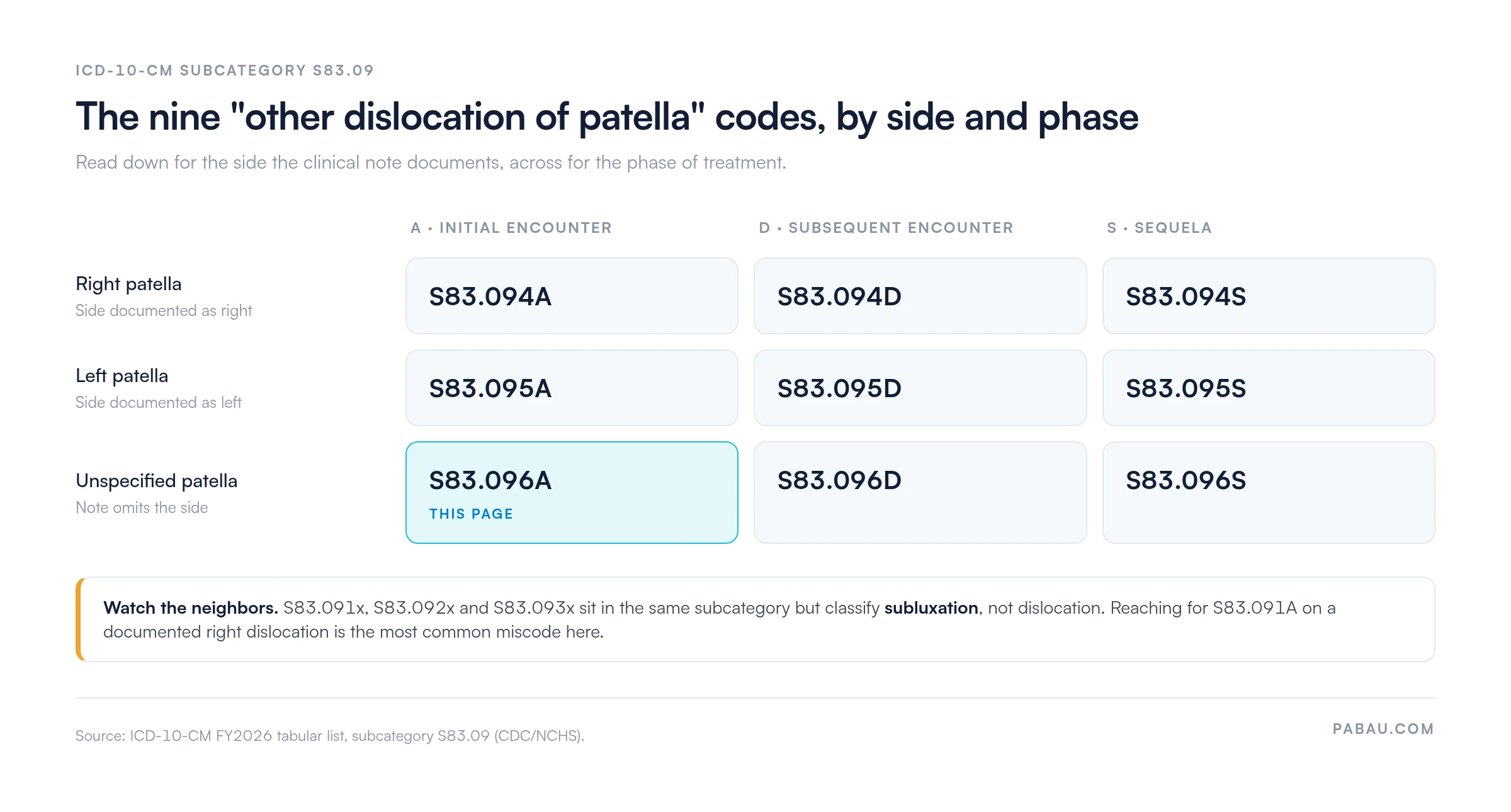
Using S83.096A for every visit is the most frequent error. The “initial encounter” designation refers to the phase of treatment, not the number of times the patient has seen a provider.
Take a patient whose patella is reduced in the ER, then seen by a sports medicine physician three weeks later. That follow-up visit sits in the subsequent encounter phase, so it takes S83.096D rather than S83.096A.
At that follow-up visit, a note recording lateral dislocation of the left patella takes S83.015D instead. Encounter phase, direction, and side all separate that code from S83.096A.
The sequela code (S83.096S) applies much later, once the original injury has healed but a residual condition remains. Patellofemoral instability and chronic knee pain are the usual examples. Code the late effect first, and S83.096S follows as the cause.
The patella (kneecap) sits in the trochlear groove of the femur, held there by the medial patellofemoral ligament, the quadriceps tendon, and surrounding soft tissue. A dislocation occurs when the patella is displaced entirely out of that groove.
Typical triggers include a direct blow to the knee, a sudden quadriceps contraction with the knee slightly flexed, or a hypermobility condition. Orthopedic and sports medicine practices see this code most often in patients aged 15 to 29. Reported recurrence after a first-time dislocation runs roughly 15% to 44% in the orthopedic literature.
Within S83.0, the classification splits by direction. Lateral dislocation is by far the most common presentation and has its own code family. S83.096x becomes the applicable code when the note says “dislocation of patella” without naming anterior, medial, or lateral. The same holds when the documented type falls outside those three categories.
This is where coders default incorrectly. ICD-10-CM guidelines allow an unspecified code only when the documentation does not contain enough information to assign a more specific one. An unspecified code is not a fallback for a note the coder has not read closely.
One trap sits immediately next door. S83.091x, S83.092x and S83.093x belong to the same S83.09 subcategory, but they classify subluxation, a partial displacement. A documented dislocation of the right patella takes S83.094A, not S83.091A.
A pattern of S83.096A on charts that do document the side becomes a compliance risk in a payer audit. Code what the note documents, and query the clinician for what it leaves out.
Coders working knee injury claims cross-reference the wider S83 family constantly. The ICD List code browser is a quick way to walk the sibling codes. Knowing the neighbors prevents under-coding and over-coding alike.
Medial collateral ligament injuries commonly accompany lateral patellar dislocations, so both conditions may be coded on the same claim. S83.096A would appear alongside the appropriate sprain code from S83.4 or S83.5. The principal diagnosis follows the reason for the encounter.
Check the operative or ER note for both the mechanism and the direction of dislocation before defaulting to S83.096A. A lateral dislocation documented explicitly belongs in S83.03xA, or in its laterality-specific sibling. S83.096A is the fallback only when direction is genuinely absent from the record.
Diagnosis codes and procedure codes travel together on the same claim. Billers using S83.096A on the ICD-10 side pair it with one of several CPT codes, depending on the treatment rendered. Our CPT code reference covers the procedure side of the same claim in more detail.
These codes all treat the acute episode. When instability recurs and the surgeon realigns the extensor mechanism, the procedure billed is 27422. That reconstruction pairs with a recurrent dislocation diagnosis, not with S83.096A.
Confirm CPT pairings against payer Local Coverage Determinations (LCDs) before submission, since payer policies on bundling 27550 with E&M codes vary. A clearinghouse edit check catches most of these mismatches before the claim transmits, which is cheaper than reworking a denial.
A technically correct code is only half the equation. Payer auditors reviewing S83.096A claims look for documentation elements that justify both the diagnosis and the encounter type. Missing one can downgrade the claim or trigger a refund request.
Before submitting a claim with S83.096A, verify the clinical record contains all of the following:
Practices running software for orthopedic billers can flag an incomplete record at the point of coding review, before the claim reaches the clearinghouse. The check costs a minute and saves a denial cycle.
For practices that bill US insurers, clean claim submission standards apply to every encounter type, including injury visits coded with S83.096A.
In many orthopedic and sports medicine practices, the coder reads the note in one system and builds the claim in another. Laterality, the seventh character, and the CPT pairing all get re-entered by hand, and each re-entry is a chance to introduce an error.
Pabau, practice management software for healthcare practices, keeps the clinical note and the claim in one patient record. Built-in ICD-10 and CPT catalogs surface S83.096A next to the documentation fields that support it. A coder can see whether the note names the side before the claim goes out.
From there the claim routes to the clearinghouse from the same record, with no export step and no retyping. Practices get fewer laterality and encounter-type denials coming back for rework, and a shorter path from the visit to the payment.

Pabau’s claims management tools include built-in ICD-10 and CPT catalogs, real-time eligibility checks, and payer-specific edit validation. Injury claims leave the practice with the code, the encounter type, and the documentation already lined up.

Getting S83.096A right comes down to three checks. Confirm the dislocation type is genuinely “other” rather than a directional type coded elsewhere in S83.0. Pick the seventh character from the treatment phase, not the visit number. Reach for unspecified laterality only when the record leaves the side out.
Most of the audit exposure sits in that third check. A chart that names the side and a claim that does not are easy for a payer to line up. The neighboring subluxation codes are the other easy mistake, and both are caught at coding review rather than after a denial.
Pabau keeps the note, the code, and the claim in one record for orthopedic and sports medicine practices. Book a demo to see how an injury claim moves from documentation to submission without re-entry.

Wondering how a clearinghouse handles the claim? Claim.MD clearinghouse review walks through what it does and how it connects for US insurance billing.
Working on denial prevention for injury codes? Denial management in healthcare covers the most common triggers and how to resolve them upstream.
Mapping the full billing cycle? What is revenue cycle management outlines the workflow from documentation through to payment posting.
New to US insurance billing? What is medical billing explains how a coded encounter becomes a paid claim.
ICD-10 code S83.096A is a billable ICD-10-CM diagnosis code describing other dislocation of unspecified patella, initial encounter. It belongs to the S83 category, which covers dislocations and sprains of the joints of the knee. It applies when a clinician documents a patella dislocation that is not classified as anterior, medial, or lateral, and laterality is not specified. The seventh character “A” confirms the patient is receiving active treatment.
Yes, S83.096A is a billable, specific ICD-10-CM code valid for reimbursement in FY2026. It became effective October 1, 2025, per the annual ICD-10-CM update published by the CDC/NCHS and adopted by CMS.
The three codes differ only in the seventh character, which reflects the phase of treatment. S83.096A (initial encounter) covers active treatment such as an ER visit or a first orthopedic consult. S83.096D (subsequent encounter) applies to follow-up visits, physical therapy, and routine healing care. S83.096S (sequela) applies when the patient develops a late effect caused by the original patella dislocation.
No. S83.096A applies only when laterality is unspecified in the clinical documentation. If the record documents the right patella, the correct code is S83.094A, and for the left patella it is S83.095A. Note that S83.091A and S83.092A describe subluxation rather than dislocation, so they are not the laterality-specific equivalents. Using S83.096A when the side is documented is a specificity error that may trigger a payer query or audit.
Two closed-treatment codes come up most often. Use 27550 for a knee dislocation reduced without anesthesia, and 27560 for a patellar dislocation without anesthesia. Surgical cases take 27566, open treatment of patellar dislocation. Physical therapy encounters take 97110, therapeutic exercise. The right code depends on the treatment rendered, so confirm every pairing against payer Local Coverage Determinations before submission.
Use seventh character “A” whenever the patient is receiving active treatment for the patella dislocation, regardless of how many times they have seen a provider. Active treatment includes the ER visit, the reduction procedure, and the first specialist consultation. Once treatment is established and the patient moves to healing or rehabilitation visits, switch to “D” for subsequent encounter. The character reflects the treatment phase, not the visit count.