ICD-10 Code S42.444P: Medial epicondyle fracture, right humerus
ICD-10 Code S42.444P: full descriptor and code validity ICD-10 Code S42.444P car...

Last Updated: Oct 13, 2026
Billable Code Specific Code
S83.015D is the billable ICD-10-CM code for lateral dislocation of left patella, subsequent encounter. It applies at follow-up visits, once active treatment has finished and the left kneecap is healing routinely.
The code sits in the S83 family of knee dislocations and sprains. Two details in the note decide assignment: the side treated, and whether the visit is active treatment or routine recovery. S83.015A covers the initial encounter, S83.015S the sequela, and S83.014D the right knee.
Let Pabau's smart automation suggest the right codes, reduce claim denials, and keep your practice compliant—effortlessly.
Automate repetitive tasks and focus on what matters most—your patients.
Reduce coding errors and ensure compliance with the latest regulations.
Clean claims, fewer denials, and faster reimbursements.
Powerful insights and reporting to help your practice thrive.
HIPAA compliant SOC 2 certified GDPR-compliant Trusted by 4,000+ clinics worldwide

S83.015D is a billable ICD-10-CM code for lateral dislocation of the left patella at a subsequent (follow-up) encounter, valid for FY2026.
Use ‘D’ once active treatment ends and routine healing begins, never at the first ED or urgent care visit.
Recurrent patellar dislocation is typically coded from the M22.0- series, not S83.015D, which covers acute traumatic episodes only.
Practice management software like Pabau validates encounter type and laterality before the claim leaves your billing queue.
ICD-10 code S83.015D carries the official descriptor “Lateral dislocation of left patella, subsequent encounter”, as published in the CMS FY2026 ICD-10-CM Tabular List.
Most billing systems show the short descriptor, “Lat disloc left patella, subs.” The seventh character ‘D’ completes the code, so it is a valid leaf code and billable across all major payer types.
A lateral patellar dislocation is the complete displacement of the kneecap from its groove in the femur. The patella shifts outward, toward the lateral side of the knee. Laterality matters twice over here. The left and right patellae have separate ICD-10-CM codes. Missing laterality in the note is also one of the most common reasons an S83.015D claim is denied.
The usual mechanisms are a planted foot with a rotational force, a direct blow to the inner side of the patella, or a non-contact pivot. Soccer and basketball produce plenty of the last kind. First-time dislocations are treated in an ED or urgent care setting and coded S83.015A. Follow-up visits are where S83.015D applies, whether that is the orthopedic review or the course of physical therapy.
The seventh character in S83.015A, S83.015D and S83.015S sets the encounter type, not the severity of the injury. The ICD-10-CM Official Guidelines for Coding and Reporting (Section I.C.19.a) code active treatment as ‘A’. Once the patient is receiving routine care during healing or recovery, the correct character is ‘D’.
Here is the audit trigger. A patient dislocates the left patella at a soccer match on Monday, coded S83.015A, then attends a physical therapy assessment on Thursday. Billing S83.015A at that Thursday visit is compliant only if active reduction or acute management is happening.
For a functional assessment and exercise prescription, which is routine healing, S83.015D is the correct code. Misapplying ‘A’ at a therapy visit does more than invite a denial. It can flag the practice for a post-payment audit.
Several codes sit close enough to S83.015D to cause daily confusion. The table below maps the ones most often mixed up, across laterality, encounter type, subluxation versus dislocation, and recurrent-episode routing. When a neighbor looks closer to the note than S83.015D does, confirm it against the full ICD-10-CM code library before you submit.
Subluxation vs. dislocation: the distinction is clinical, and it must appear in the documentation. A subluxation is partial displacement, where the patella shifts but does not fully leave the trochlear groove. A dislocation is complete displacement.
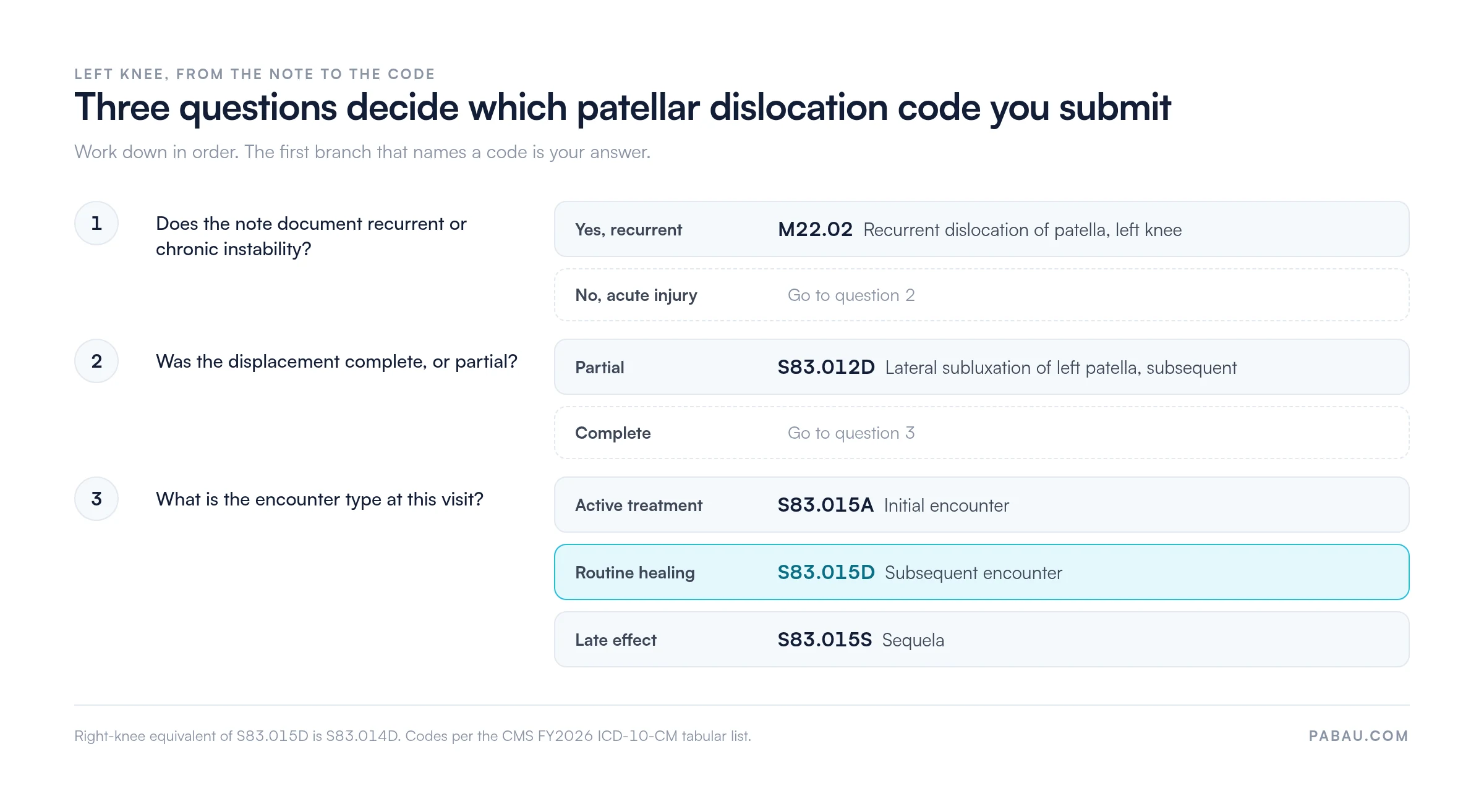
If the note records “subluxation”, use S83.012D for a left-sided subsequent encounter. If it records “dislocation”, use S83.015D. Upgrading subluxation to dislocation without matching documentation is a compliance risk.
Recurrent vs. acute: where the patient has had several prior episodes and the provider documents recurrent patellar instability, the ICD-10-CM route is M22.02, not S83.015D. The S83 category is reserved for acute traumatic episodes.
Check the clinical record each time. A patient can sustain a new acute dislocation on top of a history of recurrence. In that case S83.015D still covers the acute episode, and M22.02 may be listed secondarily. The path from the note to the right code runs through three questions.
Check the ICD-10-CM Tabular instructions at the S83 category level before you assign S83.015D. Two Excludes notes sit there, and they do different jobs.
Excludes1 at S83 covers birth trauma (P10-P15) and obstetric trauma (O70-O71). A knee injury from either cause is coded from those chapters, never from S83.
Excludes2 at S83 covers six conditions. An Excludes2 note means the condition is not part of S83, but both may be reported together when both are documented.
That fifth entry is why recurrent instability routes to M22.02 rather than S83.015D. M22.0 sits outside the S83 category by instruction, not by clinical judgment.
Two further instructions govern how the code is built and reported.
Meniscal tears (S83.2-) and knee ligament sprains (S83.5-) are subcategories of S83 itself, not exclusions from it. They can be reported alongside S83.015D when each is separately documented. NCCI edits still apply at the procedure level, so check any CPT pair before submission.
A claim carrying ICD-10 code S83.015D is read against the clinical documentation for four elements: laterality, directionality, injury type, and encounter context. Missing any one of them is grounds for a medical necessity denial.
ICD-10 code S83.015D pairs with evaluation and management or physical therapy procedure codes, depending on the setting. Practices handling a high volume of musculoskeletal follow-ups build these pairings into their billing templates. Software for billing teams can then flag an implausible CPT-ICD pair before the claim leaves the practice.
The pairings below cover most subsequent-encounter visits for a left patellar dislocation.
Confirm NCCI edits before submitting a CPT pair. Physical therapy CPT codes carry unit-per-day limits. Bundling rules can also apply when two timed codes, such as 97110 and 97140, fall on the same date.
Surgical realignment sits outside this follow-up list. Reconstruction of a dislocating patella with extensor realignment bills as 27422, and payers expect a recurrent M22.0- diagnosis on that claim rather than S83.015D.
Build a billing template that auto-populates S83.015D alongside the three most common physical therapy CPT codes for follow-up knee visits: 97110, 97140 and 97012. Then flag any claim where the provider documents reduction or aspiration. Those procedures point to S83.015A, and catching the mismatch before submission saves the cost of an appeal.
Requirements for subsequent patellar dislocation encounters vary by plan type. Authorization is one of the top reasons these claims sit unpaid, so check the rule before the visit rather than after the denial.
S83.015D claims come back for a predictable set of reasons. Most of the prevention work sits in the billing queue rather than the exam room.
A clearinghouse integration such as Claim.MD validates encounter-type and laterality fields before the claim reaches the payer. Steady denial management workflows then clear the ones that still come back, so the revenue cycle lag does not build.
A seventh-character error usually surfaces when the remittance advice arrives. By then the visit is weeks old, the coder has to reopen the note, and the appeal joins a queue nobody has time for.
Practice management software like Pabau keeps the coding decision next to the clinical record that justifies it. The treatment note, the laterality, the plan of care and the claim all sit on one patient record. Nobody reconciles two systems before submission.
Pabau’s claims management tools then check the claim before it goes out. Encounter type, laterality and CPT pairing are read against the note, and the clearinghouse integration catches the rest. Your team spends its week on patient care instead of reworking denials that were avoidable at the point of coding.

Pabau’s claims management software validates encounter type, laterality and CPT pairs before submission. The Claim.MD clearinghouse integration catches what slips through, so your S83.015D claims reach payers clean.

Three variables decide whether an S83.015D claim is right: the left side, a lateral dislocation rather than a subluxation, and a genuine subsequent encounter. Apply them consistently and the code stops being a denial source.
The seventh-character error is the one worth building a rule for. The difference between ‘A’ and ‘D’ looks small on the claim, and payers do not treat it as small. Put the check in the billing workflow, not in someone’s memory.
Pabau’s claims management software validates encounter-type logic and laterality at the point of claim generation. Book a demo to see how it handles musculoskeletal billing from the treatment note through to the remittance.

Want fewer S83.015D claims coming back? Clean claim explains what payers check before they pay, and which fields hold a claim up.
Want to understand the denial codes that come back on knee injury claims? Denial codes in medical billing decodes the CARC and RARC codes that accompany S83.015D rejections.
Need a plain-language overview of how clearinghouses work? Medical claims clearinghouse guide explains how electronic claim validation catches coding errors before payer submission.
ICD-10 code S83.015D is the billable diagnosis code for lateral dislocation of the left patella, subsequent encounter. It is used at follow-up visits during healing or recovery, after the dislocation has been treated. The seventh character ‘D’ separates it from the initial encounter code S83.015A and the sequela code S83.015S.
Yes, S83.015D is a billable ICD-10-CM leaf code valid for FY2026 claim submission. The seven-character structure is complete: laterality (5 = left), directionality (lateral) and encounter type (D = subsequent). Medicare, commercial and workers’ compensation payers all accept it as a diagnosis code.
All three describe a lateral dislocation of the left patella, and only the seventh character changes. S83.015A covers active treatment at the initial encounter. S83.015D covers routine care during healing, at a subsequent encounter. S83.015S covers a late effect or complication of the original dislocation. Applying the wrong character for the encounter type is the leading cause of denials in this code family.
Recurrent patellar dislocation of the left knee is typically coded M22.02, not S83.015D. The ICD-10-CM guidelines direct chronic or recurrent patellar instability to the M22.0- series. S83.015D applies to acute traumatic episodes. If a patient with a history of recurrent instability sustains a new acute dislocation, S83.015D may still be appropriate for that specific episode.
Yes. S83.015D is appropriate for physical therapy visits during the routine healing phase of a lateral left patellar dislocation. Those follow-up visits are a classic subsequent encounter context. Confirm that the plan of care and session notes reflect ongoing recovery rather than acute management, to avoid a seventh-character mismatch denial.
Yes. Subluxation (partial displacement) and dislocation (complete displacement) are coded separately in the S83.01x series. Left lateral subluxation at a subsequent encounter uses S83.012D, and left lateral dislocation uses S83.015D. The distinction must appear in the provider’s clinical documentation, because coders cannot upgrade subluxation to dislocation on assumption.