

ICD-10 code S61.201A: Open wound of left index finger without nail damage
ICD-10 code S61.201A covers a left index finger wound of unstated type ICD-10 co...

Last Updated: Oct 16, 2026
Billable Code Specific Code
S82.846Q is the billable ICD-10-CM code for nondisplaced bimalleolar fracture of unspecified lower leg, subsequent encounter for open fracture type I or II with malunion.
Orthopedic and physical therapy coders reach for it at follow-up visits, once imaging confirms the bone united out of alignment. Two characters do most of the work here. The 6th records displacement and side together, and the 7th records the encounter, the wound type and the healing outcome.
Let Pabau's smart automation suggest the right codes, reduce claim denials, and keep your practice compliant—effortlessly.
Automate repetitive tasks and focus on what matters most—your patients.
Reduce coding errors and ensure compliance with the latest regulations.
Clean claims, fewer denials, and faster reimbursements.
Powerful insights and reporting to help your practice thrive.
HIPAA compliant SOC 2 certified GDPR-compliant Trusted by 4,000+ clinics worldwide

S82.846Q is a billable ICD-10-CM code for a nondisplaced bimalleolar fracture of unspecified lower leg.
The 7th character Q means a subsequent encounter for an open fracture type I or II that healed with malunion.
The 6th character 6 leaves laterality unspecified, so use S82.844- for the right leg or S82.845- for the left when the side is documented.
P covers a closed fracture with malunion, and R covers an open type IIIA, IIIB, or IIIC fracture with malunion.
Practice management software like Pabau builds ICD-10 lookup into the note, so coding errors surface before the claim goes out.
ICD-10 code S82.846Q packs five layers of clinical detail into seven characters. Each position carries a specific meaning under the CMS ICD-10-CM framework, and misreading any single character produces the wrong code entirely.
The 6th character carries two facts at once. Within S82.84-, the digits 1, 2 and 3 mark displaced fractures of the right, left and unspecified lower leg. The digits 4, 5 and 6 mark nondisplaced fractures in the same order.
The series stops there, so a code such as S82.849Q does not exist. Confirm the documented side before you code, because 6 belongs only to records that genuinely do not state it.
A bimalleolar fracture breaks both malleoli at once. The medial malleolus is the bony prominence on the inner ankle, at the distal tibia. The lateral malleolus sits on the outer ankle, at the distal fibula. These two structures form the ankle mortise, the bony socket that stabilizes the talus. When both are fractured, ankle stability is significantly compromised.
Open fractures skip the usual imaging-decision rules for closed ankle injuries. A wound communicating with bone sends the patient straight to imaging and surgical assessment. Laterality should be documented from the radiographic report onward.
Nondisplaced means the fractured bone fragments have not shifted out of their anatomical alignment. The fracture line exists, but the bone ends remain in their correct relative positions. This distinction matters for coding because displaced and nondisplaced fractures carry separate codes within the S82.84- series.
Open fracture type I or II points to the Gustilo-Anderson grading of the wound. Type I is a clean wound under 1 cm with minimal soft-tissue damage. Type II is a wound larger than 1 cm without extensive soft-tissue loss or flaps. Anything more severe is type IIIA, IIIB or IIIC, which takes the 7th characters C, F, J, N or R instead.
Malunion occurs when the fracture heals in an anatomically incorrect position. After an open bimalleolar fracture, alignment can drift during wound care, external fixation, or a delay before definitive fixation. Even a nondisplaced fracture can unite with mild rotational or angular deformity. Clinically, malunion may cause chronic pain, altered gait, and a higher risk of post-traumatic arthritis.
The 7th character extension is the most technically demanding part of fracture coding. S82.846 takes 16 valid 7th character options, each reflecting a different phase of care, wound type, or healing outcome. Section I.C.19.c of the ICD-10-CM Official Guidelines for Coding and Reporting governs the choice. The character reflects the type of encounter, the open or closed status of the fracture, and the healing status documented that day.
For S82.846Q, Q belongs at a follow-up visit, once an open type I or II fracture has united in a malaligned position. The record has to carry both facts, the open wound and the malunion, for Q to be valid.
Two distinctions drive most of the daily errors. Q denotes malunion, meaning the bone united in the wrong position, while M denotes nonunion of the same open type I or II fracture. For a closed fracture, the equivalents are P and K instead. Reaching for K when the chart describes an open fracture healed with deformity gets the wound type wrong as well as the outcome. That error leads to denials and, in audits, potential overpayment findings.
Selecting the right fracture malunion ICD-10 code requires comparing several closely related codes in the S82.84- series. The differences hinge on four variables. Displacement, laterality, open or closed wound type, and healing status each change the code. Consult the AAPC ICD-10-CM code lookup or the ICD List reference to verify each code against the current fiscal year tabular.
The same character-extension logic runs through the whole S82 range. Our diagnostic code library breaks down each S82 code one at a time, including the displaced and closed variants named above.
Four conditions must all be true before S82.846Q is the correct ankle fracture ICD-10 code to submit. First, the encounter is a follow-up visit, not the initial injury visit. Second, the fracture was open and graded as Gustilo type I or II. Third, the bone has united, and imaging or examination confirms malunion. Fourth, the record does not state which leg was injured.
Run them in order, because the first one that fails changes the code you submit.
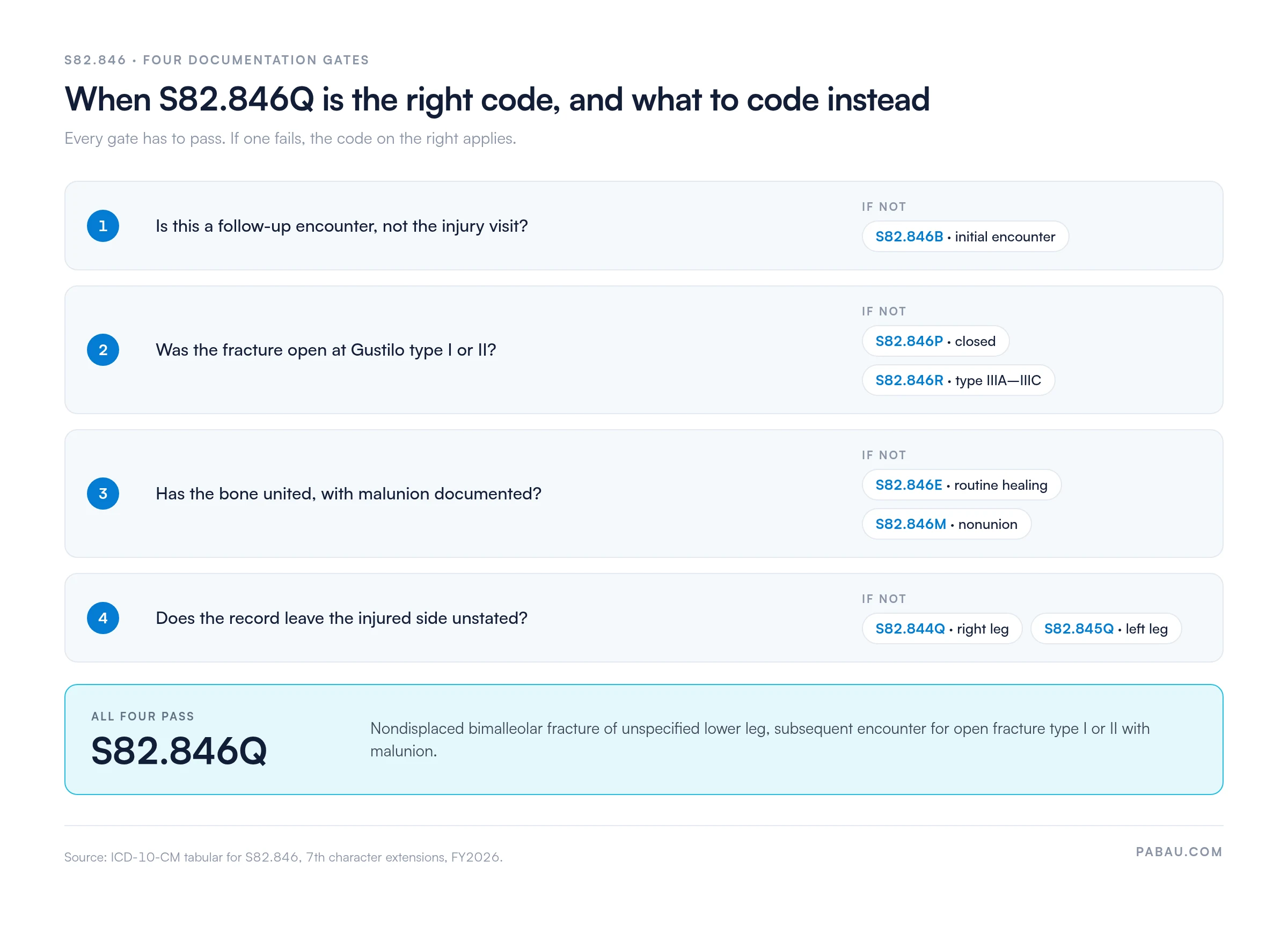
That fourth condition deserves a challenge every time. Laterality is almost always knowable from the imaging report, and an unspecified-side code invites payer scrutiny. Query the provider and move to S82.844Q for the right leg or S82.845Q for the left whenever the chart supports it.
Physical therapy teams meet this code during rehabilitation, when patients present with gait abnormalities or persistent pain after an open ankle fracture unites. In these visits, the treating provider must name the malunion explicitly, not just note “healed fracture” or “chronic ankle pain.”
Check the operative and imaging reports before assigning Q. The code needs two documented facts. The fracture was open at Gustilo type I or II, and it united in a malaligned position. A progress note saying ‘fracture healed’ supports neither one. If the chart is ambiguous, query the treating provider before coding.
Payers reviewing claims for S82.846Q look for four documented facts. The encounter is a follow-up rather than active treatment. The fracture was open, at type I or II on the Gustilo scale. The bone has united, and the record names the malunion outright.
Deficiencies in any of those areas are the main reason such claims get denied or flagged during audits.
Section I.C.19.c also settles a question that generates a lot of unnecessary provider queries. Sometimes an open fracture of the lower leg is documented but never graded. In that case the coder defaults to the type I or II 7th character. So Q can be correct without the words “type I” in the chart, as long as an open fracture and a malunion are recorded.
The same guidelines set several other requirements for fracture aftercare coding. Practices that submit claims electronically usually get ICD-10 code validation on the way out. That check catches malformed codes before they reach the payer.
Pre-submission editing at the clearinghouse lowers the risk of a wrong 7th character. It can catch a Q submitted where the documentation would only justify E, M, or P instead.
The clinical record needs evidence of the malunion, plus evidence that the original fracture was open. Look for the following:
Practices that track rejections through a structured approach to managing claim denials can spot patterns in fracture coding. Those patterns show which documentation habits to fix first.
S82.846Q codes to a subsequent encounter, which typically maps to lower-complexity office visit E/M codes when billed alongside a follow-up examination. Providers should pair the fracture code with the CPT E/M code that reflects the visit complexity. Fracture treatment codes do not belong on the claim, because no active treatment is being performed.
Medicare and most commercial payers accept S82.846Q as a principal diagnosis or secondary diagnosis, depending on the encounter’s primary reason for the visit. When malunion is the primary concern driving the visit, it may serve as the principal diagnosis. An evaluation for corrective osteotomy is the clearest example. Payer-specific local coverage determinations (LCDs) may apply. Verify with the relevant payer before submitting.
Real-time eligibility verification confirms coverage and any applicable LCDs before the patient arrives. That check removes most claim-level surprises after the visit. Front-desk and billing teams can then agree the documentation they need from clinical staff.
When S82.846Q is billed alongside a physical therapy claim, the therapy notes need functional limitations tied to the malunion. The original fracture history alone will not carry the claim. Payers look for a clear connection between the malunion diagnosis and the therapy services provided.
Practices treating ankle fracture malunion must align their documentation with both ICD-10-CM coding requirements and payer expectations. Physical therapy compliance rules in the US often intersect with Medicare’s fracture aftercare coding policies. The overlap shows up around the definition of “subsequent encounter” and the evidence needed to justify ongoing treatment.
For orthopedic practices, the key compliance checkpoint is a follow-up note that states the healing status plainly. A note reading “patient doing well, follow up in 6 weeks” gives coders nothing to work with. A short structured block in every follow-up note solves it.
Open fractures add one more line to that list. Wound status belongs in the note as well, since payers reviewing an open fracture code expect to see it followed through the healing phase.
In most practices the coder works from a note written hours earlier, in another system. The 7th character then gets chosen from memory or a printed cheat sheet, after the provider has moved on. If the note never said whether the fracture was open, the query goes out days later.
Practice management software like Pabau puts the code lookup inside the note itself. The same platform handles cleaner claims submission. The diagnosis, the treatment note and the invoice sit on one patient record. So the provider can log the wound type and the union status while the patient is still in the room.
The record then answers the two questions Q depends on before anyone opens a claim. When a denial does come back, reporting shows which 7th characters keep triggering it. You fix the note template once, instead of querying the same provider every month.

Pabau’s built-in ICD-10 code search and claims tools help orthopedic and physical therapy practices submit cleaner claims. Your team documents open fracture malunion encounters accurately the first time, so denials drop.

The hard part of this code is not finding it. It is proving from the chart that the fracture was open, and that the bone united crooked. Both facts live in notes written weeks apart, which is why the query queue fills up.
So treat the follow-up note as the place to settle it. A provider who writes the wound type and the union status on the same line removes the guesswork for whoever codes the visit. Challenge the unspecified side while you are there, because S82.844Q or S82.845Q is almost always the better claim.
Built-in ICD-10 lookup puts that check where the note gets written. Book a demo to see how an orthopedic or physical therapy practice codes fracture aftercare without a query backlog.

Coding a different fracture malunion? S82.499Q applies when the fibula shaft, rather than both malleoli, healed out of alignment.
Want to see how clearinghouse validation catches coding errors? Medical claims clearinghouse explains how pre-submission editing works for musculoskeletal claims.
Managing denials from fracture aftercare submissions? Denial management in healthcare provides a systematic approach to identifying and resolving claim rejections.
Need the documentation standards behind a clean fracture claim? Medical billing compliance covers the records payers expect to see on audit.
S82.846Q is a billable ICD-10-CM code from the bimalleolar fracture series. It describes a nondisplaced bimalleolar fracture of unspecified lower leg, subsequent encounter for open fracture type I or II with malunion. It applies at a follow-up visit, after an open ankle fracture has united in a malaligned position.
Yes, S82.846Q is a valid, fully billable ICD-10-CM code. It can be reported as a principal or secondary diagnosis, depending on the encounter’s clinical focus. The unspecified laterality can still prompt payer questions, so document the side whenever it is known.
The 7th character Q means a subsequent encounter for an open fracture type I or II that healed with malunion. P is the closed-fracture equivalent, and R covers open type IIIA, IIIB, or IIIC. Nonunion and routine healing take different characters again.
Malunion means the fracture healed in an incorrect anatomical position. Nonunion means it failed to heal at all. For an open type I or II fracture, malunion is Q and nonunion is M. For a closed fracture, the pair is P and K.
Use S82.846B at the initial encounter, while the open type I or II fracture is under active treatment. Move to S82.846Q at a follow-up visit, once the fracture has united with confirmed malunion. S82.846A applies only when the fracture was closed.
Ankle fracture ICD-10 codes sit in the S82 category, fractures of the lower leg including ankle. Bimalleolar fractures run from S82.841 to S82.846, and trimalleolar fractures from S82.851 to S82.856. Lateral malleolus fractures run from S82.61 to S82.66. Each one needs a 7th character for the encounter type, wound type, and healing status.



