

ICD-10 Code S42.444P: Medial epicondyle fracture, right humerus
ICD-10 Code S42.444P: full descriptor and code validity ICD-10 Code S42.444P car...

Last Updated: Oct 13, 2026
Billable Code Specific Code
S82.465C is the billable ICD-10-CM code for nondisplaced segmental fracture of shaft of left fibula, initial encounter for open fracture type IIIA, IIIB, or IIIC.
This code is valid and billable for fiscal year 2026. It falls within the S82 category, which covers fractures of the lower leg, including the ankle. CMS and the National Center for Health Statistics maintain that category jointly, under the ICD-10-CM Official Guidelines for Coding and Reporting.
Let Pabau's smart automation suggest the right codes, reduce claim denials, and keep your practice compliant—effortlessly.
Automate repetitive tasks and focus on what matters most—your patients.
Reduce coding errors and ensure compliance with the latest regulations.
Clean claims, fewer denials, and faster reimbursements.
Powerful insights and reporting to help your practice thrive.
HIPAA compliant SOC 2 certified GDPR-compliant Trusted by 4,000+ clinics worldwide

ICD-10 code S82.465C describes a nondisplaced segmental fracture of the shaft of the left fibula, initial encounter for open fracture type IIIA, IIIB, or IIIC
In the S82.46 subcategory the 6th character encodes displacement and laterality together, so the 5 in S82.465 means nondisplaced and left
The laterality alternates are S82.464C for the right leg and S82.466C for an unspecified leg, not S82.461C or S82.462C
The 7th character C designates an open fracture with severe soft tissue injury or arterial damage
Practice management software like Pabau integrates with Claim.MD to validate and submit fracture diagnosis codes across thousands of US payers
Per the CDC/NCHS ICD-10-CM web tool, this code is confirmed as a valid, specific code for fiscal year 2026. Coders working in sports medicine and orthopedic settings meet it in trauma and acute care contexts.
Each component of the code description carries a specific coding meaning. Misreading any one element leads to a code assignment error.
Read together, these components point to one code and one side. A segmental fibula fracture that is displaced, on the right leg, or at a later encounter takes a different code entirely. Coders in physical therapy EMR workflows also see this code on referral documentation when patients transition from acute care to rehabilitation.
The 6th character in the S82.46 subcategory does double duty. It encodes displacement and laterality at the same time, rather than laterality alone. Characters 1 through 3 cover displaced fractures, and characters 4 through 6 cover nondisplaced fractures.
That is why S82.465 reads as nondisplaced and left. The 5 is the second digit in the nondisplaced run, and the second position in each run is the left leg. The grid below shows both runs side by side.
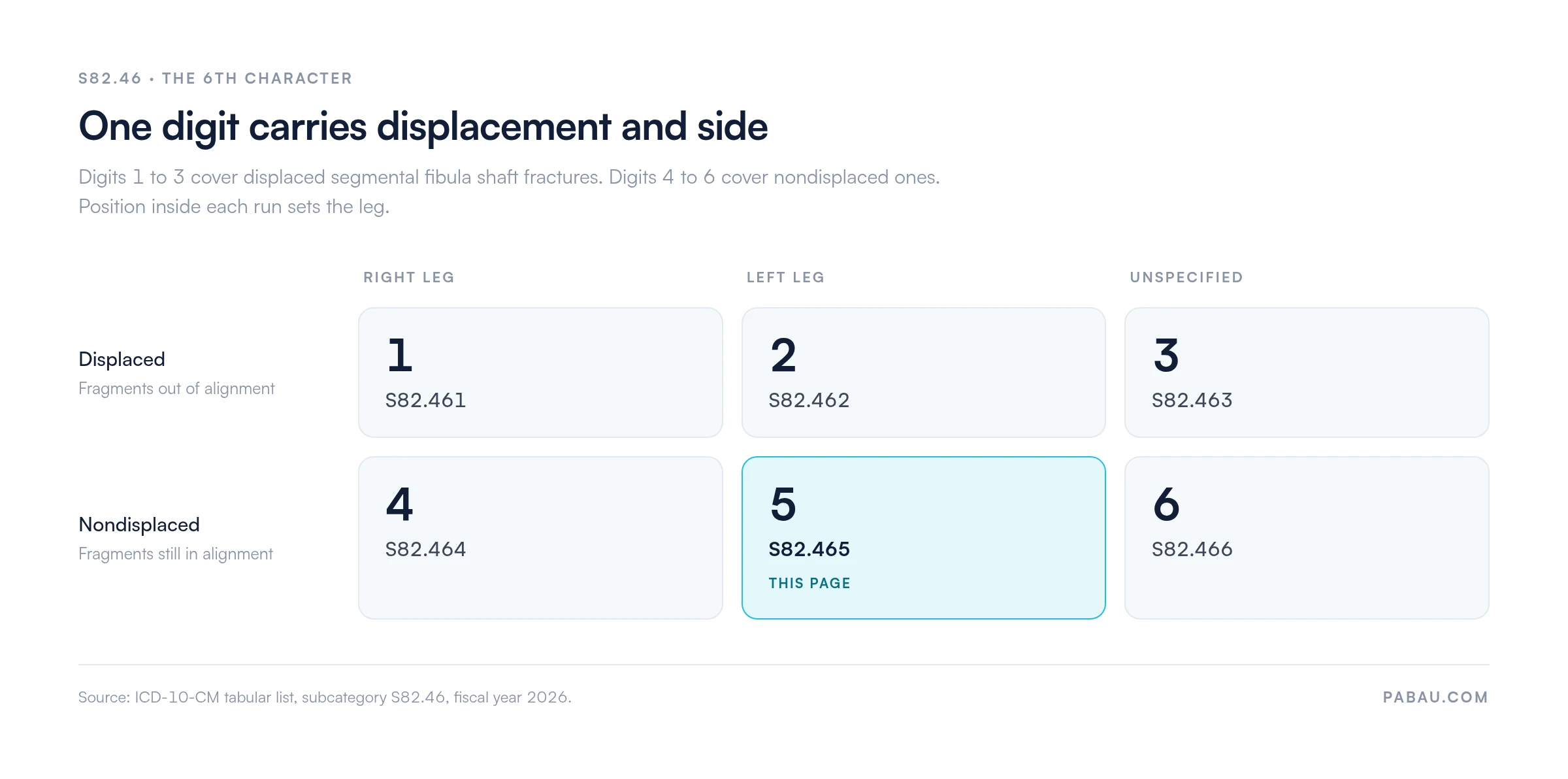
So S82.461C and S82.462C are not laterality alternates for S82.465C. Both describe a displaced segmental fracture, which is a different fracture pattern. Substituting one for the other changes the injury reported on the claim, not just the side.
The parent code S82.46 is titled segmental fracture of shaft of fibula. It covers displaced and nondisplaced variants alike, so the subcategory title on its own settles neither displacement nor side.
When the operative note says left fibula, check that the 6th character is 5 and not 2. Both codes read as left, but 2 is displaced and 5 is nondisplaced. Reading that digit as a laterality flag alone is how displaced fractures end up billed as nondisplaced.
The 7th character is the most consequential coding decision for the S82.465 code family. It specifies the encounter type and, for open fractures, the wound severity grade. Character C is among the hardest to assign, because it depends on the physician documenting the Gustilo-Anderson classification in the record.
S82.465 takes all 16 valid fracture 7th characters. The table below lists every one of them against the left-fibula base code.
The ICD-10-CM Official Guidelines add an important clarification. Initial encounter is determined by whether the patient is receiving active treatment for the fracture. It does not depend on whether a provider is seeing the patient for the first time. A surgeon performing operative fixation at a second hospital visit is still providing active treatment.
Coders can verify the full child-code tree with the AAPC Codify ICD-10-CM lookup. The right-leg and unspecified-leg codes follow the same 7th character structure, so S82.464C and S82.466C exist alongside S82.465C.
The Gustilo-Anderson classification is the standard framework for grading open fractures by wound severity and soft tissue damage. Only the attending physician can determine and document the type. Coders assign ICD-10 code S82.465C from that documented classification, never from their own clinical interpretation.
All three subtypes map to the same 7th character C in ICD-10-CM. The coding system does not separate them at the code level, so the clinical distinction lives in the surgical and nursing documentation instead. Practices coding high-acuity trauma diagnoses alongside vascular injury codes will see all three subtypes within a single inpatient episode.
Knowing where S82.465C sits in the ICD-10-CM hierarchy helps coders confirm they are at the correct specificity level. It also shows which code blocks cover adjacent injury types.
Note that S82.4 covers fractures of the fibula shaft specifically. Proximal fibula fractures near the knee are coded elsewhere in the S82 block. For distal fibula fractures involving the ankle, review the S82.6x series before assigning. This kind of hierarchy reading is the same habit that makes procedure code families easier to navigate.
For inpatient claims, ICD-10 code S82.465C triggers specific MS-DRG assignments through the CMS grouper. This code represents a high-severity open fracture, so the DRG assignment reflects the resource intensity of Gustilo type III injuries. That includes potential vascular repair, wound coverage procedures, and extended stays.
Practices submitting inpatient claims can use electronic claims via Claim.MD, our US clearinghouse partner. Claim.MD validates ICD-10-CM codes against current CMS grouper logic before submission across thousands of US payers. Understanding revenue cycle management matters here, because MS-DRG weights drive the base reimbursement the facility receives.
Key reimbursement considerations for this code:
Practices managing fracture billing can also review medical clearinghouse submission processes, so ICD-10 codes are validated before they reach the payer. That reduces the grouper errors that lead to underpayment.
The ICD-10-CM Official Guidelines for Coding and Reporting set specific fracture coding rules that shape S82.465C assignment. Meeting the documentation thresholds prevents downcoding, supports medical billing compliance, and keeps the 7th character defensible on audit.
Check whether a superbill carries the ICD-10 code in full or relies on shorthand. Incomplete code entry at the point of care is a common source of 7th character and laterality errors. Claims management software with a built-in ICD-10 catalogue flags truncated codes before submission.
Document the Gustilo-Anderson type and the side in the operative note, the admission history and physical, and the discharge summary. When all three agree, coders have a defensible audit trail for the 7th character and the laterality digit. The claim is then far less likely to draw a medical necessity query.
S82.465C is a diagnosis code, so it never travels alone on a claim. It supports the procedure codes billed for the same episode of care. The table below lists CPT codes that commonly accompany an open segmental fibula shaft fracture.
CPT is maintained by the American Medical Association, and the code billed has to match the procedure the surgeon documented. Type IIIB fractures often add a flap or graft code for soft tissue coverage. Treat this table as a starting point for the chart review, not a substitute for it.
Open fracture codes in the S82 series generate a disproportionate share of orthopedic coding denials. These are the errors seen most often with this specific code.
Practices billing through a clearinghouse catch some of these at the claim validation stage. Reviewing electronic remittance advice for diagnosis-related adjustment reason codes helps coders spot patterns across several fracture claims at once.
ICD-10-CM changes every October, so check the code against the fiscal year of the date of service. These four sources settle almost every question about this code.
When two sources disagree, the CDC/NCHS tabular listing is the one that governs. Note the fiscal year you checked in the coding note, so an auditor can retrace the decision later.
In many orthopedic practices the fracture detail lives in one system and the claim is built in another. A coder reads the operative note, picks the 7th character, then retypes the code into a billing screen. Those two details are the ones that get dropped in that handoff.
Practice management software like Pabau keeps the two together. The diagnosis code sits on the appointment record, beside the clinical note that supports it. The claim is then built from that record rather than retyped. Pabau also integrates with Claim.MD, so codes are validated before submission across thousands of US payers.
The result is fewer denials on codes that were correct in the chart and wrong on the claim. Coders keep an audit trail as well, so a 7th character or a laterality digit can be defended months later without reopening the paper record.

Pabau integrates with Claim.MD to submit and track ICD-10 coded claims across thousands of US payers. Validate laterality and 7th characters before submission, manage denials, and track electronic remittance in one platform.

Accurate assignment of ICD-10 code S82.465C rests on three details the medical record has to supply. It needs confirmation of the open fracture, the physician’s documented Gustilo-Anderson type, and the left-side laterality. Without all three, coders face either a specificity error or a 7th character they cannot defend on audit.
Keep the 6th character in mind above all. The 5 in S82.465 carries displacement as well as side, which makes S82.464C the right-leg alternate and S82.466C the unspecified-leg alternate. S82.461C and S82.462C belong to the displaced segmental family instead.
Pabau’s claims management software validates ICD-10-CM codes through Claim.MD before they reach the payer, flagging truncated codes and grouper mismatches at submission. Book a demo to see how Pabau handles orthopedic and trauma billing workflows end to end.

Need a reference for another high-acuity trauma code series? Intraparenchymal hemorrhage ICD-10 codes walks through a diagnosis family with similar 7th character complexity.
Looking to reduce claim denials on fracture billing? Denial codes in medical billing explains the most common adjustment reason codes and how to respond to each.
Want to understand the clearinghouse submission process? Submitting a clean claim covers what payers check before they adjudicate an ICD-10 coded claim.
ICD-10 code S82.465C is a billable ICD-10-CM diagnosis code for a nondisplaced segmental fracture of the shaft of the left fibula. It is reported at the initial encounter for an open fracture classified as Gustilo-Anderson type IIIA, IIIB, or IIIC. The 7th character C carries both the encounter type and the open fracture severity grade.
The left leg. In the S82.46 subcategory the 6th character encodes displacement and laterality together, and the 5 means nondisplaced and left. The right-leg equivalent is S82.464C, and S82.466C is used when the record does not state the side.
Yes. S82.465C is a billable, specific ICD-10-CM code valid for HIPAA-covered transactions in fiscal year 2026. CMS and the CDC/NCHS both confirm it as current. Code validity is reviewed every October, so verify the code for dates of service in later fiscal years.
All three describe the same fracture, a nondisplaced segmental fracture of the shaft of the left fibula at the initial encounter. They differ in the open fracture classification. S82.465A is for a closed fracture. S82.465B covers an open fracture documented as Gustilo-Anderson type I or II, and S82.465C covers type IIIA, IIIB, or IIIC.
Both codes describe a segmental fracture of the left fibula shaft at the initial encounter for a type III open fracture. The difference is displacement. S82.465C is the nondisplaced version, and S82.462C is the displaced version, so the two are not laterality alternates for each other.
Initial encounter means the patient is receiving active treatment for the fracture, not that this is literally the first visit. Active treatment covers operative fixation, wound debridement, external fixation, and cast application. Subsequent encounters cover routine follow-up, healing checks, and complications after active treatment ends.
Once active treatment ends, the subsequent encounter codes for a type IIIA, IIIB, or IIIC open fracture apply. Use S82.465F for routine healing, S82.465J for delayed healing, S82.465N for nonunion, and S82.465R for malunion. S82.465S covers the sequela, or late effect, of the original fracture.




