ICD code S82.461N – Displaced segmental fracture of shaft of right fibula
Billable Code•Specific Code
Code Definition
S82.461N is the billable ICD-10-CM code for displaced segmental fracture of shaft of right fibula, subsequent encounter for open fracture type IIIA, IIIB, or IIIC with nonunion.
That last condition carries the code. Pick a closed-fracture nonunion character instead, and the claim contradicts the operative report from the index admission.
Below, the description comes apart word by word, followed by the 7th character grid and the sibling codes. You also get the documentation a payer looks for and a check to run before you submit.
Related Information
Chapter
S00-T88 Injury, poisoning and certain other consequences of external causes
Category
S82 Fracture of lower leg, including ankle
Group
S82.461 Displaced segmental fracture of shaft of right fibula
Billable
Yes
Save time. Improve accuracy. Get paid faster.
Automate coding with Pabau
Let Pabau's smart automation suggest the right codes, reduce claim denials, and keep your practice compliant—effortlessly.
Displaced segmental fracture of shaft of right fibula
Codes
Suggested by Pabau AI
S82.461NDisplaced segmental fracture of shaft of right fibula
ICD Code Suggestion
AI
Suggested code
S82.461NDisplaced segmental fracture of shaft of right fibulaHigh match
Confidence score
98%
Why this code?
Matches patient diagnosis
Supported by clinical notes
Commonly used for this condition
Why practices choose Pabau
Save hours every week
Automate repetitive tasks and focus on what matters most—your patients.
Improve accuracy
Reduce coding errors and ensure compliance with the latest regulations.
Get paid faster
Clean claims, fewer denials, and faster reimbursements.
Grow with confidence
Powerful insights and reporting to help your practice thrive.
HIPAA compliant•SOC 2 certified•GDPR-compliant•Trusted by 4,000+ clinics worldwide
Key takeaways
S82.461N describes a displaced segmental fracture of the right fibular shaft that has failed to unite.
The 7th character N applies only when the original injury was an open fracture of Gustilo type IIIA, IIIB, or IIIC.
Character C covers the initial encounter for that same injury, while A and B belong to closed and type I or II fractures.
Nonunion needs a physician’s diagnosis in the record, not a radiology note saying that healing looks slow.
Use S82.463N when the documentation never names a side, and S82.462N for the left leg.
S82.461N is billable, specific, and current for 2026
The fields below are the ones a claim scrubber checks first, so it is worth reading them before the detail.
Field
Detail
Code
S82.461N
Full description
Displaced segmental fracture of shaft of fibula, right leg, subsequent encounter for open fracture type IIIA, IIIB, or IIIC with nonunion
Billable/specific
Yes, valid for HIPAA-covered electronic transactions
ICD-10-CM edition
2026 (effective October 1, 2025)
7th character
N, subsequent encounter with nonunion, open fracture type IIIA, IIIB, or IIIC
Laterality
Right leg, set by the 6th character 1
Parent code
S82.461, displaced segmental fracture of shaft of fibula, right leg
Code block
S82, fracture of lower leg including ankle
Every word in the S82.461N description does a job
The full description packs seven clinical facts into one line. Miss any of them and you land on a different 7th character, or a different subcategory.
Displaced: The fragments have shifted out of normal alignment. That is what separates S82.461 from S82.464, the nondisplaced segmental fracture of the right leg. Both the note and the imaging report need to support displacement.
Segmental: Two fracture lines have isolated a free segment of bone along the fibular shaft. It is mechanically different from a single transverse or oblique break. ICD-10-CM captures it at S82.46, separate from the other shaft patterns in S82.4.
Shaft of fibula: The diaphysis, not the proximal or distal end. A fibular head, neck, or malleolar fracture belongs to another category entirely.
Right leg: Laterality is mandatory here. The 6th character 1 sets the right leg. S82.462N is the left-leg equivalent, and S82.463N applies when the record never names a side.
Subsequent encounter: The patient is under continuing care after the initial treatment episode. This is not the first visit for the injury.
Open fracture type IIIA, IIIB, or IIIC: The original wound was high-energy, with the soft-tissue involvement the Gustilo-Anderson system grades as type III. ICD-10-CM puts all three subtypes in one character group.
Nonunion: The fracture has failed to unite inside the expected healing window. That is a complication rather than slow recovery, and it takes its own character.
The 7th character is where S82.461N claims go wrong
N means one thing. It is a subsequent encounter for an open type IIIA, IIIB, or IIIC fracture that has not united.
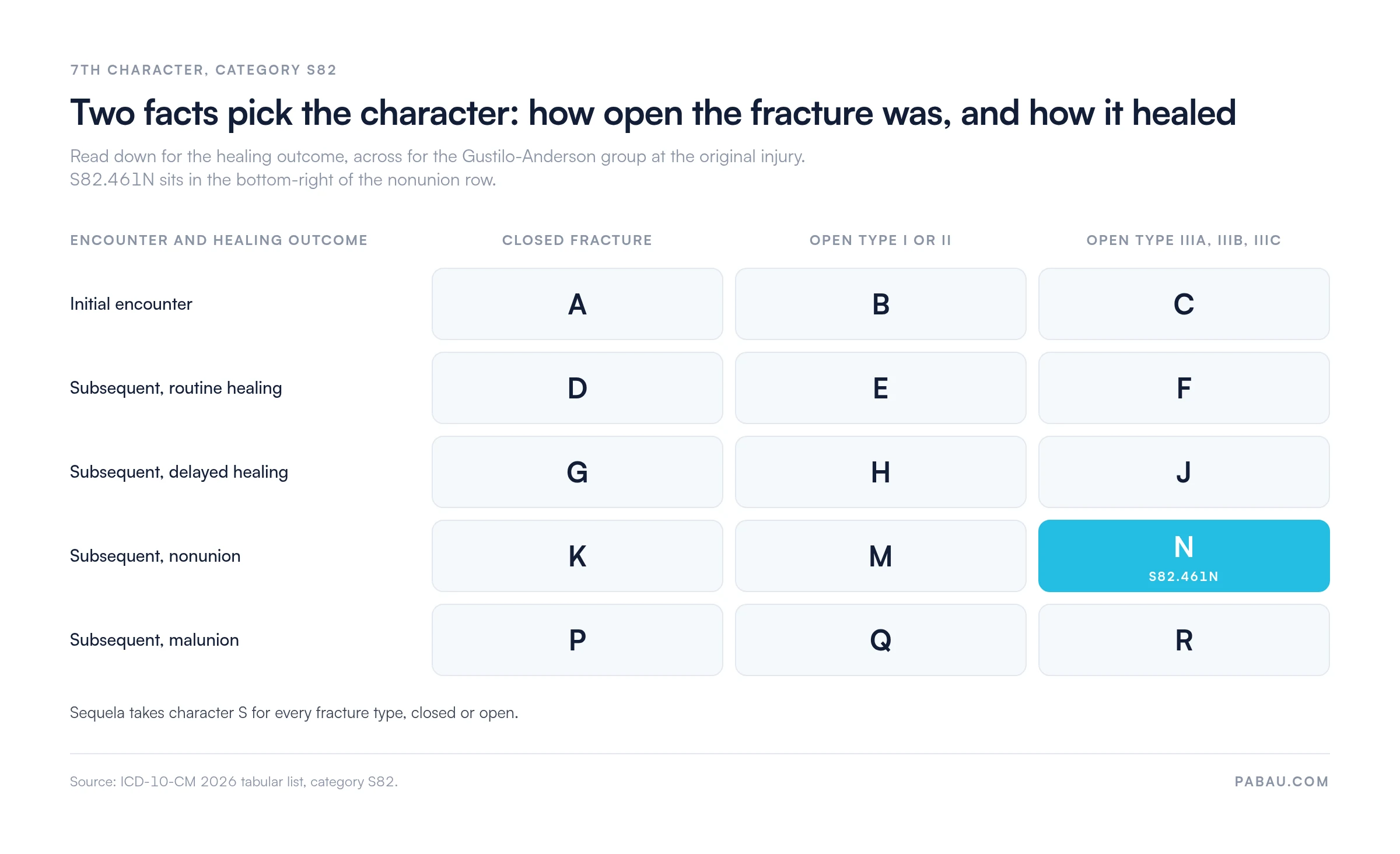
Two facts pick it. The first is the Gustilo group recorded at the original injury, and the second is how the fracture has healed since. The grid below pairs them.
Reading across the nonunion row shows why openness has to be settled first, since K, M, and N all mean nonunion. Characters as published in the ICD-10-CM 2026 tabular list.
Here is the same set as a list, with the sequela character included.
7th Character
Encounter / Healing Status
Fracture Type
A
Initial encounter
Closed fracture
B
Initial encounter
Open fracture type I or II
C
Initial encounter
Open fracture type IIIA, IIIB, or IIIC
D
Subsequent encounter, routine healing
Closed fracture
E
Subsequent encounter, routine healing
Open fracture type I or II
F
Subsequent encounter, routine healing
Open fracture type IIIA, IIIB, or IIIC
G
Subsequent encounter, delayed healing
Closed fracture
H
Subsequent encounter, delayed healing
Open fracture type I or II
J
Subsequent encounter, delayed healing
Open fracture type IIIA, IIIB, or IIIC
K
Subsequent encounter, nonunion
Closed fracture
M
Subsequent encounter, nonunion
Open fracture type I or II
N
Subsequent encounter, nonunion
Open fracture type IIIA, IIIB, or IIIC
P
Subsequent encounter, malunion
Closed fracture
Q
Subsequent encounter, malunion
Open fracture type I or II
R
Subsequent encounter, malunion
Open fracture type IIIA, IIIB, or IIIC
S
Sequela
All types
Character N is one of three nonunion characters. K covers a closed fracture, M an open type I or II, and N an open type IIIA, IIIB, or IIIC.
So the original injury decides the character, not the visit in front of you. Reporting K on a fracture the index admission documented as open is the error auditors look for.
Gustilo type at the injury decides your character group
ICD-10-CM borrows the Gustilo-Anderson classification wholesale. The type recorded at the original injury fixes which characters stay available to you, and that decision follows the patient through every later encounter.
C (initial), F (routine), J (delayed), N (nonunion), R (malunion)
Type IIIB
Extensive periosteal stripping; bone exposed; requires local or free flap coverage
Type IIIC
Associated arterial injury requiring vascular repair for limb salvage
Notice that the 7th character does not separate IIIA, IIIB, and IIIC. All three take C at the initial encounter, then F, J, N, or R once healing declares itself.
The subtype still matters clinically and in the operative note. For the diagnosis code, though, the three behave as one group.
Nonunion is not slow healing, and payers know the difference
Three healing outcomes, three sets of characters. Mixing them up is the most common error on subsequent-encounter fracture claims, and it is easy to do when the note hedges.
Healing Outcome
Clinical Definition
7th Character (Open IIIA/B/C)
7th Character (Closed)
Routine healing
Expected progression toward union, with no complication
F
D
Delayed union
Healing is slower than expected but still moving. Union remains possible without surgery.
J
G
Nonunion
Healing has ceased and the fracture will not unite without surgery. Imaging shows no bridging callus after an adequate period.
N
K
Malunion
The fracture has healed in an unacceptable position, with angular, rotational, or length deformity
R
P
Nonunion is a clinical diagnosis, not a radiology finding. The treating physician has to state that healing has stopped, with serial imaging behind the statement.
One study showing no callus will not carry it alone. Without that diagnosis in the record, S82.461N is a code the chart cannot defend.
Delayed union means healing still moves toward union, so J replaces N as the 7th character. Change the pattern to spiral on the same right fibula shaft and the open type III delayed healing code is S82.441J.
Malunion sits in the same subsequent-encounter phase but takes a different character. Stay with open type III and the malunion code is S82.461R. Character P belongs to closed fractures, so a nondisplaced oblique right fibula shaft that united in a malaligned position is S82.434P.
Pro Tip
Open the initial encounter documentation before you pick the character. A nonunion claim built on N is auditable. Payers do ask for the index admission records, to check the fracture was open and graded type IIIA, IIIB, or IIIC.
Walk the hierarchy and the code assembles itself
S82.461N is built from the top down, one character at a time. Reading the chain in order is the quickest way to confirm you are in the right subcategory before you commit to a 7th character.
S00-T88: injury, poisoning and certain other consequences of external causes
S80-S89: injuries to the knee and lower leg
S82: fracture of lower leg, including ankle
S82.4: fracture of shaft of fibula
S82.46: segmental fracture of shaft of fibula
S82.461: displaced segmental fracture of shaft of fibula, right leg
S82.461N: subsequent encounter, open fracture type IIIA, IIIB, or IIIC, nonunion
The sibling codes you will reach for next
S82.461 carries the whole encounter and healing series for one leg and one fracture pattern. The codes below are the ones coders genuinely confuse with N, either because the encounter changed or because the side was never documented.
Code
Description
S82.461A
Displaced segmental fracture of shaft of fibula, right leg, initial encounter for closed fracture
S82.461B
Displaced segmental fracture of shaft of fibula, right leg, initial encounter for open fracture type I or II
S82.461C
Displaced segmental fracture of shaft of fibula, right leg, initial encounter for open fracture type IIIA, IIIB, or IIIC
S82.461F
Displaced segmental fracture of shaft of fibula, right leg, subsequent encounter for open fracture type IIIA, IIIB, or IIIC with routine healing
S82.461J
Displaced segmental fracture of shaft of fibula, right leg, subsequent encounter for open fracture type IIIA, IIIB, or IIIC with delayed healing
S82.461N
Displaced segmental fracture of shaft of fibula, right leg, subsequent encounter for open fracture type IIIA, IIIB, or IIIC with nonunion
S82.461R
Displaced segmental fracture of shaft of fibula, right leg, subsequent encounter for open fracture type IIIA, IIIB, or IIIC with malunion
S82.462N
Displaced segmental fracture of shaft of fibula, left leg, subsequent encounter for open fracture type IIIA, IIIB, or IIIC with nonunion
S82.463N
Displaced segmental fracture of shaft of fibula, unspecified leg, subsequent encounter for open fracture type IIIA, IIIB, or IIIC with nonunion
Nondisplaced patterns run in parallel at S82.464 through S82.466, and the rest of the fibula sits outside S82.4 altogether. Our wider diagnostic code library is the place to pick up the neighboring categories.
What the record must say before you bill S82.461N
Six facts have to be in the chart. Miss one and the code can be perfectly chosen while the claim stays unsupportable.
Laterality confirmed as right leg: the operative note, the imaging report, or the encounter note names the right fibula or the right lower leg.
Segmental and displaced pattern: radiology and operative notes describe two fracture lines with a free fragment, and record the displacement.
Gustilo type IIIA, IIIB, or IIIC at the original injury: the index admission note or operative report grades the wound. If it only says “open fracture”, you cannot assign character N.
Encounter classified as subsequent: the visit is continuing management after definitive treatment. Emergency care for the original injury takes an initial character, which for this injury is C.
Nonunion diagnosed by the treating physician: the note diagnoses nonunion rather than noting slow healing. Serial imaging findings and a statement that the fracture will not unite without intervention are what support it.
External cause code where it applies: add a code from the V, W, X, or Y chapter to identify the mechanism. That matters most on work and transport injuries.
Templates help more than reminders do. An encounter note that prompts for Gustilo type and healing status at every visit does the work upfront. The chart is then complete before it reaches coding.
Coding rules, exclusions, and sequencing
S82.461N is a billable, specific code, valid for HIPAA-covered electronic transactions under the 2026 edition that took effect on October 1, 2025.
The CMS ICD-10 codes page is the primary reference. Five rules govern how the code behaves from there.
Exclusion notes do apply: S82.4 carries an Excludes1 note for traumatic amputation of the lower leg (S88.-). Its Excludes2 notes cover fracture of the foot except the ankle (S92.-) and periprosthetic fracture (M97.1- and M97.2-). Read them before you pair S82.461N with a companion diagnosis.
Use an additional code for external cause: the Official Guidelines invite an external cause code from V00-Y99 to show how the injury happened. The instruction is not mandatory, though some payer contracts require it on trauma claims.
Sequencing: S82.461N usually sits as the principal or primary diagnosis when the encounter is about nonunion management. Companion codes for vascular complications or infection follow the sequencing rules published by CMS and the CDC ICD-10-CM web tool.
Payer-specific coverage: local coverage determinations can limit which procedure codes a payer accepts next to a nonunion diagnosis. Check them before you bill revision surgery or bone grafting.
Code history: S82.461N has been billable across several ICD-10-CM editions, and the 2026 cycle brought no change to it. You can confirm current validity in the AAPC code lookup.
Before you submit: Where the S82.461N claim stalls
The code is only the first stop. From the encounter note it moves onto the superbill, where it sits beside the procedure code. From there it leaves on the 837P claim file, gets screened by a clearinghouse, and meets the payer’s own edits.
Two of those stops reject on specificity rather than on medicine. A clearinghouse will catch an invalid character combination before the payer ever sees the claim. Payer edits are the harder ones, because a valid code can still fail a coverage rule attached to nonunion surgery.
Run this check before you submit
Open the index admission record and confirm it grades the wound as Gustilo type III.
Confirm the current note carries a nonunion diagnosis, not a comment about slow healing.
Confirm the side. Right leg is the 1 in S82.461, and an undocumented side sends you to S82.463N.
Confirm the encounter is subsequent, so the character is N rather than C.
Check the payer’s coverage rules for the procedure you are billing alongside the diagnosis.
Three mistakes that get S82.461N denied
Reporting K because the note says nonunion and nobody checked whether the fracture was open.
Carrying character C forward from the initial encounter into a follow-up visit.
Sending nondisplaced S82.464N after the operative note describes displaced fragments.
Fracture codes do get rejected. A repeatable denial management workflow tells you whether the problem was the Gustilo documentation, the 7th character, or the payer’s coverage rule.
How Pabau keeps the code attached to the record behind it
A nonunion case usually crosses three systems. The note lives in the chart, the diagnosis gets keyed into a billing screen, and the claim leaves from a third tool. Every hand-off is another chance to type S82.462N when the chart says right leg.
Practice management software like Pabau keeps those steps on one record. The diagnosis code attaches to the treatment note, the invoice builds from the same record, and the claim goes out electronically through an integrated clearinghouse. Remittances and rejections land back in the same place.
The payoff for a billing team is narrow and repeatable. Nobody retypes a seven-character code, and the note supporting it sits one click from the claim. That is the point of connected claims management on cases that run across several encounters.
Pabau builds the invoice from the same record as the treatment note, so the diagnosis code follows the visit onto the claim.
Keep the code and the claim on one record
Pabau links the diagnosis code to the treatment note, then sends the claim from that same record. Fewer hand-offs mean fewer retyped characters on complex fracture claims.
S82.461N is a narrow code, and the narrowness is the point. It says right leg, segmental, displaced, open type III at the injury, and no union at this visit. If the chart cannot show all five, this is not the code to send.
So the habit worth building is small. Check the index admission before you pick the character, because that one look settles the closed-or-open question. It is where most nonunion claims lose their specificity.
Pabau keeps that record and the claim in one place, so the code a clinician documented is the code that goes out. Book a demo to see how a nonunion claim travels from note to payer without a retype.
Continue your research
Need a structured approach to fracture billing denials?Denial codes in medical billing covers the most common rejection reasons for orthopedic and injury claims.
Managing revenue cycle for a multi-provider orthopedic practice?What is revenue cycle management explains how to structure billing workflows from charge capture to payment posting.
Looking for clearinghouse options for US claims submission?Claim.MD vs Office Ally compares two major US clearinghouses on cost, payer network, and real-time eligibility.
Frequently asked questions
Can I use an aftercare Z code instead of S82.461N at a follow-up visit?
No. ICD-10-CM handles injury follow-up with the injury code plus a subsequent-encounter 7th character, so S82.461N stays on the claim. Aftercare Z codes cover situations such as joint replacement or chemotherapy, not fracture care.
Does a new surgeon taking over the case reset the encounter to initial?
No. The character reflects the phase of treatment, not who delivers it. A surgeon meeting the patient for the first time after definitive treatment still reports a subsequent encounter, so N remains correct.
How long after the injury can nonunion be coded?
ICD-10-CM sets no waiting period. The physician decides when healing has stopped, usually from serial imaging taken over several months. Assign N from the date that diagnosis appears in the record, not from a fixed interval.
What if the record says open fracture but never gives a Gustilo type?
Assign the type I or II character, which makes nonunion S82.461M rather than N. The Official Guidelines set that default when the type is undocumented. Query the surgeon if the wound description suggests a type III injury.