ICD-10 Code S53.013D: Anterior subluxation of unspecified radial head
ICD-10 Code S53.013D: Quick reference summary Use the table below as your first ...

Last Updated: Nov 6, 2026
Billable Code Specific Code
S82.113P is the billable ICD-10-CM code for displaced fracture of unspecified tibial spine, subsequent encounter for closed fracture with malunion. It applies when a closed, displaced tibial spine fracture has healed out of position and the record does not state which knee is affected.
The tibial spine, or intercondylar eminence, is the ridge between the two tibial plateaus at the top of the shinbone. The 7th character P marks a follow-up visit for a closed fracture that healed with malunion. When the chart names the right or left knee, S82.111P or S82.112P is the more specific code.
Let Pabau's smart automation suggest the right codes, reduce claim denials, and keep your practice compliant—effortlessly.
Automate repetitive tasks and focus on what matters most—your patients.
Reduce coding errors and ensure compliance with the latest regulations.
Clean claims, fewer denials, and faster reimbursements.
Powerful insights and reporting to help your practice thrive.
HIPAA compliant SOC 2 certified GDPR-compliant Trusted by 4,000+ clinics worldwide

S82.113P codes a follow-up visit for a closed, displaced tibial spine fracture that healed with malunion, where the record does not name the knee.
When the chart names the side, use S82.111P for the right knee or S82.112P for the left, since unspecified laterality invites payer review.
The 7th character P means a closed fracture that healed with malunion. Nonunion takes K, and open fractures with malunion take Q or R.
A malunion code needs an explicit provider statement of malunion plus imaging that shows the malalignment.
Claims software such as Pabau keeps the note, the imaging report and the claim in one record. Side and healing status get checked before submission.
ICD-10 code S82.113P identifies a subsequent encounter for a closed, displaced fracture of the tibial spine that has healed with malunion. It applies when the record does not state which knee is affected. The table below captures the facts a coder needs before submitting a claim, taken from the current ICD-10-CM tabular list.
S82.113P describes a follow-up visit for a patient whose displaced tibial spine fracture has healed out of position. The original fracture was closed, and the record does not say which knee was injured. Each element of the descriptor carries coding weight, so changing any one of them changes the code.
The tibial spine, also called the intercondylar eminence, is the raised ridge between the medial and lateral tibial plateaus at the top of the shinbone. The anterior cruciate ligament attaches just in front of it, so many tibial spine fractures are avulsion injuries. They are most common in children and adolescents.
A fragment that heals out of position can block full knee extension or leave the ligament lax. That clinical picture is what usually brings the patient back for the visit S82.113P describes.
Displaced status and unspecified side are where a thin chart lands by default. ICD-10-CM guidelines code a fracture as displaced when the record does not say either way. An unspecified side is what remains when laterality is missing. Before you accept S82.113P, confirm that both elements reflect the record rather than an omission.
The path below shows how displacement, side and healing status narrow the S82.11 group down to a single code.
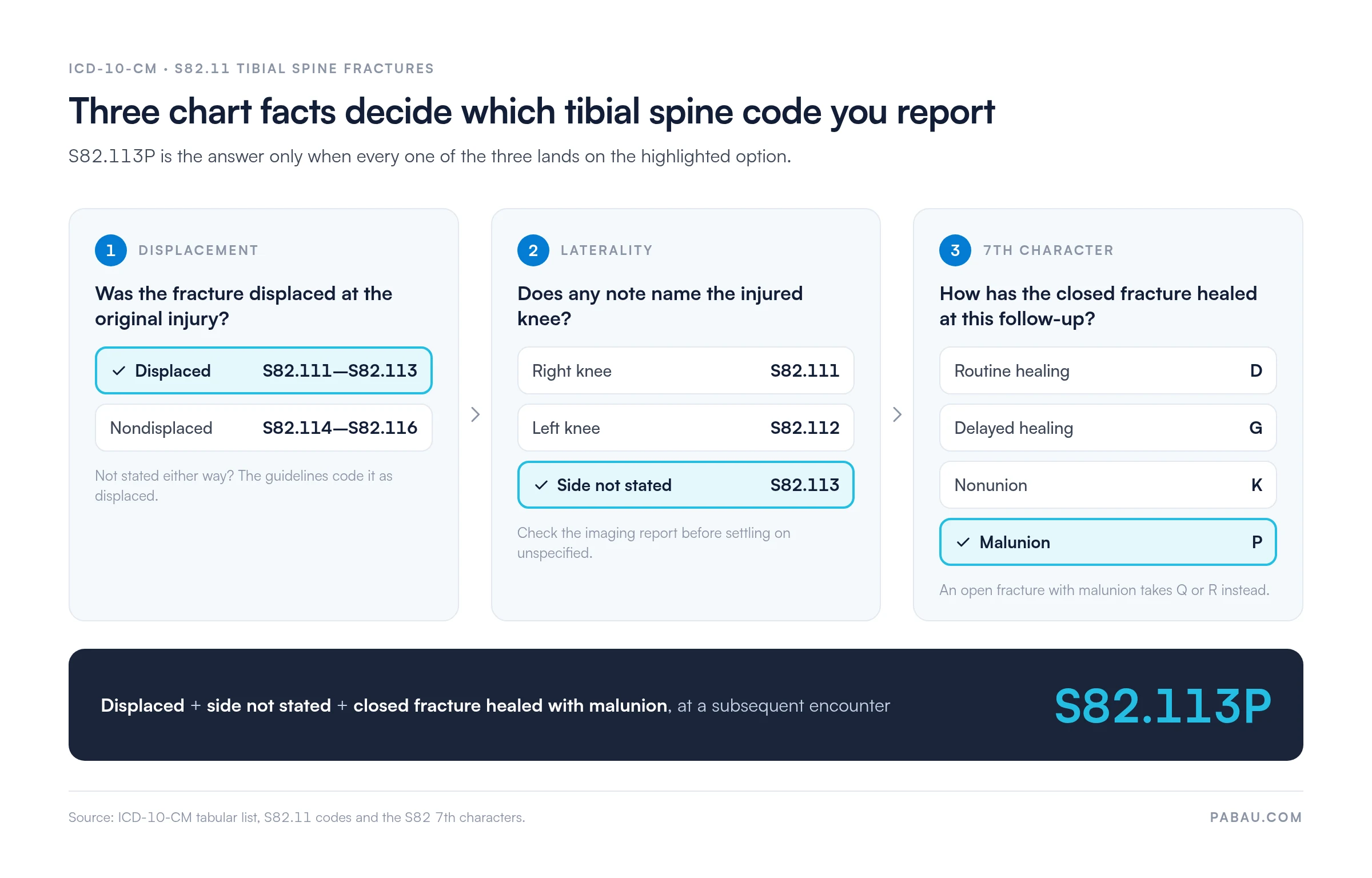
The 7th character on S82.113 sets the encounter type, whether the fracture was open or closed, and the healing status. Lower leg fracture codes use the full set of 16 characters below. Open fractures get separate values for types I or II and types IIIA, IIIB, or IIIC.
ICD-10-CM guidelines report malunion and nonunion through these 7th characters rather than a separate complication code. That is why a malunion follow-up takes P, not S. If the original fracture was open, the malunion character becomes Q or R instead.
The P, K, G, and D characters are not interchangeable. Each reflects a clinically distinct healing state, and the medical record must support it with imaging before a coder can select it.
The open-fracture equivalents follow the same logic. Routine healing takes E or F, delayed healing H or J, nonunion M or N, and malunion Q or R.
A key distinction: Malunion means the fracture has healed, but badly. Nonunion means it has not healed at all. Coders who blur the two select the wrong 7th character, and the resulting denial often needs an amended medical record to correct.
Query the treating physician before assigning P or K on a subsequent encounter. If the radiology report describes angulation but the physician’s note never says ‘malunion,’ the record does not yet support the P character. The physician must diagnose malunion explicitly. Imaging alone does not establish the code.
Laterality, displacement status, anatomical site, and healing status each produce a distinct code. The table below lists the neighbors most often confused with ICD-10 code S82.113P and the distinction that separates each one.
Payers reviewing claims coded with S82.113P look for specific elements in the medical record. That includes Medicare Administrative Contractors and commercial plans. Medical billing compliance for subsequent fracture encounters requires every element below to be chart-ready before submission.
Medicare and commercial payers handle S82.113P claims differently, but both treat the documentation checklist above as a baseline. Clean claim submissions for subsequent fracture encounters with malunion depend on checking payer-specific coverage rules before the claim goes out.
For US practices, Pabau sends electronic claims through Claim.MD, with eligibility checks, ERA processing and secondary claims. That matters on subsequent encounter claims where Medicare and a supplemental plan coordinate benefits.
Denials on ICD-10 code S82.113P cluster around five error types. Knowing each one helps practices build denial management workflows that catch them before submission. The medical billing denial codes most often seen on these rejections are CO-11, CO-16 and CO-50.
CO-11 means the diagnosis is inconsistent with the procedure. CO-16 flags missing or incorrect information, and CO-50 means medical necessity was not established.
Accurate coding of S82.113P depends on the front desk, the clinical team, and billing staff working from the same record. These habits cut the documentation errors behind most P-character denials in orthopedic and physical therapy billing workflows.
S82.113P sits within a structured hierarchy in ICD-10-CM Chapter 19. Knowing where it fits helps coders move between adjacent codes without picking the wrong level of specificity. For a broader grounding in how fracture coding feeds claim submission, see these medical billing fundamentals.
The S82.11 group holds six base codes. S82.111, S82.112 and S82.113 are displaced fractures of the right, left and unspecified tibial spine. S82.114, S82.115 and S82.116 are the nondisplaced versions in the same order.
In many practices, the coder reads a follow-up note, opens the imaging report separately, and picks the 7th character from both. Side, displacement and healing status can each sit in a different document. When one is missing, the claim drifts to an unspecified code or goes out with the wrong character.
Pabau, the practice management platform we build, keeps the clinical note, the uploaded imaging report and the claim in one patient record. Custom clinical forms can prompt for laterality, displacement and healing status at the follow-up visit. The coder then reads the answer from the record instead of reconstructing it.
The outcome is fewer claims that need an amended record before resubmission. The payer sees a malunion code backed by a provider statement and an imaging finding from the same episode of care.

Pabau keeps the follow-up note, the imaging report and the claim in one patient record. Coders confirm side and healing status before a malunion claim goes out.

S82.113P is a narrow code, and on many claims it should not be the final answer. It is correct only when a displaced tibial spine fracture has healed out of position and the side cannot be established. Where the chart names the knee, S82.111P or S82.112P gives payers the specificity they expect.
The 7th character deserves the same scrutiny. P needs a closed fracture, an explicit malunion statement and imaging that shows the malalignment. If any of the three is missing, query the provider before the claim goes out rather than defending it after a denial.
To see how Pabau keeps fracture notes, imaging reports and claims in one record, book a demo.

Need a framework for managing fracture claim denials systematically? Denial management in healthcare covers the end-to-end process for tracking, appealing, and preventing musculoskeletal claim rejections.
Looking for guidance on clean claim submission for subsequent encounters? Clean claim submission best practices outlines what payers require before accepting a claim without correction.
Want to understand how the clearinghouse fits into your billing workflow? Medical claims clearinghouse guide explains how EDI routing, eligibility checks, and ERA processing work together for US practices.
ICD-10 code S82.113P is the billable diagnosis code for a displaced fracture of unspecified tibial spine, subsequent encounter for closed fracture with malunion. It applies when a closed tibial spine fracture has healed out of position and the record does not name the knee.
Yes, S82.113P is a billable, specific ICD-10-CM code that can go on a claim as written. It carries the fracture site, displacement status, laterality, encounter type and healing status. Verify its active status each October against the current tabular list.
Malunion means the fracture has healed in an abnormal position or angulation, coded with P for a closed fracture. Nonunion means the fragments have failed to unite, coded with K for a closed fracture. Both need an explicit physician diagnosis and supporting imaging in the record.
Use P for a closed fracture that healed with malunion and Q for an open type I or II fracture with malunion. Use K for a closed fracture with nonunion and G for a closed fracture with delayed healing. P and K are the pair most often confused, because P means healed badly and K means not healed.
The record needs an explicit physician diagnosis of malunion and imaging that shows malalignment at the tibial spine. It must also establish that the original fracture was displaced and closed, and that this is a subsequent encounter. If any note names the knee, code S82.111P or S82.112P instead.
The usual triggers are the wrong 7th character, an initial encounter character on a follow-up visit, and missing imaging of the malalignment. Unspecified laterality when the chart names the knee is another. So is pairing S82.113P with a CPT code for acute fracture care.
Medicare generally covers medically necessary subsequent fracture visits when the record supports the malunion diagnosis and the treatment plan fits it. Medicare Administrative Contractors can apply their own local coverage policies to documentation and imaging. Check your MAC’s policies before submitting.