ICD-10 Code S42.444P: Medial epicondyle fracture, right humerus
ICD-10 Code S42.444P: full descriptor and code validity ICD-10 Code S42.444P car...

Last Updated: Oct 13, 2026
Billable Code Specific Code
S79.001G is the billable ICD-10-CM code for unspecified physeal fracture of upper end of right femur, subsequent encounter for fracture with delayed healing.
S79.001A, S79.001D, and S79.001K describe the same injury at different points in its course.
The 2026 edition of ICD-10-CM S79.001G became effective on October 1, 2025, under CMS ICD-10-CM coding guidelines. It falls within the S79 block covering other and unspecified injuries of the hip and thigh. It is the only code in its family that pairs right-sided, unspecified proximal femur physeal injury with documented delayed healing.
Let Pabau's smart automation suggest the right codes, reduce claim denials, and keep your practice compliant—effortlessly.
Automate repetitive tasks and focus on what matters most—your patients.
Reduce coding errors and ensure compliance with the latest regulations.
Clean claims, fewer denials, and faster reimbursements.
Powerful insights and reporting to help your practice thrive.
HIPAA compliant SOC 2 certified GDPR-compliant Trusted by 4,000+ clinics worldwide

S79.001G is the billable FY2026 code for an unspecified physeal fracture of the upper end of the right femur, subsequent encounter with delayed healing.
Seventh character G means delayed healing. The nonunion code for the same injury is S79.001K, and malunion is S79.001P.
G applies when the physician documents that the fracture is uniting more slowly than expected but has not declared a nonunion.
Coders frequently misassign the initial encounter character A on follow-up visits, a documentation error that triggers claim rejections and audit flags.
Practice management software like Pabau validates ICD-10 codes against the current code set and submits claims through the Claim.MD clearinghouse.
Before reviewing documentation requirements or sibling codes, confirm the core attributes of S79.001G. Each field below has billing implications.
Practices managing orthopedic billing at scale can verify code validity through the CDC/NCHS ICD-10-CM web tool before each submission. Routing the code through medical claims management software adds a check against the current code set. That catches a retired or wrongly sequenced code before it reaches the payer.

Each word in the long description carries clinical and billing weight. Misread one and the code shifts to a different encounter type or anatomical site.
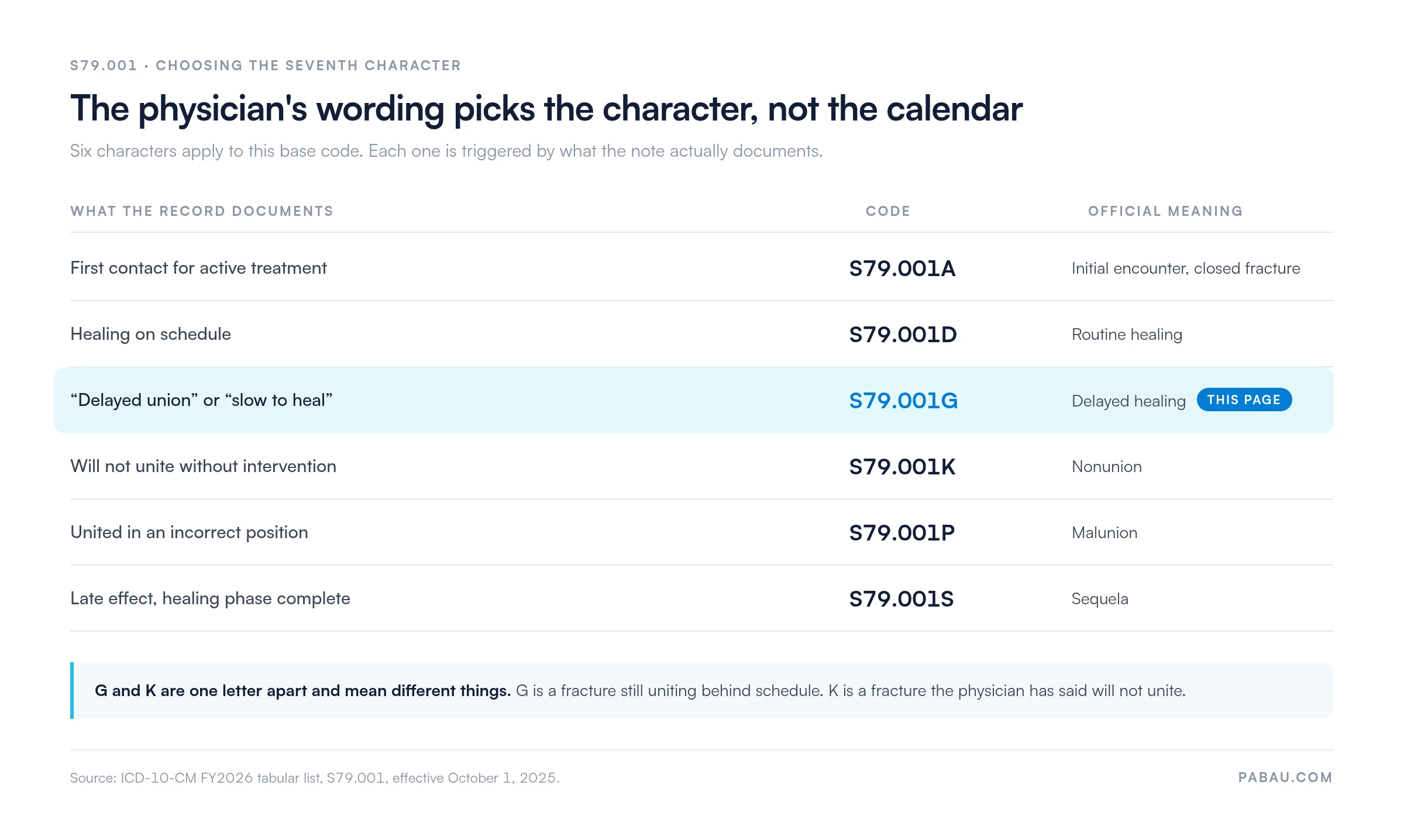
The seventh character is the most frequently miscoded element in the S79.001 family, and G is the one coders most often get wrong. G means delayed healing, and nonunion is character K instead. The table below shows all six applicable characters for this base code, plus when to select each one.
The practical distinction between D, G, and K is physician documentation, not time elapsed. A follow-up visit six months post-injury may still warrant D if the physician documents normal healing progression. The shift to G requires wording such as “delayed union” or “slow to heal,” and the shift to K requires an explicit nonunion determination. Coding G when the record documents nonunion, or K when it only notes slow progress, means the claim no longer matches the medical record.
The map below runs the same logic in the direction a coder works, from the phrase in the note to the character it supports.
S79.001G sits within a defined hierarchical path. Reading that path helps coders cross-check a selection against the tabular list structure before the code goes on a claim.
Each level of the hierarchy narrows the clinical picture. The path runs from general injury to hip region, then physeal injury, upper end, unspecified type, right side, and finally healing status. Coders using the AAPC Codify ICD-10-CM lookup can navigate this path directly to confirm the full tabular list description before submitting.
Three axes differentiate the codes around S79.001G: healing status in the seventh character, laterality in the sixth, and fracture type in the fourth and fifth. The table below covers the adjacent codes coders reach for most often.
One structural point trips coders up here. The upper end of the femur has no Salter-Harris Type II, III, or IV codes. Those exist only at the lower end, under S79.12-, S79.13-, and S79.14-. A typed injury at that site takes a code such as S79.141A. At the proximal physis your only typed options are Salter-Harris Type I (S79.011G) and “other” (S79.091G). S79.001G covers the encounters where the record leaves the type unspecified.
Physeal fractures at the proximal femur occur at the growth plate, the cartilaginous zone between the epiphysis and metaphysis where longitudinal bone growth originates. This structure is present in skeletally immature patients and closes progressively through adolescence.
In growing patients, the physis is mechanically weaker than the surrounding ligamentous structures. High-energy trauma can therefore produce growth plate disruption rather than ligament tears, a pattern that rarely presents in adults whose physes have fused.
Proximal femur physeal injuries can affect multiple anatomical zones: the capital femoral epiphysis, the greater trochanteric apophysis, and the lesser trochanteric apophysis. Slipped capital femoral epiphysis (SCFE) is a distinct but related condition coded separately under the M93 family rather than S79.
The proximal femur also has a precarious blood supply, which is part of why healing here can stall. That vascular risk matters for coding. A delayed healing encounter at this site tends to generate more imaging and closer follow-up than the same character would elsewhere. Expect the record to carry repeat radiographs, and expect the payer to read them.
When a patient presents with a suspected physeal injury at the proximal femur, check whether the treating physician specifies a fracture type based on imaging. If a Salter-Harris Type I is documented, use S79.011G; if another pattern is named, use S79.091G. Reserve S79.001G for encounters where the fracture type is genuinely unspecified.
This is the distinction the whole code turns on, and it is where most S79.001G errors start. Delayed healing means the fracture is still uniting, just behind schedule. Nonunion means the physician has concluded that the fracture will not unite without intervention. The first is a timing judgment; the second is a prognosis.
The ICD-10-CM Official Guidelines set no fixed timeframe for either determination. Both rest on physician judgment supported by clinical and radiographic findings, which makes the medical record the decisive factor in code selection. Four healing outcomes map to distinct seventh characters:
The shift from D to G is a billing event as much as a clinical one. It can trigger a different coverage review, different authorizations, and different decision trees in the payer’s adjudication logic. Read the assessment first, then pick the character it supports.
Supporting S79.001G at audit requires specific documentation elements. Missing any one of them creates a claim that can be denied or downcoded during medical record review.
Five errors account for most denials on this code. Each one is visible in the note before the claim goes out.
Each of these errors leaves a trail that payers pick up on routine review. Checking the rejection against a reference of denial codes shows which single-character mistake triggered the edit. On a code this specific, one wrong letter is enough.
The table below identifies the procedural codes most commonly reported alongside S79.001G in orthopedic and pediatric surgical encounters. Any CPT-ICD pairing should be validated by a certified coder against current AMA CPT descriptors and payer LCD policies before submission.
CPT codes 27516, 27517, and 27519 all carry distal femur descriptors in their official AMA language. Confirm with a certified orthopedic coder whether they apply to the proximal site in your clinical scenario. Stalled-healing cases usually need pre-authorization for the surgical CPT code paired with S79.001G. Payer medical necessity criteria vary by plan, so settle them before the case is scheduled.
Coders locate S79.001G through the ICD-10-CM alphabetical index using several entry paths. Knowing the synonyms helps when the clinical documentation uses terminology that differs from the tabular list description.
The ICD10Data listing for the S79.0 category shows every valid code in the family side by side. That is the fastest way to confirm a seventh character before submission. Practices handling a high volume of pediatric orthopedic encounters can also cross-reference synonyms against the ResDAC ICD codes guidance. It explains how these codes appear in Medicare claims data and research datasets.
Build your superbill or charge capture template to include the full S79.001 family with all six seventh characters spelled out in words, not just letters. A picklist that reads “G – delayed healing” and “K – nonunion” stops the single most expensive error on this code from ever reaching the claim.
In most orthopedic practices, a coder chooses the seventh character while reading a progress note days after the visit. It is then typed by hand into a claim form. No step in that chain checks the letter against what the physician actually wrote. The delayed healing and nonunion codes differ by one character, so the error survives all the way to the payer.
Practice management software like Pabau removes that hand-off. Codes are stored against the encounter rather than re-keyed per claim. The value the clinician selected in the note is the one that reaches the payer. Built-in ICD-10 validation checks each code against the current code set before submission. That catches invalid combinations, such as a Salter-Harris Type II code at the upper end of the femur.
Pabau also connects to the Claim.MD clearinghouse for real-time eligibility verification and clean electronic submission. Code validation sits inside the billing workflow rather than at the end of it. For orthopedic and sports medicine teams, that turns a manual review step into a check running on every claim.

Pabau integrates with Claim.MD to validate ICD-10 codes, run real-time eligibility checks, and submit clean claims electronically. See how orthopedic and physical therapy practices reduce denials on complex encounter codes.

S79.001G is a narrow code with one job. It reports a follow-up encounter for a right proximal femur growth plate fracture that is healing more slowly than expected. Delayed healing is what the G stands for. If the physician has declared the fracture a nonunion, the code is S79.001K, and if it has united in a bad position, it is S79.001P.
Laterality, the physeal location, the encounter status, and the healing status all have to appear in the medical record. Otherwise the code will not survive audit. Getting the seventh character wrong on a follow-up claim is the single most common error in this code family. It is also entirely preventable with clear documentation protocols.
Is your practice managing complex fracture follow-up billing? Book a demo to see how Pabau builds code validation into the submission process, rather than bolting it on as a manual check.

Need to see how a coded claim reaches the payer? Claim.MD clearinghouse covers how electronic claims are validated and routed to payers.
Unsure what documentation an auditor will want? Medical billing compliance sets out the standards that support high-specificity codes at audit.
Coding a different right hip injury on a follow-up visit? ICD-10 code S79.911D covers the unspecified right hip injury, subsequent encounter.
Want fewer rejections on first submission? Clean claim explains what a payer accepts without raising an edit.
S79.001G is a billable ICD-10-CM code. It means unspecified physeal fracture of the upper end of the right femur, subsequent encounter for fracture with delayed healing. It identifies a follow-up visit where the treating physician has documented that a right proximal femur growth plate fracture is uniting more slowly than expected.
No. In ICD-10-CM, G means subsequent encounter for fracture with delayed healing, and seventh character K means nonunion. For this injury the nonunion code is S79.001K, so G and K differ by one character.
Yes. S79.001G is a billable and specific ICD-10-CM code valid for FY2026, effective October 1, 2025. It can be used as a primary or secondary diagnosis code for reimbursement purposes when supported by appropriate clinical documentation.
All three codes describe the same base injury: an unspecified physeal fracture of the upper end of the right femur. They differ only in encounter type. A is the initial encounter for the closed fracture. D is a subsequent encounter while the fracture heals on schedule. G is a subsequent encounter where healing is documented as delayed.
It means the patient is returning for a follow-up visit rather than the first treatment contact. The physician has documented that union is taking longer than expected. The fracture is still expected to heal. ICD-10-CM sets no fixed time period, so delayed healing is a clinical determination based on physician assessment and radiographic findings.
Use G when the physician documents that healing is behind schedule but still anticipated. Use D when the fracture is healing normally. Use K when the physician has declared a nonunion. Time elapsed alone does not determine the seventh character. Physician documentation does.
No. ICD-10-CM provides only three type options at the upper end of the femur: unspecified (S79.00-), Salter-Harris Type I (S79.01-), and other (S79.09-). Salter-Harris Types II, III, and IV exist only at the lower end of the femur, under S79.12-, S79.13-, and S79.14-.
Commonly paired CPT codes include 27519, open treatment of distal femoral epiphyseal separation, and 27244, intertrochanteric or subtrochanteric fixation. Bone grafting is reported with 20902. CPT-ICD pairing should always be verified by a certified coder against current AMA CPT descriptors and payer LCD policies before submission.