ICD-10 Code S42.444P: Medial epicondyle fracture, right humerus
ICD-10 Code S42.444P: full descriptor and code validity ICD-10 Code S42.444P car...

Last Updated: Oct 13, 2026
Billable Code Specific Code
S75.909A is the billable ICD-10-CM code for unspecified injury of unspecified blood vessel at hip and thigh level, unspecified leg, initial encounter.
Vascular trauma notes often land before the imaging does, so the vessel and the side sit blank while the billing clock runs. That is the moment coders reach for this code.
Drop that 7th character and the claim comes back unpaid, which is why the suffix rules matter more here than the anatomy.
Let Pabau's smart automation suggest the right codes, reduce claim denials, and keep your practice compliant—effortlessly.
Automate repetitive tasks and focus on what matters most—your patients.
Reduce coding errors and ensure compliance with the latest regulations.
Clean claims, fewer denials, and faster reimbursements.
Powerful insights and reporting to help your practice thrive.
HIPAA compliant SOC 2 certified GDPR-compliant Trusted by 4,000+ clinics worldwide

S75.909A is a billable ICD-10 code for an unspecified blood vessel injury at hip and thigh level, unspecified leg, initial encounter.
The 7th character carries the phase of care, with A for active treatment, D for healing, and S for a late effect.
S75.909 on its own is not a valid code, so a claim missing the 7th character comes back rejected.
Use S75.909A only when the vessel, the injury type, and the leg are all absent from the record.
Practice management software like Pabau keeps all seven characters attached to the note they came from.
The official description reads unspecified injury of unspecified blood vessel at hip and thigh level, unspecified leg, initial encounter. Three separate details are missing from that one line. The injury type is unspecified, the vessel is unspecified, and the leg is unspecified.
Each blank reflects what the record does not say, so the moment one of them is documented, a more precise code takes priority. A note reading “laceration of the femoral artery, right leg” has no business being coded here.
The code is valid on HIPAA-covered electronic transactions, including Medicare Part A and Part B, Medicaid, and commercial payer claims. It sits in Chapter 19 of ICD-10-CM (S00-T88), under category S75, injury of blood vessels at hip and thigh level.
According to CMS ICD-10-CM guidance, complete and correct code assignment is required on every one of those transactions.
Where the nerve rather than the vessel took the damage, the claim moves to category S74. A right-leg sciatic nerve injury at an initial encounter is S74.01XA.
The table below holds the attributes worth confirming before the claim leaves your system.
The 7th character records where the patient sits in the course of treatment, not how many times they have been seen. Get it wrong and the claim is wrong, even when the first six characters are perfect.
Three extensions are valid on this code.
A against D. Initial encounter does not mean the patient’s first visit anywhere. It means this encounter is part of active treatment. A patient returning to a vascular surgeon for repair of a vessel injury found last week is still in active treatment, so A still applies.
Sequela. S75.909S never travels alone. Sequence the code for the late effect first, then S75.909S behind it, per the ICD-10-CM official guidelines. One question separates D from S. Is the patient healing from the original injury, or being treated for a new problem the injury left behind?
The tabular list nests this code several levels deep. Reading it from the top makes the sibling codes much easier to find.
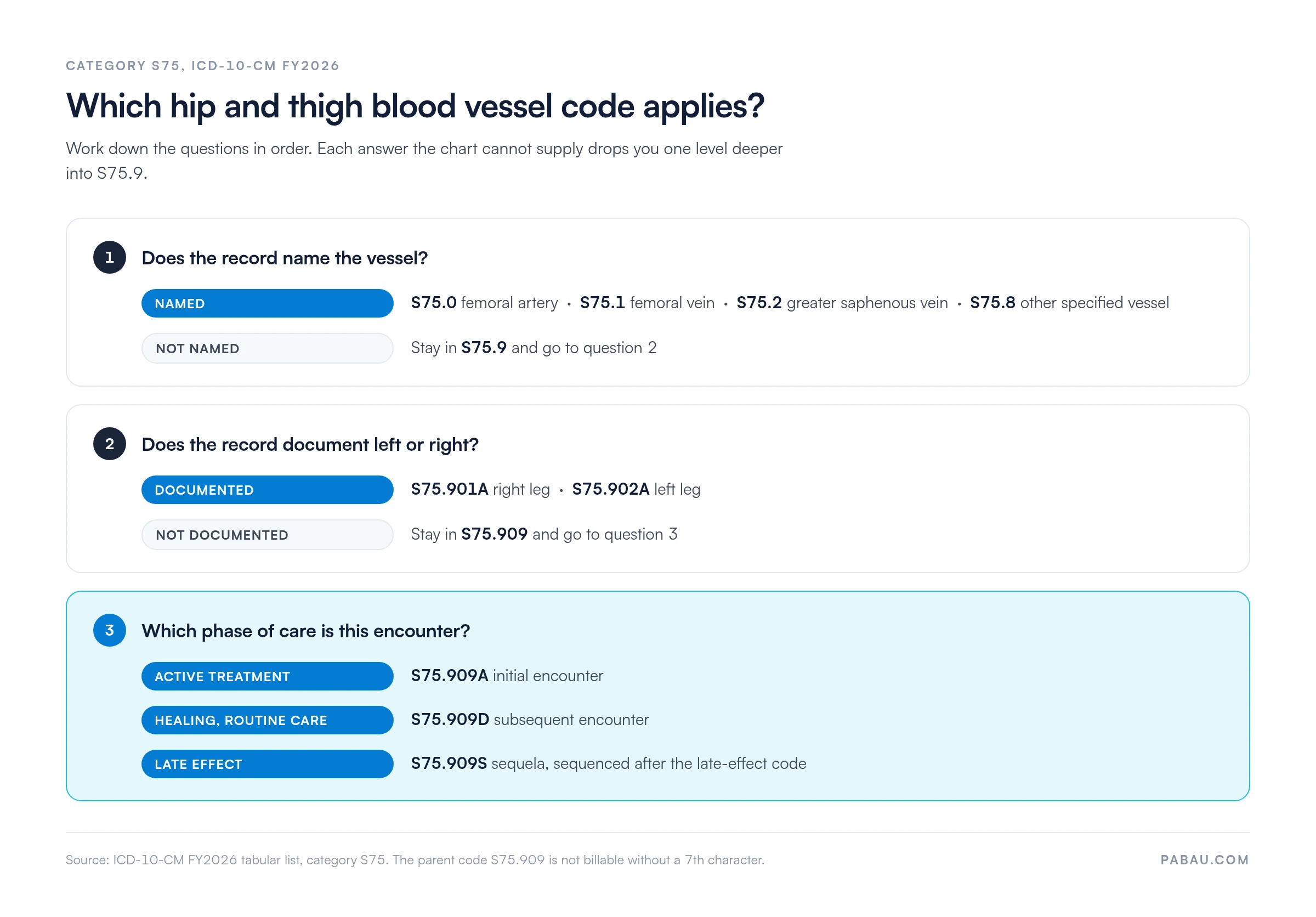
Category S75 also carries subcategories for named vessels. S75.0 is the femoral artery, S75.1 the femoral vein, S75.2 the greater saphenous vein at hip and thigh level, and S75.8 other specified vessels.
When the documentation names the vessel, one of those replaces S75.9 entirely. CMS guidance discourages routine unspecified coding wherever the record supports something sharper.
Before you assign S75.909A, read the operative note and the radiology report again for a vessel name. If the femoral artery, femoral vein, or saphenous vein appears anywhere, use the matching S75 subcategory instead. Querying the treating provider is the right move when the record is genuinely ambiguous.
Laterality is the detail most often available, so check the two sibling codes before you settle on unspecified. Then look at the named-vessel codes underneath them.
The CDC ICD-10-CM browser confirms current-year status when you need a second source.
Every code in that table takes the same three 7th characters, so each one has a healing-phase form. A right-leg vascular injury seen again during healing is S75.901D.
This code holds up only when the record leaves all three details blank. Work down the questions below in order, because each one rules out a sharper code.
Three situations produce this code honestly. A trauma patient arrives from a multi-vehicle accident and the vascular workup is still pending.
Imaging is ordered in the emergency department, but the results have not reached the record. Or a provider query is open and the claim cannot wait for the answer.
The path from encounter to payment is short. There are only a few points along it where this code causes trouble:
Three stalls account for most of the rework. The 7th character gets dropped when a code is re-typed or copied forward from a problem list.
Laterality contradicts the procedure line, so an unspecified-side diagnosis sits next to a left-side modifier and invites a review. And the suffix never moves, so A keeps going out months after active treatment ended.
Work every rejection against the payer’s denial codes before you resubmit. A missing 7th character and a laterality mismatch are different problems, and they need different fixes.
Six confirmations, under a minute per encounter:
None of this is exotic. The habits behind a clean claim are the same ones that keep S75 codes off the rework pile.
Trauma vascular codes generate a predictable set of errors. These five account for most rejections and audit findings on hip and thigh vascular encounters:
Audit your S75.909A claims once a quarter. Filter by patient, then sort by date of service. Any patient carrying three or more consecutive A-suffix claims past 90 days from the injury deserves a documentation review. In most trauma cases the move to D should happen within a few visits of definitive treatment.
In most practices the diagnosis code travels by hand at least once. It gets written on a superbill or pasted into a message, then re-typed into the billing system. That re-typing is where a 7th character quietly goes missing.
Practice management software like Pabau keeps the code with the note it came from. The clinical record, the diagnosis, and the claim sit in one system, so nobody re-enters seven characters from memory. For US practices, claims then go out electronically through our Claim.MD clearinghouse integration.
Pabau’s approach to cleaner claims management starts in the chart, not at the clearinghouse. Your coders read the documentation and the assigned code side by side, so an open query is easy to spot before submission.

Pabau stores the diagnosis with the clinical note and submits US claims through our Claim.MD clearinghouse integration. Fewer handoffs mean fewer rejections for your team to rework.

Unspecified codes are part of trauma billing. S75.909A is a legitimate answer when the record leaves the vessel, the injury type, and the side blank. What it cannot be is a shortcut past a provider query.
So the discipline here is small and repeatable. Check the record for specificity, attach all seven characters, and move the suffix when the phase of care moves. Do that and S75 claims stop coming back.
The trade-off worth remembering is that every unspecified code you submit is one a payer can question later. Book a demo to see how Pabau keeps ICD-10 codes and the notes behind them in one place.

Coding a thigh injury where the muscle took the damage, not the vessel? S76.909A follows the same unspecified pattern one category across.
Does the operative note name the femoral artery after all? S75.092A is the specified-vessel code for the left leg at initial encounter.
Wondering how the 7th character works when a code needs an X placeholder? S72.91XG shows the placeholder and the healing-phase suffix together.
Chasing a rejection on a trauma claim? Denial codes in medical billing explains the payer messages you are most likely to see.
Want the documentation standards behind clean submissions? Medical billing compliance covers the workflow rules that reduce preventable rejections.
No. S75.909 already runs to six characters, so the 7th character attaches straight onto the end. Shorter codes are the ones that need a placeholder, which is why you see forms like S72.91XG.
Yes, when the record documents one. Category S75 carries a code-also instruction for any associated open wound in the S71 range. Sequence the two codes to match what the provider treated at that encounter.
Add one wherever the record says how the injury happened. The ICD-10-CM guidelines expect an external cause code from Chapter 20 alongside an injury code, reported as secondary. Many payers look for it on trauma claims.
Yes, when the vascular injury is the reason for the encounter. If a fracture or an open wound drove the admission instead, that condition is sequenced first and S75.909A follows it.